
What is MiniMax M3
MiniMax M3 is MiniMax a brand-new AI model launched by, featuring leading capabilities in coding, Agents, and long-text processing. The model adopts an innovative MSA sparse attention architecture, supports a 1M ultra-long context, and improves efficiency by 20 times. It also natively supports image and video input and can control a computer desktop. In evaluations such as SWE-Bench, it surpassesGPT-5.5and other models, and it has been open-sourced and can be experienced through MiniMax Code, API, and more.
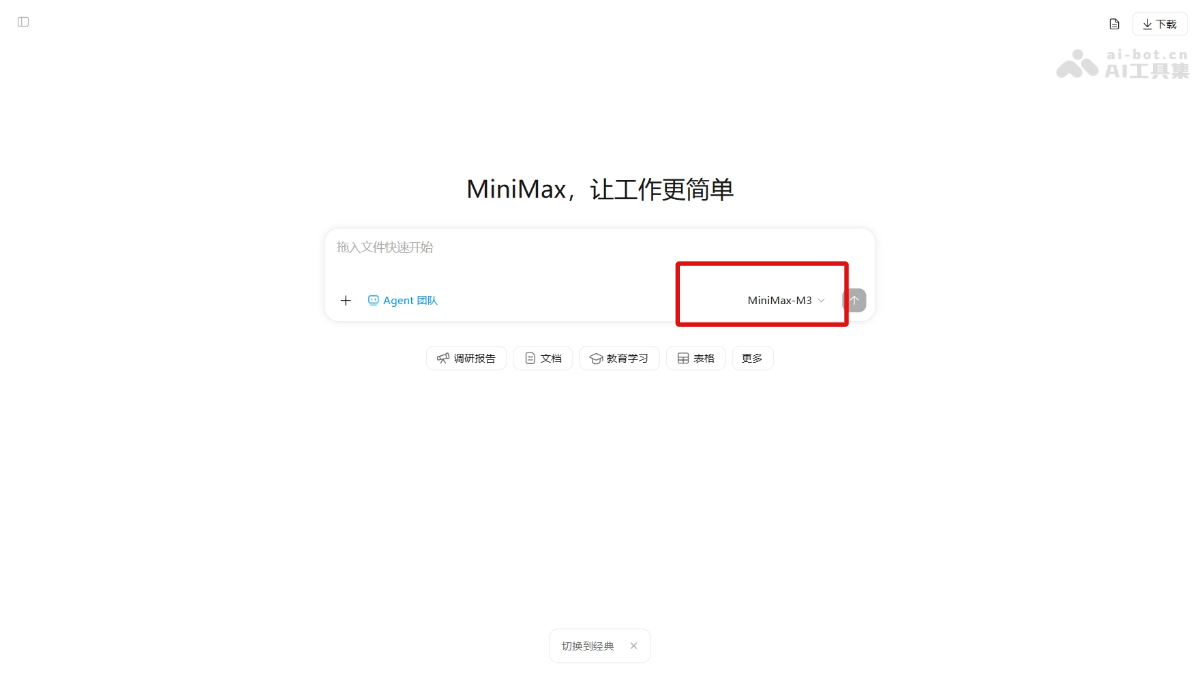
Main features of MiniMax M3
- Coding and Agent: In the SWE-Bench Pro coding test, it surpasses mainstream models such as GPT-5.5. It can autonomously perform task decomposition, tool calling, and multi-step reasoning, with the goal of directly deliverable code。
- 1M ultra-long context: Based on the self-developed MSA architecture, the API supports a context window of up to 1 million tokens (at least 512K tokens guaranteed to be available)。
- Native multimodal support: Supports image and video input, can understand charts and formulas in papers, and has the ability to simulate operating a computer desktop。
- Efficient model architecture: Adopts a sparse MoE architecture, with a total parameter count of 196B, but only about 11B parameters activated per inference, ensuring operating efficiency。
Technical principles of MiniMax M3
- MSA sparse attention architecture: The model adopts the self-developed MSA (MiniMax Sparse Attention) mechanism, which uses a lightweight indexing module to quickly screen out key KV blocks, then performs sparse computation on these blocks, greatly reducing the amount of computation for long sequences.
- Two-stage computation process: In the indexing stage, the model uses a low-cost attention module to evaluate the importance of all tokens; in the sparse stage, it performs full attention computation only on the selected high-value blocks, reducing the computation for a 1 million token context to 1/20 of that of traditional models.
- MoE mixture-of-experts structure: The model has a total parameter count of 196B, and only about 11B parameters (about 6 experts) are activated per inference, significantly improving inference speed and deployment efficiency while maintaining large-model capacity.

Follow WeChat and reply “Open Source” to join theAI Open Source Project Communication Group
How to use MiniMax M3
- Online experience (MiniMax Code): Visit the MiniMax Code official website https://agent.minimaxi.com/download, where you can directly experience coding, long-text, and other capabilities without deployment.
- API calling: Visit MiniMax the open platform, obtain an API key, and integrate M3 into your own application or workflow. Supports image/video input and Agent tasks.
Core advantages of MiniMax M3
- Top-tier coding and Agent capabilities: Reaches internationally leading levels in authoritative evaluations such as SWE-Bench Pro and Terminal Bench, with some metrics surpassing GPT-5.5 and Gemini 3.1 Pro, and can complete end-to-end code delivery and complex task automation.
- Ultra-long context + ultimate efficiency: Supports a 1M token context. With the self-developed MSA sparse attention architecture, the computation for processing million-level tokens is only that of traditional models 1/20, with the prefill and decoding stages accelerated by 9.7 times and 15.6 times respectively.
- Native multimodality and desktop operation: Directly supports image and video input, can understand visual information such as paper charts and formulas, and can simulate operating a computer desktop (e.g., clicking, typing), expanding the application boundaries of Agents.
MiniMax M3 project address
- GitHub repository:https://github.com/MiniMax-AI/MiniMax-M3
- HuggingFace model library:https://huggingface.co/MiniMaxAI/MiniMax-M3
Comparison of MiniMax M3 with similar competitors
| Comparison item | MiniMax M3 | GPT-5.5 |
|---|---|---|
| Programming capability | SWE-Bench Pro Surpasses GPT-5.5 | Excellent, but slightly lower than M3 |
| Context efficiency | 1M tokens, computation only 1/20 | Supports 1M but with high computational cost |
| Multimodal | Native support for image/video/desktop operation | Image only (requires multimodal version) |
| Open source | Fully open source | Closed source |
Application scenarios of MiniMax M3
- Intelligent software development: Directly generates deliverable code according to requirements, completing automated testing, code refactoring, and debugging. Agent capabilities can autonomously invoke tools, break down tasks, and assist in completing full project development.
- Ultra-long document analysis: Processes one million tokens at a time (such as hundreds of pages of financial reports, an entire technical manual, or all medical records), performing summarization, question answering, contract review, or multi-document comparison.
- Desktop automation and digital employees: The model can "understand" screen content and simulate computer operations such as clicking and typing, suitable for scenarios including RPA process automation, software testing, and data entry.
- Multimodal scientific research and education: Understands charts, formulas, and experimental screenshots in papers, assisting with literature interpretation and experiment reproduction; can be used for teaching courseware analysis and intelligent question answering.