

Many friends have asked me how it is that most video software nowadays is making comic dramas and short dramas, and whether there are any models for commercial videos that can be recommended.
Not to mention, recently I actually tested an AI video generation model for commercial videos, which is MiniMax H3。
As soon as it launched, it rushed to TOP1 on the Artificial Analysis video editing leaderboard.
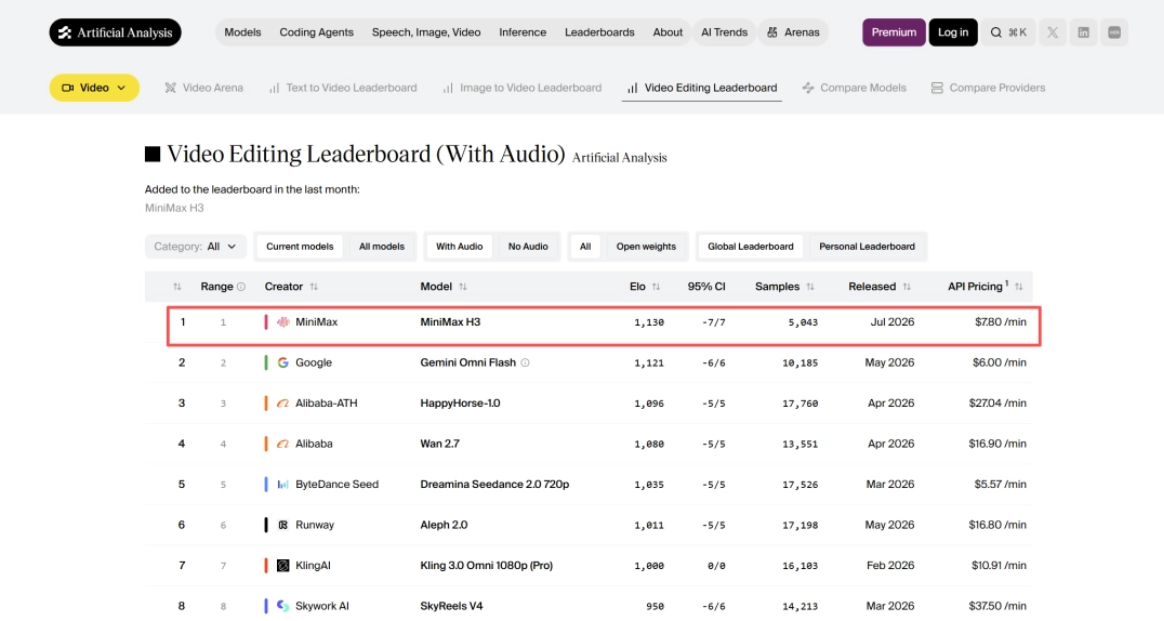
When we usually use ordinary AI models to make a deliverable commercial video, the most time-consuming part is often rework.
The product turns around, and its structure changes; the shot cuts to a close-up, and the model's face changes; one English letter is wrong in the end credits, and the brand information is directly ruined. The visuals are barely usable, but the audio still has to be redone.
MiniMax H3 was made by focusing on these problems.
MiniMax H3 is a lightweight, full-modality video model that supports text, image, audio, and video input, and can also directly generate videos with visuals, ambient sound, dialogue, or music.
Everyone will definitely want to ask how it compares with Seedance, so I will make an episode for everyone with an actual test comparison of the two models in commercial scenarios. You can first look at a set of comparison results:
In this set of comparisons, in terms of lighting effects and camera movement, MiniMax H3 is indeed much stronger than Seedance.
As for how the other aspects compare, everyone will know after reading on!
01. Model Actual Test
In the past, when doing reference-based video generation, the common process was to upload a character image, then use a prompt to describe the action and scene. The model had too many things to guess, and the characters, products, and camera easily drifted.
MiniMax Hub 's all-around reference can put different materials into the same set of context:
- Up to 9 images, which can separately fix the character, product, scene, material, UI, and brand layout.
- Up to 3 video clips, which can reference character actions, camera movement, and editing rhythm.
- Up to 3 audio clips, which can reference timbre, dialogue, music, and sound atmosphere.
- When images, videos, and audio are input in a mix, the total limit is 12 files.
We used the Hailuo MiniMax Hub capability to test the video output of the two models with the same reference and the same prompt.
case 1 Pure image reference brand advertisement
Reference image:
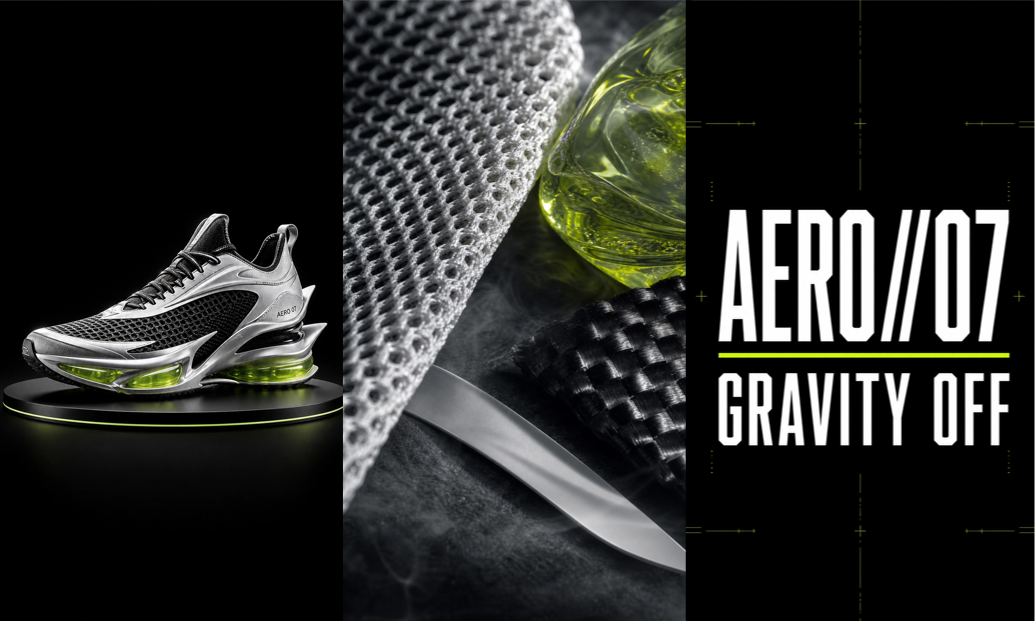
Prompt:
Generate a 15-second, 9:16, 2K futuristic running shoe launch film.
Reference relationships:
@Image 1 fixes the shoe shape, the silver-black fluorescent green color scheme, the sole structure, and the "AERO 07" text on the shoe body.
@Image 2 fixes the materials of mesh fabric, silver frame, carbon fiber, and fluorescent green cushioning gel.
@Image 3 fixes the opening and ending layout, fully preserving "AERO//07" and "GRAVITY OFF"; do not change, omit, or add text.
0–2 seconds: A fluorescent green scan line appears on a pure black screen. "AERO//07" is assembled segment by segment from thin lines into complete letterforms, with metal buckle sounds synchronized with low-frequency pulses.
2–6 seconds: The running shoe floats on a black magnetic circular platform. The camera slowly半 surrounds from the toe to the side of the shoe. The mesh, silver frame, carbon fiber plate, and fluorescent green cushioning gel float in layers in sequence, each layer maintaining a reasonable spacing, and the shoe shape does not deform.
6–10 seconds: The camera enters a macro view of the fluorescent green gel. The transparent gel forms stable ripples under pressure, and the ripples flow along the sole. The camera pulls back, and each component accurately returns to its original structure.
10–13 seconds: The running shoe lands lightly on the circular platform. The cushioning chamber compresses once and then naturally rebounds, the white rim light switches to fluorescent green, accompanied by a short air-pressure sound.
13–15 seconds: cut to the black-background layout of @图片3. Fully display "AERO//07" and "GRAVITY OFF", with the running shoe resting below the text. A restrained neutral female voice says: "AERO zero seven. Gravity off."
The entire film uses three colors: silver, black, and fluorescent green. Use hard rim lighting, macro material close-ups, and editing that follows a low-frequency electronic beat. Keep the shoe shape, sole structure, lettering, and color scheme consistent. Do not add people, brand logos, or extra copy; do not show running, jumping, rolling, flames, or explosions.
“`
Seedance:
Seedance 2.0 changed the side exploded structure in the reference image into a front top-down structure, and the shapes of the upper and sole also changed noticeably, with some silver components turning into decorative wings extending to both sides.
After the macro shot ends, the image cuts directly to the already assembled running shoe, without actually showing the process of the parts settling into place. From about 6.7–10.7 seconds it lingers for a long time on the same material composition, and the pacing also feels a bit sluggish.
MiniMax H3:
MiniMax H3 has a more complete understanding of the product structure. After entering the shoe exploded view at about 2 seconds, the upper, carbon fiber support layer, fluorescent green cushioning layer, and outsole remain arranged laterally, and the order of the parts and their connections are relatively clear.
After 9 seconds, you can still see the layers gradually coming together, finally assembling into a complete running shoe, completing the commercial narrative of "disassembly—material display—reassembly—brand finish."
case 2 image + sound reference e-commerce video
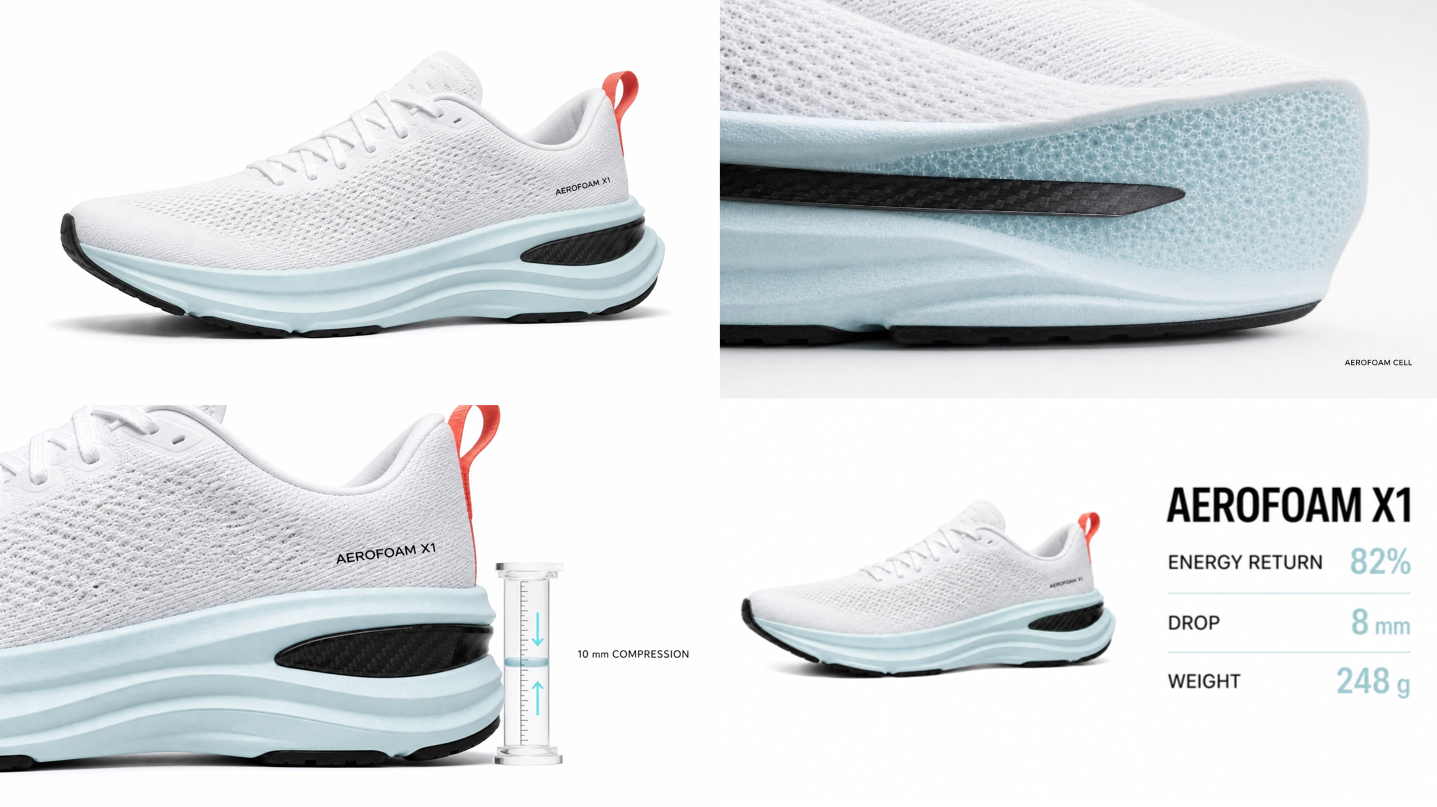
Reference image:
Reference sound 1:
Prompt:
Reference material binding:
[图片1] = AEROFOAM X1 product image on a white background
[图片2] = heel cushioning and 10 mm compression detail image
[图片3] = AEROFOAM foam microstructure image
[图片4] = product specifications layout image
[声音1] = reference for the sound of a sports shoe landing on a hard surface
Generate a 10-second, 16:9 AEROFOAM X1 e-commerce product video. Strictly maintain the same left shoe from the reference image: white engineered mesh upper, light cyan thick foam midsole, three streamlined compression grooves, black carbon plate heel insert, black rubber outsole, and coral red heel pull tab.
This film proves only one selling point: sole cushioning rebound.
0-2 seconds: use the product angle and product shape from [图片1]. A three-quarter side view of the product in a pure white studio, the shoe is stationary, and the camera slowly moves closer to the heel.
2-5 seconds: use [图片2] to determine the heel structure and compression direction. A transparent pressure plate presses down once on the heel from directly above, and the midsole compresses vertically by about 10 mm; the pressure plate immediately lifts, and the foam rebounds only once and returns to its original shape. The upper, carbon plate, and outsole connections remain intact, and the shoe does not jump up or flip over.
5-7 seconds: cut to the foam macro shot from [图片3]. The light cyan micropores simultaneously compress slightly and then recover, and the black carbon plate does not bend or detach.
7-10 seconds: return to the specifications page composition from [图片4], and only let "ENERGY RETURN 82%" highlight once in light cyan; "DROP 8 mm" and "WEIGHT 248 g" remain static. All English text and numbers are preserved word for word.
Sound: use [声音1] only as a timbre reference for the rubber outsole landing, not copying continuous footsteps. At 2.5 seconds, capture one soft, solid landing sound; at 4.5 seconds, generate one short, clean elastic rebound pulse based on that timbre; for the rest of the time, keep only very light studio air sound. No musical climax, no narration, no continuous running sounds.
Constraints: only one shoe appears; compress only once and rebound only once; no runner, feet, test machine casing, second pair of shoes, or other functional icons appear; no new selling points are added; the product colorway, outsole groove positions, and carbon plate position must not change; avoid jelly-like deformation, outsoleclipping, garbled text, and parameter jitter.
Seedance:
Seedance missed the most important part: "compress once, rebound once." From 0–7.7 seconds it stays almost entirely on the outsole macro shot, doing only a camera push-in.
The four-shot sequence was compressed into "outsole macro + parameter page," so the commercial story is incomplete.
MiniMax H3:
MiniMax H3's shot execution is very close to the prompt, all four reference images were correctly used, and no other assets were missed. The same shoe's white mesh, light cyan midsole, black carbon plate, and red pull tab are well preserved, and the force-induced deformation is also very good.
case 3 pure image reference game video
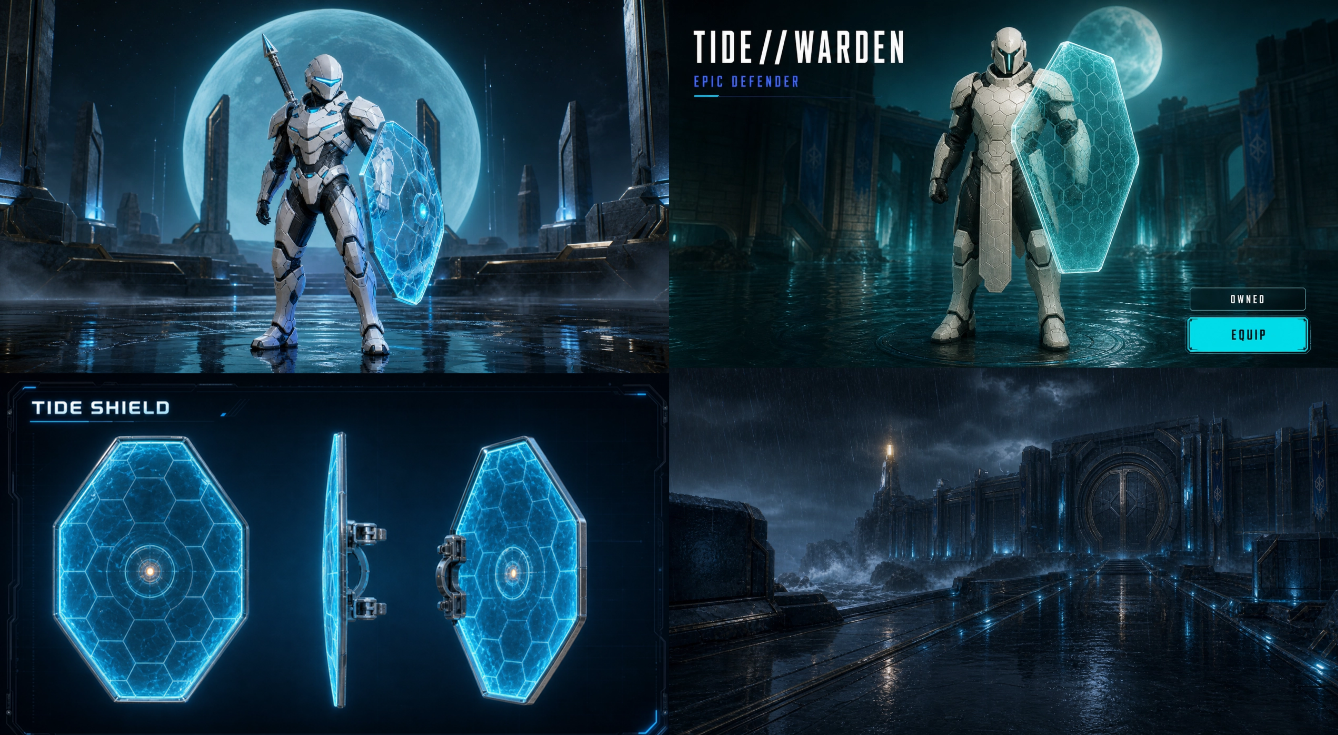
Reference images:
Prompt:
Reference asset binding:
[Image 1] = TIDE//WARDEN character design sheet
[Image 2] = TIDE SHIELD equipment three-view
[Image 3] = game equipment UI reference image
[Image 4] = empty scene of a rainy-night sea fortress
Generate a 15-second, 16:9 AAA sci-fi game equipment demo. Strictly follow the TIDE//WARDEN white armored character, rainy-night sea fortress, TIDE SHIELD, and UI hierarchy from the reference images.
0-3 seconds: a thin narrow cyan loading line appears on a black screen, with the text accurately displaying "LOADING 100%". After the loading line completes once, cleanly transition to the empty scene in [Image 4]. Rotating logos and complex particle explosions are prohibited.
3-7 seconds: use [Image 1] to lock the character's appearance. The character enters from the lower left of the frame in [Image 4], takes only two steps, then stops in the center. The character's height, white armor segmentation, helmet silhouette, and body proportions remain unchanged. The camera is fixed, with only a slight game idle breathing motion.
7-11 seconds: use [Image 2] to lock the equipment structure. The matte training shield shell on the character's left forearm is replaced once by the TIDE SHIELD. The target shield retains the semi-transparent cyan hexagonal panels, dark metal outer frame, central amber core, and two mechanical latches. The two latches close in sequence, and the shield lights up once. The shield must be attached to the left forearm and must not float, pass through the arm, or switch to the right hand.
11-15 seconds: use [Image 3] as the interface structure reference, and the equipment interface smoothly overlays onto the scene, keeping the hierarchy, button positions, and character proportion consistent. The text only retains and accurately spells:
TIDE//WARDEN
EPIC DEFENDER
EQUIP
The "EQUIP" button highlights only once, the character and shield remain still, and other interface elements do not jitter.
Sound: natively generate light rain, the sound of two metal boots landing, two mechanical latch sounds, one low-frequency energy activation sound, and one short UI confirmation sound. No dialogue, no battle shouts, no continuous gunfire.
Constraints: do not change the character's body type, helmet, armor color, or shield shape; do not add enemies, weapons, damage numbers, or new buttons; UI text must not deform or overlap; avoid equipment attachment point drift, character foot sliding, interface perspective tilt, and continuous button flickering.
Seedance:
During the equipment phase, Seedance actively cuts to a close-up of the arm, where the two ring-shaped mechanical connectors are very prominent, and the equipment attachment and energy lighting have a strong impact.
But the loading screen ends after about 1.25 seconds, clearly shorter than the specified 3 seconds. In the first half, the character wears relatively fine layered armor, and in the equipment phase it suddenly becomes a long-piece hexagonal chestplate.
MiniMax H3:
The relationship between the four H3 reference images is handled fairly completely: the scene, character, equipment, and UI all enter the same video flow, and the time segments are basically controllable. The training shield shell is clearly presented, and the equipment replacement is then completed on the left forearm. The shield does not float to the right hand, and there is no obvious clipping.
However, after the EQUIP button enters the UI, it remains highlighted for a long time, lacking a clear change of "lighting up once, then stabilizing."
case 4 video + image motion transfer video
Reference image:
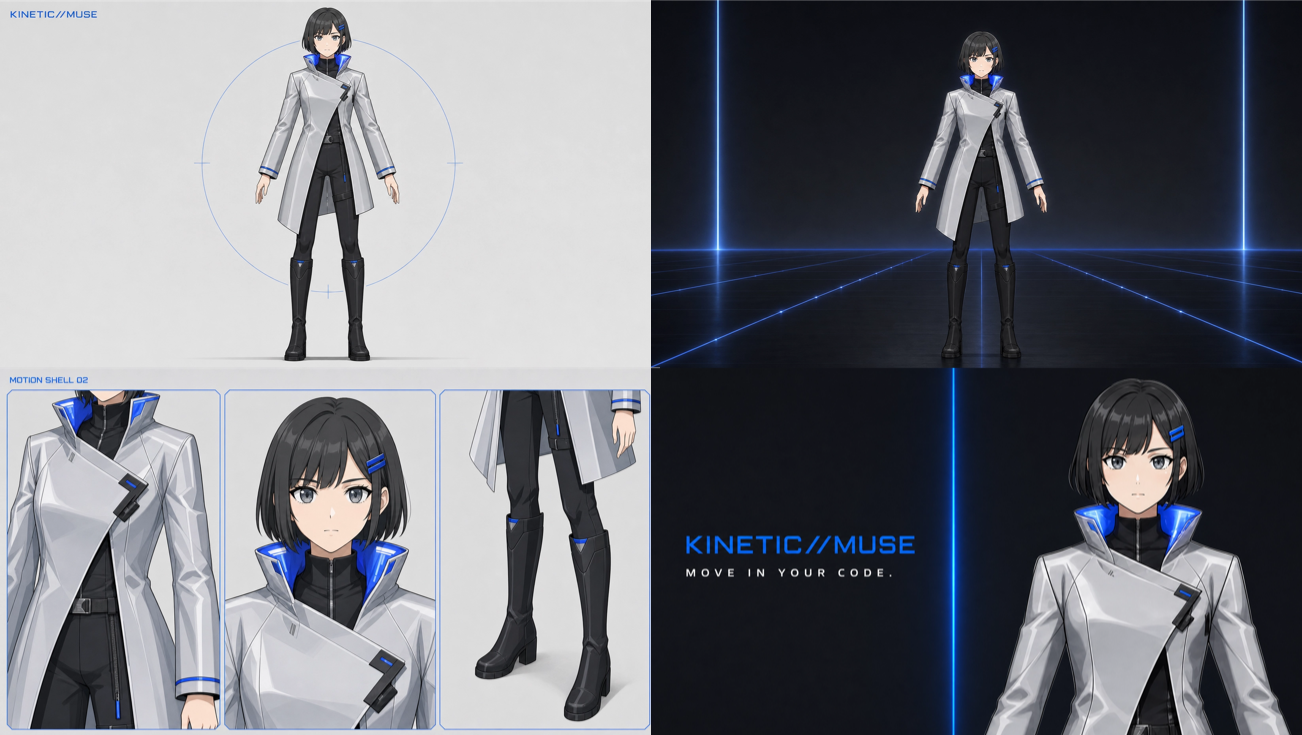
Reference video 1:
Prompt:
Reference asset binding:
[Video 1] = 8-second anime boy horizontal walking video, reference only motion and fixed camera
[Image 1] = KINETIC//MUSE anime female character front full-body image, lock character identity
[Image 2] = jacket, glowing collar, hairpins, and technical boots detail image, lock clothing connection points
[Image 3] = deep graphite black and cobalt blue light-line brand stage, lock output scene
[Image 4] = KINETIC//MUSE brand end card, lock ending composition and text
Use [Video 1] as the only motion reference, preserving frame by frame the anime boy's horizontal walking step frequency, stride length, left and right foot placement, hip and knee angles, body center of gravity, arm swing path, clothing hem rhythm, character movement direction, fixed camera position, and camera height.
Completely replace the anime boy in [Video 1] with the KINETIC//MUSE anime female character in [Image 1], without retaining the boy's face, hairstyle, clothing, gender, or body features. Use [Image 2] to lock the short graphite black bob, two cobalt blue hairpins on the right side, gray-blue anime eyes, silver diagonal-front mid-length jacket, black fitted inner top, rigid cobalt blue glowing stand collar, black long pants, black knee-high boots, diagonal-front fasteners, and blue lines on the cuffs. The character must always maintain a clear two-dimensionalcel-shaded animationstyle.
Use [Image 3] to rebuild the output scene: completely replace the rainy night station, station building, railway tracks, light signs, rainwater reflections, and distant train in [Video 1] with a deep graphite black brand stage, low-reflection floor, and narrow cobalt blue light lines. Retain only the original video's horizontal walking trajectory, character proportion, foot contact positions, fixed camera position, and movement direction; do not copy the station background.
From 0.0–0.4 seconds, cut in from black to the brand stage, with cobalt blue light lines lighting up in sequence. From 0.4–6.5 seconds, have KINETIC//MUSE walk steadily from left to right according to the motion in [Video 1], with the full body always in frame. The soles must contact the ground on the corresponding frames of the source video, and must not slide, float, or change step frequency; the silver jacket only produces slight follow-through sway, and the glowing stand collar must not soften or fold. From 6.5–6.8 seconds, use a narrow blue light to wipe horizontally across the character and stage. From 6.8–8.0 seconds, complete the ending strictly according to [Image 4], accurately displaying "KINETIC//MUSE" and "MOVE IN YOUR CODE."
Sound: natively generate short, clean technical boot landing sounds based on the foot contact frames, with each step synchronized to the picture; add slight clothing sway sounds, a low-frequency electronic pulse, and a blue-light transition current rising sound; at the ending, drop a brief confirmation sound. No dialogue, no human voice, no lyrics, and do not copy the sound of [Video 1].
Hard constraints: the entire video may only feature two-dimensional anime or cel-shaded animation characters; live-action people, photorealistic live-action, live-action skin texture, and live-action photographic texture are prohibited. Do not add waving, dancing, running, jumping, or turning; do not crop out the head or shoes; do not add passersby; avoid foot sliding, limb ghosting, joint inversion, extra fingers, clothing hem passing through legs, face drift, character flicker, glowing collar deformation, and garbled brand text.
Seedance controlled the opening very precisely, completing the cut-in from black in about 0.46 seconds, close to the specified 0.4 seconds. The character entered from the left side of the frame and produced a clear lateral displacement.
The problem appeared at about 2.7 seconds. The character began turning toward the camera, and by around 3.2 seconds had become a frontal standing pose, then stayed that way until about 4.8 seconds. The original action video maintained a side-on walk throughout, and the prompt also explicitly prohibited turning around.
MiniMax H3:
MiniMax H3 fully preserved the anime style. There was no obvious face swapping, clothes clipping through legs, or joints bending backward while walking. The action lasted about 5 seconds, the character remained side-on throughout, and the arm swing, hip and knee bending, and jacket hem all followed the gait. The fixed camera position and character framing ratio were also close to the source video. The blue horizontal wipe format matched the prompt, and the transition logic was relatively clear.
But H3's character center of gravity stayed almost fixed in the center of the frame, with little lateral displacement during the footstep cycle, giving it a slight treadmill-walking feel.
MiniMax H3's overall capabilities can already go head-to-head with Seedance.
Especially in lighting performance, camera movement, and video editing, MiniMax H3's performance is even more impressive.
However, model capability is only the entry ticket; price is also a core metric determining whether it can truly be deployed in production.
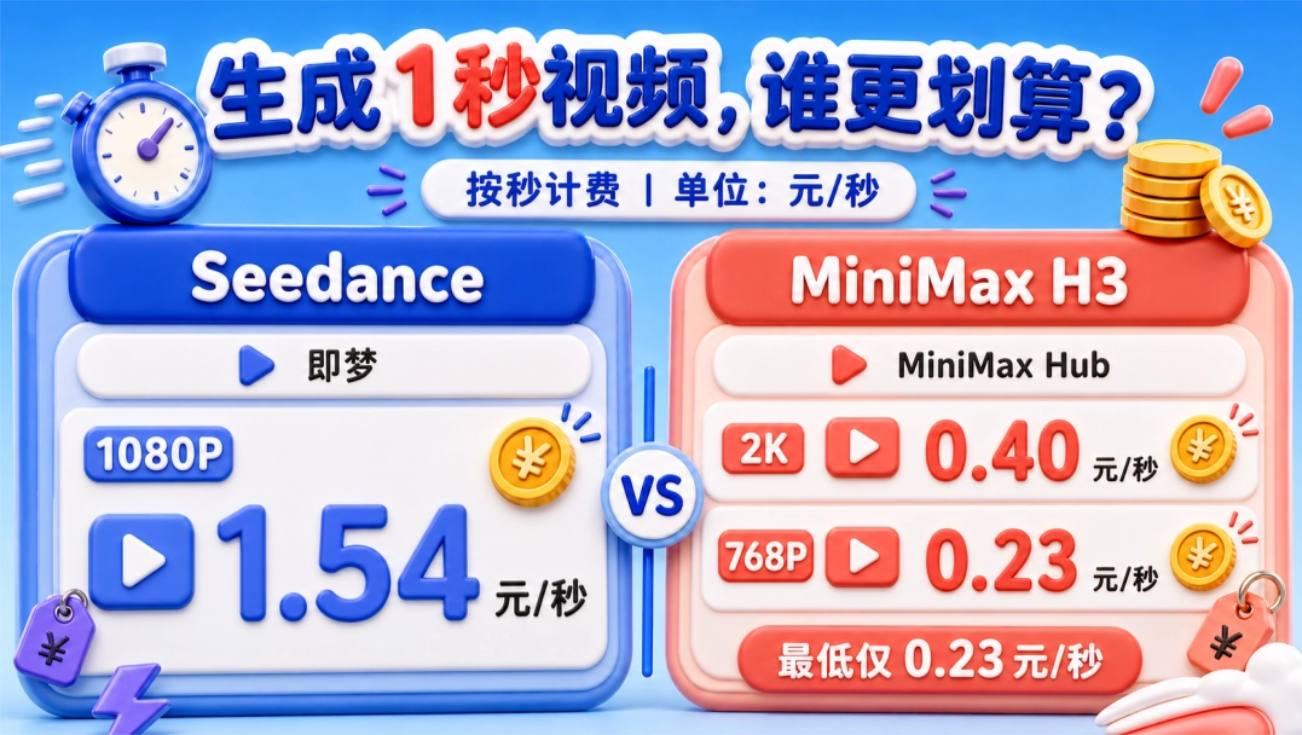
Generating with Seedance on Jimeng 1080P text-to-video, the lowest cost per second is about 1.54 yuan.
MiniMax H3 generating on MiniMax Hub 2K video costs only 0.40 yuan per second,768p at the lowest just 0.23 yuan/second.
Cheaper and better. I don't need to say much about how to choose.
02. Some Sharing
Generating commercial videos with models must be judged by whether the entire finished video can be delivered. Face swapping, product structure changes, and errors in parameters or brand English all increase rework; missing core actions can also make an ad lose its original selling point.
Among the four test groups, MiniMax H3 completed more script content. The glasses ad retained five storyboard shots, the sneaker video achieved compression and rebound, the game video completed shield installation and UI overlay, and the action transfer also maintained about 5 seconds of continuous side-on walking.
Seedance produced some impactful shots in equipment attachment, energy lighting, and lateral character movement. The sneaker test missed compression and rebound, and the action transfer turned into a frontal standing pose at about 3.2 seconds, making scripts containing multiple tasks prone to errors.
It can be said that in commercial video production, MiniMax H3's results overall exceed Seedance's.
Of course, when we use models to generate images ourselves, each reference image also needs its purpose clearly specified: character images handle identity, product images handle structure, and the end card handles brand text. The results will then better match expectations.
Friends who are interested can use the desktop version hub.minimaxi.com to experience 3 free H3 video generations.
Existing users can also directly use the web version hailuoai.com
Original link:AI video has suffered from Seedance for too long! The better-performing MiniMax H3 has brought the price down!