
What is MiniMax H3
MiniMax H3 is a general-purpose omni-modal generation model launched by MiniMax. It breaks the boundaries of traditional tasks and modalities, and supports unified understanding and native generation of text, images, video, and audio. The model can output native dual-channel audio and video, supports up to 15-second 2K resolution, and performs excellently in commercial scenarios such as instruction following, brand information presentation, and video-to-video motion transfer. MiniMax H3 adopts self-developed technologies such as Contextual Omni Representation and H3-VAE, and at 2K resolution its per-second price is less than one-third that of mainstream models.
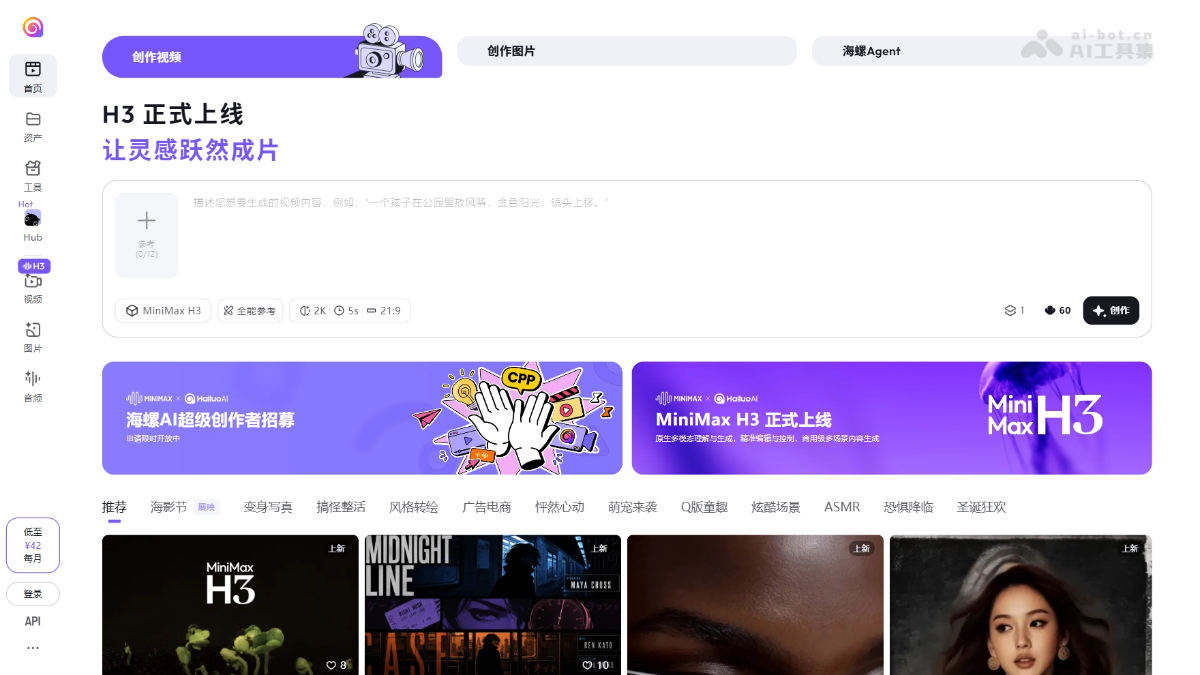
Main features of MiniMax H3
-
Unified omni-modal generation: Supports unified understanding and native generation of text, images, video, and audio, breaking traditional modality boundaries.
-
Native dual-channel audio and video output: Can directly generate video with native dual-channel audio, without the need for post-production dubbing.
-
Multimodal context understanding: Can simultaneously process multi-source inputs such as reference videos, images, and audio, and complete complex creations according to natural language instructions.
-
Video-to-video motion transfer (V2V Motion Transfer): Can transfer the motion in a reference video to a target person.
-
Generalized reference and editing: Supports a variety of editing and reference tasks such as image-to-image, image-to-video, audio-to-audio, and audio-video-to-audio-video.
-
Multi-shot modeling: Natively supports multi-shot narrative, without the need for step-by-step generation and then splicing.
-
High-resolution output: Provides 2K resolution by default, with image detail reaching commercial grade.
Technical principles of MiniMax H3
- Contextual Omni Representation: The core capability of MiniMax H3 comes from the construction of contextual omni-modal representation. Traditional models only need to describe the target content, while H3 needs to simultaneously understand the relationship between the multimodal context and the target output, and even the associations among elements within the context. To this end, MiniMax customized a dedicated omni-modal understanding pipeline, with a single material inference consuming about 100,000 tokens, ultimately generating a detailed description averaging about 4K tokens. Language serves as a generalizable bridge for connection and interpretation, enabling tasks to be unified in the form of open descriptions.
- H3-VAE (efficient visual audio encoding): MiniMax H3 completely revolutionized the previous generation's tokenizer technology, achieving comprehensive improvements in reconstruction quality and learnability. The encoder has a high compression rate, bringing a 4x gain in sequence length, significantly reducing training and inference costs, while also supporting native 2K resolution output.
- H3-Omni Transformer (heterogeneous training architecture): Aiming at the core goal of task generalization, H3 abandoned the specialized architecture that brought significant advantages in the previous generation and instead adopted a simpler and more general design. Due to the introduction of multimodal context, the variance in sequence length expanded by 3x, and the computational loads of the understanding and generation parts became significantly heterogeneous. H3 adopts a heterogeneous training architecture for understanding and generation, finely tuning hardware utilization under different loads, jointly optimizing heterogeneous computation per sample and load balancing across samples, improving end-to-end training throughput by nearly 30%.
How to use MiniMax H3
-
Visit the platform: Visit MiniMax Hub、Hailuo AIor access the MiniMax open platform.
-
Prepare multimodal materials: Upload context materials such as reference videos, images, and audio.
-
Input a natural language instruction: Describe your creative intent in natural language, e.g., "Refer to the camera movement in Video 1, make the person in Image 2 sing, and use Audio 3 as the singing voice reference."
-
Generate and preview: The model automatically understands the multimodal context and generates native dual-channel audio and video.
-
Download and re-edit: Obtain output at up to 2K resolution, for commercial use.
Core advantages of MiniMax H3
-
Strong task generalization capability: Unifies independent tasks such as text-to-image, text-to-video, text-to-audio, and reference editing into a single model, greatly increasing freedom of use.
-
Commercial-grade cost-effectiveness: At 2K resolution, the price per second is less than 1/3 of mainstream models, and at 768P resolution it is less than 1/2, significantly reducing content production costs.
-
Native audio generation: All audio outputs are native dual-channel, not post-synthesized, making audio-video synchronization more natural.
-
Domestic chip compatibility: Multiple domestic chips were considered for adaptation from the initial design stage, facilitating localized deployment.
MiniMax H3 project address
- HuggingFace model repository:https://huggingface.co/MiniMaxAI/MiniMax-H3
Comparison of MiniMax H3 with similar competitors
| Comparison dimension | MiniMax H3 | Seedance 2.0(ByteDance Jimeng) |
|---|---|---|
| Modality coverage | Unified understanding and generation across text, image, video, and audio modalities, with a single model covering all tasks | Mainly focuses on video generation, with image/audio capabilities relatively independent, requiring switching between different functional modules |
| Native audio | Native dual-channel audio-video synchronized output, with integrated audio-video generation | Mainly video generation, with audio mostly post-synthesized or independently generated |
| Task generalization | Text-to-image, text-to-video, editing, reference, motion transfer, etc. are all unified and can be invoked with natural language | Functions are split by scenario (text-to-video, image-to-video, video editing, etc.), with relatively clear task boundaries |
| Resolution and duration | Default 2K resolution, up to 15 seconds | Supports high resolution, with duration up to 10-12 seconds, and 2K is not the default configuration |
| Open-source strategy | Plans to open-source model weights in the near future, supporting domestic chip adaptation and customized development | Closed-source, only available through the Jimeng platform or API |
| Pricing positioning | At 2K, less than 1/3 per second of mainstream models, with outstanding commercial cost-effectiveness | Billed by credits or membership subscription, with pricing at the industry median |
| Motion transfer | Supports V2V Motion Transfer, accurately transferring motions from reference videos | Supports motion reference and subject consistency, with limited accuracy for complex motion transfer |
| Multi-shot capability | Native multi-shot modeling, no stitching required | Supports multi-clip generation, but native multi-shot narrative capability is relatively weak |
Application scenarios of MiniMax H3
-
Advertising and brand videos: Input product images and reference shots to generate commercial-grade advertising short videos with brand information and native voiceover in one click.
-
E-commerce dynamic displays: Combine static product images with motion reference videos to automatically generate multi-shot, 360-degree product demonstration videos with sound effects.
-
Film and Television Post-Production: Use V2V motion transfer to precisely replace actor performances or camera movements in the target footage, reducing reshoot costs.
-
Game UI and Marketing: Quickly generate interface previews and game promotional openings with dynamic effects and native sound effects.
-
Motion Posters and Social Media: Fuse image styles, character references, and audio to generate autoplay stereo motion posters and short video content.