
What is ECC
ECC (Everything Claude Code) is a cross-platform AI Agent performance optimization system. The system provides Claude Code、Codex、Cursor and 7+ other AI programming tools with 63 professional Agents, 249 on-demand loading Skills, cross-session memory persistence, and the AgentShield security audit tool, enabling automated workflows through the Hook mechanism, transforming the AI programming assistant into an AI team with clear division of labor.
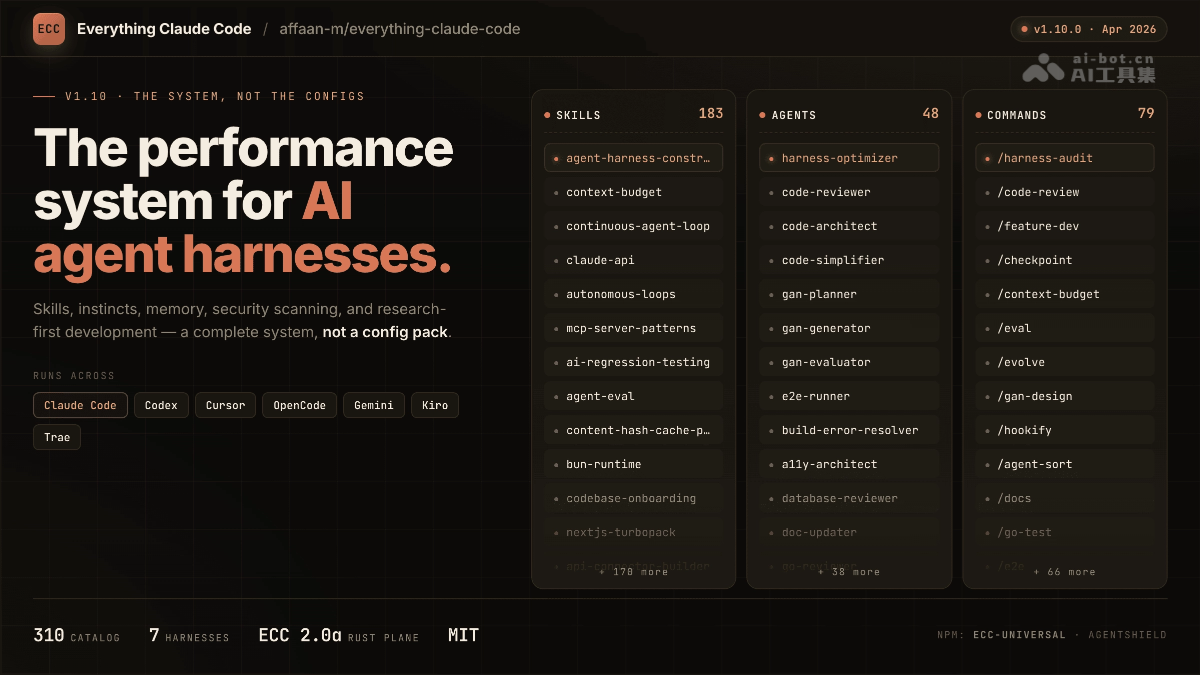
ECC's Main Features
-
63 Professional Agents: Covering roles across the entire development chain, including architecture design, code review, security audit, test-driven development, build error fixing, and documentation updates.
-
249 On-Demand Loading Skills: Dynamically match skills based on the project's tech stack. TypeScript projects automatically load the TS review Skill, Python testing scenarios trigger the TDD Skill, avoiding context overflow.
-
Cross-Session Memory Persistence: Automatically store and retrieve context between different sessions through the Hook mechanism, enabling uninterrupted continuous workflows.
-
AgentShield Security Audit: Built-in 1282 tests and 102 static analysis rules, scanning for credential leaks, misconfigurations, and injection risks at millisecond speed.
-
Continuous Learning v2: An intuition-based learning system that automatically extracts reusable patterns from sessions, generates Instincts, and clusters them into Skills.
-
Verification Loops and Checkpoints: Supports
/checkpointsaving verification states,/quality-gatequality gates, and the/evalevaluation framework. -
Multi-Agent Collaboration: Supports
/multi-plan、/multi-executeand other multi-model collaborative workflow commands. -
Dashboard GUI: Provides a Tkinter desktop application supporting theme switching, font customization, and visual browsing of components.
ECC's Technical Principles
-
On-Demand Loading Architecture: Uses a Manifest-driven installation pipeline, with state storage tracking installed components, injecting Skills into context only when the corresponding tech stack is detected.
-
Hook Event System: Based on the Hook mechanism of Claude Code v2.1+, triggering automated scripts at 8 event points including SessionStart, PreToolUse, PostToolUse, and Stop.
-
Context Budget Management: Controls the session startup context limit through environment variables such as
ECC_SESSION_START_MAX_CHARS, combined with strategic compression suggestions to prevent Token overflow. -
AgentShield Adversarial Scanning:
--opusmode launches a three-agent adversarial pipeline consisting of a red team Agent (finds vulnerabilities), a blue team Agent (fixes them), and an auditor Agent (summarizes and evaluates). -
Selective Installation Architecture: Supports
minimal、core、fulland other multi-tier installation configurations, allowing users to copy rules, Agents, and Skills as needed. -
Cross-Harness DRY Adapter: Hook events from platforms such as Cursor are converted to Claude Code format through
adapter.js, reusing the same set of script logic.
How to Use ECC
- Plugin Installation:
- In Claude Code, execute
/plugin marketplace add https://github.com/affaan-m/ECCto add the marketplace source. - Execute
/plugin install ecc@eccto install the plugin, automatically loading Skills, commands, and Hooks. - Manually copy the required
rules/directory to~/.claude/rules/ecc/(the plugin does not support automatic distribution of rules).
- In Claude Code, execute
- Manual installation:
- Clone the repository
git clone https://github.com/affaan-m/ECC.git。 - Copy as needed
agents/、skills/、commands/to~/.claude/the corresponding directory. - Run
./install.sh --profile minimal --target claudeto install the Hook runtime.
- Clone the repository
ECC's core advantages
-
Broadest cross-platform coverage: Native support for 7+ Harnesses including Claude Code, Codex, Cursor, OpenCod, etc., with one configuration reused across multiple tools.
-
Intelligent context management: 249 Skills loaded on demand, combined with MCP tool count control recommendations (no more than 10 MCPs per project), effectively protecting the 200K context window.
-
Production-grade security built in: AgentShield provides static analysis with 98% coverage, supporting
--fixautomatic fixes and--opusin-depth adversarial auditing. -
Self-evolution capability: The continuous learning system extracts patterns from real development sessions, making the configuration increasingly tailored to personal workflows with use.
ECC's project address
- Project official website:https://ecc.tools/
- GitHub repository:https://github.com/affaan-m/ECC
Comparison of ECC with similar competitors
| Dimension | ECC | claude-skills | Superpowers |
|---|---|---|---|
| Positioning | AI Agent Harness performance optimization system | The most comprehensive open-source Skill & Agent plugin library | Enterprise-grade development discipline framework |
| GitHub Stars | 182K+ | 5,200+ | ~57,000 |
| Number of Agents | 63 | 30+ | A small number (mainly Skills) |
| Number of Skills | 249 | 338 | 14+ |
| Commands/Tools | 79 legacy commands | 70+ custom commands + 533 Python CLI tools | Mainly Skill-based invocation |
| Coverage areas | Full-stack engineering (frontend and backend, DevOps, security, ML) | 16 major domains (engineering, marketing, product, compliance, C-level advisory, academic research, etc.) | The entire engineering development process (testing, debugging, design, review) |
| Cross-platform support | 7+ Harness(Claude Code / Codex / Cursor / OpenCode / Gemini / Zed / GitHub Copilot / Trae) | 13 tools (Claude Code / Codex / Gemini / Cursor / Aider / Windsurf / OpenCode / Augment, etc.) | Mainly for Claude Code |
| Installation method | Plugin installation /plugin install ecc@ecc + manual copying of rules |
Domain-based plugin installation (engineering / marketing / product, etc.) + manual copying | Plugin installation |
ECC's application scenarios
-
Full-stack project development: A complete AI-assisted development pipeline from requirements planning and architecture design to TDD coding, code review, and E2E testing.
-
Multi-technology-stack teams: Simultaneously maintain multilingual projects such as TypeScript, Python, Go, Java, Rust, Swift, and PHP, automatically matching the corresponding review Agent.
-
Secure and compliant development: In financial and enterprise-grade projects, use AgentShield to prevent key leakage, configuration errors, and injection attacks.
-
Long-term maintenance: Leverage cross-session memory and continuous learning to keep AI's understanding of large codebases across multiple sessions.
-
Hackathons and rapid prototyping: Drawing on the author's championship-winning experience, complete the entire chain from customer research to product prototype within a few hours.