
What is CloudBase
CloudBase is a Serverless full-stack cloud development platform launched by Tencent Cloud. It integrates cloud functions, databases, storage, static hosting, and AI large model invocation capabilities, supporting one-stop development and deployment for multi-platform applications such as mini programs, Web, and official accounts. Developers do not need to build their own servers, and through unified billing with resource points they can invoke Kimi K3、GLM 5.2, DeepSeek, and other mainstream models, enabling code to go live directly once written.
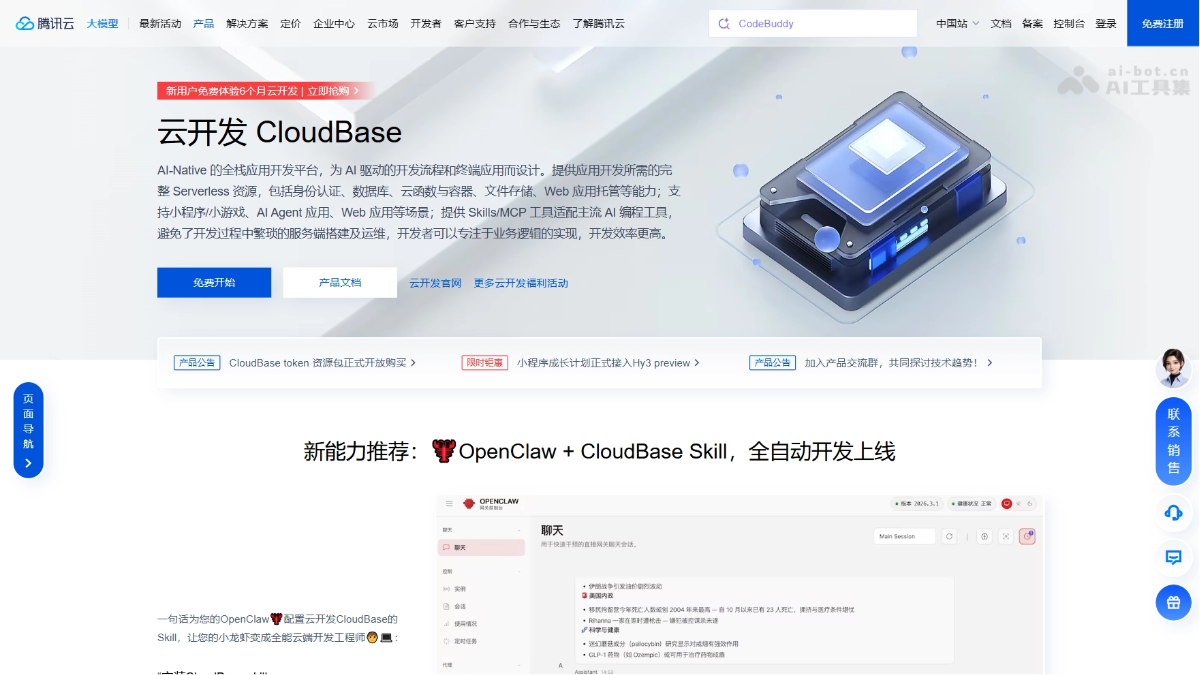
Main features of CloudBase
-
Serverless cloud functions: automatic scaling, billing by number of invocations, and support for runtimes such as Node.js, Python, and Java.
-
Cloud database and storage: provides a document database and object storage, with built-in permission management, and frontend SDKs can read and write directly.
-
AI model marketplace: built-in models such as Kimi, GLM, DeepSeek, Qwen, MiniMax, and Hunyuan; switching models requires changing only one parameter.
-
Static website hosting: one-click deployment of frontend pages, with support for CDN acceleration and custom domains.
-
Multi-platform SDKs: provides SDKs for WeChat mini programs, Web, Flutter, and more, allowing AI streaming output to be integrated with just a few lines of code.
How to use CloudBase
- Registration and authentication: visit the CloudBase official website https://cloud.tencent.com/product/tcb,完成账号注册与实名认证,获取云开发使用权限。
- Create an environment: enter the Cloud Development console to create a new environment, and select a Standard or Enterprise plan as the base resource pool.
- Enable models: enable the required large models such as Kimi K3 in the generative text model list of the AI console.
- Configure tools: copy the Base URL and API Key, enter them into AI coding tools such as Cursor and WorkBuddy, or integrate them into applications through the SDK.
- Develop and deploy: write cloud functions and frontend code, invoke the database and AI interfaces, and deploy online with one click when finished.
Core advantages of CloudBase
- Full-stack integration: a unified platform for cloud functions, databases, storage, AI model invocation, and static hosting, with no need to switch between multiple service providers.
- Pooled model resources: mainstream models such as Kimi, GLM, DeepSeek, and Qwen share one resource point pool; switching models requires changing only one parameter.
- AI out of the box: built-in direct large model invocation capability, with no need to build your own inference service or manage API keys; copy the URL and integrate.
- Domestic compliance and low latency: deployed on Tencent Cloud's domestic nodes, meeting data compliance requirements, with faster access than similar overseas products.
- Deep adaptation to the multi-platform ecosystem: natively supports Tencent ecosystem platforms such as WeChat mini programs, official accounts, and Web, with SDKs enabling integration in just a few lines of code.
- Native MCP protocol support: AI coding tools can directly operate cloud resources through MCP, enabling seamless connection between code generation and deployment.
- Unified billing reduces costs: Cloud resources and Tokens are billed together by resource points, avoiding scattered bills across multiple platforms, and the full stack goes live with one package.
Comparison of CloudBase's similar competitors
| Comparison Dimensions | CloudBase (Tencent Cloud) | Firebase(Google) |
|---|---|---|
| Core Positioning | Domestic Serverless full-stack cloud development + AI model aggregation platform | Global mobile and Web application Backend as a Service (BaaS) |
| AI Model Support | Built-in direct invocation of domestic models such as Kimi, GLM, DeepSeek, and Qwen | Mainly integrates Gemini and Vertex AI, requiring additional configuration |
| Billing Model | Unified resource point pool, with cloud resources and Tokens billed together | Spark is billed on demand, with storage/bandwidth/invocation volume priced separately |
| Deployment Ecosystem | Deeply adapted to WeChat Mini Programs, Official Accounts, and the Tencent Cloud ecosystem | Deeply adapted to Android, iOS, Web, and the Google ecosystem |
| Compliance and Speed | Domestic nodes, compliant with data regulations, low access latency | Global nodes; domestic access requires CDN or a proxy |
| Open Source and Lock-in | Some SDKs are open source, with ecosystem tied to Tencent Cloud | Some services are open source, with ecosystem tied to Google Cloud |
CloudBase Application Scenarios
- AI Mini Program Development: Quickly build WeChat Mini Programs with intelligent customer service and content generation capabilities, with integrated front-end and back-end deployment.
- Front-end Programming Agent: Combined with Kimi K3's long-horizon coding capabilities, AI tools can directly operate cloud databases and functions through MCP.
- Enterprise Knowledge Base Q&A: Use million-context models to process large amounts of PDF and web page materials, and build internal research report and document Q&A systems.
- Low-code Operations Backend: Through cloud databases + static hosting, quickly build campaign pages, admin backends, and data dashboards.
- Multi-model AI Middle Platform: Flexibly switch between large models from different vendors within the same resource pool, providing multi-strategy text generation and inference services for products.