
We have consistently shared many articles about workflow platforms and LLM application platforms.
Mainly including:Dify、Coze、n8n、Fastgpt、Ragflow。
But in the comment section of almost every article, friends ask, how does platform xxx compare to platform xxx, and how should one choose?
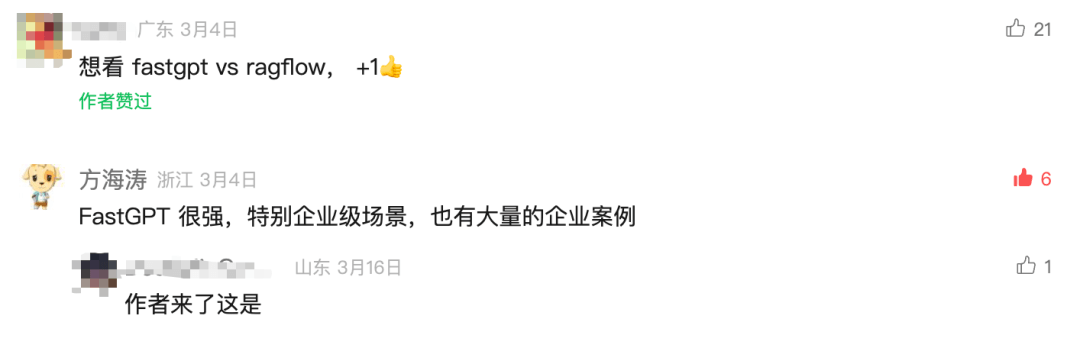


Indeed, faced with ever-changing AI technology and rapidly evolving various LLM platforms, we are prone to choice difficulty.
But what I want to say is that each platform has its own advantages, and you just need to choose the appropriate one based on your own needs.
This article willstart from a practical perspective, through detailed feature comparisons, real user experiences, and specific application scenarios, help you find the one that suits you best among the five mainstream platforms: Dify, Coze, n8n, FastGPT, and RAGFlow.
Whether you are an AI developer, an enterprise user, or a beginner just getting into AI, this comparative analysis can provide you with a clear selection guide.
This article is 5,000 words, full of useful content, recommended for bookmarking.
First, we need to clarify
LLM application platforms include:Dify、Coze、Fastgpt、ragflow
n8n is a bit special; it is an LLM platform primarily focused on workflows.
The core value of LLM application platforms lies in greatly lowering the development threshold for AI applications, accelerating the process from concept to product launch, and providing developers with a toolset (plugins, MCP tools, etc.) to integrate, manage, and optimize AI capabilities.
Through these platforms, we canfocus more on business logic and user experience innovation, rather than repetitive underlying technology construction。
First, let's briefly understandthe characteristics of these platforms
n8n: Known for its powerful general-purpose workflow automation capabilities, in recent years it has actively embraced AI, allowing users to embed LLM nodes into complex automation processes.
Coze (Kouzi): Launched by ByteDance, it focuses on low-code/no-code AI Agent development, emphasizing rapid construction and deployment of conversational AI applications.
FastGPT: An open-source AI Agent construction platform, focused on building knowledge base question-answering systems, providing data processing, model invocation, and visual workflow orchestration capabilities.
Dify: An open-source LLM application development platform that integrates BaaS and LLMOps concepts, aiming to provide one-stop rapid development and operation capabilities for AI applications, including Agent workflows, RAG Pipeline, etc.
RAGFlow: An open-source RAG engine based on deep document understanding, focused on solving knowledge extraction and high-quality question answering for complex-format documents.
Detailed Introduction to Each Platform
Dify: The Swiss Army Knife of LLM Platforms
Let's first give Dify 3 keywords.
#OpenSource #LLMOps #ProductionReady
In one sentence: Dify is an LLM application development platform open-sourced in April 2023. If you want to build professional, production-ready AI applications and also want to fully handle backend and model operations, just use it.
Address:dify.ai
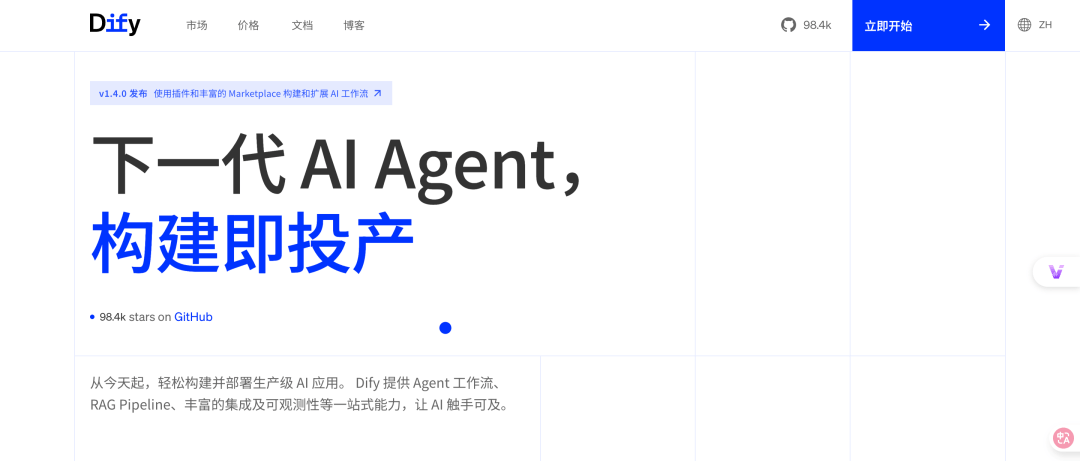
Dify focuses on "Backend-as-a-Service" and "LLMOps," with the goal of enabling developers and non-technical innovators to easily get started and quickly build practical AI solutions.
It packs RAG (Retrieval-Augmented Generation) pipelines, AI workflows, monitoring tools, model management, and MCP features into one platform.
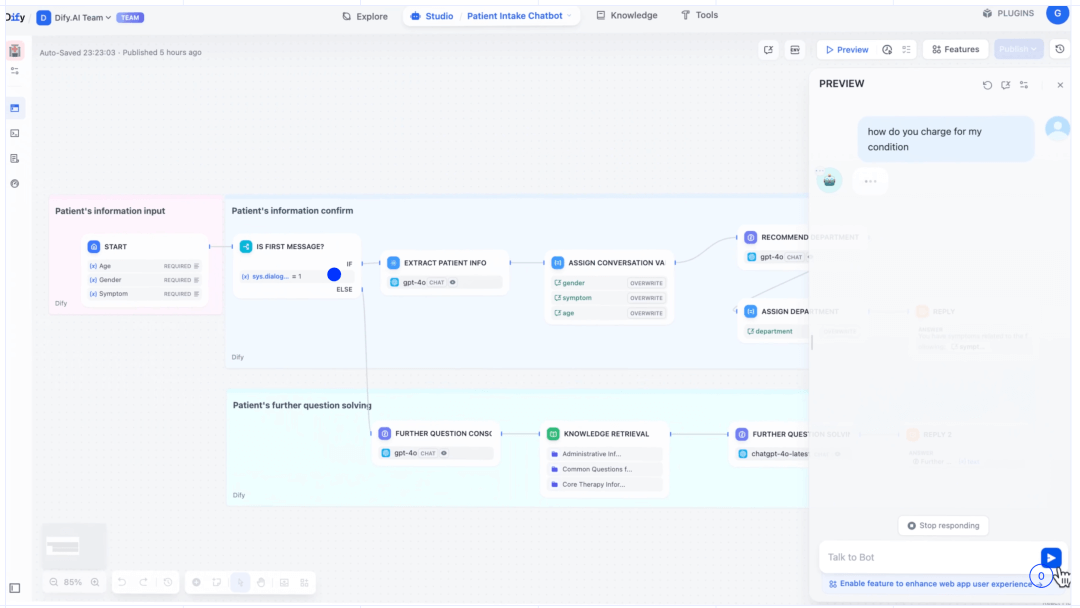
It is indeed like a Swiss Army knife; it basically has whatever functionality you want.
Its main theme is "You just focus on innovation; leave the rest to Dify."
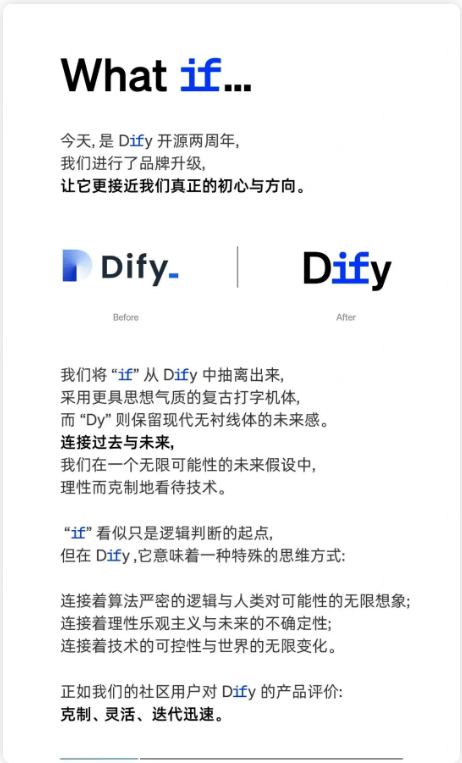
By the way, Dify recently underwent a brand refresh.
It supportsDocker private deployment, and the minimum server configuration to run it is2 cores, 4GB RAM
The community activity is also quite good; currently onGitHub it already has 98.3K Stars.
But it always gives me the feeling of being a jack of all trades, "master of none," as if there's nothing particularly outstanding about it.
Another downside is that if a Bot created in Dify wants to provide services externally, its API is not compatible with the OpenAI API, which makes it relatively difficult for external applications to integrate with it.
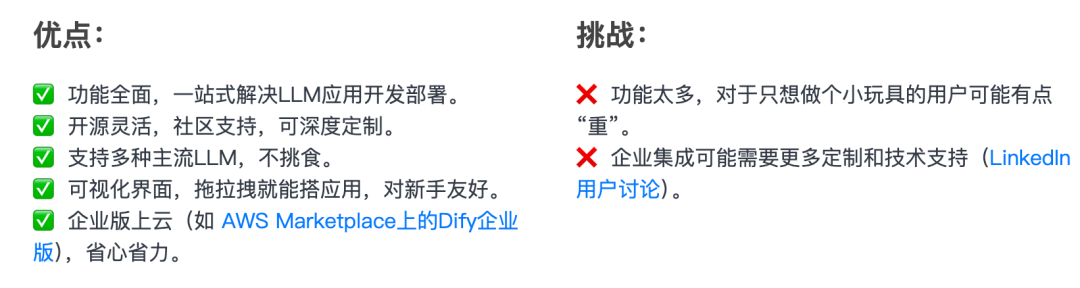
In addition, for users who just want to quickly implement some small features, it is a bit heavy.
For large enterprise integration, you should still need to do your own secondary development on top of it.
Suitable for: Developers with some technical skills, teams pursuing professionalism and efficiency, and enterprises needing customized AI solutions.
Coze: The "LEGO" of the LLM platform world
#NoCode #AgentBuilding #MultiPlatformPublishing
First, a one-sentence summary:Coze is owned by ByteDance, with the main idea that "everyone is an AI developer," featuring thousands of built-in tool plugins, letting you create and publish AI Agents as easily as building with blocks.
Address:coze.cn

Whether or not you understand programming, Coze can let you quickly bring the AI agents in your imagination to life.
Visual building, rich plugins, knowledge bases, and workflows are all available, and it also supports one-click publishing to major platforms such as Douyin, Feishu, WeChat Official Accounts, Mini Programs, Discord, Telegram, and more.
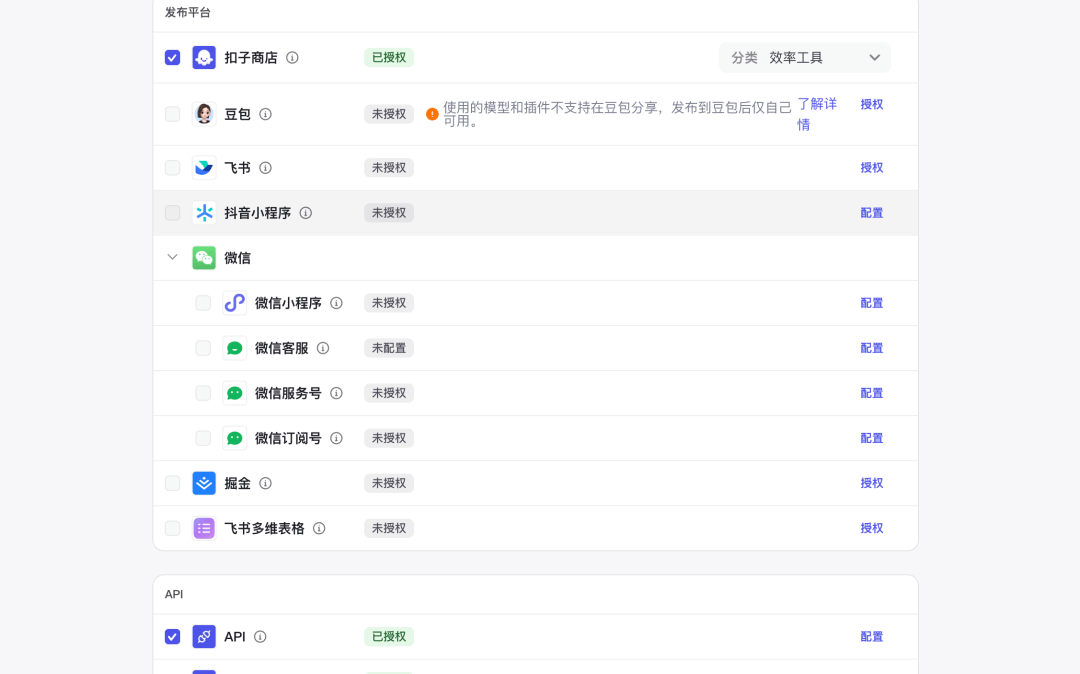
There is an overseas version (Coze) and a domestic version (Kouzi)
Coze is closed-source, but its features are richer than Dify's.
What I particularly like are the code plugin, zero-code mini programs, web pages, scheduled tasks, and other features.

Suitable for: AI beginners, product managers, operations personnel, creators who want to quickly build personalized AI Agents, and individuals and small teams with limited budgets and technical resources.
FastGPT: The knowledge base whiz
#OpenSource #RAGKnowledgeBase
In one sentence: FastGPT is afree and open-source AI knowledge base platform, letting AI accurately answer questions based on your private data. It is your second "brain"
Address:FastGPT
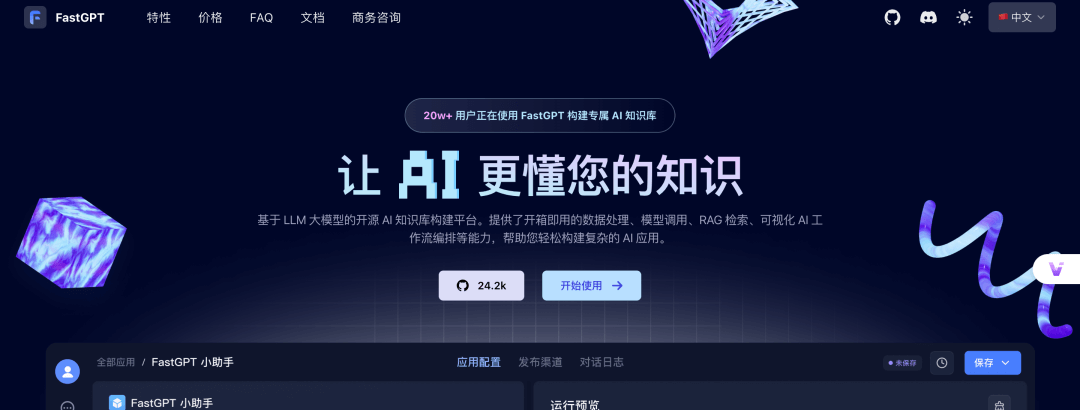
FastGPT provides data processing, model invocation, RAG retrieval, and visual AI workflows, with one-stop MCP services.
You can import documents in various formats (Word, PDF, web links, etc.) and build an AI Q&A assistant for a specific domain in the shortest time possible.
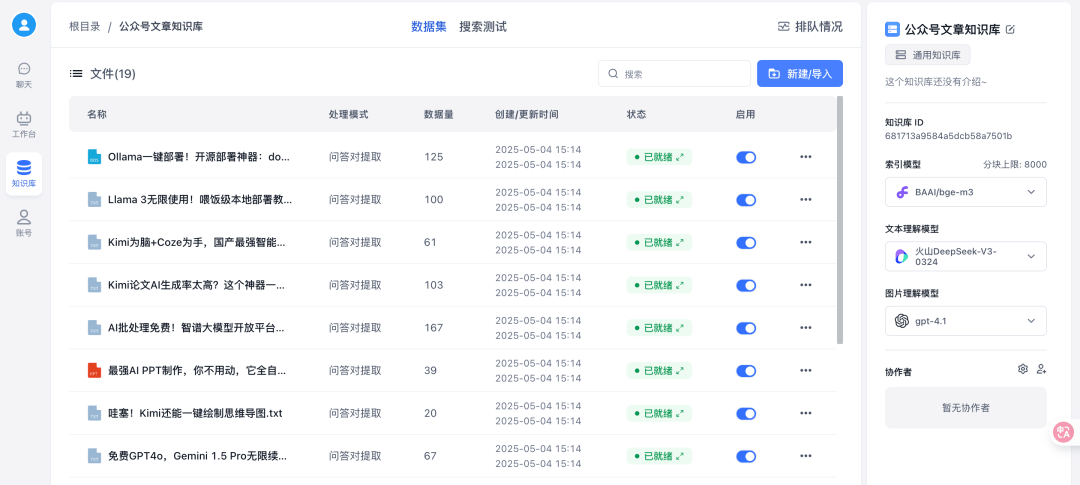
FastGPT's RAG performance is quite good. It can build a high-quality knowledge base simply and quickly. I previously used it as customer service for my WeChat AI assistant product, and it was great.
For some enterprise-level clients, I also helped them use FastGPT to build knowledge bases. It is lightweight, simple, and easy to use.
It also provides an OpenAI-compatible API, making it very convenient to integrate into other existing applications.
It supports Docker private deployment, and it is best to use2 cores, 4GB RAMserver to run it.

Compared with Dify, its advantages are that it is more lightweight, has better knowledge base performance, is API-compatible with the OpenAI API, and is more convenient to integrate into other applications.
However, in terms of feature richness and some aspects of the experience, it is not as good as Dify, and its community is not as active as Dify's. Currently, onGitHub it has 24.2K Stars
But if you want to quickly build AI applications focused on knowledge bases, I recommend trying FastGPT first.
Suitable audience: developers or enterprises that need to build internal enterprise knowledge bases and AI customer service, as well as AI enthusiasts interested in RAG technology.
RAGFlow: Knowledge Base Expert
Tags: #OpenSource #RAGEngine #DeepDocumentUnderstanding
In one sentence: RAGFlow is an open-source RAG engine
Address:ragflow.io
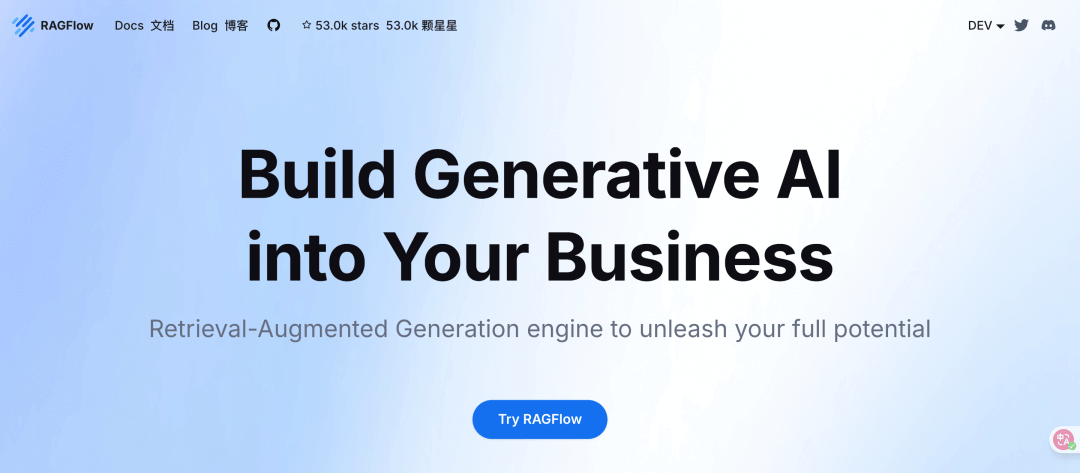
RAGFlow's core competitiveness lies in "deep document understanding," for example, being able to extract clauses from contracts and summarize long reports. It also supports preprocessing of more than 10 types of data. Whether in RAG knowledge base construction or the question-answering stage, there are very rich parameters to adjust. It also supports knowledge graph functionality.
RAG's granularity is fine, and the upper limit of knowledge base effectiveness is very high.
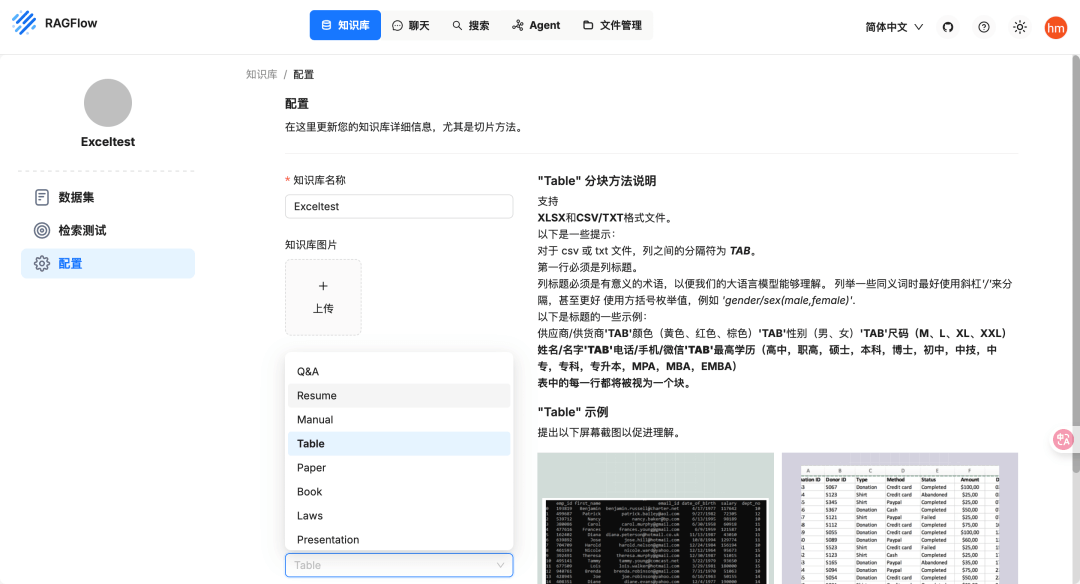
If FastGPT is a knowledge base whiz, then Ragflow is a knowledge base expert (as can be seen from its name).
Supports Docker deployment, but it is relatively heavy and requires at least4 cores 16Gconfigured server to use smoothly. Currently, onGitHub it has 53.1K Stars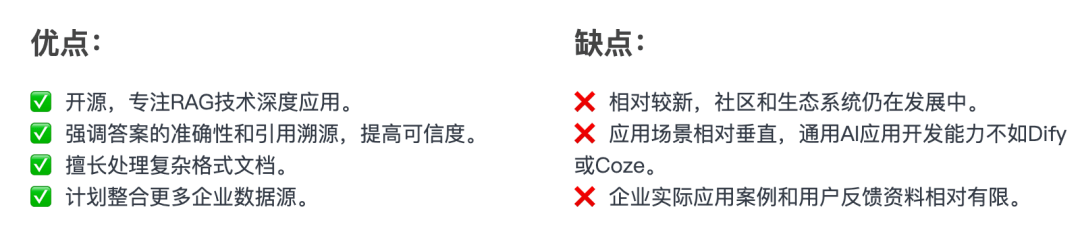
Suitable forindustries with high requirements for answer accuracy and traceability (such as law, healthcare, finance), enterprises that need to process large amounts of complex documents, and researchers and developers of RAG technology.
n8n: The Most Powerful Open-Source Workflow Platform
#OpenSource #WorkflowAutomation #LowCode
In one sentence: n8n is an open-source low-code workflow automation tool focused on connecting various applications and services to form automated business processes.
Address:n8n.io
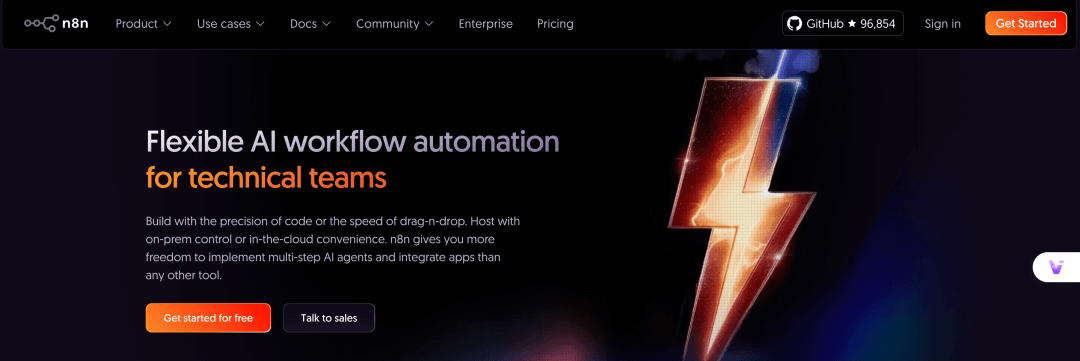
n8n's core is building automated processes through visual nodes (Node), and the configuration parameters provided by each node are rich, with a high degree of customization.
It provides over 400 preset integrations, covering various SaaS services and databases. Workflows can be built through simple drag-and-drop operations, and more complex customization can also be done through JS or Python code.
It includes Agent nodes, can quickly connect to various large models, and also supports MCP.
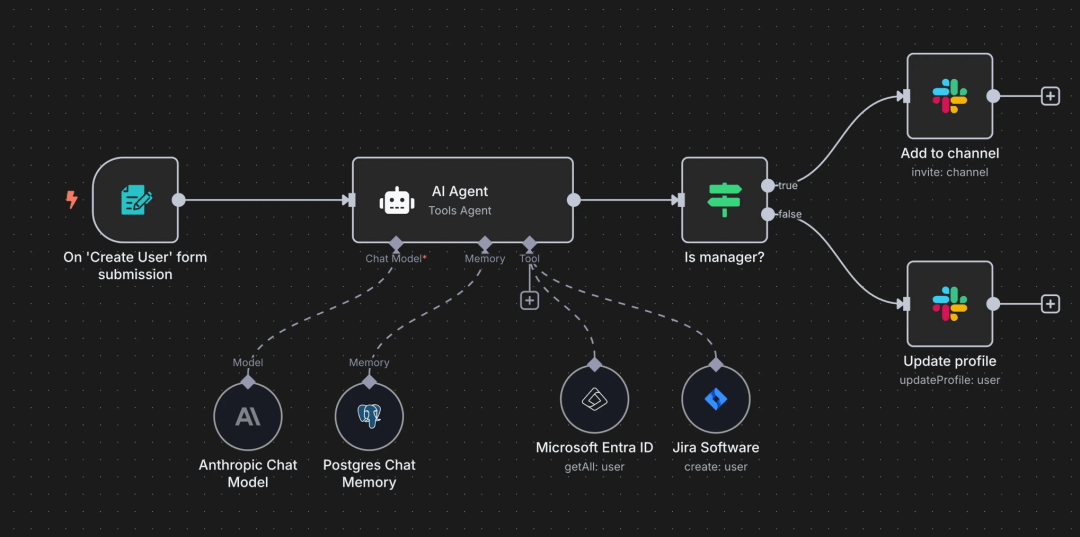
In actual business, n8n can greatly improve work efficiency
For exampleDelivery Herousing n8n saved more than 200 hours of work time per month
https://n8n.io/case-studies/delivery-hero/
StepStone also relies on it to run more than 200 critical task processes
https://n8n.io/case-studies/stepstone/
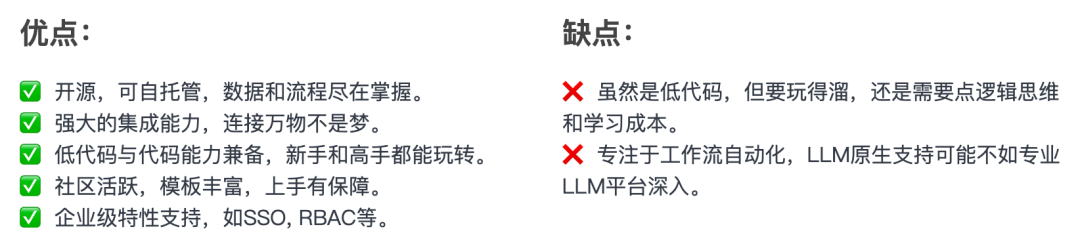
Although n8n has many advantages, after all, it is a workflow platform, mainly focused on workflows. In the LLM area, its smoothness still cannot compare with other professional LLM application platforms. It has everything it should have in the LLM area, but it feels more troublesome to use.
At the same time, its learning difficulty is also the greatest among these platforms. It requires some logical thinking and upfront learning costs, but once you get the hang of it, efficiency will be greatly improved.
It also supportsDocker private deployment, completely not resource-intensive,1 core 1Gservers should be able to run it.
Suitable audience: teams that need highly customized automation processes, developers, and small and medium-sized enterprises pursuing maximum efficiency.
Horizontal Comparative Analysis of the Functions of 5 Major Platforms
To help everyone more clearly understand the differences and advantages of these five platforms, I have put together a detailed comparison table, providing an objective analysis from multiple dimensions:Among them, Coze is currently no longer free
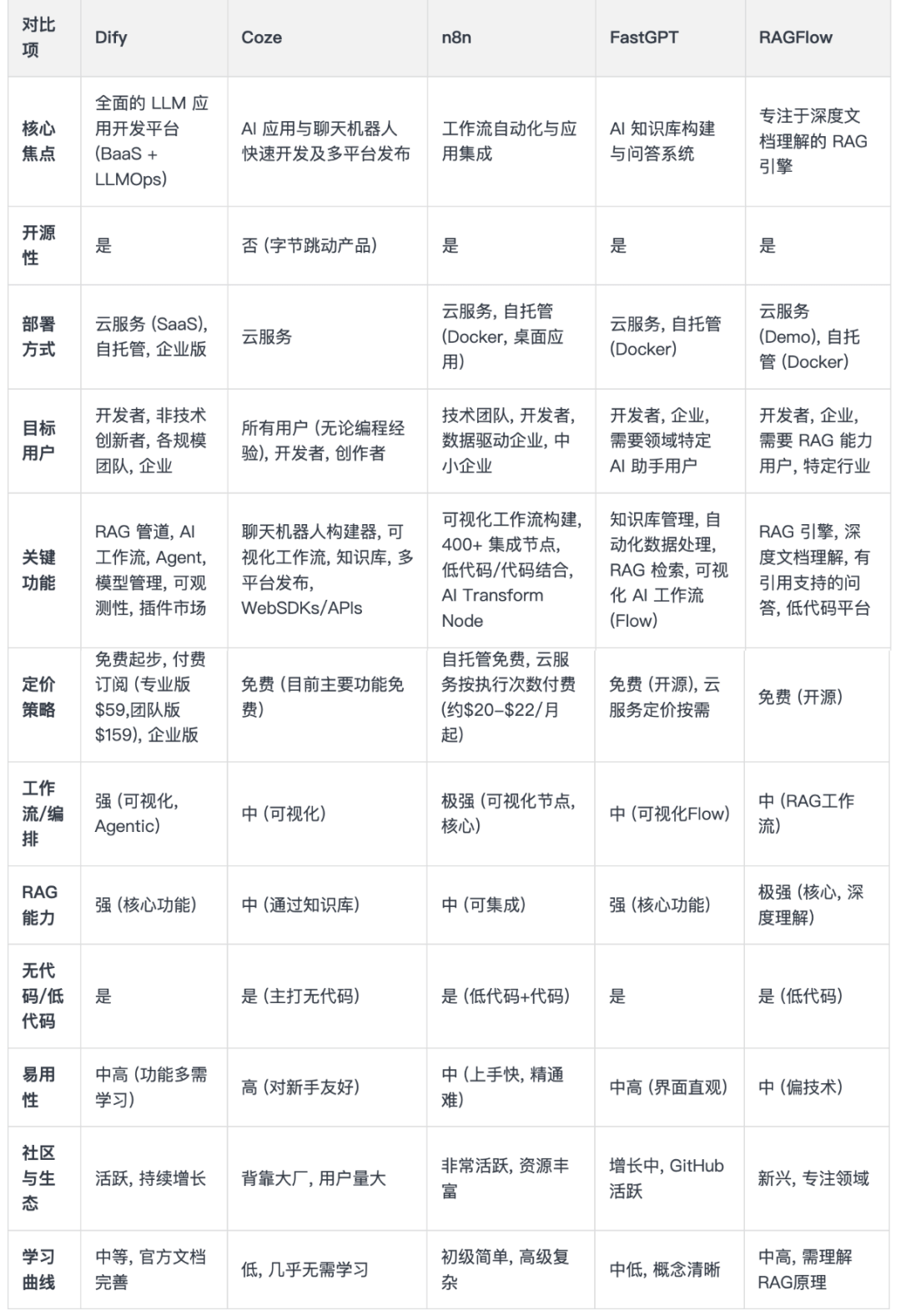
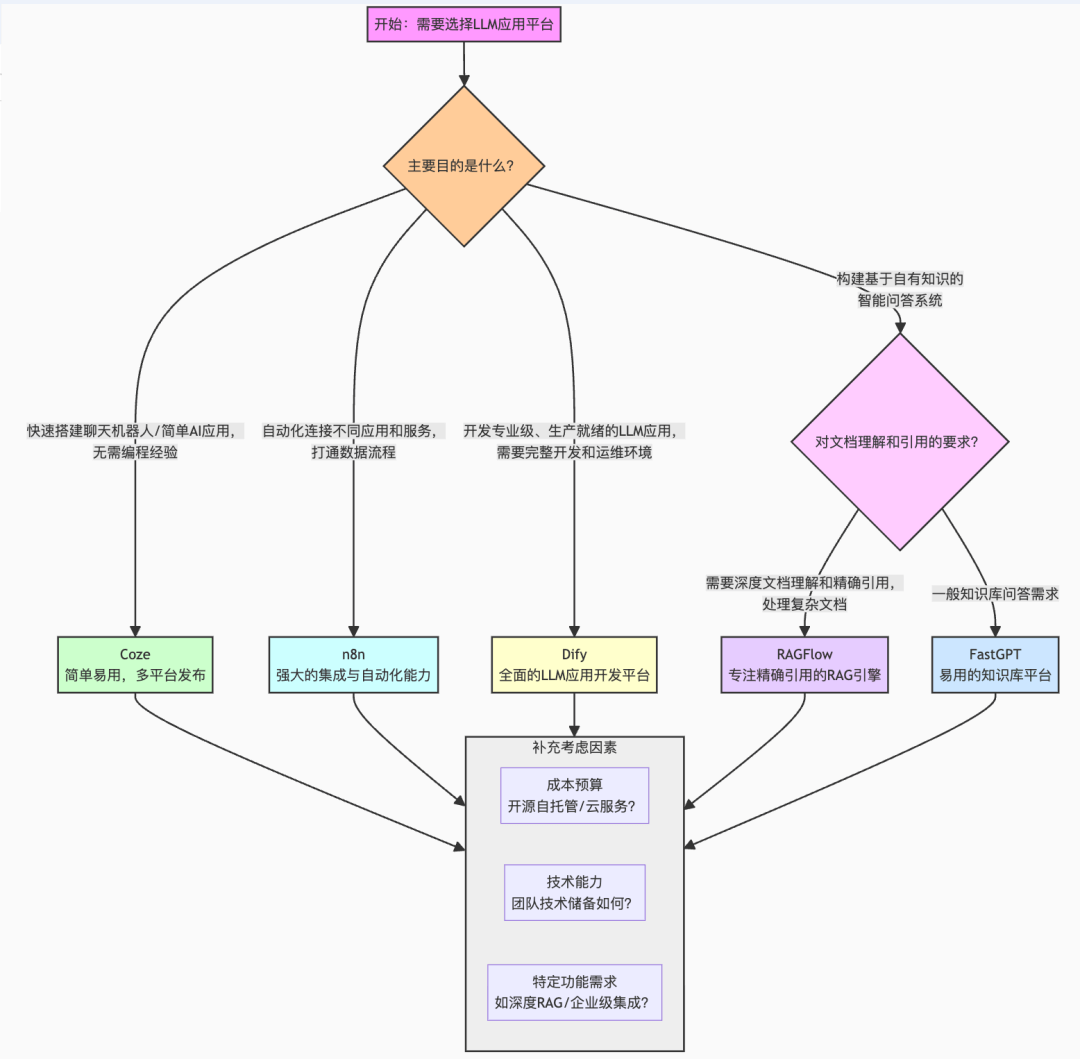
Practical suggestions for platform selection:
From my actual experience, if you are just getting started with AI application development and want to see results quickly,Cozeis the easiest option to get started with.
If your work or business involves data flow between multiple systems and services and requires automated processing,n8n's powerful automated workflows will save you a huge amount of time.
If you want to build an internal enterprise intelligent knowledge base or Q&A system, FastGPT,Ragflow canbe given priority; they are both relatively strong in RAG, FastGPT is more lightweight, and Ragflow is heavier (but has a higher ceiling)
For teams with long-term plans that need to build scalable enterprise-grade AI applications,Dify's complete ecosystem and enterprise-grade features are a good choice.
To make it more intuitive, based on my actual usage experience and the characteristics of each platform, I have put togetherthe "user suitability scoring chart" below (out of 5 points), hoping to help everyone quickly identify which platform matches their needs:
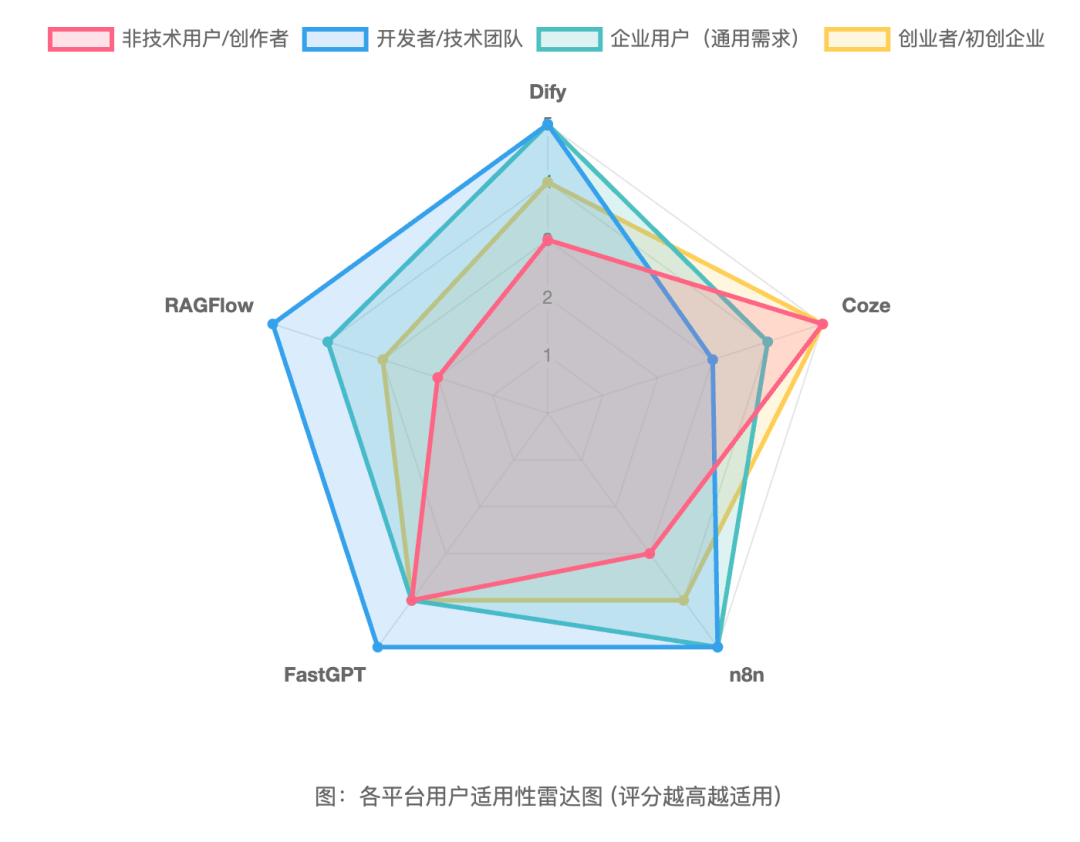
There is also the chart below, which you can also refer to
Factors to consider in selection
Before making a final choice, I suggest everyoneconsider the following key factors, as they will directly affect your user experience and long-term results:
Budget:
Open-source platforms can be self-hosted for free, but server and maintenance costs need to be considered; cloud services are paid by usage or subscription, with low upfront costs but potentially higher long-term costs. Choose the appropriate solution based on your resource situation and business scale.
Technical capability:
Evaluate your or your team's technical background and willingness to learn. If technical strength is limited, choosing a no-code platform like Coze will be more suitable; if you have a strong technical team, you can consider platforms such as Dify or n8n that provide more customization capabilities.
Deployment:
Consider whether local data privatization is needed. Self-hosted solutions provide higher data security and privacy protection, but require more technical support; cloud services provide rapid deployment and low maintenance costs, but may have data security risks.
Core functional requirements:
List your most core requirements in detail and see which platform can best satisfy these key points. For example, if RAG capability is the most important, then FastGPT or RAGFlow may be more suitable than Coze; if complex workflows are needed, n8n or Dify will be a better choice.
Platform sustainability:
Evaluate the platform's update frequency, community activity, and long-term support. For open-source projects, look at community activity and the number of contributors; for commercial products, look at the company background and market performance. This directly relates to whether the platform you choose can develop over the long term and keep up with technological changes.
Data security and compliance:
Especially for enterprise users, data privacy protection, access control, and compliance are crucial. Open-source self-hosted platforms have more advantages in data security because data can be fully kept in your own environment; for commercial platforms, you need to carefully read their privacy policies and data processing agreements, etc.
By carefully evaluating the above factors and combining them with the comparative analysis earlier, I believe everyone should be able to find the LLM application platform that best suits their own needs.
"Finally"
Through this comprehensive comparative analysis
I hope everyone now has a clearer understanding of the five platforms Dify, Coze, n8n, FastGPT, and RAGFlow.
There is no absolutely perfect tool, only the choice that best suits the current needs and stage of development.My suggestion is:
If possible, you can start by trying a platform with a lower barrier to entry (such as:Coze) to become familiar with the basic concepts and processes of LLM application development;
Later, as your needs become more complex and your technical skills improve to a certain extent, gradually transition to more professional platforms (such as Dify or n8n).
AI Agent is a rapidly developing field, and platforms are also evolving and improving at a rapid pace.
I hope this analysis can provide everyone with a basic reference framework
to help everyone find the tools and direction that suit them in this AI era full of opportunities and challenges.
Original link:How exactly should you choose among Dify, n8n, Coze, Fastgpt, and Ragflow? A super detailed guide~