
Over the past six months,AI IDE competition has become increasingly fierce, and almost every month, someone wants to redefine "AI Coding."
This time it's Alibaba. They recently built a new AI Agentic IDE called Qoder。
It can understand the entire codebase, grasp the project structure, capture the context, and then provide the most suitable code based on the team's habits and conventions.
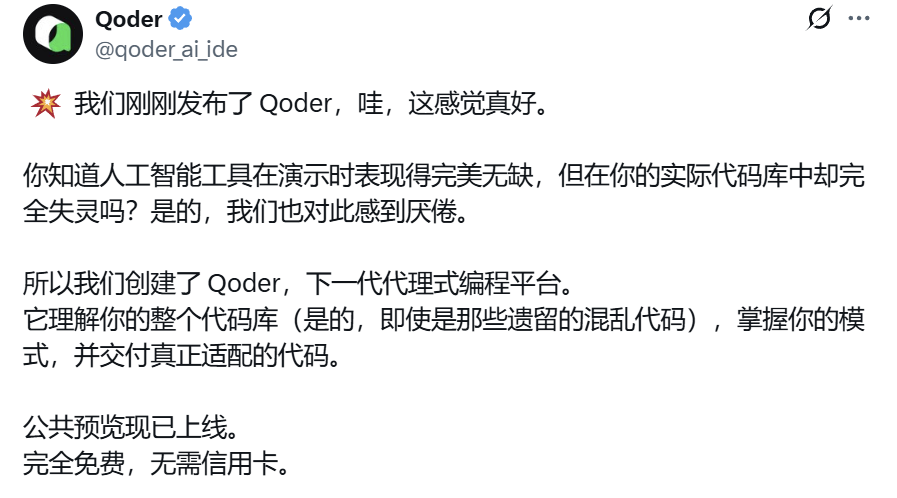
Most importantly, it's currently in preview and free to use, with no invitation code needed!
So what if we gave the same task to Alibaba's Qoder, ByteDance's TRAE SOLO and Tencent's CodeBuddy IDE ?
I ran through it with three identical prompts. Let's take a look at the comparison.
01. Qoder — an IDE that understands the project
Qoder natively supports Chinese, so it's easy for beginners to get started too. The overall layout is similar to VS Code andTRAE but when I actually used it, I found that Qoder is quite different in a few ways.
Official website:Qoder
Automatic model selection
Qoder integratesClaude , GPT, Gemini, and other mainstream international models, and automatically calls the appropriate model based on our task.

During the preview phase, everyone gets a free quota of 2,000 credits. After using them up, you can still continue to use it for free, but it will automatically switch to a standard large model.
Three task modes
Friends who have used Tongyi Lingma will definitely find it familiar~
In intelligent Q&A mode, when Qoder answers our questions, it will not make any modifications to the project files. This mode is great for having Qoder give us some inspiration and suggestions, or for code interpretation.
In agent mode, Qoder will proactively modify code and execute tasks, including making To-do plans, using tools, using MCP , etc.
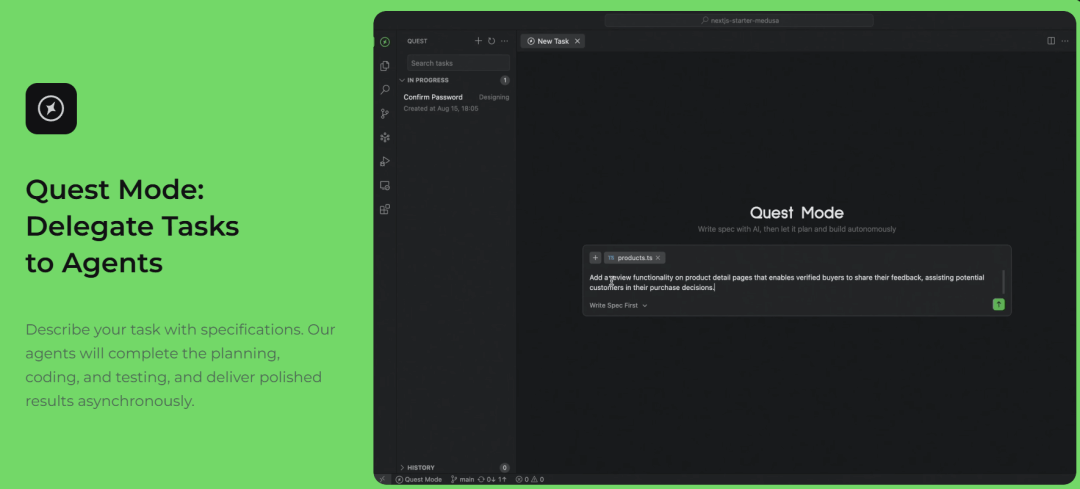
In addition, Qoder also has a Quest (AI autonomous programming) mode, designed specifically for teams to solve complex, long-term tasks, and suitable for large tasks。
Supports Repo Wiki
In traditional codebases, information such as architecture and interface design is mostly implicit — either kept in people's heads or scattered across various documents.
The Repo Wiki introduced by Qoder is about making this implicit knowledge explicit.
After reading the entire codebase, it automatically generates a "project encyclopedia" that clearly lays out the project structure, dependency relationships, API usage, technical debt, and the thread of key decisions.
Even more convenient is that Qoder also generates a clear To-do list. As the project evolves, the Wiki can continue to update and stay in sync with the codebase.
02. Hands-on comparison
At the beginning of the month, K did a hands-on comparison of TRAE SOLO and CodeBuddy IDE.Which is stronger, TRAE SOLO or CodeBuddy IDE? A hands-on test for programming beginners
Today let's send the same prompts to Qoder and see which of these three domestic AI IDEs is actually stronger.
Mini-game
Prompt: Generate a pixel-style Snake mini-game
The interface of this mini-game is very similar in style to TRAE SOLO, and it plays very smoothly too.
Generating a webpage from a reference image
Prompt: Generate a shopping website just like the image, with a soft, soothing, jelly-like style. The color palette should mainly be milky white and misty purple, giving an overall relaxing feel, with soft and natural animations.

Qoder did a great job on this webpage. I think it's the best among these three at restoring and optimizing the original template.
Qoder has a very thorough understanding of the page. It restored the Banner page design at the top of the webpage just from a static image, and the three themed Banner pages can be switched automatically and manually.
After scrolling down the page, the settings for sections like Featured Categories and Featured Recommendations were done pretty similarly by all three.
The difference is that TRAE SOLO used different Emoji icons instead of product displays; CodeBuddy IDE used Emoji to replace product images in some modules, while keeping only imageplaceholdersin others, without actually rendering images.
Qoder directly loaded real product images into the page, which fits the overall positioning of a shopping website much better.
Community Small Dining Table Meal Ordering Webpage
Prompt: Help me generate a webpage for a community small dining table.
Users select the dishes, desserts, fruits, drinks, etc. they want and put them in their own lunchbox.
When placing an order, they can choose the delivery time (date and lunch/dinner) and fill in the address;
after the order is placed successfully, an animation will show: being prepared… enjoy your meal!
The page layouts Qoder generated all look great, and the category and ordering interaction logic I requested were implemented quite well! However, the page didn't load the matching product images.
Full-Stack Development
Prompt: Make a Tencent Video homepage
The homepage layout is quite good, and the categories for each video are all quite complete. The video positions are all shown with placeholders.
Let's continue generating the backend and database to make it convenient to manage the webpage content.
Prompt: Match my website with a backend and database so I can manage the website conveniently.
Qoder generated a backend interface for me, where I can see what content each section has, but I still can't edit it.
We can continue asking it to modify things step by step, for example, allow editing the carousel images.
We added a backend carousel page display for "Sister K Research Club". As you can see, after we edit it in the backend, the frontend page also updates in real time.
Now we can use the backend interface to upload the content we want to display to the website.
Overall, after using it, I feel that Qoder is indeed quite powerful. These small projects were almost all successful on the first try, and it lets us clearly see every step it executes. It's very reliable.
This feeling is like having a colleague by your side who both understands the project and can get work done.
However, it also has some imperfect aspects. For example, sometimes modifying one task takes a long time, and many steps require you to confirm them one by one. Occasionally, the delivered project is not completely consistent with expectations, requiring us to point out the problems and give clear directions for adjustment.
03. Some Sharing
Two years ago, IDEs could only autocomplete a few lines of code.
In the second half of 2023, IDEs gained conversational interaction, able to explain bugs and answer questions.
In November 2024, Anthropic proposed MCP, enabling AI IDEs in theory to directly call external tools and databases, but the configuration was complex and the barrier to integration was high, so very few people actually used it.
Then by May of this year, MCP interfaces were unified, and all you needed was to enter an API Key, and the AI IDE could directly call external tools. "Generate an app in one sentence" and "deploy in one sentence" gradually became the norm.
In just two years, AI IDEs have been turned upside down.
The arrival of Qoder pushed this evolution to a new height. It is no longer satisfied with "writing faster"; instead, it lets AI understand first, then execute.
This is not just a smarter IDE; it is more like having an extra virtual engineer on the team who can independently take charge of a module.
What Qoder represents is a shift in the development paradigm. Future teams may not be "humans using AI to write code," but rather "humans and AI developing products side by side."
Original link:Comparative review of domestic AI IDEs: Does Qoder completely defeat TRAE SOLO and CodeBuddy IDE?