
In today's digital age, artificial intelligence is reshaping the world at an unprecedented speed. From the convenient control of smart homes to the precision and efficiency of medical diagnosis, from the smooth operation of intelligent transportation to the accurate prediction of financial risks, AI is everywhere, profoundly changing our lifestyles and work patterns. To step into this field and master its mysteries is no easy task. This article will introduce 9 free artificial intelligence learning and self-study AI websites. They do not require high course fees or complex professional knowledge, and provide nourishment for every soul passionate about AI. They are suitable for beginners, workplace professionals eager to transition, or hobbyists driven purely by interest. Here, everyone can find the key to the door of the AI world and begin a fantastical and fulfilling learning journey.
1. AI University
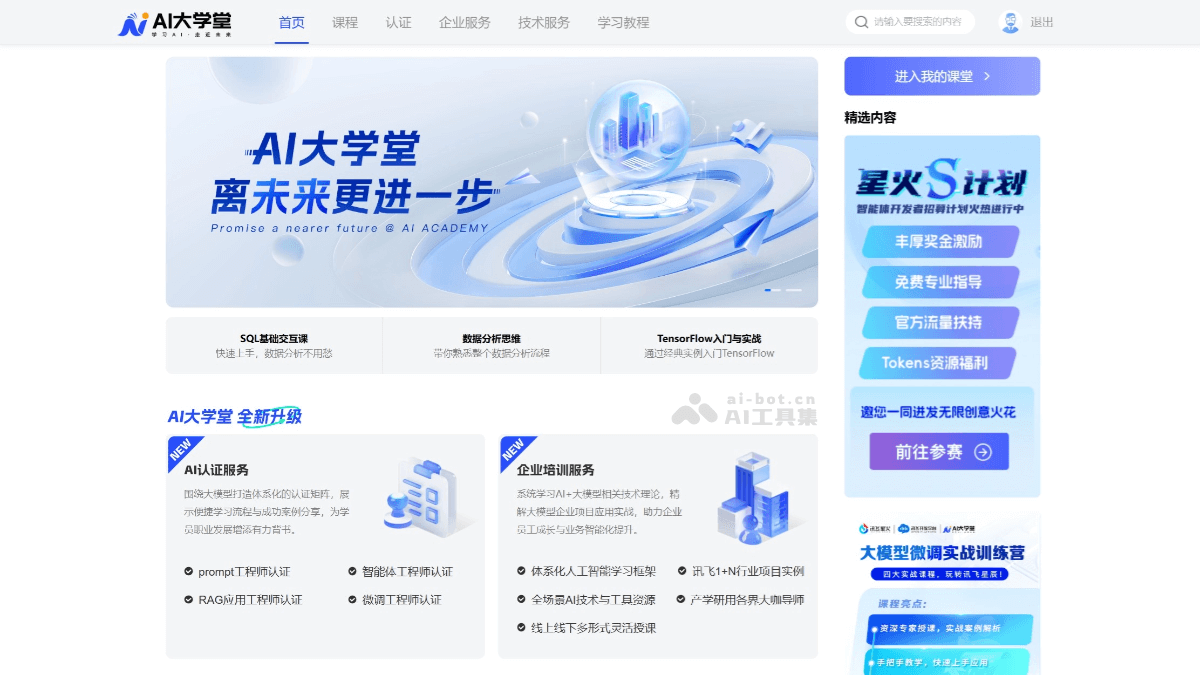
AI Universityis an online AI learning platform launched by iFlytek, focusing on knowledge transfer and skill development in the field of artificial intelligence. Based on powerful Spark large model technology, it provides learners with different foundations rich courses ranging from zero-based introduction to advanced cutting-edge technology, covering popular directions such as Prompt engineering, large model development, and Python data analysis. The platform has systematic video courses and is equipped with practical resources such as an online coding environment, case library, and model library. AI University provides professional certification services, such as Prompt engineering certification. After passing the certification, learners can obtain official certificates to enhance their career competitiveness.
🧑🏫Course Settings
- Basic Courses
-
Programming Fundamentals: Includes Python programming, Python web scraping in practice, Python office automation, etc.
-
Mathematics Fundamentals: Covers advanced mathematics, linear algebra, probability theory and mathematical statistics, etc.
-
Introduction to Artificial Intelligence: Introduces the basic concepts, history, and development of AI.
-
- Professional Courses
-
Machine Learning: Includes supervised learning, unsupervised learning, reinforcement learning, etc., involving commonly used algorithms and models such as decision trees, support vector machines, and neural networks.
-
Deep Learning: Covers convolutional neural networks (CNN), recurrent neural networks (RNN), generative adversarial networks (GAN), etc., as well as deep learning frameworks such as TensorFlow and PyTorch.
-
Natural Language Processing (NLP): Includes text classification, sentiment analysis, machine translation, speech recognition, etc. Commonly used tools and libraries include NLTK, spaCy, and Transformers.
-
Computer Vision: Involves image classification, object detection, image generation, video analysis, etc. Commonly used tools and libraries include OpenCV, YOLO, and DALL-E.
-
Data Science: Includes data cleaning, data analysis, data visualization, etc. Commonly used tools and libraries include Pandas, NumPy, and Matplotlib.
-
- Large Model Related Courses
-
Prompt Engineering: Systematically learn the technical theories related to Prompt engineering and deepen understanding through enterprise project practice.
-
Agent Development: Provides an agent engineer certification course to help learners master agent development technology.
-
RAG Application Development: Provides a RAG application engineer certification course to help learners improve their abilities in the field of RAG application development.
-
- Practical Projects: Provide real project cases to help learners apply theoretical knowledge to practical problems and improve practical skills. Through practical cases and project-driven methods, learners can master AI technology in practice.
- Industry Application Courses: Cover AI applications in multiple fields such as healthcare, finance, education, and the internet. Provide industry project examples to help learners understand the application and development of AI technology in actual work.
- Certification and Certificates: After completing the course, learners can obtain certificates issued by AI University, such as Prompt Engineer Certification and Intelligent Agent Engineer Certification. The certificates can serve as bonus points for career development.
- Entrepreneurship Support: Provide entrepreneurship classes and AI industry sharing courses to help users understand industry trends and promote innovation and entrepreneurship.
🧑🎓Target Audience
- Zero-foundation Beginners: Those who are interested in artificial intelligence but lack relevant foundational knowledge, such as students, professionals, or technology enthusiasts from non-computer science backgrounds.
- Developers and Engineers: Those with a certain programming foundation who hope to deeply study artificial intelligence technology, improve development capabilities, or apply AI technology to existing projects.
- Data Analysts: Those engaged in data analysis work who hope to use artificial intelligence technology to improve data analysis capabilities or expand the application scope of data analysis.
- Enterprise Employees and Managers: Employees in enterprises who hope to improve their technical capabilities, or managers who need to understand AI technology to promote intelligent transformation of enterprises.
- University Students and Researchers: Current students or researchers in computer science, artificial intelligence, data science, and related majors who hope to deeply study AI technology and improve their academic level.
- Entrepreneurs: Those who have entrepreneurial ideas and hope to use artificial intelligence technology to create innovative products or services.
2. AI Tool Collection
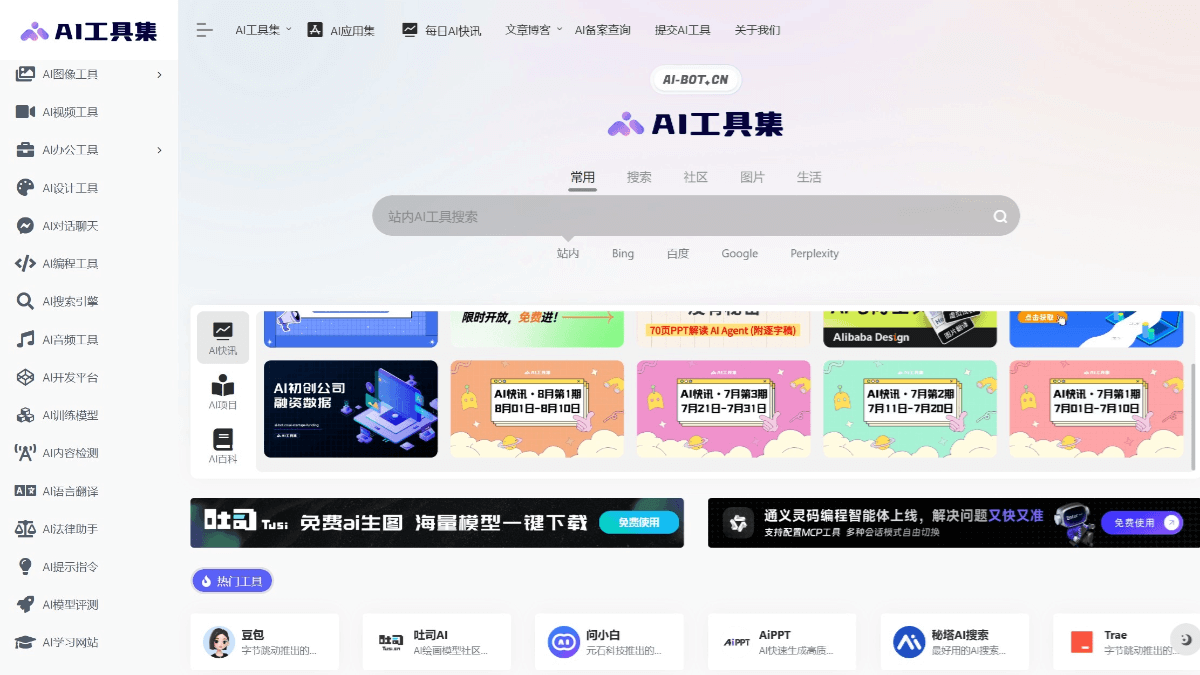
AI Tool Collectionis a comprehensive portal website that brings together numerous AI tools, providing users with one-stop services such as AI tool navigation, the latest news, tutorials and usage methods. It covers many fields from AI writing, painting, image processing to video production, office automation, programming assistance, design optimization, audio processing, and more. AI Tool Collection also provides abundant learning resources, the latest open-source projects, frameworks, and paper interpretations to help users better master and apply AI technology.
🧑🏫Course Settings
- AI News: Provide the latest AI news, hot news, AI product updates, and industry trend research every day, offering a one-stop understanding of all important events in the artificial intelligence circle.
- AI Encyclopedia: Introduce the basic concepts of artificial intelligence, its development history, and its applications in various fields, helping learners establish a foundational understanding of AI.
- AI Projects and Frameworks: Share the latest AI open-source projects, frameworks, and interpretations of the latest frontier papers, helping advanced learners understand specific AI applications and implementation projects.
- AI Tool Navigation: Carefully selected 1000+ AI tools by category, equipped with detailed product functions and usage introductions, helping you quickly get started.
🧑🎓Target Audience
- University Students : Students majoring in computer science, artificial intelligence, data science, and related fields can deeply study professional knowledge and conduct course experiments and project practice through the programming tools, model training platforms, and other resources in AI Tool Collection.
- Programmers and developers : AI programming tools, development platforms, and model training tools provide them with powerful support, helping them quickly develop and optimize AI applications, and improve work efficiency and code quality.
-
Content creators : This includes copywriters, video producers, new media operations personnel, and others. AI writing tools can quickly generate draft copy and provide writing ideas and creativity; AI video tools can help them quickly generate video scripts, edit videos, add special effects, and more, improving the efficiency and quality of content creation.
- Small and medium-sized enterprises : They can use various tools in the AI toolset to improve their operational efficiency and innovation capabilities.
-
Freelancers : Such as freelance designers, freelance writers, freelance programmers, and others, they can use the tools in the AI toolset to improve their work efficiency and professional capabilities, better complete client projects, and enhance their competitiveness.
3. OpenAI Academy
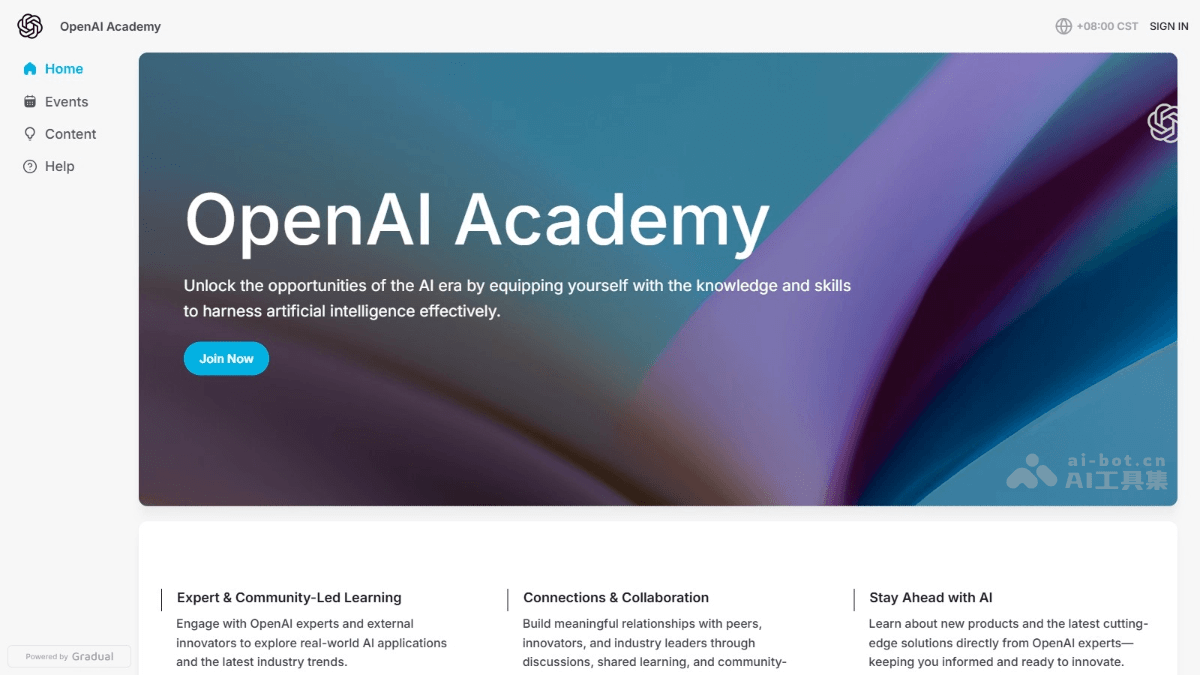
OpenAI Academy is a free AI learning platform launched by OpenAI to popularize artificial intelligence knowledge and empower more people to use AI. It offers a rich set of courses from beginner to advanced levels, covering multiple fields such as machine learning and natural language processing, including "Prompting Masterclass" and "ChatGPT Edu Academic Assistant Guide". The teaching formats are diverse, including on-demand video courses, live workshops, and more, and there is also a community for users to communicate. Currently, it only supports English. The courses are suitable for people from different backgrounds, such as older adults, educators, university students, and technical personnel.
🧑🏫Course offerings
-
Basic courses: Including "ChatGPT Edu Academic Assistant Guide" and "AI Introduction for Older Adults", suitable for beginners to quickly understand the basic concepts and application scenarios of AI.
-
Intermediate courses: Such as "Prompting Masterclass" and "Building Knowledge Graphs with GraphRAG", helping learners improve their skills in interacting with AI and increase the efficiency of using AI tools.
-
Advanced courses: Covering multiple fields such as machine learning, deep learning, natural language processing, and data science, including tutorials on fine-tuning GPT-4o mini, building multi-assistant systems, enhancing recommendation systems, and best practices for function calling, among other content.
-
Sora video generation tutorial: Covering Sora basics, mixed video and storyboard creation, and other content.
🧑🎓Target audience
-
Middle-aged and older adults: Helping middle-aged and older adults easily get started with artificial intelligence and improve digital literacy.
-
K-12 educators: Providing K-12 educators with introductory AI courses to integrate generative AI such as ChatGPT into classroom teaching.
-
University students: Learning how to use AI to assist with writing papers, doing research, preparing resumes and interviews, and improving study and job-seeking efficiency.
-
Developers and technical personnel: Learning advanced courses, such as GPT-4o mini fine-tuning and multi-assistant system construction, to improve technical skills and develop innovative AI applications.
-
Ordinary learners interested in AI: Understanding the basic concepts and application scenarios of AI, and improving digital literacy.
4. Day of AI
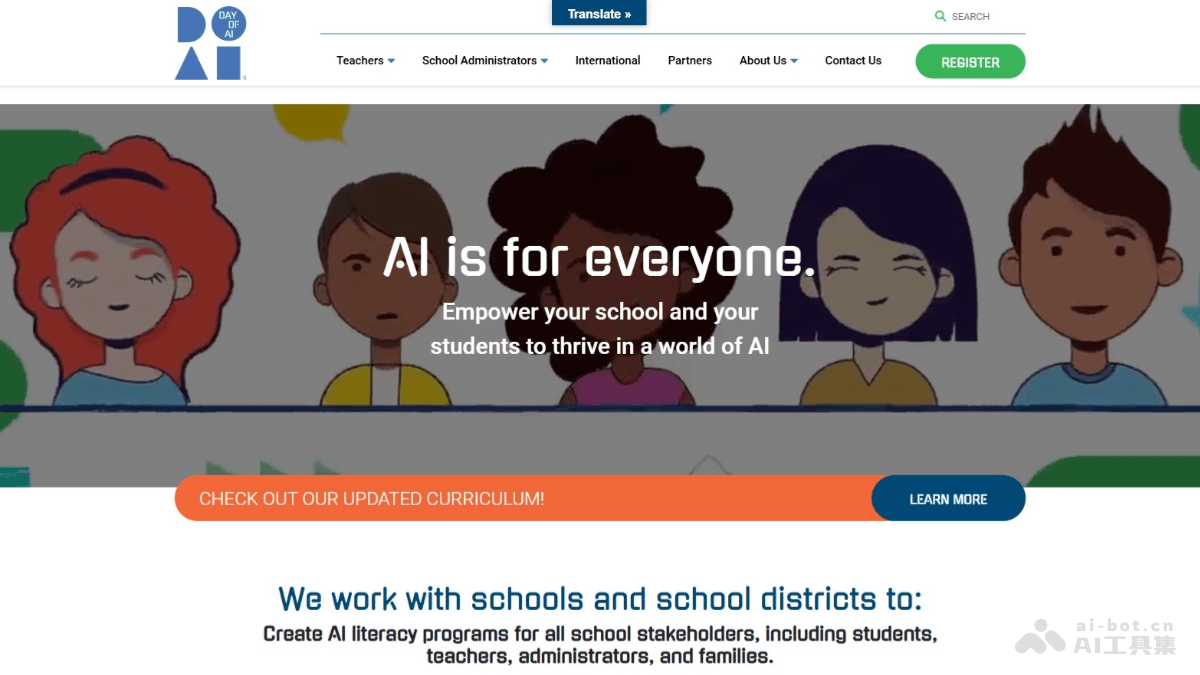
Day of AIIt is a free AI education project for K12 students launched by the MIT RAISE team. Through easy-to-understand methods, it introduces children to the fundamentals of artificial intelligence, application scenarios, and ethical issues. The course content is rich and highly interactive, including mini-games and hands-on tasks, suitable for students of different age groups. The project is divided into beginner, intermediate, and advanced courses, ensuring that every student can find learning content that suits them.
🧑🏫Course Offerings
-
Foundations of AI Literacy: Covers basic AI concepts such as machine learning and algorithms, suitable for beginners. Through vivid case studies, a combination of text and images, and multimedia presentations, the course helps students understand the principles and applications of AI.
-
AI Applications: Explores in depth the applications of AI in different fields, such as natural language processing and image recognition, helping students understand the practical uses of AI.
-
Beyond AI Literacy (AI Programming): For upper-grade students, it provides more in-depth programming instruction, including using Blocks or Python for programming and building chatbots, cultivating students' programming ability and innovative thinking.
🧑🎓Target Audience
-
Elementary School: The course design focuses on introducing basic concepts, stimulating students' interest in AI through easy-to-understand methods.
-
Middle School: The course content places more emphasis on AI applications and technical background, helping students understand the role of AI in the real world.
-
High School: The course focuses on in-depth discussion of project implementation and cutting-edge applications, suitable for students with some foundation.
5. Alibaba Cloud AI Learning Path
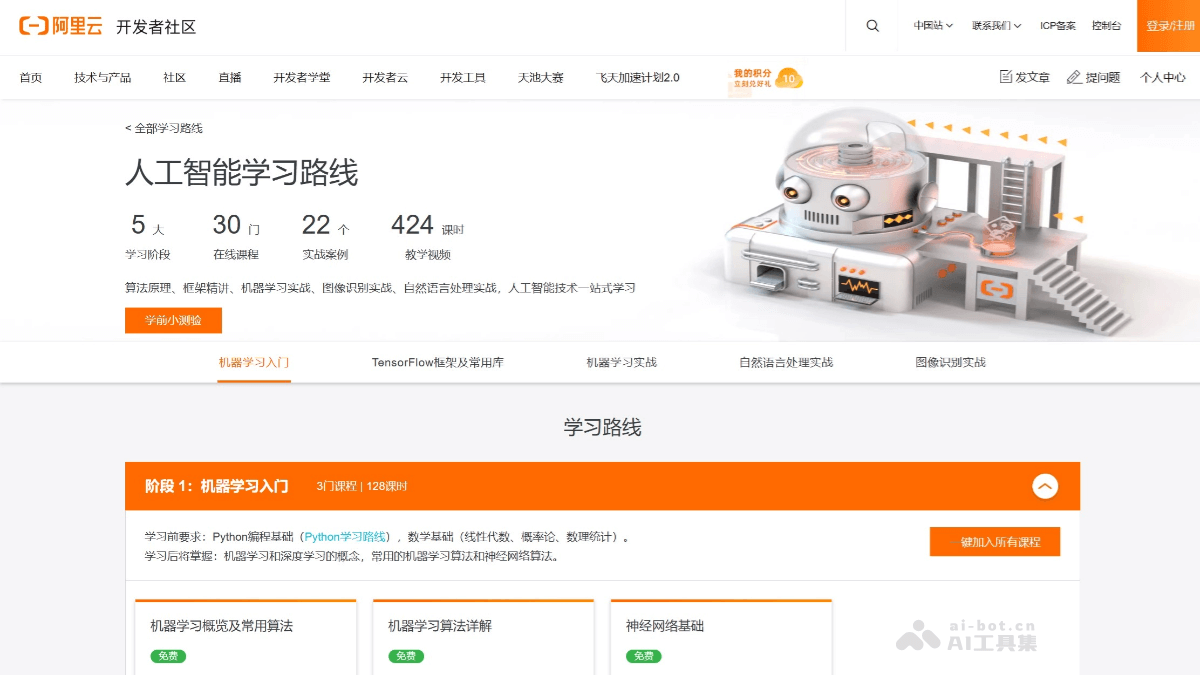
Alibaba Cloud AI Learning Pathis a systematic learning path launched by Alibaba Cloud to help learners go from zero foundation to mastering artificial intelligence technology. It is divided into multiple stages, covering comprehensive content from basic theory to advanced applications. Beginner stage: Learn the basic concepts of artificial intelligence, the principles of machine learning algorithms, the fundamentals of Python programming, etc., laying a solid foundation for subsequent learning. Intermediate stage: Study deep learning frameworks such as TensorFlow in depth, and master core skills such as data preprocessing, model training, and optimization. Gain experience through practical projects, such as applications in image recognition and natural language processing. Advanced stage: Focus on deep learning in specific fields, such as computer vision and natural language processing, learn advanced model architectures and optimization techniques, and carry out practical development through tools such as the Alibaba Cloud Machine Learning Platform PAI.
🧑🏫Course Offerings
-
Introduction to Machine Learning: Learn foundational knowledge such as the basic concepts of artificial intelligence, algorithm principles, and programming languages, and build a preliminary understanding of AI.
-
TensorFlow Framework and Commonly Used Libraries: Study in depth the TensorFlow deep learning framework and the usage of Python data science libraries, and master these tools to support subsequent AI development.
-
Machine Learning in Practice: Through actual projects, learn core practical machine learning methods such as data analysis, feature engineering, and model building, and improve the ability to solve real-world problems.
-
Natural Language Processing in Practice: Understand the applications of machine learning and deep learning technologies in the field of natural language processing, such as language models, text classification, named entity recognition, etc.
-
Image Recognition in Practice: Focus on the applications of machine learning and deep learning technologies in the field of image recognition, including image classification, object detection, image segmentation, etc.
-
Online Courses: Includes 30 online courses, covering all aspects from basic knowledge to advanced applications.
-
Practical Cases: Provides 22 practical cases to help learners apply theoretical knowledge to real-world problems.
-
Certification Courses: For example, the Alibaba Cloud Certified Associate (ACA) in Artificial Intelligence course, which includes Introduction to Artificial Intelligence, Fundamentals of Neural Networks, Fundamentals of TensorFlow Development, and Alibaba Cloud Machine Learning and Deep Learning Development Platform PAI, among other content.
-
Hands-on Bootcamps: Such as the Tongyi Qianwen Hands-on Bootcamp, which provides developers with hands-on training in large model fine-tuning and deployment.
🧑🎓Target Audience
- Beginners with no prior experience: Interested in artificial intelligence but without any relevant background knowledge. Suitable for introductory courses in the learning path, such as Fundamentals of Artificial Intelligence and Fundamentals of Python Programming.
- Computer science and data science students: Have some programming foundation and computer science knowledge, but lack a systematic AI learning path. Suitable to start with basic courses and gradually progress to learning deep learning frameworks such as TensorFlow, as well as machine learning practical projects.
- Data analysts and data engineers: Already possess certain data analysis and programming abilities and wish to further advance into the AI field. Suitable for advanced courses, such as the use of deep learning frameworks, feature engineering, model optimization, etc.
- Software developers and engineers: Have extensive programming experience and wish to apply AI technology in projects. Suitable for advanced courses, such as deep learning applications in specific domains, model deployment, etc.
- Self-learners with a strong interest in AI technology: Wish to master AI technology through self-study and improve personal skills. Suitable for free online courses, practical cases, etc. provided by Alibaba Cloud
6. ShowMeAI Knowledge Community
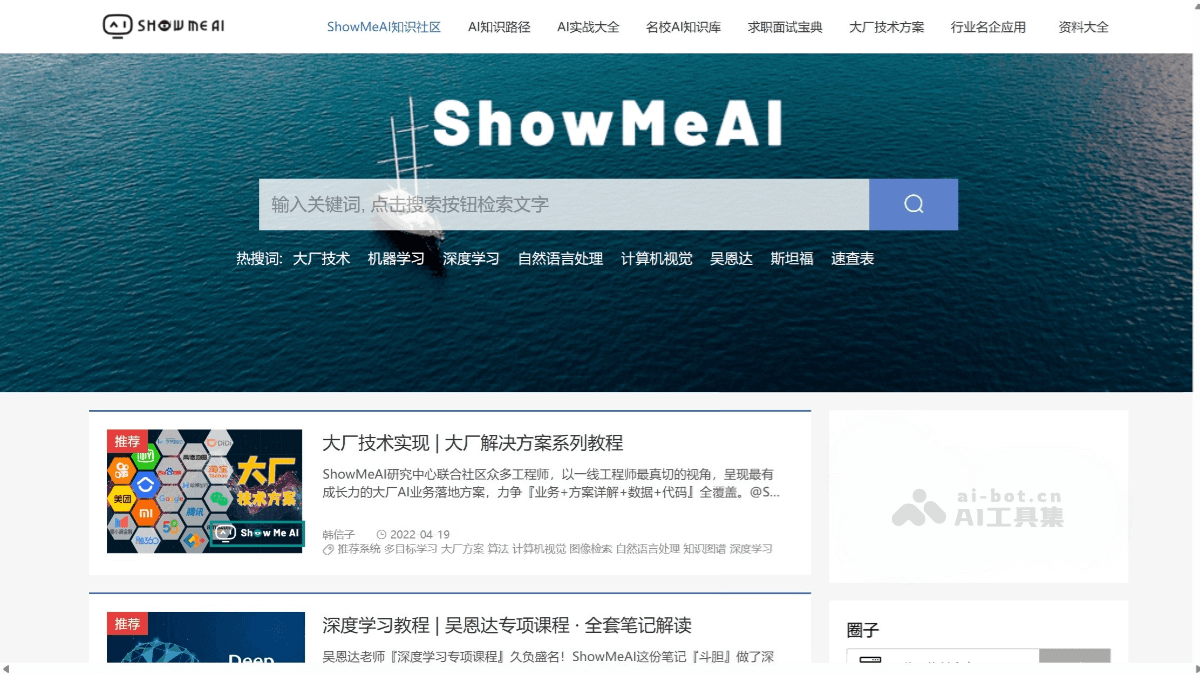
ShowMeAI Knowledge Communityis a comprehensive learning platform focused on the AI field, covering directions such as Python, data science, machine learning, deep learning, natural language processing, and computer vision. Created by a professional team in collaboration with frontline engineers, it provides systematic learning paths from basic to advanced levels, practical cases, and tutorials on solutions from major companies. The platform is positioned as an "encyclopedia in the AI field," providing one-stop learning and solutions for developers, students, and enterprise users.
🧑🏫Course Offerings
-
Mathematical Foundations: Includes linear algebra, probability and statistics, etc., laying a solid mathematical foundation for AI learning.
-
Programming Foundations: Provides illustrated tutorials on Python programming and data analysis, suitable for users with no prior experience.
-
Machine Learning: Covers supervised learning, unsupervised learning, reinforcement learning, etc., helping learners gain in-depth understanding through illustrations and practical cases.
-
Deep Learning: Based on Andrew Ng's Deep Learning Specialization, it provides in-depth organization and expansion, with content including neural networks, backpropagation, optimization algorithms, CNN, RNN, etc.
-
Natural Language Processing: Involves word embeddings, Seq2seq models, attention mechanisms, etc., helping learners master the core technologies and applications of NLP.
-
Computer Vision: Includes CNN, object detection, face recognition, neural style transfer, etc., demonstrating technology applications through practical cases.
- Practical Projects: Provides real project cases, such as the MovieLens movie recommendation system, combined with code templates and datasets, to help learners apply theoretical knowledge to practice.
- Big Tech Technical Implementation: From the perspective of frontline engineers, provides big tech AI business implementation solutions, covering the entire process including business, data, code, etc., to help learners understand industrial-grade application logic.
-
Advanced Topics: Such as hyperparameter tuning, Batch Normalization, handling label errors and data mismatch, etc.
-
Cutting-Edge Technology Interpretation: Provides in-depth interpretation of well-known courses such as Stanford CS224n, helping learners keep up with the industry frontier.
🧑🎓Target Audience
-
Zero-Basis Learners: For those interested in artificial intelligence but with no programming or mathematics background, the illustrated Python programming and mathematics foundation courses provided by ShowMeAI are very suitable for you. Through vivid illustrations and easy-to-understand examples, the courses help you get started quickly.
-
Cross-Disciplinary Learners: For people from non-computer science majors who wish to enter the AI field, ShowMeAI's systematic learning path and rich foundational courses can help you gradually build an AI knowledge system.
-
Learners Hoping to Improve Practical Skills: ShowMeAI's practical project library provides a wealth of practical cases, such as movie recommendation systems, image classification, etc., combined with code templates and datasets, helping you apply theoretical knowledge to actual projects and improve practical skills.
-
AI Engineers: For engineers already engaged in AI-related work, ShowMeAI's big tech technical implementation courses can help you understand the logic and technical details of industrial-grade applications, enhancing your technical depth and breadth in actual work.
-
Recent Graduates: For those about to graduate and hoping to enter the AI field, the job-seeking guide and interview tips provided by ShowMeAI can help you better prepare for job hunting and improve your competitiveness.
7. Google AI
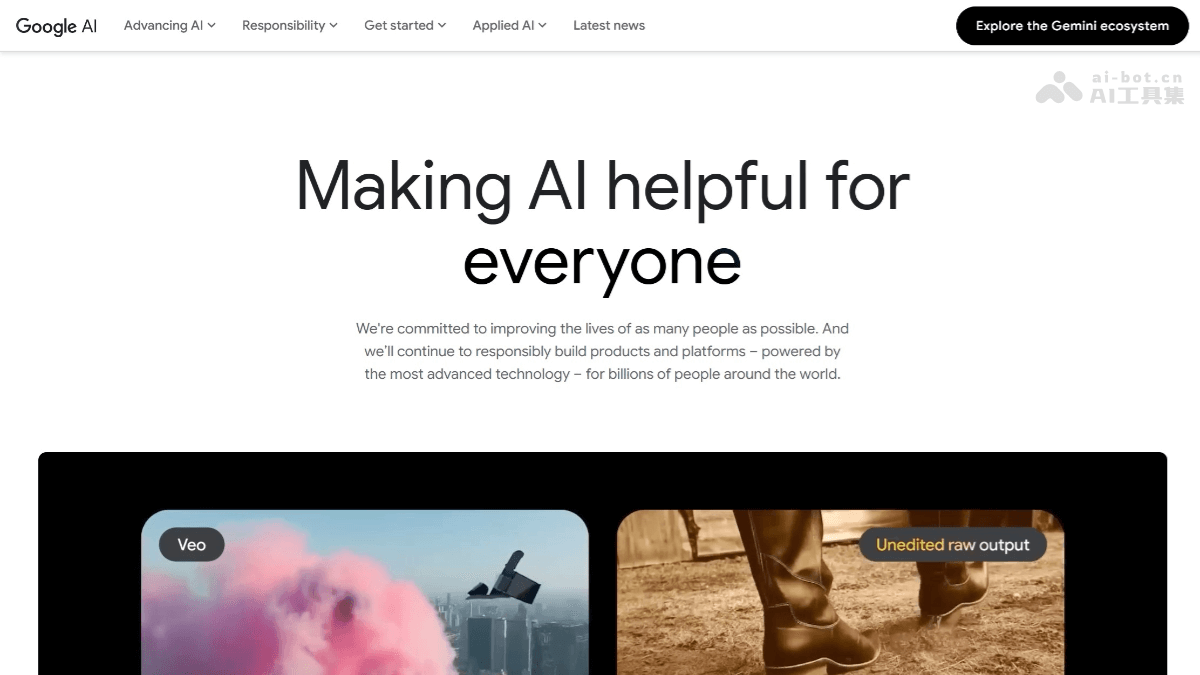
Google AIIt is a one-stop resource center launched by Google to help developers and learners master artificial intelligence technology. It provides rich courses from basic to advanced, such as the Machine Learning Crash Course, designed specifically for beginners, to quickly get started with machine learning through theoretical explanations and practical operations. For advanced learners, the Generative AI course covers cutting-edge technologies and combines practical cases to facilitate in-depth understanding. The platform provides powerful developer documentation, such as TensorFlow documentation and the Google Generative AI documentation library, covering tutorials, code examples, and API references from beginner to advanced, helping developers quickly get started and deeply master AI technology.
🧑🏫Course Settings
- Generative AI Learning Path: It is a learning path designed specifically for beginners, containing 10 independent courses, covering generative AI knowledge from basic to advanced, helping learners gradually master relevant skills:
- Introduction to Generative AI: Suitable for beginners, introduces the basic concepts and application scenarios of generative AI.
- Introduction to Large Language Models: Explains the working principles of large language models and their applications in real-world problems.
- Introduction to Responsible AI: Explores the ethical and social impacts of AI, helping learners develop responsible AI products.
- Introduction to Image Generation: Covers the fundamentals of image generation and the latest research directions.
- Introduction to Text Generation: Introduces text generation technology and its applications in natural language processing.
- Introduction to Audio Generation: Explains the basic principles and application scenarios of audio generation.
- Introduction to Multimodal Generation: Explores how to combine multiple modalities (such as text, images, and audio) for generative AI development.
- Evaluating and Optimizing Generative AI: Teaches how to evaluate and optimize the performance of generative AI models.
- Deploying and Applying Generative AI: Explains how to deploy generative AI solutions on Google Cloud and apply them to real-world problems.
- Future Trends in Generative AI: Explores the future development directions and potential opportunities of generative AI.
-
Machine Learning Crash Course: Suitable for learners with some programming background, this course helps them quickly master the basic concepts and skills of machine learning through theoretical explanations and hands-on practice.
-
Deep Learning Specialization: Covers the fundamentals of deep learning, the construction and training of neural networks, convolutional neural networks, recurrent neural networks, and other content, helping learners gain an in-depth understanding of deep learning technologies.
-
Google Cloud Computing Foundations: Introduces the basic concepts of cloud computing and the use of the Google Cloud platform, helping learners master the fundamentals of cloud computing.
-
Machine Learning and AI Development on Google Cloud: Through courses on Coursera and lab exercises on the Qwiklabs platform, learners gain an in-depth understanding of machine learning and AI development tools on Google Cloud.
-
AI Ethics and Social Impact: Explores the ethical issues and social impact of AI technology, as well as how to develop responsible AI products.
🧑🎓Target Audience
-
Beginners: Through the Machine Learning Crash Course and introductory generative AI courses, learners can quickly understand the basic concepts and application scenarios of AI, laying a foundation for in-depth learning.
-
Developers: By using the advanced courses and developer documentation provided by the platform, learners can gain an in-depth understanding of specific technologies such as TensorFlow and the Gemini API, enhancing their development capabilities in real projects.
-
Researchers: By reading academic papers and technical reports on the platform, learners can understand the latest research results, gain research inspiration, and advance their own research work.
-
Entrepreneurs: By learning from the platform's courses and practical tools, learners can quickly master AI technology, develop innovative AI products or services, and promote the development of entrepreneurial projects.
8. PaddlePaddle AI Studio
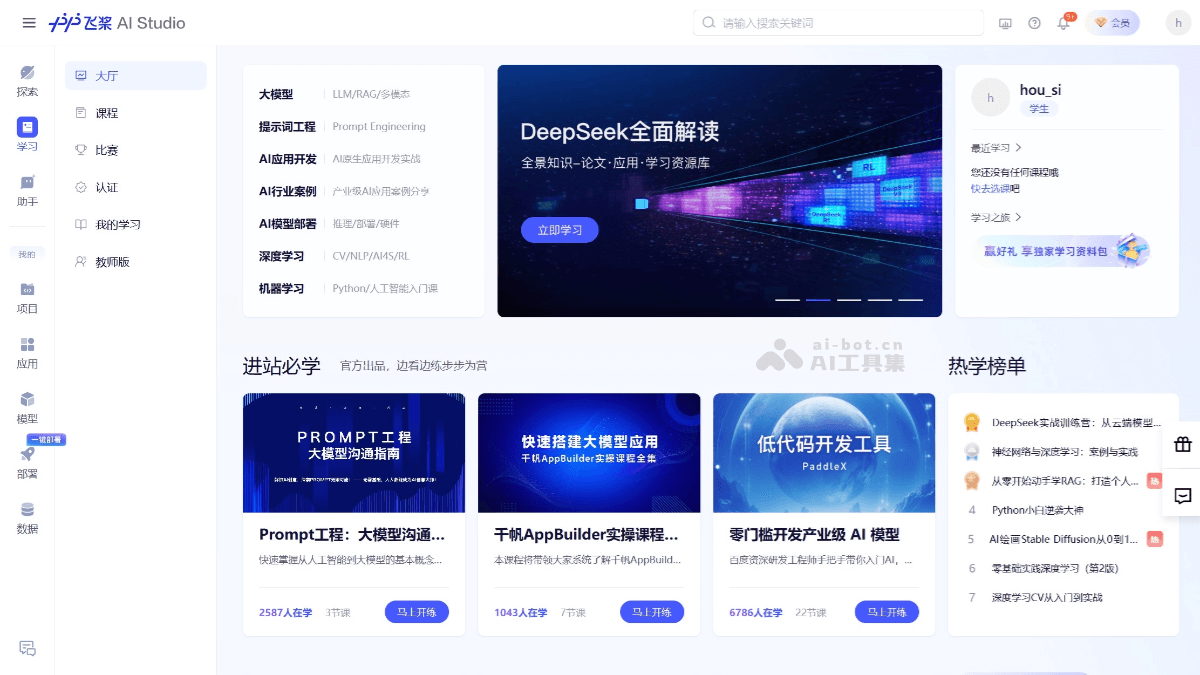
PaddlePaddle AI Studiois an artificial intelligence learning and training community launched by Baidu, based on Baidu's deep learning platform PaddlePaddle. It provides developers with an efficient cloud-based learning environment, supporting online programming, free GPU computing power, and a massive collection of open-source algorithms and datasets, helping developers quickly get started with deep learning.
🧑🏫Course Offerings
-
Basic Courses: Includes an overview of artificial intelligence, linear algebra, fundamentals of machine learning, fundamentals of deep learning, etc., suitable for beginners to build a knowledge system.
-
Advanced Courses: Covers supervised learning, unsupervised learning, reinforcement learning, computer vision, natural language processing, etc., helping learners deeply understand and apply AI technology.
-
Practical Courses: Provides real project cases and massive datasets, such as image classification, object detection, text recognition, etc., enhancing learners' hands-on ability through practical projects.
-
Industry Application Courses: Combined with industry needs, explains the application of AI technology in different industries, such as PaddlePaddle industry practice examples, helping learners understand actual application scenarios.
-
Competitions and Practical Courses: Holds various AI competitions, such as CVPR challenges, etc., enhancing learners' practical ability and innovative thinking through competitions.
-
"Dive into Deep Learning" PaddlePaddle Version: Adapted from the classic textbook written by Teacher Li Mu, systematically explaining the theory and practice of deep learning.
-
Zero-Basics Training Camp: Such as the PaddlePaddle image classification zero-basics training camp, from basic concepts of image processing to the fundamentals of convolutional neural networks, and then to the full-process practice of image classification competitions, gradually guiding learners to master image classification technology.
- Learning Path: PaddlePaddle AI Studio provides an AI learning map, planning a complete learning path for learners from beginner to expert, including stages such as AI basic learning, professional advancement, framework deployment applications, and academic frontiers.
🧑🎓Target Audience
- AI Beginners: Interested in artificial intelligence but lacking systematic learning and practical experience. Need to start learning from the basics and gradually master the basic concepts and skills of deep learning.
- University Students and Teachers: Need to systematically learn and teach AI courses, improving academic ability and teaching effectiveness. Need high-quality teaching resources and practical platforms to support course teaching and research projects.
- Enterprise Developers: Need to apply AI technology to actual projects, improving business efficiency and competitiveness. Need efficient learning and development tools to quickly master and apply deep learning technology.
- Data Scientists and Researchers: Need to conduct cutting-edge research and model optimization, exploring new technical directions. Need powerful computing resources and rich research tools to support the training and optimization of complex models.
- AI Enthusiasts: Have a strong interest in artificial intelligence and hope to improve their skills through learning and practice. Need an easy-to-use and resource-rich platform to support self-directed learning and project practice.
9. fast.ai
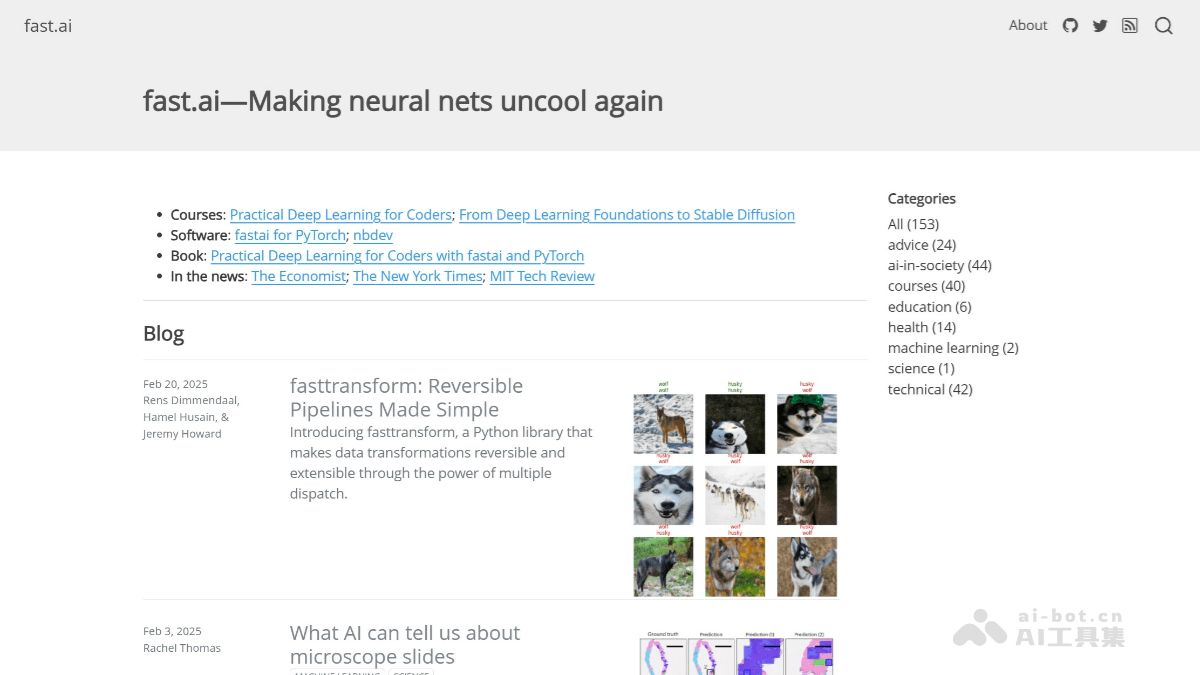
fast.ai is an open-source library and education platform focused on deep learning, developed based on PyTorch, lowering the threshold of deep learning so that beginners and developers can quickly get started. fast.ai provides a high-level API that encapsulates complex low-level operations, allowing users to easily build and train deep learning models without deeply understanding complex mathematical principles. It supports multiple fields such as computer vision, natural language processing, and tabular data analysis, and provides practical functions such as learning rate optimization and training acceleration.
🧑🏫Course Settings
- Deep Learning Task Crash Course: This part of the course is suitable for beginners, with a total of 7 lessons, mainly including:
- Image Classification: Learn how to use deep learning for image classification.
- Getting Started with SGD: Introduces basic optimization algorithms such as stochastic gradient descent (SGD).
- Multi-label Classification: Learn to handle multi-label classification problems.
- Natural Language Processing (NLP): Explore how to use deep learning to process text data.
- Backpropagation: Neural Networks from Scratch: Gain an in-depth understanding of the backpropagation mechanism of neural networks.
- Convolutional Neural Networks (CNN): Learn about the application of CNNs in image processing.
- Generative Adversarial Networks (GAN): Understand the basic principles and applications of GANs.
- Deep Learning Fundamentals: This part of the course is suitable for learners with some foundation, with 7 lessons in total and more in-depth content, including:
- The Basic Structure of Deep Neural Networks: Understand the structure of neural networks from the ground up.
- The Training Process of Neural Networks: Learn how to train deep neural networks.
- Internal Structure of Models: Explore the internal mechanisms of models in depth.
- The Data Block API: Learn how to use fast.ai's Data Block API for data processing.
- Matrix Multiplication, Mean Shift Clustering, Backpropagation, and MLP: Study these core concepts in depth.
🧑🎓Target Audience
-
Learners with No Prior Experience: fast.ai's course design is very friendly and suitable for learners without any deep learning background. It starts from basic concepts and gradually guides learners to master the core knowledge of deep learning.
-
Self-learners with Some Programming Foundation: For those with basic programming skills (especially Python) but no knowledge of deep learning, fast.ai is a great starting point. The course and documentation are very practice-oriented and can help you get started quickly.
-
Data Scientists and Machine Learning Engineers: For developers who already have some machine learning foundation, fast.ai provides powerful tools and high-level APIs that can quickly build and optimize deep learning models and improve work efficiency.
-
Software Engineers: If you are a software engineer who wants to integrate deep learning functionality into projects, fast.ai's ease of use and flexibility will be very helpful.
-
Academic Researchers: fast.ai provides rich low-level functionality and flexible interfaces, making it suitable for academic researchers conducting cutting-edge research and experiments.