
What is the Alibaba Cloud AI Learning Path
The Alibaba Cloud AI Learning Path is a systematic artificial intelligence learning program launched by the Alibaba Cloud Developer Community, suitable for developers from zero foundation to advanced levels. The entire path is divided into five major stages: Introduction to Machine Learning, Intensive Explanation of the TensorFlow Framework, Machine Learning in Practice, Natural Language Processing in Practice, and Computer Vision in Practice, covering core AI technologies and application scenarios. During the learning process, users can conduct online experiments through the Alibaba Cloud Tianchi platform, and with 30 premium courses and 22 practical cases, gradually master key skills such as data analysis, model training, and algorithm optimization. Alibaba Cloud provides community support to help learners exchange experience and solve problems. After completing the learning, users will have the ability to independently develop AI projects and be proficient in using the Alibaba Cloud PAI platform for model deployment and management.
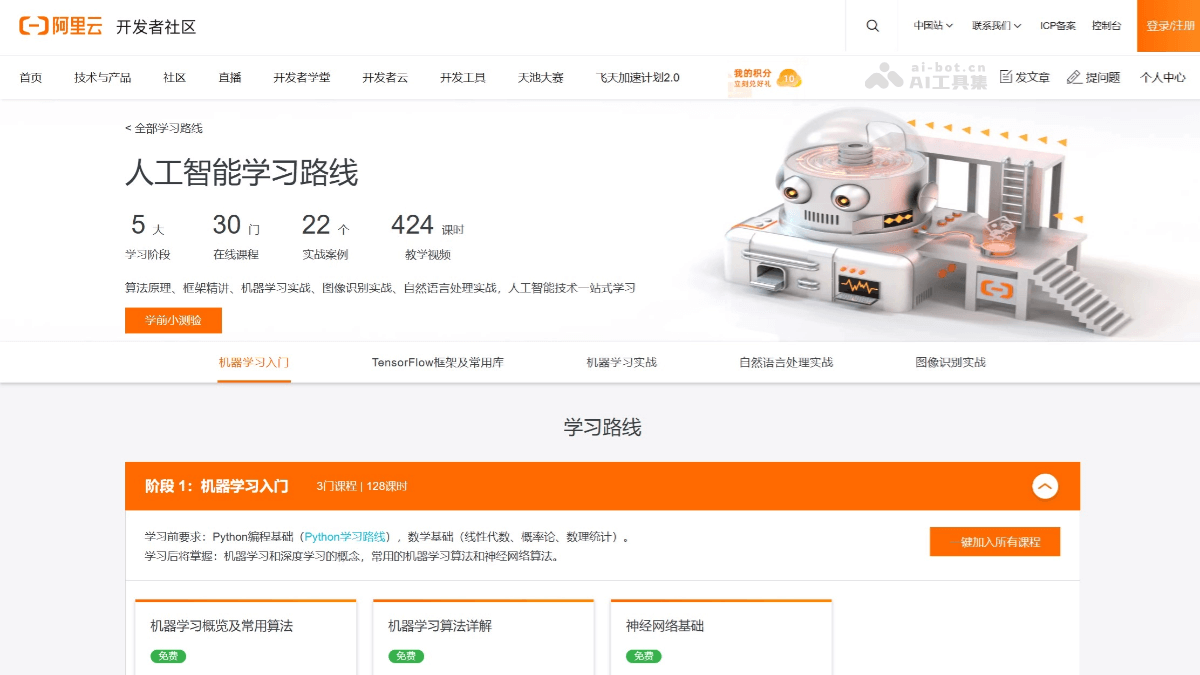
Main features of the Alibaba Cloud AI Learning Path
-
Systematic learning path: The learning path is divided into five major stages: Introduction to Machine Learning, Intensive Explanation of the TensorFlow Framework, Machine Learning in Practice, Natural Language Processing in Practice, and Computer Vision in Practice, covering a complete knowledge system from basic theory to practical application.
-
Rich online courses and practical cases: It provides 30 online courses and 22 practical cases. Users can learn through videos, documents, code examples, and other methods, and practice with real scenarios to improve their ability to solve practical problems.
-
Intelligent learning path planning and management: The platform intelligently recommends suitable learning paths based on users' learning behavior and interests, and provides learning progress management, learning reports, and data analysis functions to help users formulate and adjust learning plans.
-
Cloud experiment environment and skill certification: It provides an online experiment environment based on the Alibaba Cloud PAI platform, supporting direct use of GPU resources for model training. After completing the learning, users can take the Alibaba Cloud ACA/ACP certification exams to enhance their career competitiveness.
-
Developer community support: It connects to the Alibaba Cloud Developer Forum, providing technical Q&A, project collaboration, and industry news sharing, building a good learning and exchange ecosystem.
Course settings of the Alibaba Cloud AI Learning Path
-
Introduction to Machine Learning: Through 3 courses (about 128 class hours), it helps learners master basic concepts of artificial intelligence, commonly used machine learning algorithms, and neural network principles, requiring a foundation in Python programming and certain mathematical knowledge.
-
TensorFlow framework and commonly used libraries: This stage includes 4 courses (about 78 class hours), providing in-depth explanation of how to use the TensorFlow framework, as well as application techniques of Python data science libraries such as NumPy, Pandas, and Matplotlib.
-
Machine Learning in Practice: Through 9 courses (about 94 class hours), combined with real business projects such as recommendation systems, news classification, and temperature prediction, it helps learners master practical skills such as data analysis, feature engineering, model construction, and tuning.
-
Natural Language Processing in Practice: This stage includes 7 courses (about 67 class hours), focusing on practical applications in NLP fields such as text classification, sentiment analysis, machine translation, and dialogue robots.
-
Image Recognition in Practice: Through 7 courses (about 57 class hours), learn technologies such as image recognition and object detection. Practical cases include face detection, cat and dog recognition, CAPTCHA recognition, etc.
How to use the Alibaba Cloud AI Learning Path
- Define learning goals clearly: Before starting to learn, it is recommended to first define your own learning goals, such as mastering specific directions like the fundamentals of machine learning, deep learning frameworks, natural language processing, or computer vision.
- Visit the platform: Visit the official website of the Alibaba Cloud AI learning path.
- Learn in stages: The Alibaba Cloud AI learning path is divided into five stages, and users are advised to learn step by step:
-
Introduction to machine learning: Learn basic AI concepts, the principles of common algorithms, Python programming fundamentals, and more.
-
TensorFlow framework and commonly used libraries: Study the TensorFlow framework in depth as well as Python data science libraries such as NumPy and Pandas.
-
Machine learning in practice: Through practical projects such as recommendation systems, news classification, and temperature prediction, master skills including data analysis, feature engineering, and model construction and tuning.
-
Natural language processing in practice: Practice NLP tasks such as text classification, sentiment analysis, machine translation, and dialogue robots.
-
Computer vision in practice: Learn technologies such as image recognition and object detection, and master tools and algorithms such as OpenCV and CNN.
-
- Combine with practical projects: Alibaba Cloud provides 22 practical cases, and users can conduct online experiments through the Alibaba Cloud PAI platform, learning while practicing, consolidating theoretical knowledge, and improving practical development capabilities.
- Use the Alibaba Cloud PAI platform: The Alibaba Cloud PAI platform provides one-stop algorithm services, including functions such as data preparation, preprocessing, data visualization, algorithm modeling, and model evaluation. Users can quickly build and deploy AI models through a visual interface or command-line operations.
- Participate in community exchanges and certification exams: During the learning process, users can join the Alibaba Cloud Developer Community to exchange experience and solve problems with other learners. Alibaba Cloud provides ACA/ACP certification exams to help users test their learning results and improve their professional competitiveness.
Who the Alibaba Cloud AI learning path is suitable for
-
Beginners and students: Beginners who are interested in artificial intelligence and hope to systematically master the fundamentals of AI, as well as students majoring in computer-related fields, can all start from scratch through this path and gradually master AI theory and practical skills.
-
Working developers and technical practitioners: Including programmers, data analysts, AI technology enthusiasts, and others, suitable for developers who hope to transition to the AI direction or improve their technical depth. The course content covers mainstream frameworks such as TensorFlow and PyTorch and emphasizes practical ability, making it suitable for users with some programming foundation.
-
Workplace professionals and entrepreneurs: Including administrative, marketing, human resources, corporate managers, and others. The AIGC (generative AI) content involved in the course can help them improve office efficiency and drive business innovation, such as AI writing, image generation, and data analysis.
-
Education and family users: Teachers, parents, and students can use AI tools to assist teaching and learning, such as essay polishing, language learning, and math problem solving. It is suitable for users who hope to improve learning efficiency through AI.
-
Traditional industry transformers and career changers: Practitioners from traditional industries such as retail, manufacturing, and agriculture, or job seekers who hope to enter the AI field, can use this path to master the ability to empower business with AI and improve their employment competitiveness.