
What Is a Neural Network?
A neural network (Neural Network), as a computational model in artificial intelligence, is a type ofmachine learninginspired by the human brain, composed of multiple layers of interconnected nodes (called neurons). A neural network learns the relationship between inputs and outputs through a process of repeated trial and error using large amounts of data, in order to determine the connections and weights between nodes that produce the desired output. These nodes work together to perform complex tasks such as pattern recognition, classification, and prediction.
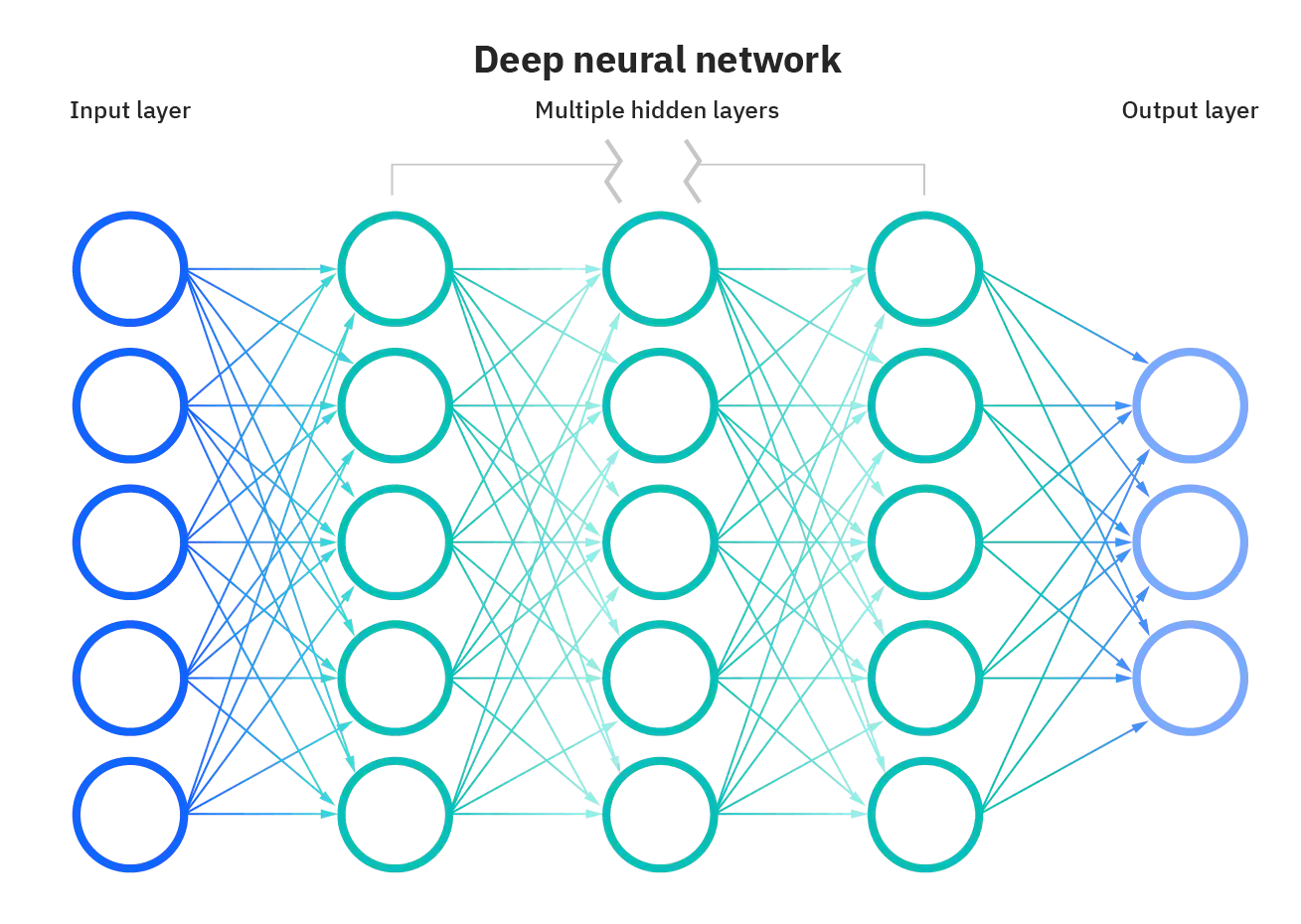
Neural network explanation (Image source: IBM)
As a neural network continues to learn, it becomes better at pattern recognition and making accurate predictions or decisions. In recent years, neural networks have achieved tremendous breakthroughs and made great progress in fields such as computer vision, natural language processing, and speech recognition.
How Neural Networks Work
Neural networks work by processing input data through a series of interconnected layers of neurons. Each neuron receives input from other neurons and applies a mathematical function to the input to produce an output. The output is then passed to the next layer of neurons, and the process repeats until a final output is produced. During training, the neural network adjusts the weights and biases of the neurons through a training process using large amounts of data to minimize the error between the predicted output and the actual output. Once training is complete, the neural network has established a mathematical model that can be used for inference to make predictions or decisions about new data.
Types of Neural Networks
Several types of neural networks are currently being studied in the industry, and some of the most common types include:
- Feedforward Neural Network (FNN): This type of network processes input data in a single direction, from input to output, and is commonly used for pattern recognition and classification.
- Recurrent Neural Network (RNN): This type of network can process sequences of data, such as speech or text, and is commonly used for natural language processing and time series analysis.
- Convolutional Neural Network (CNN): This type of network is optimized for image and video processing and uses specialized layers to detect features such as edges and corners.
- Generative Adversarial Network (GAN): This type of network generates new data by having two neural networks compete against each other, one generating data and the other trying to distinguish it from real data.
Applications of Neural Networks
Neural networks can be used in a wide range of applications, including:
- Image recognition. Identifying people or objects in pictures. Used by Facebook to tag friends, by self-driving cars to detect traffic lights, etc.
- Natural language processing. Machine translation, sentiment analysis, speech recognition, etc. It powers many virtual assistants and chatbots.
- Prediction. Predicting future values of time series data based on historical data. Used for stock price forecasting, sales forecasting, etc.
- Robotics. Controlling the movement of robots based on image recognition and sensor data.
- Recommendation systems. Product recommendations on e-commerce websites are often based on neural networks.
- Diagnosing diseases. Detecting abnormalities in medical scans to identify diseases such as cancer.
- Predicting customer churn. Identifying customers who may stop using a service.
- Detecting fraud. Identifying credit card or insurance fraud based on spending patterns and other data.
Advantages of Neural Networks
Compared with traditionalmachine learningCompared with algorithms, neural networks have several advantages:
- Neural networks can detect complex nonlinear relationships between inputs and outputs that are difficult to explicitly program.
- Neural networks can learn from large amounts of data and adapt to new information, which makes them ideal for applications that require continuous learning.
- Neural networks can identify complex patterns and relationships in data that may not be obvious to humans or other machine learning algorithms.
- Neural networks can handle noisy or incomplete data, making them very useful in practical applications.
Limitations of neural networks
Although neural networks have many advantages, there are also some limitations to consider. Some limitations of neural networks include:
- Overfitting: Neural networks sometimes overfit the training data, which means they become too specialized and may perform poorly on new data.
- Interpretability: Neural networks can be difficult to interpret, so it is hard to understand how they arrive at a particular prediction or decision.
- Training time: Training neural networks can be very time-consuming and computationally intensive, especially for large datasets or complex networks.
- Dependence on data quality: The performance of neural networks depends heavily on the quality and quantity of the training data, which may be a limitation in some applications.
- Lack of transparency: Neural networks can be seen as a "black box" because it is often difficult to understand how they reach a given prediction, which may be a limitation in applications that require transparency or accountability.
- Limited transferability: Neural networks trained on one task may not perform well when applied to a different task or domain, which may limit their general applicability.