

A Generative Adversarial Network (GAN, full English name Generative Adversarial Network) is a type ofdeep learningmodel that has gained tremendous attention in recent years due to its ability to generate high-quality, realistic data. GANs have been used in a wide range of applications, including image synthesis, style transfer, and data augmentation. In this article, we will explore what GANs are, how GANs work, the advantages of GANs compared with otherneural networkmodels, and their main applications and use cases.
What is GAN
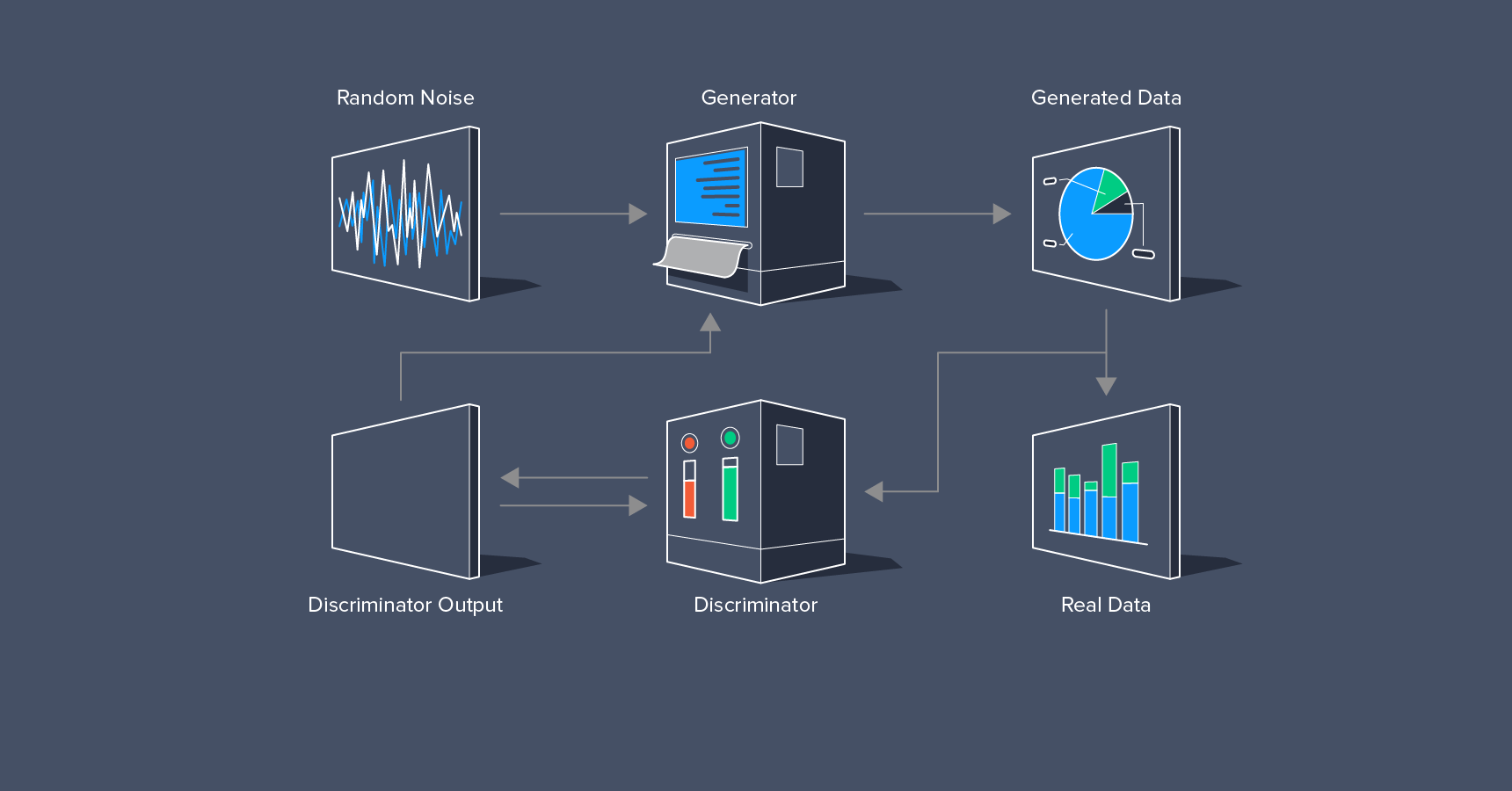
A Generative Adversarial Network (GAN) is a class of machine learning models composed of two neural networks, a Generator and a Discriminator, which compete with each other in a zero-sum game. The generator creates synthetic data samples, while the discriminator's job is to distinguish between real and fake data samples. The generator's goal is to improve its ability to create realistic data that can "fool" the discriminator, while the discriminator's goal is to improve its ability to identify fake data.
How GANs Work
A Generative Adversarial Network (GAN) consists of two main parts:
- Generator. The generator is a neural network that takes random noise as input and generates synthetic data samples (such as images, text, etc.), with the goal of creating data that looks the same as the real data distribution.
- Discriminator. The discriminator is another neural network that takes real data samples and synthetic data samples created by the generator as input. Its goal is to classify a given sample to determine whether it is real or fake.
The GAN training process includes the following steps:
- Draw a batch of real data from the dataset
- Use the generator to generate a batch of synthetic data
- Train the discriminator on real and synthetic data, updating its weights to improve its ability to distinguish real from fake samples
- Sample a batch of new random noise and use the generator to generate a batch of new synthetic data
- Train the generator by backpropagating the discriminator's gradients, updating the generator's weights to create more realistic samples and thereby better fool the discriminator
This training process is repeated continuously until the generator produces realistic data samples and the discriminator can no longer reliably distinguish between real and fake samples.
Advantages of GANs Compared with Other Neural Networks
Compared with traditional neural network models, GANs have several advantages in various tasks:
- High-quality data generation. GANs are able to generate high-quality, realistic data samples that are often indistinguishable from real data. This is particularly useful in applications where the availability of real data is limited or the cost of obtaining it is high.
- Unsupervised learning. GANs can learn patterns and features in data without requiring labeled data. This makes them very suitable for tasks where labeled data is limited or manual labeling is not feasible.
- Flexibility. GANs can be combined with other neural network architectures and techniques, such as Convolutional Neural Networks (CNNs) and Recurrent Neural Networks (RNNs), to produce a wide variety of data types, including images, text, and audio.
- Data augmentation. GANs can generate additional training data for supervised learning tasks, which can help overcome problems related to overfitting and improve the performance of models trained on small datasets.
Main Application Scenarios of GANs
GANs have now been used in various applications across different fields, including but not limited to the following scenarios:
- Image synthesis. GANs have been used to generate high-quality synthetic images, such as creating realistic faces, artwork, and even realistic product scenes.
- Style transfer. GANs can be used to transfer the style of one image to another, thereby creating artistic images and novel visual effects.
- Data augmentation. GANs can generate additional training data for supervised learning tasks, improving the performance of models trained on small datasets.
- Text-to-image generation. GANs can be used to generate images from text descriptions, which is useful for generating new visual content or applications in advertising, entertainment, and design.
- Super-resolution and image inpainting. GANs can be used to improve the resolution of low-quality images, or to fill in missing regions in images, improving their overall quality and utility, and are very useful for lossless image enlargement and image restoration.
- Drug discovery. GANs have been used in the field of drug discovery to generate new chemical structures and identify potential drug candidates.
- Anomaly detection. GANs can be used to identify anomalous data points in a dataset, which is helpful for identifying fraud, network intrusions, or other abnormal behavior.
Generative adversarial networks have opened up new possibilities in the field of deep learning and have found a wide range of application areas. Their ability to generate high-quality, realistic data samples and perform unsupervised learning makes them a powerful tool for many tasks that traditional neural network models cannot handle.