
What is Vidu Q3
Vidu Q3 is the world's first 16-second audio-video synchronized AI video model launched by Shengshu Technology, purpose-built for narrative scenarios such as short dramas, comic dramas, and advertisements. A single prompt can directly produce a 16-second 1080p finished film, with visuals, dialogue, ambient sound effects, and BGM all aligned, no post-production needed. The model comes with a "director brain" and can automatically or manually switch between wide shot, medium shot, and close-up to complete complex transitions; it supports Chinese, English, and Japanese text directly rendered in the frame, with street signs and subtitles clearly readable; during multi-person conversations, lip movements, timbres, and characters are synchronized, and the three languages can be mixed. The official claim is that it ranks first in China and second globally on the Artificial Analysis leaderboard, surpassing Runway Gen-4.5、Google Veo 3.1 and Sora 2. It is now available on the web version vidu.cn and API platform.
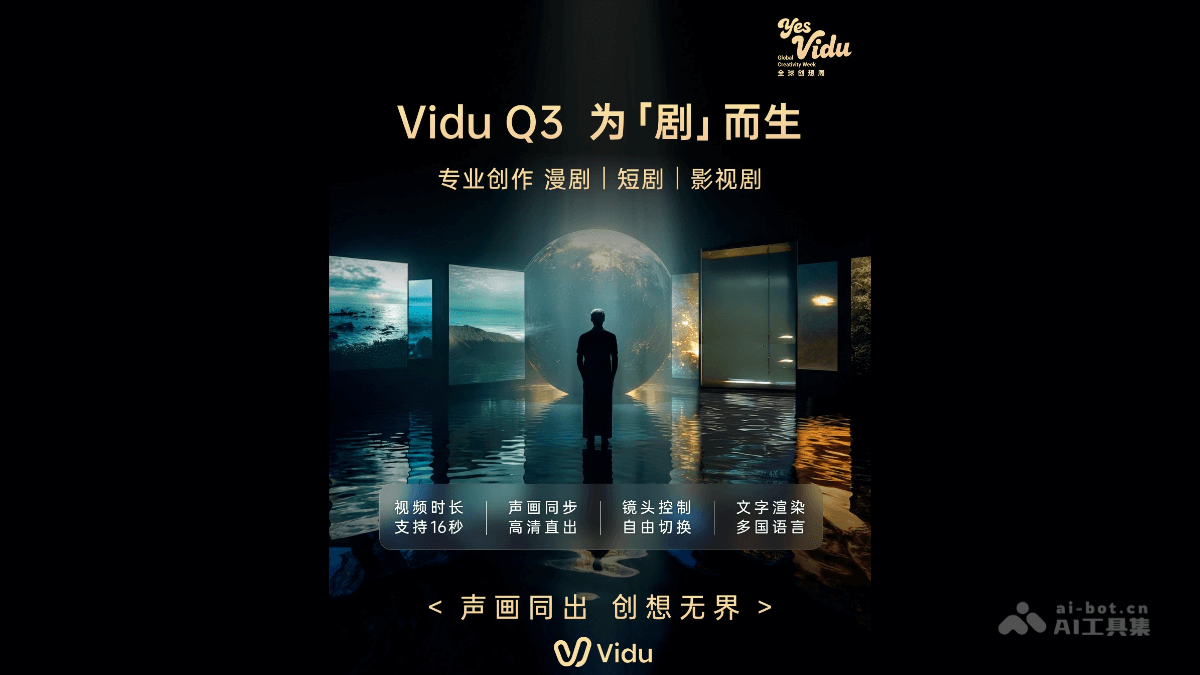
Vidu Q3's main features
-
16-second direct audio-video output: Generate a 16 s 1080p video in one pass, with visuals + dialogue + ambient sound + BGM fully synchronized, zero post-production.
-
Director-level shots: Automatically or manually switch between wide shot / medium shot / close-up, complete multi-camera transitions in a single pass, with rhythm aligned to emotion.
-
Multilingual text rendering: Chinese, English, and Japanese text is directly embedded in the frame, with street signs, subtitles, and product packaging clearly readable.
-
Multi-person dialogue synchronization: Multiple characters' lip movements, timbres, and emotions are synchronized, three-language dialogue can be mixed, and vocal tones change with the characters' appearance.
-
Dual-mode creation: Both text-to-audio-video / image-to-audio-video support any duration from 1-16 s, with selectable resolution and motion amplitude.
-
Industrialized interface: The web version vidu.cn and the API platform.vidu.cn are opened simultaneously, billed by usage, and support batch production.
Vidu Q3's technical principles
-
U-ViT backbone architecture: Replaces the traditional U-Net with a Transformer, retains long skip connections, and global attention can "see" the complete 16-second sequence in one pass, so errors do not accumulate over time, ensuring consistency between the first and last frames.
-
Video compression and distributed training: First perform spatiotemporal compression on 16-second high-resolution video to reduce sequence length; then combine it with a self-developed distributed framework, doubling communication efficiency, reducing VRAM by 80%, and increasing cumulative training speed by 40x, enabling end-to-end long video inference at the single-card level.
-
Multimodal unified diffusion: Jointly trains the visual, audio, and text domains within the same noise space of U-ViT, achieving "one noise - simultaneous denoising": video frames, dialogue waveforms, and ambient audio tracks are generated synchronously rather than assembled in post-production.
-
3D speech-lip synchronization: The audio branch uses 3D VAST-style speech synthesis, first predicting character lip coefficients, then reversely generating dialogue and sound effects with a sense of spatial orientation, ensuring alignment of lip movements, timbre, and emotion during multi-person conversations.
-
Camera scheduling algorithm: Drawing on film storyboard theory, it encodes camera position labels such as "wide shot - medium shot - close-up" as condition vectors and injects them into the Transformer's cross-attention layers; the model dynamically decides the next frame's camera position at each denoising step, achieving automatic switching within a single shot.
-
Pixel-level text rendering engine: Additionally trains a "glyph-pixel" alignment module, embedding text vector outlines as prior masks into the diffusion process, so that Chinese/English/Japanese text directly grows on the surface of objects in the frame and is clearly readable without post-production compositing.
How to use Vidu Q3
-
Register/Log in: Visit Vidu 's official website, register with mobile phone verification code, new users get free credits, and earn more by checking in daily.
-
Choose a creation mode: On the left side of the workspace, click "AI Video" to choose a mode
- Text-to-audio-video (text only)
- Image-to-audio-video (upload image + text)
- Reference-to-video (upload 1-7 subject images to lock the character).
-
Write a prompt(key step): Official structure: scene + subject + action + camera + emotion + sound.
-
Set parameters
-
Duration: 4 / 8 / 16 s
-
Resolution: 540p | 720p | 1080p
-
Motion amplitude: small-medium-large-auto
-
Audio: synchronized dialogue | ambient sound | BGM can each be toggled separately.
-
-
Generate and preview: Click "Create", wait for generation, and preview online once complete; if unsatisfied, directly modify the prompt and run again. A 4 s clip takes about 30 s to produce.
-
Post fine-tuning: If the quality is not enough, click "Smart Upscale" for one-click upgrading,you can change the seed for comparison, or adjust the motion amplitude and generate again。
-
Export/download: On the preview page, click "Download" to get a 16 s 1080p final video (including audio track); you can also share it directly to social media.
-
API batch (optional): Developers can visit platform.vidu.cn and choose REST API; the parameters are the same as on the web page, and billing is by the second, with a minimum of $0.07/second.
Application scenarios of Vidu Q3
-
Short drama film and television: Generate a complete 16-second clip in one click, preview storyboards, proofread pacing, and reduce pre-production visualization costs to the level of "writing a prompt"; multi-person dialogue and progressive emotions are achieved in one go, directly usable as a "digital film set."
-
Advertising and e-commerce: In the proposal stage, directly output product oral presentations with aligned lip sync, with the host's actions, speaking speed, and selling points synchronized; upload one product image to generate multi-scene demonstrations, increasing A/B testing efficiency by 10 times.
-
Self-media accounts: For "wild idea" series such as cat and dog talk shows and ACG radio, you only need one reference image + a joke to produce a finished product with subtitles, sound effects, and dialogue in a few minutes. One person is the entire editorial team.
-
Music MV: Static cover image + lyric prompt directly generates a singer's singing and playing clip, with lighting, lip sync, and timbre synchronized, saving the band from renting a studio to shoot sample videos.
-
Education and popular science: A 5-second concept introduction + 10-second summary for a course, automatically synchronizing voice and subtitles, letting teachers focus on writing the script while the visuals are batch-output by the model.
-
City tourism promotion: Aerial shots + text banners and nighttime neon subtitles are generated in one go, so "Sydney Opera House" and "Pattaya Beach" can be made into vertical short videos without road closures or renting a helicopter.