
What is Tempolor v4.7
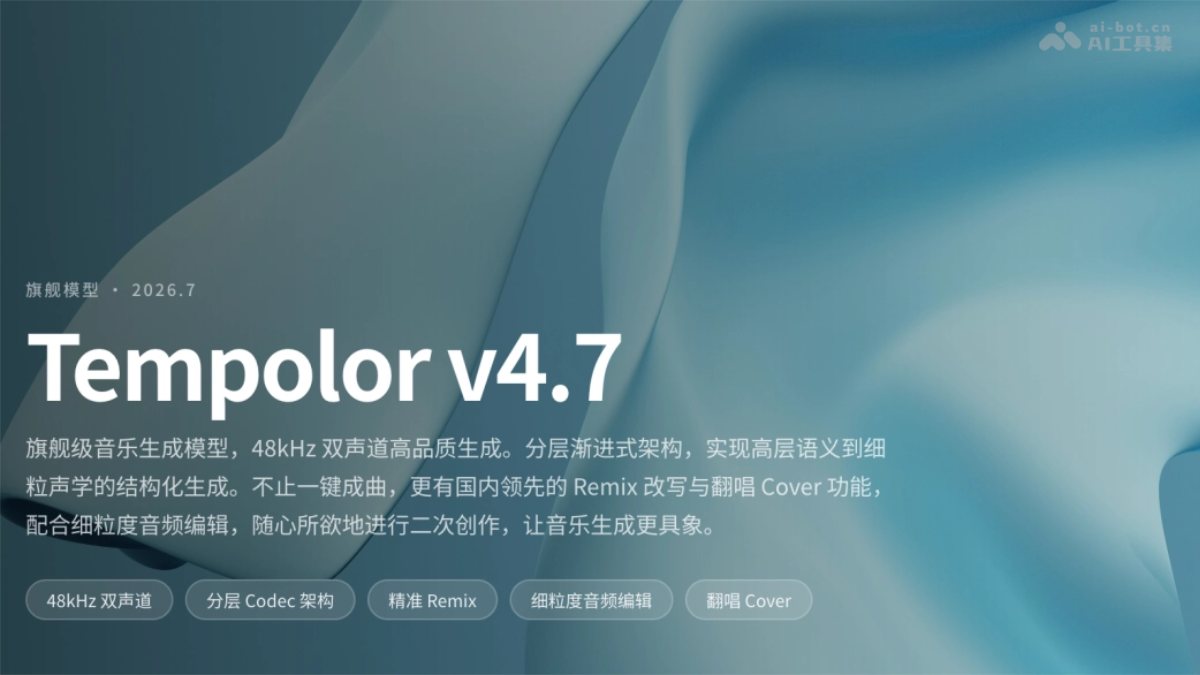
Tempolor v4.7 is Quwan Technology's flagshipAI music generationlarge model, adopting a fourth-generation hierarchical progressive architecture, supporting 48kHz dual-channel high-quality output. The model focuses on controllable generation and secondary creation, enabling genre rewriting, cover songs, and fine-grained audio editing while preserving the core melody, moving from one-click song creation to modify-as-you-wish, while opening up to developers and ordinary users through OpenAPI and intelligent agentsTunee.
Main Features of Tempolor v4.7
-
Remix Rewriting: Upload existing music material, preserve the core melody and motif, and redesign the genre, arrangement, and vocal performance.
-
Cover Songs: Replace lyrics and vocal timbre, maintaining the original song's recognizability through "rapid motif regression" technology to avoid melody misalignment.
-
Fine-Grained Audio Editing: Precisely adjust instrument timbre, harmony, vocals, and backing vocals through prompts.
-
Reference Audio Style Transfer: Upload reference audio to generate new songs in the same style, while optimizing audio leakage to output more independent and clean sound.
-
Multimodal Generation: Supports generating music from text, images, videos, and other input methods.
-
Conversational Creation: Integrates the Tunee intelligent agent to complete music creation and visual generation through conversation.
Technical Principles of Tempolor v4.7
-
Fourth-Generation Hierarchical Progressive Architecture: Splits music generation into three layers: musicality, semantics, and acoustics, completed sequentially from coarse to fine, first determining the theme motif and overall structure, then generating specific content, and finally adding vocal and instrumental details.
-
Rapid Motif Regression: In cover scenarios, the model appropriately rewrites based on the new lyrics structure while converging back to the main melody at key positions, balancing creative freedom and original song recognizability.
-
Reference Audio Leakage Optimization: When learning the original melody structure, the model reduces direct copying of the original vocals and timbre.
-
Tag System Restructuring: Readjusts training data tags to improve recognition and response accuracy for instrument timbre, harmony, vocals, and other information.
-
Continuous Acoustic Representation: Adopts a continuous audio representation scheme combining masked autoregression and diffusion models, balancing generation quality and local modification capability.
How to Use Tempolor v4.7
-
Ordinary Users: VisitTuneeintelligent agent, and input creative requirements through conversation or uploading materials.
-
Developers/Enterprises: Visit the Tianpule OpenAPI platform, call V4.7 capabilities through interfaces, and integrate into your own applications or workflows.
-
Creators: Upload reference audio or input prompts, choose Remix, Cover, or completely new generation modes, and continuously modify and iterate on the output results.
Core Advantages of Tempolor v4.7
-
Strong Controllability: The hierarchical architecture makes prompt responses more stable, with higher determinism in output results for the same input, reducing the cost of repeated generation and screening.
-
Leading Secondary Creation: Domestic leading Remix rewriting and cover song capabilities, supporting free adjustment while preserving the core motif.
-
Excellent sound quality: 48kHz dual-channel output, improved spatial separation of drums, bass, harmonies, and vocals, and more delicate emotional expression in slow-tempo styles.
-
Multimodal input: The world's first large music generation model that supports text/image/audio/video multimodal input.
-
Performance improvement: Overall performance improved by about 20%, with streaming generation first-packet response of about 20 seconds.
Comparison of Tempolor v4.7 with similar competitors
| Dimension | Tempolor v4.7 | Suno v5.5 |
|---|---|---|
| Core positioning | Controllable generation + secondary creation | One-click generation of complete songs |
| Remix/Cover | Supports precise Remix and cover songs, preserving the core melody | Mainly supports style-reference generation, with limited secondary editing capability |
| Architecture | Fourth-generation hierarchical progressive (musicality→semantics→acoustics) | End-to-end generation architecture |
| Output sound quality | 48kHz dual-channel | Standard sound quality output |
| Prompt response | Reconstructed label system, more precise adjustments for instruments/harmonies/vocals | Prompt execution stability is average |
| Multimodal | Supports text/image/audio/video input | Mainly supports text input |
| Open source/API | OpenAPI available | API provided but with limited functionality |
Application scenarios of Tempolor v4.7
-
Short video soundtrack: Creators quickly generate or adapt BGM matching the video's mood, with support for multiple fine-tunings until satisfied.
-
Advertising and film/TV: Generate customized music for brand advertisements and film/TV clips, and quickly adapt to different version requirements through Remix.
-
Music education: Students upload practice pieces, and AI assists in adapting them to different styles, lowering the barrier to learning arrangement
-
Independent musician creation: Musicians use AI-generated results as creative material, continuously revising and processing them to form complete works
-
Game audio: Generate theme music for game scenes, and quickly adapt multilingual versions of theme songs through the Cover function