
What is Talksign-1
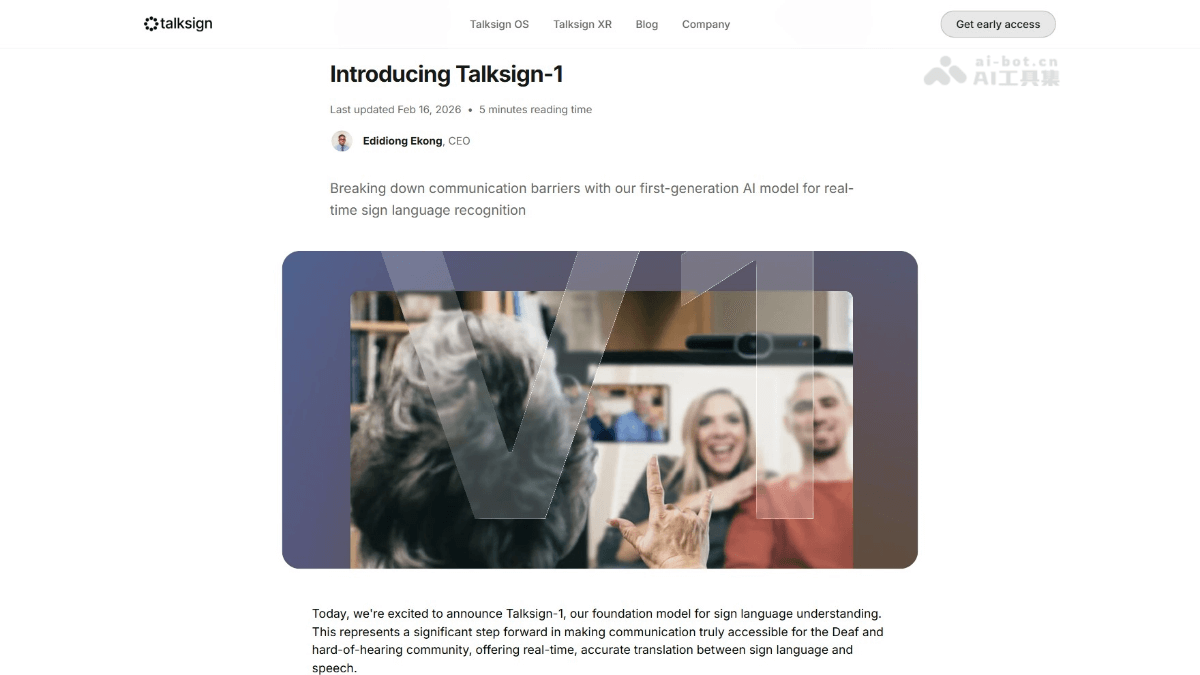
Talksign-1 is an AI real-timetranslationmodel designed specifically for American Sign Language (ASL), supporting bidirectional conversion. It can recognize 250 ASL vocabulary words by capturing 3D human keypoints through a camera, or convert speech/text into sign language videos. The model is built onTensorFlow/Kerasand adopts a Transformer-enhanced CNN architecture, with inference latency below 100 milliseconds, and can run in the browser. The model is trained on the WLASL2000 dataset and currently supports isolated gesture recognition, suitable for education, healthcare, workplace, and other scenarios, committed to improving the barrier-free communication experience for the hearing-impaired community.
Main features of Talksign-1
-
Sign-to-Speech: Captures 3D human keypoints through a camera, recognizes 250 American Sign Language vocabulary words in real time, and converts them into speech or text, with inference latency below 100 milliseconds.
-
Speech-to-Sign: Converts input speech or text into sign language video sequences, with support for generating optional 3D virtual human animation data for subsequent rendering.
-
Motion-aware gating: Triggers model inference only when meaningful gestures are detected, effectively reducing computational overhead and false recognition rates.
-
Native browser support: All features can run in standard web browsers, without the need to install additional software or hardware devices.
Technical principles of Talksign-1
- Input processing and privacy protection: Talksign-1 uses MediaPipe to extract 3D body, hand, and facial keypoint coordinates in real time on the browser side, and sends only anonymized keypoint data to the backend API for further processing.
- Model architecture and training: The core model is built on the TensorFlow/Keras framework, combining Transformer and convolutional neural networks into a hybrid architecture that can simultaneously capture the spatial features and temporal dependencies of sign language motions; the model is trained on the large-scale WLASL2000 American Sign Language dataset, focusing on recognizing commonly used isolated gesture vocabulary in daily life.
- Real-time inference mechanism: The system maintains a 30-frame sliding buffer (about 1 second long), performs spatiotemporal pattern analysis on the input keypoint sequence, and outputs the most likely sign language vocabulary words and their confidence scores through an encoder-decoder structure, enabling a low-latency continuous gesture recognition experience.
- Deployment architecture: The entire platform adopts a microservices architecture. The frontend, backend, and two AI engines (sign2speech, speech2sign) are all orchestrated through Docker Compose and run on a single EC2 instance, using Nginx for TLS termination and reverse proxy; each AI service is deployed as an independent container, supporting vertical scaling by increasing instance resources or horizontal scaling by adding nodes. Model weights are loaded and started from the local file system, without relying on external cloud storage services.
Talksign-1 project address
- Project official website:https://www.talksign.co/blog/introducing-talksign-v1
- Apply for trial:https://app.foorm.xyz/f/talksign-v1-feedback
Application scenarios of Talksign-1
- Education: Supports real-time sign language translation between hearing-impaired students and teachers, creating a more inclusive classroom environment and ensuring equal access to learning resources.
- Healthcare: The model enables direct and clear communication between patients and medical staff, improving diagnostic accuracy and care quality, without waiting for human interpreters to arrive.
- Workplace office: Helps hearing-impaired employees fully participate in meeting discussions and team collaboration, and obtain real-time sign language translation services for human resources and compliance information.
- Public spaces: Instantly convert traffic broadcasts, emergency alerts, and public service information into sign language, and push them to personal devices or digital displays.
- Radio and Television: Membrane performance provides on-screen sign language virtual human broadcasting for live news, entertainment programs, and breaking news, enhancing content accessibility.