

What is Skills For Real Engineers
Matt Pocock Skills islaunched by Matt Pocockan AI Agent skills library for professional engineers, derived from Matt Pocock daily .claude directory practices. Unlike process frameworks such as GSD and BMAD, Matt Pocock Skills adheres to a design philosophy of being small and beautiful, composable, and hackable, through /grill-me、/tdd、/diagnose and other commands to address Agent development pain points. Matt Pocock Skills supports GitHub, Linear, or local files as Issue trackers, and installation and configuration can be completed in 30 seconds.
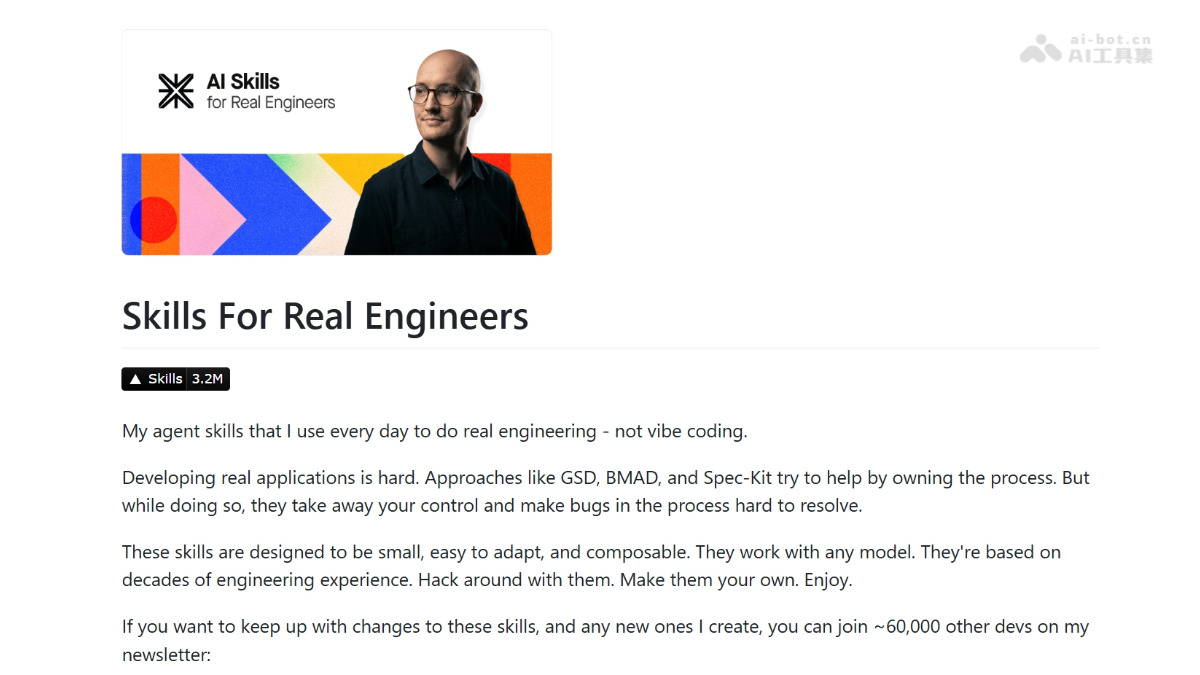
Main features of Skills For Real Engineers
-
/grill-me: Through high-intensity questioning sessions, thoroughly align requirements and decision branches before coding. -
/grill-with-docs: Build a shared project language and architecture decision records on top of grilling. -
/tdd: Drive the Agent to execute the red-green refactoring cycle, building features or fixing defects incrementally in vertical slices. -
/diagnose: A standardized diagnostic loop—reproduce → minimize → hypothesize → instrument → fix → regression test. -
/triage: Triage and dispatch Issues based on a state machine, supporting custom label vocabularies. -
/to-prd: Automatically synthesize the current conversation context into a PRD and submit it as a GitHub Issue. -
/to-issues: Split a plan or PRD into vertical slice tasks that can be claimed independently. -
/improve-codebase-architecture: Based onCONTEXT.mdand ADR, identify module deepening opportunities and govern architecture mudballs. -
/zoom-out: Require the Agent to step out of local code and provide explanations from the overall system perspective. -
/prototype: Quickly build runnable terminal prototypes or multiple UI variants to validate designs. -
/caveman: An extremely compressed communication mode that reduces token consumption by about 75% while maintaining technical precision. -
/handoff: Compress the current session into a handoff document, making it easy for other Agents to seamlessly continue. -
/teach: Use the current directory as a stateful teaching space, teaching new skills or concepts across multiple sessions. -
/write-a-skill: Create new skills according to a standardized structure, supporting progressive disclosure and resource packaging.
How to use Skills For Real Engineers
- Installation: Run
npx skills@latest add mattpocock/skills, select the target Agent and check/setup-matt-pocock-skills。 - Initialization: Execute
/setup-matt-pocock-skillsin the Agent to configure the Issue tracker (GitHub/Linear/local), tiered labels, and document directories. - Daily development: Before each change, use
/grill-meor/grill-with-docsto align requirements; during development, use/tddto ensure quality; when encountering bugs, use/diagnoseto troubleshoot. - Architecture maintenance: Regularly run
/improve-codebase-architectureto prevent code rot.
Core advantages of Skills For Real Engineers
-
Lightweight and composable: Rejects heavy frameworks; each skill is independently usable and can be freely tailored to fit.
-
Model-agnostic: Not bound to a specific model; Claude, Codex, Cursor, etc. can all be used.
-
Engineering-native: Based on classic engineering principles such as 《The Pragmatic Programmer》 and 《Domain-Driven Design》, rather than prompt engineering techniques.
-
Shared language mechanism: Through
CONTEXT.mdestablish a project terminology system, significantly reducing Agent communication costs and token consumption. -
Feedback loop: Emphasize real feedback such as static typing, automated testing, and red-green refactoring to prevent the Agent from flying blind.
Comparison with similar competitors of Skills For Real Engineers
| Dimension | Skills For Real Engineers | Azure Skills |
|---|---|---|
| Design goal | Solve engineering methodology problems in Agent coding (alignment, quality, architecture, diagnosis) | Solve coding pattern problems when Agents use the Azure SDK and cloud services |
| Essence | Engineering practice skill library (how to correctly build software) | Cloud service SDK skill library (how to correctly call Azure APIs) |
| Philosophy | "Small and beautiful, composable, users retain control" | "Selective loading, avoid context dilution, official SDK patterns" |
| Source | Practices from the .claude directory by individual engineer (Matt Pocock) |
Officially maintained by Microsoft, updated in sync with the Azure SDK team |
Application scenarios of Skills For Real Engineers
- Requirements alignment and planning: Before project kickoff or feature changes, use
/grill-meor/grill-with-docsto conduct intensive questioning with the Agent, ensuring both parties are fully aligned on requirements, decision branches, and domain terminology. - Test-driven development: In scenarios where code quality must be ensured, use
/tddto drive the Agent through the red-green refactoring cycle, building features or fixing defects incrementally in vertical slices, ensuring every change is guarded by automated tests. - Complex bug diagnosis: When encountering hard-to-reproduce performance regressions or logic defects, use
/diagnoseto initiate a standardized diagnostic process—reproduce→minimize→hypothesize→instrument→fix→regression test. - Continuous architecture governance: In large, long-term maintained codebases, regularly run
/improve-codebase-architecture, based onCONTEXT.mdand ADRs, identify module deepening opportunities, prevent the Agent from accelerating code decay, and maintain system maintainability.


