

What is Teamo
Teamo is a multi-Agent collaboration launched by the Xixiaoyao teamAI agent, positioned as "the world's first A2A paradigm super Agent born for knowledge workers." It adopts the Agent2Agent (A2A) collaboration model, simulates real team collaboration, and combines multiple professional Agents to jointly complete complex tasks. Users can interact with Agents of different functions, issue instructions, or make fine-tunings, and the interaction mode is closer to real-world team management. Examples include professional report generation, content creation, market analysis, and more. Core advantages include a transparent and traceable workflow, multi-model scheduling capability, and a highly modular design, providing users with an efficient and reliable AI productivity tool.
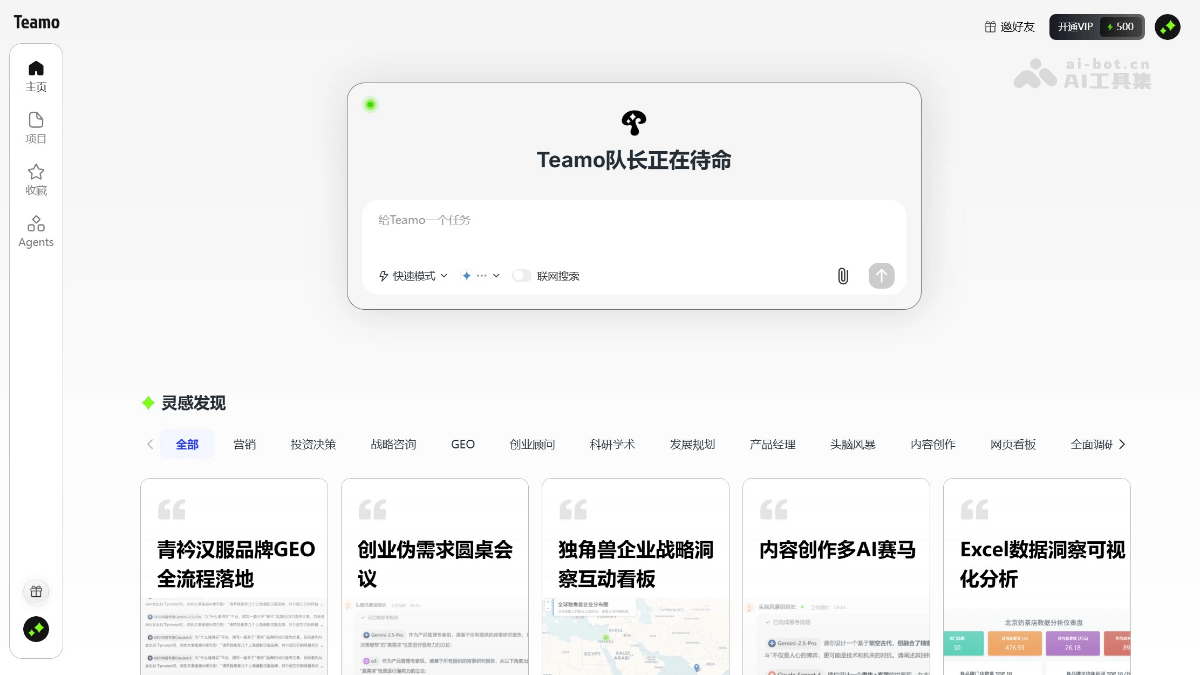
Teamo's main features
- Multi-agent collaboration: Simulates a real team structure, with a "captain" (CEO Agent) in unified command, and under it professional groups such as the search group, consulting group, writing group, and design group. Members of each group (different AI models) divide labor and collaborate to jointly complete complex tasks.
- Super search-and-write feature: Covers the full-chain intelligent process from task understanding and planning decomposition to multi-source retrieval, cross-validation, analysis integration, and then structured generation, and can efficiently generate professional reports, market analyses, academic papers, and other content.
-
Role-based interactive interface: Users can interact with Agents of different functions, issue instructions, or make fine-tunings, and the interaction mode is closer to real-world team management.
- Transparent and traceable workflow: Users can view in real time each agent's work progress, search content, analysis process, and generated drafts, effectively alleviating the AI "hallucination" problem and enabling human-AI co-creation.
- Cross-modal scheduling capability: Schedules multiple AI models for text, data, images, code, and more, intelligently combining and matching them according to the scenario, and issuing multiple tasks with one click, reducing the cost of switching tools.
- Structured output templates: Built-in professional report templates such as SWOT analysis, business plans, and academic papers, ensuring that the output content has standardized formatting and accurate information.
- Iterative collaboration: Users can intervene at any time during task execution, adjust direction, supplement information, or correct results, achieving efficient collaboration between humans and the AI team.
- Automatic optimization and evaluation: Agents can engage in "horse racing"-style competition, group leaders conduct performance evaluations of group members' work results, and users can choose the optimal output based on the evaluation results.
How to use Teamo
-
Visit the official website and register and log in: Visit the Teamo official website through a browser https://teamoteam.com/ , register, and log in.
-
Enter task instructions: Directly enter text requirements in the input box on the homepage, or simultaneously upload files, images, and other attachment information for multimodal processing.
-
Select an Agent group: According to task requirements, select an appropriate Agent group for task assignment, such as the search group, consulting group, writing group, etc.
-
View the task execution process: During task execution, you can view each Agent's work progress and report content in real time.
-
Obtain the final result: After the task is completed, the system will generate the final output result, and users can further adjust or use it as needed.
Official example one: Help me gather some information about Labubu and generate a beautiful and clear front-end dashboard, output as an HTML attachment. The requirements are to be rich in both images and text, include some cute pictures of Labubu; the data should be clear and detailed, presented with visualization charts, with animations and interactivity.
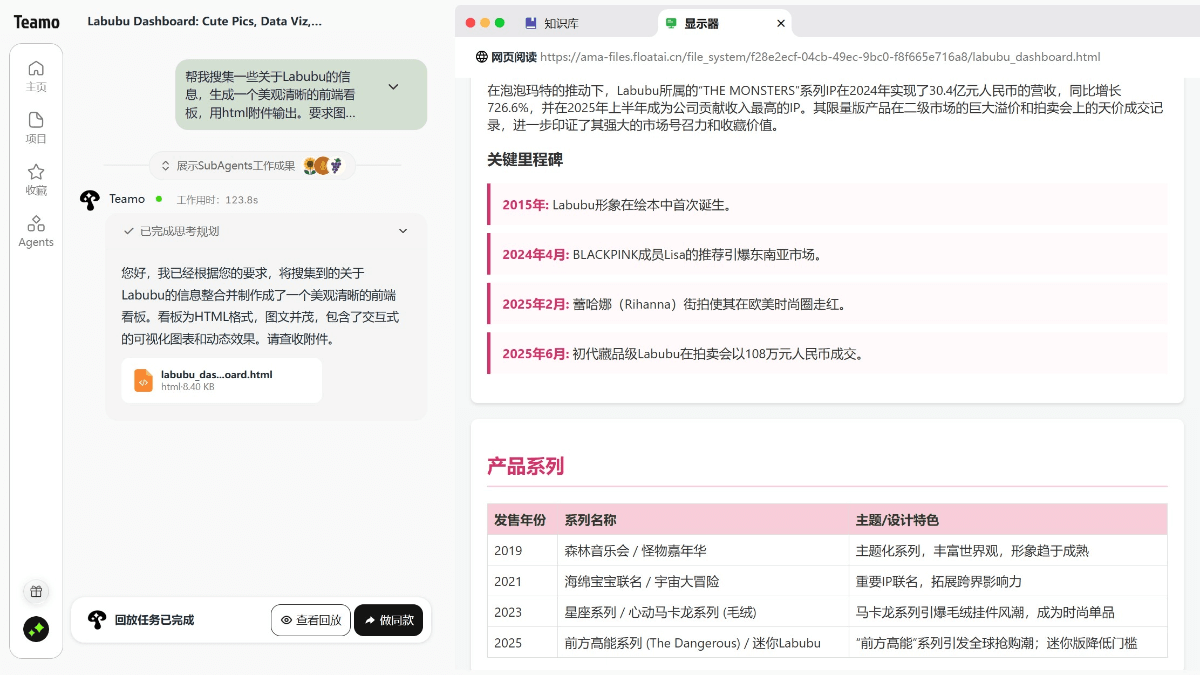
Official Example Two:
# Role
You are a senior product analyst focused on the AI + social entertainment field, with in-depth research and market insight into virtual companionship, emotional AI, and digital human interaction.# Task Background
Virtual companion AI is becoming an emerging blue ocean market. We plan to enter this track and need a strategic-level competitive analysis of the current mainstream virtual companion products.# Analysis Targets
Please focus on analyzing the following virtual companion AI products:
– **Character.AI** (overseas leader, multi-character AI chat)
– **Xingye** (domestic virtual lover)
– **Maoxiang** (anime-style AI companionship)
– **Replika** (emotional companion AI)
– **Xiaoice** (Microsoft social AI)
– **Yuanyin** (domestic AI companionship)# In-Depth Analysis Framework
## Layer One: Product Positioning and User Psychology Analysis
– **Core value proposition**: Which emotional need it addresses (loneliness, venting, entertainment, role-playing)
– **Target user profile**: Age group, gender distribution, willingness to pay, usage frequency
– **Emotional dependency design**: How to balance user stickiness with healthy use
– **Cultural adaptability**: Differences in acceptance among users in different regions## Layer Two: AI Technical Capabilities and Interaction Experience
– **Conversational intelligence level**: Context understanding, personalized memory, emotion recognition
– **Character-building capability**: Persona consistency, degree of personalization, growth-oriented design
– **Multimodal interaction**: Degree of integration of voice, images, and video
– **Real-time response performance**: Latency, stability, concurrent processing capability## Layer Three: Content Ecosystem and Security Compliance
– **Character content library**: Number of preset characters, quality, update frequency
– **UGC mechanism**: Degree of openness for user-defined characters
– **Content safety strategy**: Sensitive content filtering, youth protection mechanisms
– **Regulatory compliance response**: Policy risks in various countries and response measures## Layer Four: Business Model and Growth Strategy
– **Profit model innovation**: Subscriptions, item payments, character unlocks, virtual gifts
– **User acquisition cost**: Traffic sources, conversion funnel, viral transmission mechanisms
– **User lifetime value**: Retention curves, payment conversion, repurchase behavior
– **Ecosystem expansion potential**: IP licensing, hardware integration, social network effects## Layer Five: Market Competition and Future Trends
– **Technical barrier analysis**: Algorithmic advantages, data accumulation, team capabilities
– **User migration cost**: Emotional investment, usage habits, data migration
– **Emerging threat identification**: Entry by large model vendors, positioning by hardware vendors
– **Development trend prediction**: Direction of technological evolution, changes in user needs# Special Focus
1. **The boundary issue of emotional AI**: How to handle excessive user dependence
2. **Privacy protection mechanisms**: Storage and use of chat data
3. **Cross-cultural adaptability**: Differences in acceptance between Eastern and Western users
4. **Hardware integration trends**: Integration with smart speakers and VR/AR devices
5. **Regulatory policy risks**: Changes in various countries' attitudes toward AI companion products# Output requirements
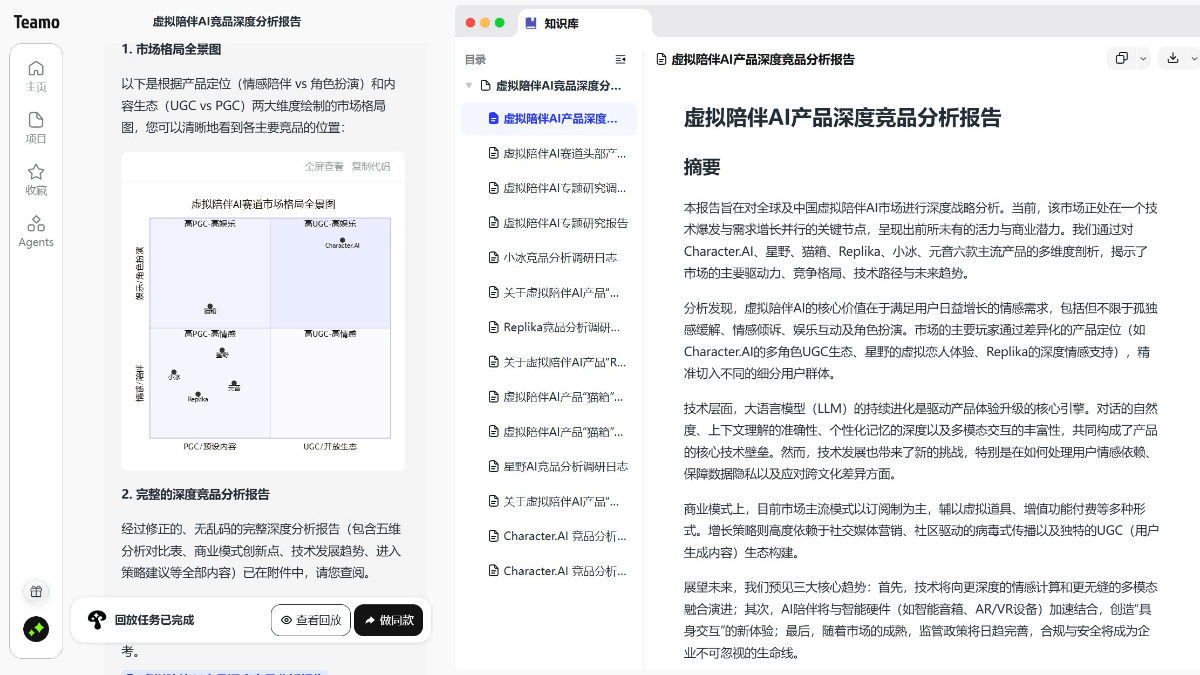
1. **Market landscape overview** (positioning quadrants + market share)
2. **Five-dimensional analysis comparison table** (detailed features and capability matrix)
3. **Business model innovations** (comparison of profit models + growth strategies)
4. **Technology development trends** (technology roadmap for the next 3 years)
5. **Entry strategy recommendations** (3 differentiation directions + specific execution paths)Please conduct the analysis based on public data, user reviews, and industry reports to ensure that the conclusions are well-supported.
Teamo's product advantages
-
Multi-Agent collaboration: By simulating real team collaboration, multiple specialized Agents work together to complete tasks, improving efficiency and quality.
-
Super search and writing feature: It can quickly understand user needs, conduct in-depth information retrieval and filtering across the entire web, and generate high-quality manuscripts.
-
Role-based interactive interface: Users can interact with Agents in different roles, issue instructions, or make fine adjustments, making interaction more natural.
-
Structured output templates: Built-in multiple professional report templates ensure that the output content is formatted properly and the information is accurate.
-
Iterative collaboration: Users can intervene at any stage of task execution, adjust direction, or supplement information to achieve efficient collaboration.
Teamo's application scenarios
-
In-depth research: Helps users quickly investigate specific topics, integrate information, and generate high-quality research reports, suitable for academic research, market research, and other scenarios.
-
Content creation: Provides content creators with one-stop services from topic selection and material collection to writing the final draft, improving the efficiency and quality of content creation.
-
Business analysis: Analyzes business information such as market trends and competitors, providing data support and professional advice for corporate decision-making.
-
Knowledge management: Organizes and summarizes large amounts of knowledge materials, generating a structured knowledge base for easy team sharing and learning.
-
Educational tutoring: Provides services such as searching for learning materials, organizing knowledge points, and formulating study plans for students or self-learners.
Teamo's target users
-
Knowledge workers: Professionals who need to efficiently process information, write reports, and conduct in-depth research.
-
Content creators: Including writers, bloggers, editors, etc., for content planning, material collection, and creative assistance.
-
Corporate decision-makers: Obtain data support through business analysis and market research to assist corporate decision-making.
-
Academic researchers: Conduct academic research, literature reviews, and paper writing to improve research efficiency.
-
Students and self-learners: Used for searching learning materials, organizing knowledge points, and formulating study plans.
-
Team managers: Manage team projects, coordinate task assignments, and improve team collaboration efficiency.


