
Generative AI for Beginners is a 12-chapter introductory series on generative AI launched by Microsoft's Cloud Advocates team, introducing the fundamentals of building generative AI applications. Each chapter covers a key knowledge point in generative AI principles and application development, providing instructional videos, written materials, code examples, and recommendations for further learning resources. Through the entire course, you will have the ability to build your own generative AI products and tools and realize ideas for applying AIGC technology.
Generative AI for Beginners has added 9 special video tutorials on generative AI, exploring in depth key practical skills including the principles of large language models (LLMs), efficient prompt engineering techniques, and image generation, aiming to comprehensively improve learners' professional skills and practical operating capabilities in the field of generative AI.
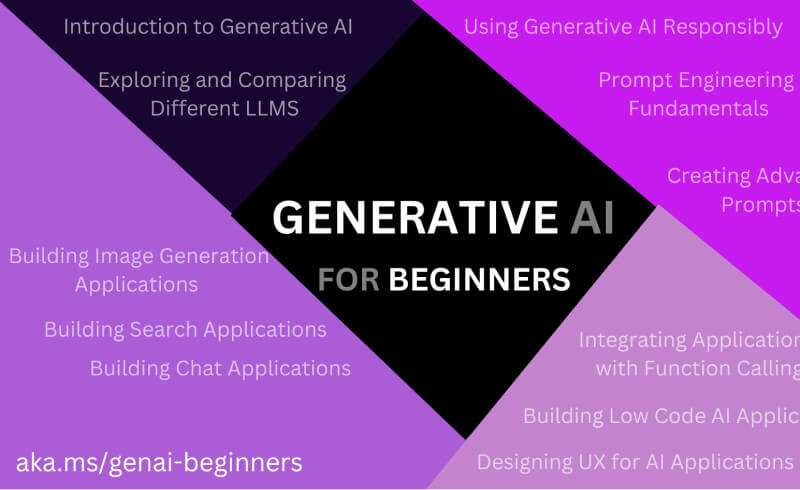
Course directory of Generative AI for Beginners
| Course Chapter | Related Teaching Content | Learning Objectives | |
|---|---|---|---|
| 00 | Course Introduction and Learning Environment Setup | Learning environment configuration and course structure | Help you succeed while studying this course |
| 01 | Introduction to Generative AI and LLMs | Knowledge Point: Generative AI and how we adapt to the current technological landscape | Understand what generative AI is and how LLMs work |
| 02 | Explore and Compare Different LLMs | Knowledge Point: Test, iterate, and compare different LLM models | Choose the right model for your application scenario |
| 03 | Use Generative AI Responsibly | Knowledge Point: Understand the limitations of foundation models and the risks behind artificial intelligence | Learn how to build generative AI applications responsibly |
| 04 | Prompt Engineering Fundamentals | Code/Knowledge Point: Prompt engineering best practices | Understand prompt structure and usage |
| 05 | Create Advanced Prompt Engineering Techniques | Code/Knowledge Point: Expand your prompt engineering knowledge by applying different techniques in prompts | Apply prompt engineering techniques to improve prompt results |
| 06 | Create a Text Generation Application | Code: Build a text generation application using Azure OpenAI | Learn how to effectively use tokens and temperature to change model output |
| 07 | Create a Chat Application | Code: Techniques for effectively building and integrating chat applications | Identify key metrics and considerations to effectively monitor and maintain the quality of AI chat applications |
| 08 | Create a Search Application | Code: Semantic search and keyword search. What text embeddings are and how they are applied to search | Create an application that uses embeddings to search data |
| 09 | Create an Image Generation Application | Code: Image generation and its role in building applications | Build an image generation application |
| 10 | Create a Low-Code Artificial Intelligence Application | Low-code: Introduction to Generative AI in Power Platform | Build a student assignment tracking application for our education startup using low-code |
| 11 | Add function calling for generative AI | Code: What Function Calling is and examples of its use in applications | Set up Function Calling to retrieve data from an external API |
| 12 | Add user experience to AI applications | Key points: Designing AI applications for trust and transparency | Principles related to user experience design when developing generative AI applications |
| 13 | Secure your generative AI applications | Key points: Understanding the threats and risks faced by AI systems, and how to protect these systems | Master the security measures for protecting generative AI applications to ensure application reliability and security |
| 14 | Generative AI application lifecycle | Key points: Tools and metrics for managing the LLM lifecycle and LLMOps | Learn how to manage the entire lifecycle of generative AI applications, including deployment, monitoring, and optimization |
| 15 | Retrieval-Augmented Generation (RAG) and vector databases | Code: Applications that use the RAG framework to retrieve embeddings from a vector database | Learn how to combine retrieval-augmented generation techniques to improve the performance and accuracy of generative AI applications |
| 16 | Open-source models and Hugging Face | Code: Create applications using open-source models on Hugging Face | Master how to leverage model resources from open-source platforms such as Hugging Face to quickly build generative AI applications |
| 17 | AI agents | Code: Create applications using AI agent frameworks | Understand the concept of AI agents and learn how to build intelligent applications through AI agent frameworks |
| 18 | Fine-tuning LLMs | Key points: What, why, and how to fine-tune LLMs | Master how to fine-tune large language models to adapt to specific business needs |
| 19 | Building with SLMs | Key points: Advantages of building with small language models | Understand the characteristics and application scenarios of small language models, and how to use them to build efficient applications |
| 20 | Building with Mistral models | Key points: Characteristics and differences of the Mistral series models | Master the characteristics of Mistral models and how to choose the right model in practical applications |
| 21 | Building with Meta models | Key points: Characteristics and differences of the Meta series models | Understand the advantages and application scenarios of Meta models, and learn how to use them to build advanced applications |
| xx | Extended learning | Includes extended links for each chapter! | Master skills related to generative artificial intelligence |
Main features of Generative AI for Beginners
-
Foundational teaching: Provides foundational knowledge of generative artificial intelligence (Generative AI), enabling beginners to understand the basic principles and working mechanisms.
-
Model introduction: Introduce different generative AI models, including large language models (LLMs), and explain the applications and limitations of the models.
-
Technical Applications: Show how to apply generative AI technologies in real projects, including text generation, image creation, and chatbot development.
-
Hands-on Exercises: Through hands-on experiments and project exercises, let learners personally operate generative AI tools and platforms to enhance practical skills.
-
Innovation Guidance: Encourage learners to explore innovative uses of generative AI and inspire creative thinking and problem-solving abilities.
Application Scenarios of Generative AI for Beginners
-
Content Creation: Generative AI can help writers, designers, and artists quickly generate creative content, such as text, images, and music.
-
Customer Service: In the field of customer service, generative AI can create chatbots, automatically answer common questions, and provide personalized services.
-
Education and Training: Generative AI is used to develop personalized learning materials and simulated training environments to adapt to the needs of different learners.
-
Game Development: In the gaming industry, generative AI can automatically generate game levels, storylines, and behavior patterns of non-player characters (NPCs).
-
Healthcare: Generative AI can help doctors analyze medical images, predict disease progression, and personalize treatment plans.


