
What is MachineLearningMastery
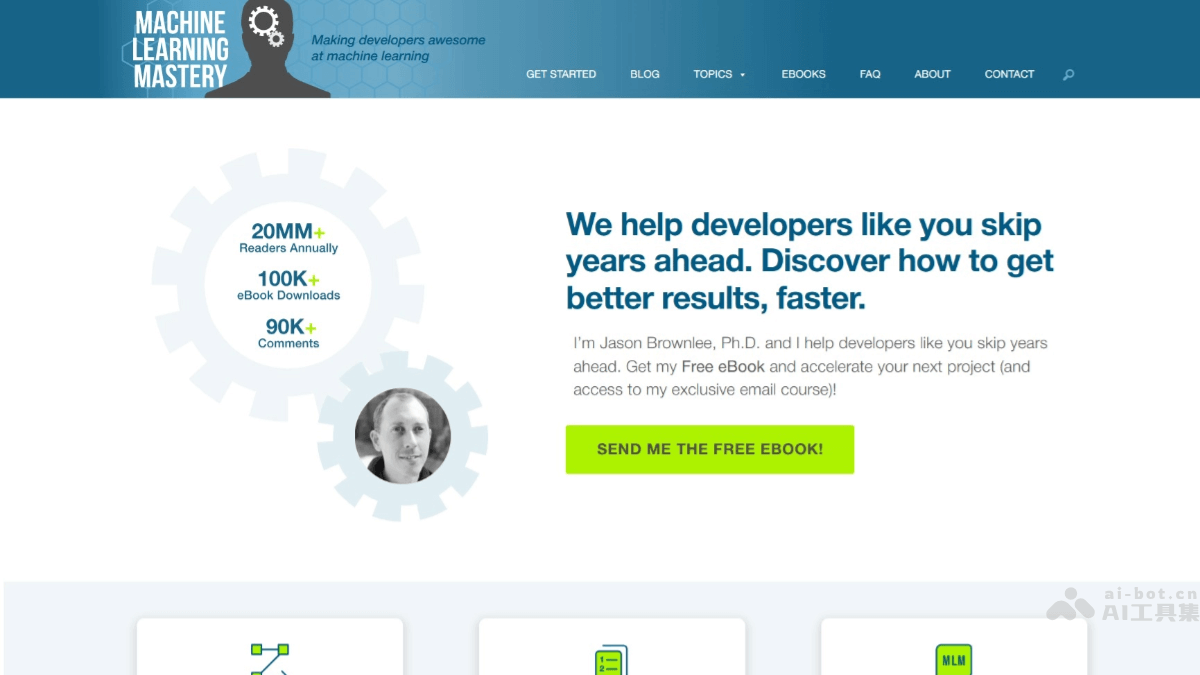
MachineLearningMastery is a platform focused on machine learning launched by Dr. Jason Brownlee, helping developers quickly master machine learning skills. MachineLearningMastery offers comprehensive tutorials from beginner to advanced, covering multiple fields such as deep learning, natural language processing, computer vision, and more. The website provides paid ebooks, quick start guides, and FAQs to help users systematically learn and solve practical problems. The core team is composed of multiple machine learning experts, dedicated to using high-quality content to help developers succeed in machine learning projects.
Main Features of MachineLearningMastery
- Provides rich machine learning tutorials: Covers multiple fields from beginner to advanced, such as deep learning, natural language processing, computer vision, time series forecasting, data preparation, etc., helping learners of different levels get started quickly.
- Quick Start Guides: Provides beginners with a concise and clear entry path, helping users quickly master the basic concepts and practical methods of machine learning.
- Paid Ebooks: Provides systematic machine learning ebooks, helping users learn specific topics more deeply and accelerate skill improvement.
- Frequently Asked Questions (FAQ): Answers common questions learners may encounter in the machine learning process, providing practical advice and solutions.
- Expert Team Support: A team composed of multiple machine learning experts provides high-quality content, ensuring learners can obtain authoritative and practical knowledge.
MachineLearningMastery Course Offerings
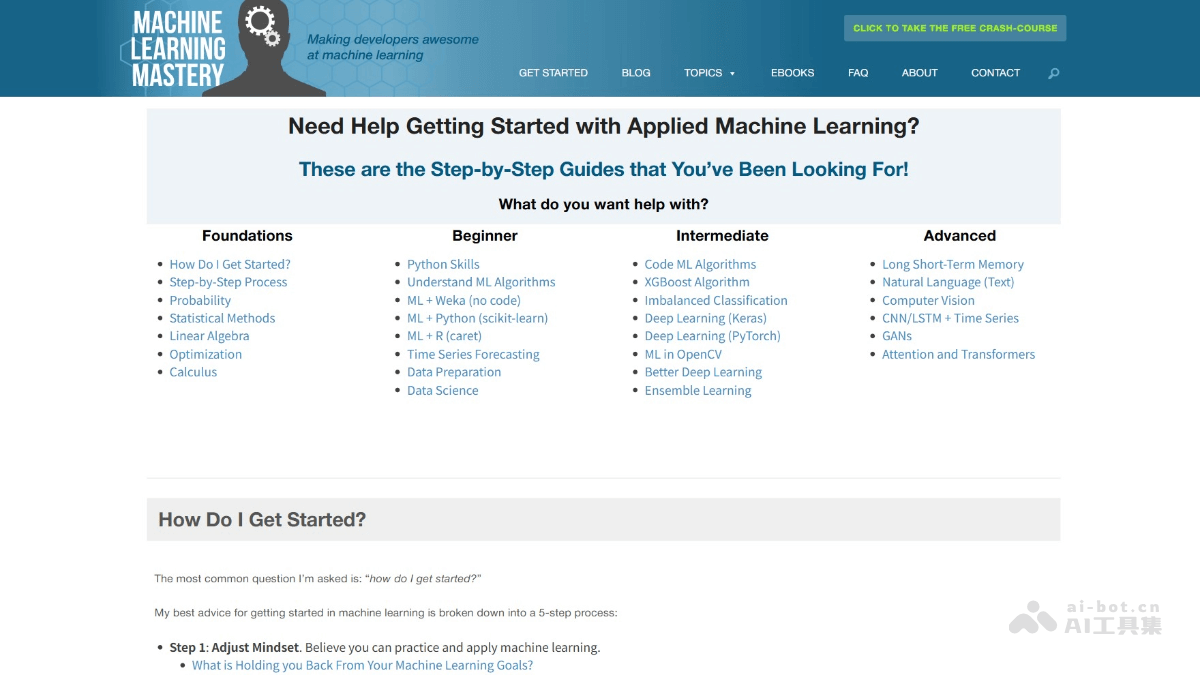
- Fundamentals:
- Mathematical Foundations: Includes probability, statistics, linear algebra, optimization, and calculus.
- Python Programming: Includes Python basics, data processing, and data visualization.
- Machine Learning Tools:
- Weka: Suitable for beginners, no programming required.
- Python (scikit-learn): Suitable for intermediate learners, covering data preparation and model evaluation.
- R (caret): Suitable for data scientists, providing rich statistical and machine learning tools.
- Deep Learning:
- Keras and TensorFlow: Suitable for beginners and intermediate learners, covering multilayer perceptrons, convolutional neural networks, recurrent neural networks, etc.
- PyTorch: Suitable for advanced learners, providing a flexible deep learning framework.
- Advanced Topics:
- Natural Language Processing (NLP): Includes word embeddings, text generation, and translation.
- Computer Vision: Includes image processing, feature extraction, and object detection.
- Time Series Forecasting: Includes data preparation, model development, and deep learning methods.
- Ensemble Learning: Advanced techniques for improving model performance.
- Generative Adversarial Networks (GANs): Cutting-edge technology for generative models.
- Attention Mechanisms and Transformer: Advanced architectures for processing long sequence data.
- Practical Projects:
- Machine Learning Projects: The complete process from defining the problem to deploying the model.
- Deep Learning Projects: Develop and optimize deep learning models.
- Data Science Projects: Extract insights from data to solve real-world problems.
- E-books: Books for systematic learning, covering multiple topics from beginner to advanced, for example:
- 《Python for Machine Learning》
- 《Deep Learning with Python》
- 《Machine Learning Algorithms From Scratch》
MachineLearningMastery Application Scenarios
- Data Science and Analytics: Help data scientists perform data preprocessing, feature engineering, model selection and evaluation, extract valuable insights from data, and support decision-making.
- Business Intelligence and Market Forecasting: Use time series forecasting techniques to predict market trends and customer demand, and optimize corporate marketing strategies and customer satisfaction.
- Healthcare: Predict disease occurrence based on analysis of medical data to assist doctors in formulating treatment plans; use computer vision technology to analyze medical images and improve diagnostic efficiency.
- Natural Language Processing (NLP): Develop text analysis tools to help enterprises analyze customer feedback and social media data; build machine translation systems to support cross-language communication.
- Computer Vision: Develop image recognition and object detection systems for fields such as security surveillance and autonomous driving, enhancing intelligence levels and safety.


