

What is Dive into Deep Learning
Dive into Deep Learning is a deep learning textbook and course that combines theory and practice, offering Chinese and English versions. The course explains the core concepts of deep learning, such as neural networks, convolutional neural networks, and recurrent neural networks, in an easy-to-understand way, and helps readers get started quickly through extensive code examples and practical projects. The course covers foundational knowledge and also touches on cutting-edge technologies such as natural language processing and computer vision. The companion website provides abundant resources, including datasets, code, and instructional videos, making it convenient for readers to learn and practice. Dive into Deep Learning is suitable for learners with some programming background, beginners, and researchers with some experience; all can benefit from it.
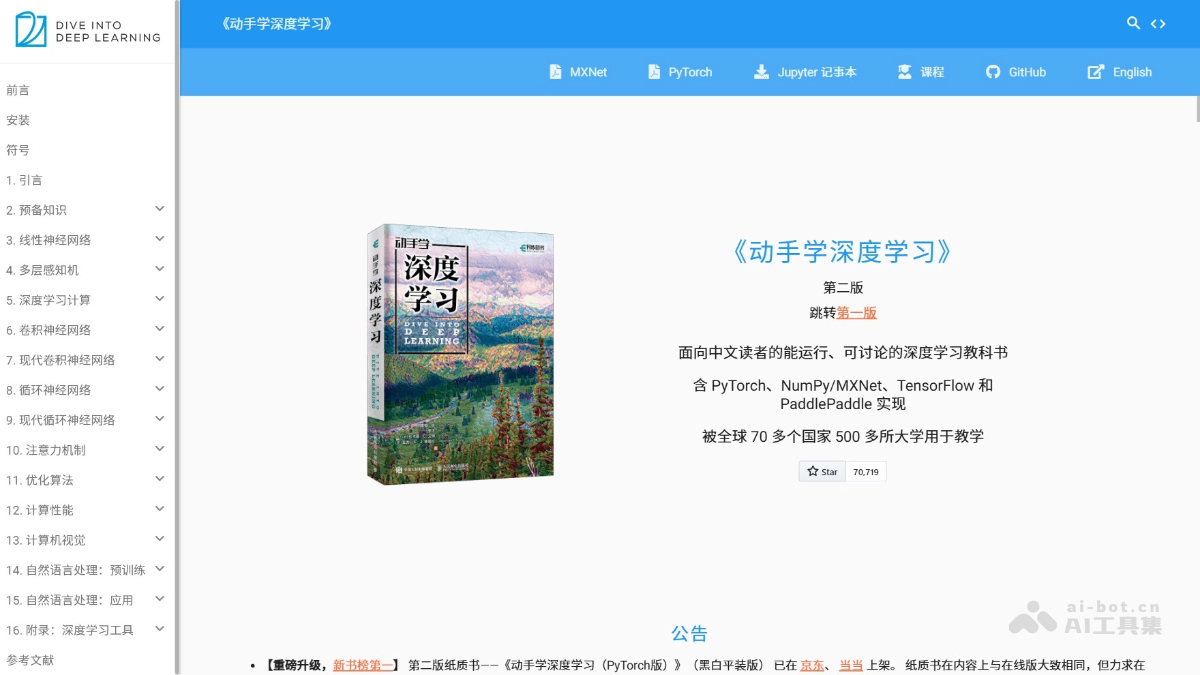
Main Features of Dive into Deep Learning
- Theoretical Instruction: Systematically explains the core concepts and mathematical foundations of deep learning, helping readers gain an in-depth theoretical understanding of how models work.
- Practical Guidance: Provides abundant code examples, datasets, and experimental projects, allowing readers to reinforce theoretical knowledge through hands-on practice.
- Resource Support: The companion website provides online documentation, instructional videos, and forum support, making it convenient for readers to consult and communicate at any time.
- Teaching and Self-Study: The content is clearly structured and suitable for use as a university textbook, while also being suitable for self-study, helping readers gradually improve their technical skills.
Course Content of Dive into Deep Learning
- Introduction: Introduces the background, development history, and application prospects of deep learning.
- Preliminaries: Explains the foundational knowledge needed to learn deep learning, including mathematical foundations and programming skills.
- Linear Neural Networks: Introduces the simplest neural network model—the linear neural network.
- Multilayer Perceptrons: Discusses the structure and functions of multilayer perceptrons, including activation functions and forward propagation.
- Deep Learning Computation: Explains the computational principles in deep learning, including forward propagation and backpropagation.
- Convolutional Neural Networks: Introduces the basic concepts and applications of convolutional neural networks (CNNs).
- Modern Convolutional Neural Networks: Discusses modern convolutional neural network architectures and design concepts.
- Recurrent Neural Networks: Introduces recurrent neural networks (RNNs) and their applications in sequence data processing.
- Modern Recurrent Neural Networks: Explains modern recurrent neural network structures, such as LSTM and GRU.
- Attention Mechanisms: Introduces attention mechanisms and their applications in deep learning.
- Optimization Algorithms: Discusses optimization algorithms in deep learning, such as gradient descent and its variants.
- Computational Performance: Explains how to improve the training and inference efficiency of deep learning models.
- Computer Vision: Introduces applications of deep learning in computer vision, such as image recognition and processing.
- Natural Language Processing: Pretraining. Discusses pretrained models in natural language processing, such as BERT and GPT.
- Natural Language Processing: Applications:. Introduces applications of natural language processing, such as text classification and machine translation.
- Appendix: Deep learning tools. Provides an introduction to commonly used tools and resources in deep learning.
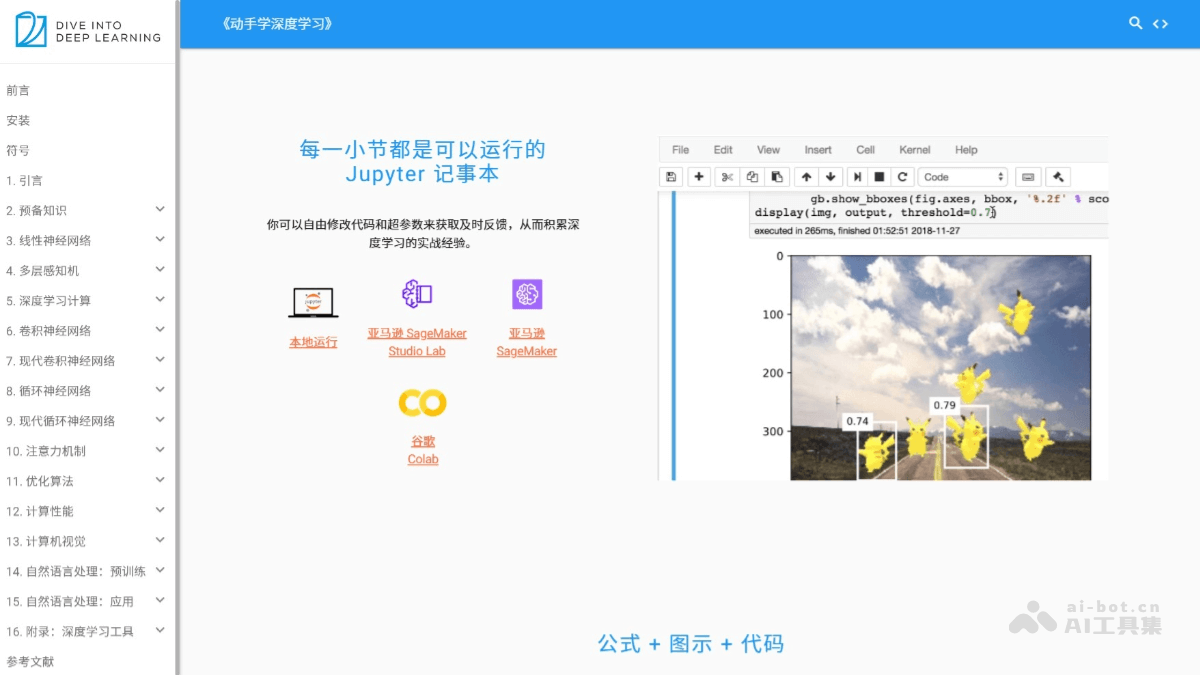
Application scenarios of Dive into Deep Learning
- Computer vision: Enables machines to understand and interpret visual information, applied in image and video analysis.
- Natural language processing (NLP): Gives machines the ability to understand and generate human language, used in translation, text analysis, etc.
- Speech recognition: Converts human speech into text, used in voice assistants and automatic subtitle generation.
- Recommender systems: Analyzes user behavior and preferences to provide personalized content or product recommendations.
- Healthcare: Assists doctors in disease diagnosis and treatment decisions, improving the quality of medical services.


