

What is JAX
JAX is a high-performance numerical computing library introduced by Google, providing a NumPy-like API and supporting features such as GPU/TPU acceleration, automatic differentiation, just-in-time compilation (JIT), and vectorization. JAX optimizes code through the XLA (Accelerated Linear Algebra) compiler, significantly improving runtime efficiency and excelling in large-scale data processing and machine learning. JAX supports automatic differentiation, making it easy to compute function gradients, and is suitable for optimization algorithms. JAX's asynchronous execution model and immutable array design make it superior to traditionalNumPy, and it is an important tool in modern scientific computing and machine learning research.
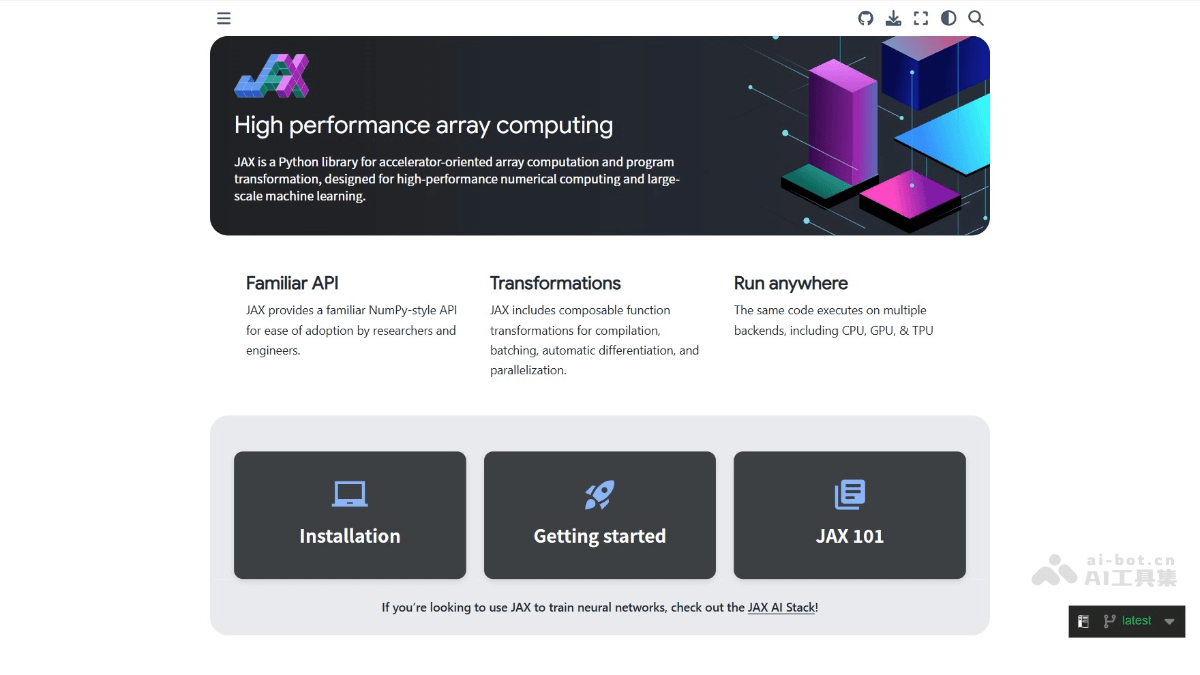
Main features of JAX
-
Automatic differentiation: Through
jax.gradand other functions, it automatically computes function gradients, supports higher-order derivatives, and is widely used in model training in machine learning. -
Just-in-time compilation (JIT): Use
jax.jitto compile Python functions into optimized machine code, significantly improving runtime efficiency, with notable results in large-scale computation. -
Vectorization: Through
jax.vmap, it automatically vectorizes functions, avoiding manual loops and improving code efficiency and readability. -
Parallelization: Use
jax.pmapto support parallel computation across multiple devices (such as GPU and TPU), accelerating large-scale task processing. -
Hardware acceleration: Supports running code on CPU, GPU, and TPU, fully utilizing the hardware's parallel computing capabilities.
-
Program transformation: Provides a rich set of program transformation tools, such as
jax.lax, used to build more complex program logic and improve code flexibility and extensibility.
How to use JAX
- Environment setup and installation:
- Create a Python environment: Use conda to create a dedicated Python environment.
conda create -n jax_test python=3.13 -y
conda activate jax_test-
- Install the JAX library: Choose the appropriate JAX version according to the hardware configuration.
pip install jupyter numpy "jax[cuda12]" matplotlib pillow- Use the main features of JAX:
- Automatic differentiation: Use
jax.gradto automatically compute function gradients.
- Automatic differentiation: Use
import jax
import jax.numpy as jnp

def cubic_sum(x):
    return jnp.sum(x**3)

grad_cubic_sum = jax.grad(cubic_sum)
x_input = jnp.arange(1.0, 5.0)
gradient = grad_cubic_sum(x_input)
print("梯度 df/dx:", gradient)-
- Just-in-time compilation (JIT): Use
jax.jitto compile functions into optimized machine code.
- Just-in-time compilation (JIT): Use
@jax.jit
def selu_jax_jit(x):
    return 1.0507 * jnp.where(x > 0, x, 1.67326 * jnp.exp(x) - 1.67326)

x_jax = jnp.random.normal(jax.random.PRNGKey(0), (10000, 10000))
result_jax_jit = selu_jax_jit(x_jax)-
- Vectorization: Use
jax.vmapto automatically vectorize functions.
- Vectorization: Use
def mat_vec_product(matrix, vector):
    return jnp.dot(matrix, vector)

batched_mat_vec = jax.vmap(mat_vec_product, in_axes=(None, 0))
matrix_jax = jnp.random.normal(jax.random.PRNGKey(0), (10000, 10000))
vectors_jax = jnp.random.normal(jax.random.PRNGKey(1), (128, 10000))
result_vmap = batched_mat_vec(matrix_jax, vectors_jax)
Application scenarios of JAX
- Machine learning and deep learning: JAX's automatic differentiation and hardware acceleration capabilities can efficiently train and infer neural networks, improving model performance.
- Scientific computing: JAX can compute derivatives of complex physical equations and optimize simulations and predictions in physics, chemistry, and materials science.
- Data analysis and processing: With vectorization and parallelization, JAX can quickly process large-scale data and is suitable for fields such as image and signal processing.
- Financial modeling: Used in financial risk assessment and high-frequency trading, efficient computation supports real-time data analysis and decision-making.
- Computational biology: Processes genomic data and predicts protein structures, accelerating biomedical research and applications.

