

What is NumPy
NumPy is the foundational library used for scientific computing in Python, providing a powerful N-dimensional array object and tools for manipulating arrays. Through NumPy, large-scale numerical computations can be performed efficiently, supporting array broadcasting, linear algebra operations, Fourier transforms, and more. NumPy provides functionality such as random number generation. NumPy arrays are faster and more memory-efficient than native Python lists, and are widely used in fields such as data analysis, machine learning, and image processing; it is the foundation of many advanced scientific computing libraries (such as Pandas, SciPy, Matplotlib, etc.).
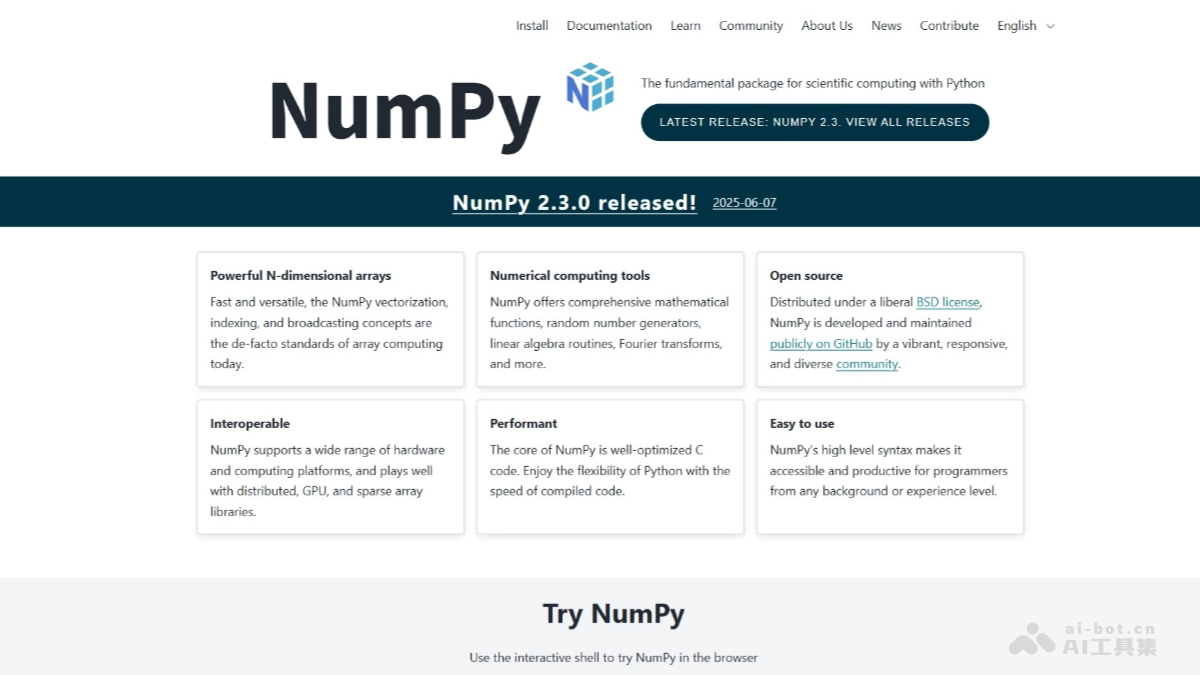
Main Features of NumPy
-
Powerful N-dimensional array object: Provides an array structure for efficiently storing and manipulating large-scale data, supporting multiple data types.
-
Array operations: Supports operations such as indexing, slicing, reshaping, and transposing, making data processing convenient.
-
Mathematical operations: Provides a rich set of mathematical functions, supporting addition, subtraction, multiplication, division, and exponentiation of arrays, as well as trigonometric functions, logarithms, and more.
-
Broadcasting mechanism: Supports operations on arrays of different shapes, simplifying code.
-
Linear algebra operations: Supports operations such as matrix multiplication, inversion, and eigenvalue decomposition.
-
Random number generation: Provides various random number generators for simulation and statistical analysis.
-
Data type support: Supports multiple data types (such as integer, floating-point, complex, etc.), and allows custom data types.
-
Integration with C/C++ and Fortran code: Supports interaction with low-level language code to improve performance.
-
Tools and modules: Provides tools for reading and writing files, data sorting, statistical analysis, and more.
How to Use NumPy
-
Install NumPy: Use the pip command to install NumPy, which is a scientific computing library for Python used for efficiently processing large-scale data.
-
Import NumPy: In a Python script or interactive environment, import NumPy via
import numpy as np, usually usingnpas an alias. -
Create arrays:
-
One-dimensional arrays: Convert Python lists into NumPy arrays.
-
Multidimensional arrays: Create multidimensional arrays through nested lists.
-
Special arrays: Use functions to create all-zero arrays, all-one arrays, random arrays, and more.
-
-
Array operations:
-
Indexing and slicing: Index and slice arrays just like operating on Python lists, but NumPy supports multidimensional indexing.
-
Reshape arrays: Readjust arrays to different shapes.
-
Mathematical operations: Supports operations such as addition, subtraction, multiplication, and division, and performs complex operations such as matrix multiplication.
-
-
Broadcasting mechanism: Supports operations on arrays of different shapes, with smaller arrays automatically "broadcast" to match the shape of larger arrays, simplifying code.
-
Linear algebra operations: Provides rich linear algebra functionality, such as matrix inversion, eigenvalue decomposition, matrix multiplication, and more.
-
Random number generation: Provides a variety of random number generators, capable of generating random integers, random floating-point numbers, etc., suitable for simulation and statistical analysis.
-
Data Types: NumPy supports multiple data types (such as integer, floating-point, complex, etc.), and can specify the data type of an array.
-
File Operations: NumPy can save arrays to files or load arrays from files, making data storage and reading convenient.
NumPy Application Scenarios
-
Data Analysis: NumPy provides efficient array operations and mathematical computation capabilities, and can quickly process and analyze large-scale datasets.
-
Machine Learning: As a low-level computing library, it provides matrix operations and data processing support for machine learning algorithms, and is the foundation of many machine learning frameworks.
-
Image Processing: Images can be represented as multidimensional arrays, and NumPy can be used in operations such as image reading, transformation, and filtering.
-
Scientific Computing: Supports complex mathematical operations and linear algebra functions, suitable for scientific computing tasks in fields such as physics, chemistry, and biology.
-
Statistical Analysis: Provides a rich set of statistical functions, used in descriptive statistics of data, probability distribution calculations, etc.

