

What is the Udacity School of AI
The Udacity School of AI is an online learning platform focused on artificial intelligence technology, offering courses from foundational to advanced levels. The courses cover popular fields such as machine learning, deep learning, natural language processing, and computer vision, helping learners master cutting-edge AI skills. The courses combine theory and practice, reinforcing learning outcomes through projects and case studies. The school collaborates with industry giants such as AWS and Nvidia to ensure the content keeps pace with industry needs. Whether you are a beginner or a professional, you can find a learning path that suits you here and open the door to a high-paying AI career.
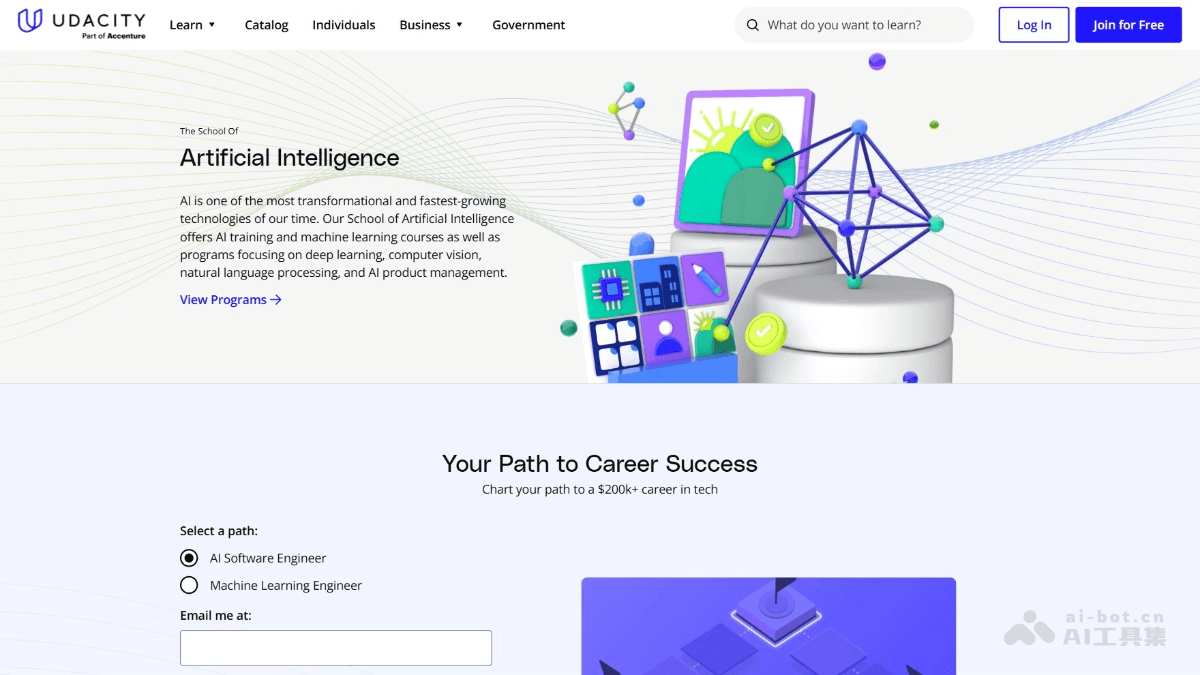
Main features of the Udacity School of AI
- From beginner to advanced: The courses cover everything from the foundations of AI programming (such as Python programming, linear algebra, etc.) to advanced topics (such as deep learning, reinforcement learning, natural language processing, etc.).
- Multiple learning paths: Customized learning paths are designed for different career goals (such as machine learning engineer, deep learning engineer, artificial intelligence specialist, etc.).
- Hands-on practice: The courses include a large number of practical projects to help learners apply theoretical knowledge to real problems.
- Real-world cases: By solving real-world problems, learners develop practical operational skills and problem-solving abilities.
- Collaboration with industry leaders: Courses are developed in collaboration with industry giants such as AWS, Nvidia, and IBM Watson to ensure the content is closely aligned with industry needs.
Course offerings of the Udacity School of AI
- Foundational courses:
- AI Programming with Python: Includes Python programming fundamentals, linear algebra, neural network training, backpropagation, the PyTorch framework, and more. Suitable for beginners to get started with AI programming and master basic programming skills and AI algorithm implementation.
- Intro to Machine Learning: Includes basic machine learning concepts, data preprocessing, supervised and unsupervised learning, model evaluation, and more. Helps learners understand the basic principles and common algorithms of machine learning.
- Intermediate courses:
- Introduction to Machine Learning with TensorFlow: Includes use of the TensorFlow framework, deep learning fundamentals, convolutional neural networks, recurrent neural networks, and more. Suitable for learners with some programming background who want to study deep learning techniques in depth.
- Introduction to Machine Learning with Pytorch: Includes use of the PyTorch framework, deep learning fundamentals, convolutional neural networks, recurrent neural networks, and more. Similar to the TensorFlow course, but uses the PyTorch framework.
- Advanced courses:
- Deep Learning: Advanced deep learning techniques, including convolutional neural networks, recurrent neural networks, Transformers, and more. Suitable for learners with some foundation in deep learning who want to master advanced techniques in depth.
- Deep Reinforcement Learning: Includes reinforcement learning fundamentals, Q-learning, policy gradients, deep reinforcement learning, and more. Suitable for learners interested in reinforcement learning who want to master cutting-edge techniques.
- Industry-specific courses:
- AWS Machine Learning Engineer Nanodegree: Includes the use of AWS SageMaker, model training and deployment, hyperparameter tuning, cloud resource management, and more. Suitable for learners who want to develop machine learning on the AWS cloud platform.
- Free Courses:
- Intro to TensorFlow for Deep Learning: Basic use of TensorFlow, suitable for beginners to quickly get started with deep learning.
- Introduction to Generative AI with Google Cloud): The basic concepts of generative AI and related tools on Google Cloud.
- Other Courses:
- Computer Vision: Includes computer vision technologies such as image processing, object detection, and image segmentation.
- Natural Language Processing: Includes natural language processing technologies such as text processing, language models, and sentiment analysis.
Application Scenarios of the Udacity AI School
- Predictive Maintenance in Manufacturing: Use machine learning algorithms to analyze equipment operating data (such as temperature, vibration, current, etc.), predict equipment failures in advance, arrange preventive maintenance, and reduce downtime and repair costs.
- Medical Imaging Diagnosis Assistance: In the healthcare field, use deep learning technologies (such as convolutional neural networks) to analyze medical images (such as X-rays, CT, MRI), assist doctors in quickly and accurately discovering lesions, and improve diagnostic efficiency and accuracy.
- Financial Risk Assessment: In the financial industry, machine learning models can be used to assess credit risk. By analyzing data such as customers' credit records and spending behavior, they can predict default risk and optimize the loan approval process.
- Traffic Flow Optimization: In the transportation field, optimize urban traffic flow. By analyzing traffic data (such as vehicle flow, road conditions, etc.), intelligently adjust traffic signals to alleviate congestion.
- Personalized Recommendations in the Retail Industry: In the retail industry, use machine learning algorithms to analyze consumers' purchase history and browsing behavior, provide customers with personalized product recommendations, and improve the shopping experience and sales performance.


