
What is Qwen-Image-Edit
Qwen-Image-Edit is an all-in-one image editing model built on the Qwen-Image architecture with 20 billion parameters. The model combines both semantic and appearance editing capabilities, and can perform low-level visual appearance editing (such as adding, deleting, and modifying elements) and high-level visual semantic editing (such as IP creation, object rotation, and style transfer). The model supports precise editing of Chinese and English text, and supports modifying text in images while preserving the original font, font size, and style. Qwen-Image-Edit performs excellently on multiple public benchmarks and has SOTA performance. It can be experienced through Qwen Chat.
Qwen-Image-Edit-2509 is the latest monthly iteration of Qwen-Image-Edit released by the Qwen team. The model supports multi-image input and can achieve various combined edits such as 'person + person' and 'person + scene', significantly improving the consistency of single-image editing, including person, product, and text editing. The model natively supports ControlNet and can flexibly use image conditions such as depth maps and edge maps, making it suitable for various creative scenarios such as making memes, restoring old photos, and generating cartoon dolls.
Qwen-Image-Edit-2511 is the latest large image editing model officially released by the Tongyi Qianwen team, focusing on 'more stable, faster, and more controllable'. Compared with version 2509, the core upgrades can be summarized in five points: drift in character identity, facial features, and clothing texture during group photos is significantly reduced. Structural preservation is more complete in complex scenes (multiple objects, multiple light sources). Built-in community LoRAs: popular style/character LoRAs have been directly integrated into the base weights and can be invoked without additional loading. It improves industrial design capabilities and geometric reasoning capabilities, and can generate or preserve auxiliary lines, perspective grids, and dimension annotations according to prompts, making it suitable for product rendering and engineering drawings. Stability is higher when replacing materials and generating design variants in batches.
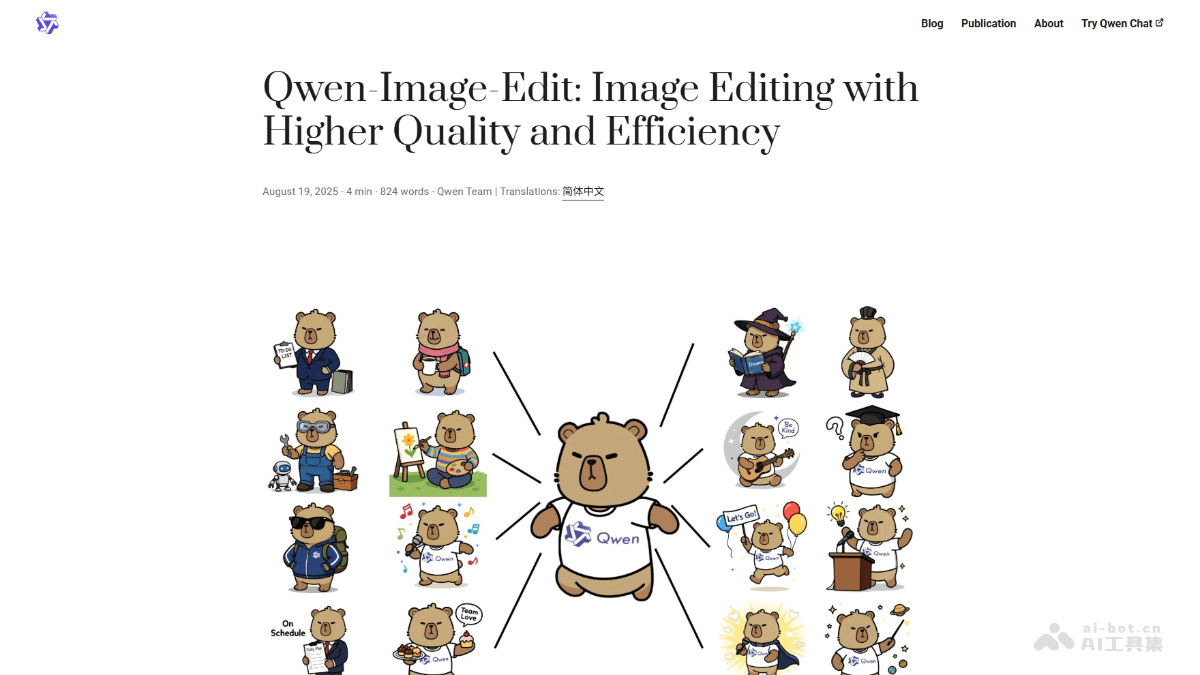
Main Features of Qwen-Image-Edit
- Semantic editing: Supports modifying image content while maintaining consistency with the original image's visual semantics.
- Appearance editing: Supports precise modification of local areas of an image, such as adding, deleting, or modifying elements in the image, while keeping other areas unchanged.
- Precise text editing: Supports Chinese and English bilingual text editing, and can add, delete, and modify text in images while preserving the original font, font size, and style.
- Powerful benchmark performance: Performs excellently on multiple public benchmarks and has SOTA (State-of-the-Art) performance, and can efficiently complete various complex image editing tasks.
Technical Principles of Qwen-Image-Edit
- Model architecture: Qwen-Image-Edit is further trained based on the 20-billion-parameter Qwen-Image model, inheriting its powerful text rendering and image generation capabilities. The input image is simultaneously fed into two modules.Qwen2.5-VLis responsible for visual semantic control, and can understand the semantic content of the image and perform semantic-level editing. The VAE Encoder is responsible for visual appearance control, and can precisely process the visual details of the image to achieve editing of local areas.
- Semantic and appearance editing: Through the Qwen2.5-VL module, the model can understand the overall semantics of the image and modify content while maintaining semantic consistency. Through the VAE Encoder module, the model can precisely process the visual details of the image and achieve adding, deleting, or modifying local areas.
- Text editing: Qwen-Image-Edit is optimized for text rendering, enabling precise recognition and editing of text in images. The model supports both Chinese and English, allowing operations such as adding, deleting, and modifying text while preserving the original font, font size, and style.
- Chained Editing: The model supports chained editing, enabling fine-grained adjustments to complex image content through step-by-step corrections. Users can specify the regions that need modification, and the model gradually optimizes those regions until the desired effect is achieved.
Qwen-Image-Edit Project Address
- Project Official Website:https://qwenlm.github.io/blog/qwen-image-edit/
- GitHub Repository:https://github.com/QwenLM/Qwen-Image
- HuggingFace Model Library:https://huggingface.co/Qwen/Qwen-Image-Edit
- Online Experience Demo:https://huggingface.co/spaces/Qwen/Qwen-Image-Edit
Qwen-Image-Edit Application Scenarios
- Creative Design: Quickly generate and modify the appearance, clothing, and background of virtual characters, efficiently completing diverse creations of original IP.
- Advertising and Poster Design: Directly modify text content in posters and adjust the font, font size, and color without redesigning, improving design efficiency.
- Film, Television, and Video Production: Quickly adjust scene elements or character appearances in post-production, or convert the style of video footage from realistic to anime style.
- Education and Training: Quickly generate and modify instructional images and charts, such as portraits of historical figures and scientific experiment diagrams, enhancing teaching effectiveness.
- Personal Applications: Quickly adjust personal photos, such as changing the background, adding decorative elements, and modifying clothing, making it easy to create personalized photos.