
What is Qwen-Image
Qwen-Image is a 20B parameter MMDiT model open-sourced by the Alibaba Tongyi Qianwen team, and is the firstimage generationfoundation model in the Tongyi Qianwen series. The model excels in complex text rendering and precise image editing, supports multi-line layouts, paragraph-level text generation, and fine-grained detail presentation, and can achieve high-fidelity output in both Chinese and English. Qwen-Image demonstrates strong capabilities in general image generation and editing tasks, and supports a variety of artistic styles and advanced editing operations. Currently, users can experience the model's performance through the image generation feature in Qwen Chat.
The latest open-source Qwen-Image-2512 image generation model achieves significant improvements in human skin texture, natural texture restoration, and complex text rendering. By simply inputting text instructions, the new model can generate high-quality images with "zero AI feel," where even human hair strands are clearly visible, comparable to real photos taken by professional photographers. It supports the smooth generation of complex images such as comic-style PPTs and data infographics, and can meet diverse needs in professional design scenarios.
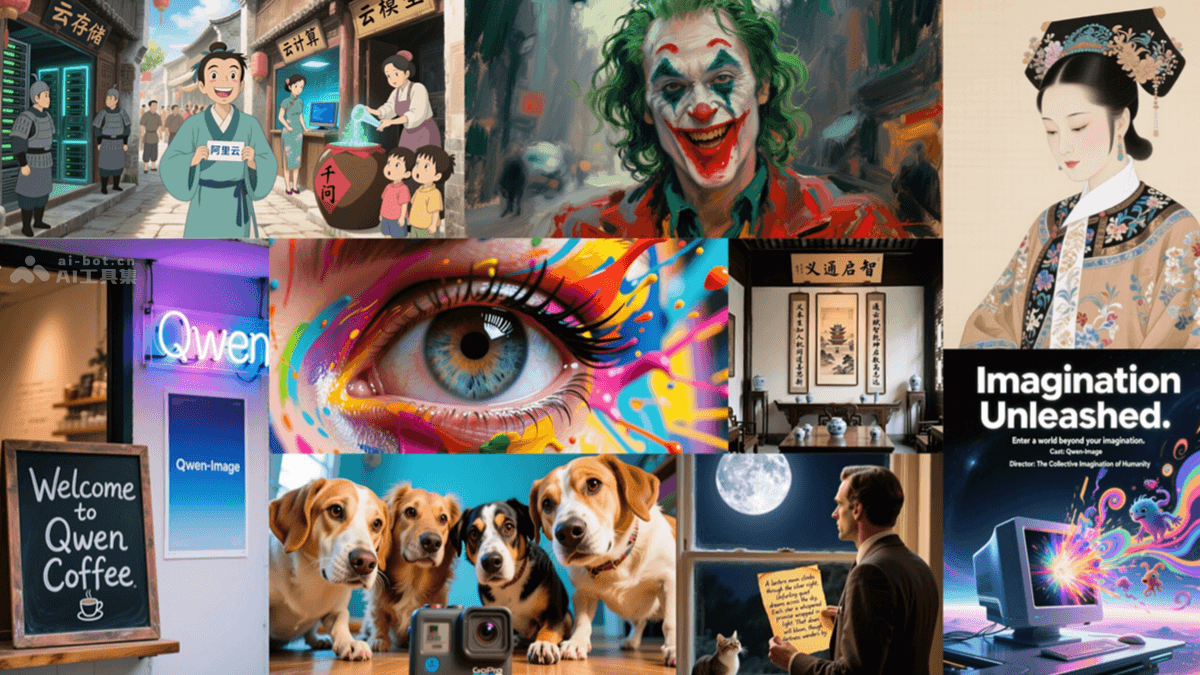
Main Features of Qwen-Image
- Complex text rendering: Supports multi-line and paragraph text generation, can clearly present small text, and is skilled at Chinese and English rendering.
- Precise image editing: Supports style transfer, object addition, deletion, and modification, detail enhancement, text editing, and human pose adjustment, while maintaining a natural and realistic look for the image.
- General image generation: Supports a variety of artistic styles and can generate creative images based on user descriptions.
Technical Principles of Qwen-Image
- Model architecture: Based on an advanced multimodal large language model (MLLM) as the text feature extraction module, it can accurately understand text semantics and convert them into the features required for image generation. The variational autoencoder (VAE) is responsible for encoding input images into compact latent representations, and decoding them during the inference stage to achieve efficient image processing and generation. The core part of the model is the multimodal diffusion transformer (MMDiT), which generates images by gradually removing noise and combines text features for guidance, ensuring that the generated images are highly consistent with the text descriptions.
- Data processing: Through large-scale data collection and annotation, a rich dataset covering nature, design, people, and synthetic data is constructed. Based on a multi-stage data filtering process, low-quality or non-compliant data is gradually removed to ensure the high quality and diversity of the data.
- Training strategy: During training, flow matching is used as the pretraining objective, and ordinary differential equations (ODE) are used to achieve stable training dynamics while maintaining equivalence with the maximum likelihood objective. The model combines text-to-image (T2I), image-to-image (I2I), and text-image-to-image (TI2I) multi-task training paradigms, and realizes multi-task learning based on a shared latent space.
Performance of Qwen-Image
- Overall performance:
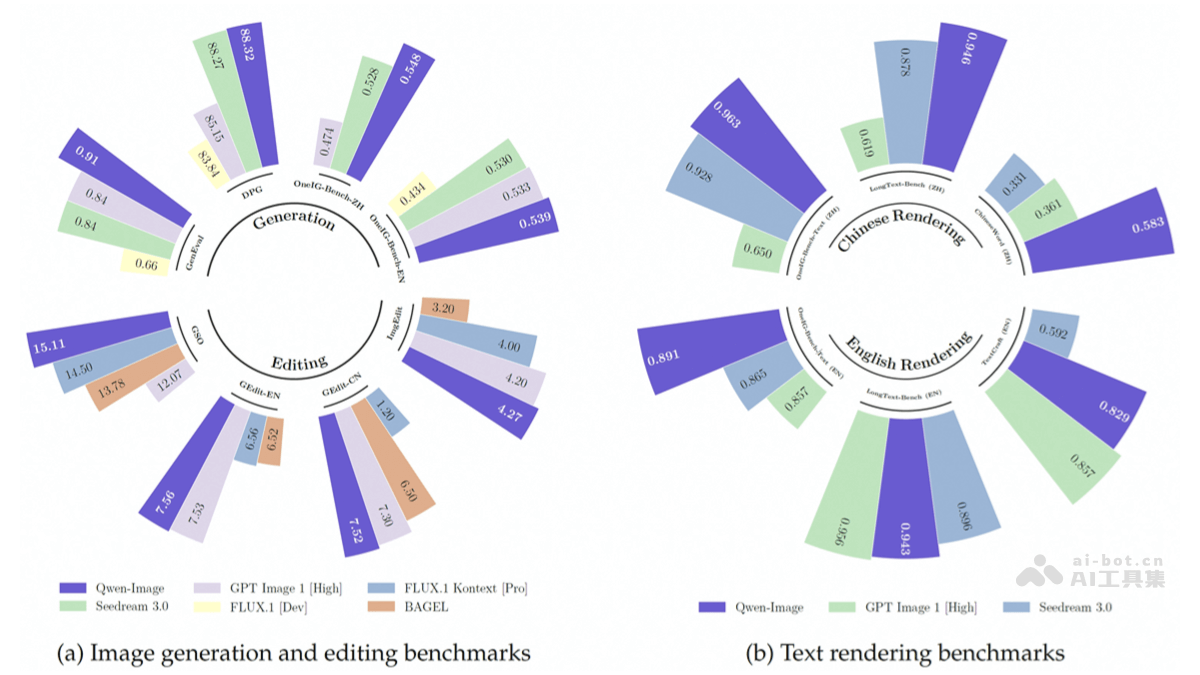
- Leading across multiple benchmarks: Qwen-Image achieved 12 state-of-the-art (SOTA) results in multiple public benchmarks, and is highly competitive in the fields of image generation and editing.
- Surpassing leading models: In general image generation tests (such as GenEval, DPG, and OneIG-Bench) and image editing tests (such as GEdit, ImgEdit, and GSO), Qwen-Image surpasses open-source models such as Flux.1 and BAGEL, and also surpasses closed-source models such as ByteDance's SeedDream 3.0 and OpenAI's GPT Image 1 (High). Qwen-Image achieves a relatively high level in both generation quality and editing capability.
- Text Rendering Capability Performance:
- Text Rendering Benchmark Tests: In benchmarks such as LongText-Bench, ChineseWord, and TextCraft, Qwen-Image performs particularly well, especially in Chinese text rendering, greatly leading existing state-of-the-art models such as SeedDream 3.0 and GPT Image 1 (High).
- Advantages in Chinese Text Rendering: Qwen-Image has unique advantages when handling Chinese text rendering, with more optimized technologies in language understanding, font generation, typesetting, etc., and can better adapt to the complexity and diversity of Chinese.
How to Use Qwen-Image
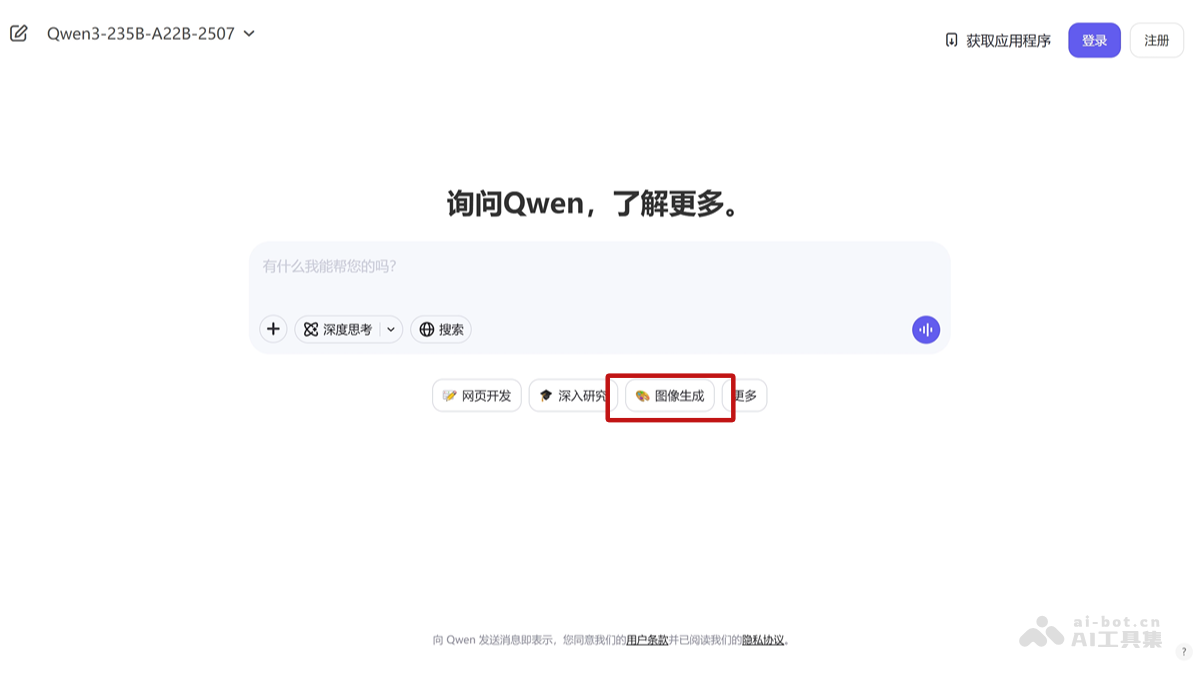
- Visit QwenChat: Visit Qwen Chat the official website.
- Select the Image Generation Feature: In the QwenChat interface, find and select the "Image Generation" feature.
- Enter a Text Prompt: Enter a description of the image you want to generate in the text input box.
- Generate the Image: Click the "Generate" button, and Qwen-Image generates an image based on the text prompt.
- View and Download the Generated Image: The generated image is displayed on the interface, allowing users to view the generated result and choose to download and save it locally.
Qwen-Image Project Address
- GitHub Repository:https://github.com/QwenLM/Qwen-Image
- HuggingFace Model Library:https://huggingface.co/Qwen/Qwen-Image
- Qwen-Image-2512:https://huggingface.co/Qwen/Qwen-Image-2512
- Technical Paper:https://qianwen-res.oss-cn-beijing.aliyuncs.com/Qwen-Image/Qwen_Image.pdf
- Online Experience Demo:https://huggingface.co/spaces/Qwen/Qwen-Image
Application Scenarios of Qwen-Image
- Content Creation: Quickly generate high-quality images, posters, and PPT pages based on text descriptions, greatly improving the efficiency and visual effects of creative design and presentation creation.
- Art and Design: The model can easily achieve style transfer and creative painting, providing artists and designers with a rich source of inspiration and accelerating the creation process of artworks.
- Education and Learning: By generating images related to teaching materials and language learning, it helps teachers impart knowledge more vividly and assists learners in better understanding and memory.
- Business and Marketing: In the business field, quickly generate attractive advertising images and brand promotion materials, effectively enhancing the appeal of advertisements and the market influence of brands.
- Entertainment and Gaming: Used to generate images of characters, scenes, and props in games, as well as special effects and concept art in film and television production, accelerating the creation cycle of entertainment content.