
What is Ornith-1.0
Ornith-1.0 is an open-source large model series launched by the DeepReinforce team, specifically designed for Agentic programming tasks. The models are based on Gemma 4 and Qwen 3.5 pre-trained foundations, adopting a self-improving training framework, and achieving SOTA-level performance among open-source models of the same tier on code generation and software engineering benchmarks.
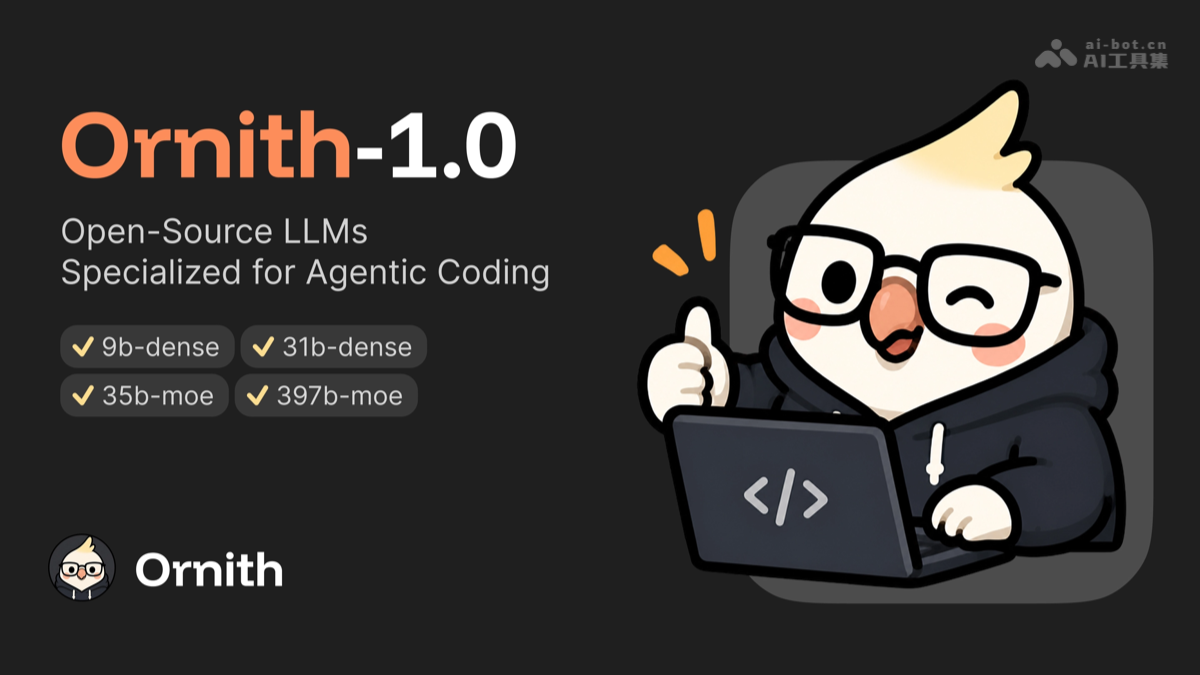
Main Features of Ornith-1.0
-
Full-Spec Coverage: Offers four specifications: 9B Dense, 31B Dense, 35B MoE, and 397B MoE, meeting full-scenario deployment needs from edge devices to flagship servers.
-
Agentic Programming: Optimized specifically for agentic programming tasks, supporting automated resolution of complex software engineering problems such as code repair, feature implementation, and terminal command execution.
-
Self-Improving Scaffold Generation: The model can autonomously generate task-specific scaffolds (harness), guiding and optimizing the search path for solutions.
-
Local Deployment Compatibility: Already available on HuggingFace, providing an OpenAI API-compatible interface and multiple local deployment options.

Follow WeChat and reply "Open Source" to join theAI Open Source Project Communication Group
Technical Principles of Ornith-1.0
-
Foundation Models: Post-training is performed based on the pre-trained weights of Gemma 4 and Qwen 3.5, inheriting their language understanding and code generation capabilities.
-
Self-Improving Training Framework: Unlike traditional RL that relies on manually designed scaffolds, Ornith-1.0 uses reinforcement learning to let the model jointly generate solution rollouts and task-specific harnesses, achieving collaborative optimization of the scaffold and the final solution.
-
Joint Optimization Mechanism: During training, task scaffolds and generated results are optimized simultaneously, enabling the model to autonomously discover better search trajectories and continuously improve output quality.
How to Use Ornith-1.0
-
Obtain the Model: Visit the HuggingFace platform and search for the Ornith-1.0 series to download the model weights of the corresponding specification.
-
Local Deployment: Choose the 9B (edge devices), 31B/35B, or 397B version according to hardware configuration.
-
API Calls: Use the OpenAI API-compatible interface to integrate into existing development workflows or Agent frameworks.
-
Task Configuration: For Agentic coding scenarios, connect the model to IDE plugins or automated software engineering pipelines.
Core Advantages of Ornith-1.0
-
Same-Tier SOTA: The 397B flagship version scored 77.5 on Terminal-Bench 2.1 and 82.4 on SWE-Bench Verified, surpassing Claude Opus 4.7.
-
Outperforming Higher Tiers: The 35B MoE version scored 64.4 on Terminal-Bench 2.1, surpassing the 397B-parameter Qwen 3.5-397B which scored 53.5, achieving more with less.
-
Edge-Friendly: The 9B model can be deployed in low-resource environments, with performance matching Gemma 4-31B and Qwen 3.6 35B.
Ornith-1.0 Project Address
- Project Official Website:https://deep-reinforce.com/ornith_1_0.html
- HuggingFace Model Repository:https://huggingface.co/collections/deepreinforce-ai/ornith-10
Comparison of Ornith-1.0 with Similar Competitors
| Comparison Dimension | Ornith-1.0 | DeepSeek-V4-Pro |
|---|---|---|
| Parameter Scale | 9B / 31B Dense, 35B / 397B MoE (full-series gradient coverage) | Ultra-large parameters (specific specifications not publicly broken down by gradient) |
| Open-source license | MIT(Fully open source, free for commercial use) | Open source (specific license subject to official terms) |
| Terminal-Bench 2.1 | 77.5(397B)/ 64.4(35B) | 67.9 |
| SWE-Bench Verified | 82.4(397B) | 80.6 |
| Core training method | Self-improving training framework: The model autonomously generates task harnesses and jointly optimizes them with solutions, reducing reliance on manual design | RLHF + rule-driven optimization: Relies on human feedback and preset rules for code optimization |
| Model positioning | Dedicated to Agentic programming: Designed specifically for agentic programming, terminal command execution, and software engineering automation | General-purpose open-source programming: Oriented toward a broad range of code generation and programming assistance tasks |
| Deployment flexibility | Full specification coverage: 9B can be deployed on edge devices, 397B is oriented toward server clusters | Mainly focuses on the ultra-large parameter version, with limited edge deployment |
Application scenarios of Ornith-1.0
-
Agentic programming assistant: As the core engine of an AI programmer, automatically handles GitHub Issue fixes, code review, and feature development.
-
Terminal command agent: Based on Terminal-Bench optimization capabilities, executes complex server operations and maintenance, data analysis, and automated scripting tasks.
-
Edge device code assistance: The 9B version can be integrated into local IDE plugins or offline development environments, providing real-time code completion for resource-constrained scenarios.
-
Enterprise-level software engineering: The 397B flagship version can be used for large codebase maintenance, cross-file refactoring, and complex software architecture design.