
What is MiniMax M2.7
MiniMax M2.7 is a new-generation self-evolving AI model launched by MiniMax. It can autonomously build an Agent Harness, optimize its own training process, and participate in iterating on itself. It performs outstandingly in software engineering, with the model scoring 56.22% on SWE-Pro, approaching the international top level, and supports complex tasks such as end-to-end project delivery, bug troubleshooting, and code security. At the same time, in the professional office domain, it achieved the highest open-source ELO score of 1495 on the GDPval-AA evaluation, and is proficient in high-fidelity editing of the Office trio. The model has excellent emotional intelligence and identity preservation capabilities, and has been fully launchedMiniMax Agentand the open platform.
Main features of MiniMax M2.7
- Self-evolution: MiniMax M2.7 can autonomously build an Agent Harness, enabling self-iteration and optimization of the model.
- Software engineering: Supports real engineering scenarios such as end-to-end project delivery, log analysis, bug localization, code refactoring, code security auditing, machine learning task development, and Android development.
- Professional office: Proficient in complex editing and multi-round high-fidelity modifications of Excel, PPT, and Word, and can autonomously read research reports, cross-compare information, build financial forecasting models, and generate professional PPT reports and Word documents based on templates.
- Agent collaboration: Has native multi-agent collaboration capabilities, supports role boundary preservation, adversarial reasoning, and protocol adherence, and can achieve team task division and collaboration without complex prompts.
- Tool use: Possesses complex Skill invocation and Tool Search capabilities, and can still maintain a 97% instruction-following rate in long-horizon interactions exceeding 2000 tokens, flexibly adapting to various contextual environments.
- Interactive entertainment: Has excellent identity preservation capabilities and emotional intelligence, supports natural conversational interaction, and can be applied to visual interactive scenarios such as OpenRoom.
Technical principles of MiniMax M2.7
- Self-evolving architecture: Based on the Agent Harness framework, the model autonomously builds a complex skill system including data pipelines, training environments, and evaluation infrastructure. Through the three modules of short-term memory, self-feedback, and self-optimization, it forms an iterative closed loop, executing an autonomous optimization cycle of analyzing failure trajectories, planning changes, modifying code, running evaluations, comparing results, and deciding whether to keep or roll back.
- Reinforcement learning-driven: The model builds dozens of complex skills in the RL Harness by itself and autonomously updates memory, systematically searches for the optimal combination of sampling parameters such as temperature and frequency penalty, and designs specific workflow guidance such as automatically searching for the same bug pattern after a fix.
- Native Agent Teams capabilities: Internalizes role boundaries, adversarial reasoning, and protocol adherence as native model capabilities rather than relying on prompt engineering, supporting autonomous decision-making and multi-agent collaboration in complex state machines.
- Long-horizon interaction stability: Relying on a persistent memory system, it can still maintain a 97% instruction-following rate across 40 complex skills exceeding 2000 tokens, ensuring reliable execution of multi-round complex tasks.
Project addresses for MiniMax M2.7
- Project official website:https://www.minimax.io/news/minimax-m27
- GitHub repository:https://github.com/MiniMax-AI/MiniMax-M2.7
- HuggingFace model library:https://huggingface.co/MiniMaxAI/MiniMax-M2.7
Key information and usage requirements for MiniMax M2.7
-
Publisher: MiniMax
-
Model positioning: The first self-evolving model deeply involved in iterating on itself
-
Core highlights: Self-evolution, software engineering, professional office work, Agent collaboration
-
Main benchmark results: SWE-Pro 56.22%, GDPval-AA ELO 1495 (highest among open-source), MM-Claw 62.7%
-
Launch status: Fully launched on MiniMax Agent and the open platform
-
Access method: MiniMax Agent or API service
Core advantages of MiniMax M2.7
- First-of-its-kind self-evolution capability: The industry's first model to deeply participate in its own iteration, capable of autonomously building Agent Harness, optimizing training processes, and updating its memory system, forming a complete self-evolution loop.
- Top-tier software engineering strength: Outstanding performance in real development scenarios, with SWE-Pro reaching 56.22%, approaching the international top level, supporting end-to-end project delivery, log analysis, bug localization, code security, and other complex tasks.
- Highest open-source office capability: GDPval-AA benchmark ELO score of 1495 is the highest among open-source models, proficient in high-fidelity editing of the Office suite, and can autonomously complete research report analysis, financial modeling, and professional report generation.
- Native Agent collaboration capability: Role boundaries, adversarial reasoning, and protocol adherence are internalized as native model capabilities, enabling multi-agent team collaboration without complex prompts.
- Ultra-long-horizon stable interaction: Maintains a 97% instruction-following rate across 40 complex skills each exceeding 2000 tokens, with persistent memory supporting reliable execution of multi-turn complex tasks.
How to use MiniMax M2.7
-
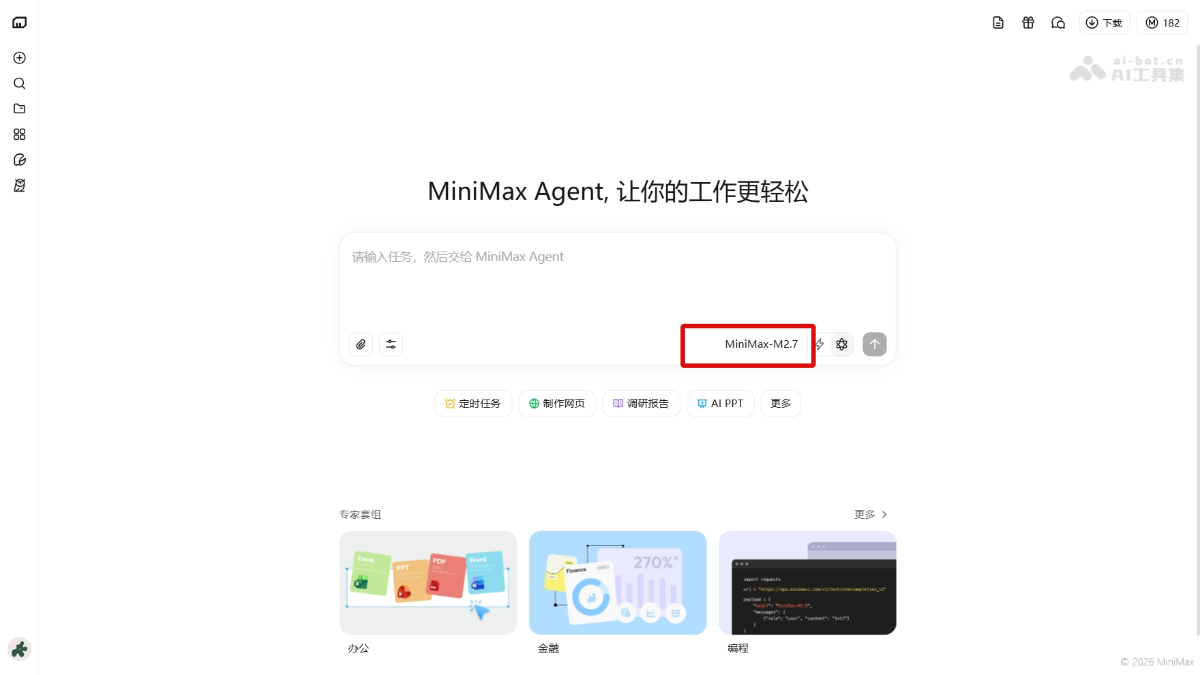
MiniMax Agent: Visit theMiniMax Agentofficial website to directly experience the model's conversational capabilities.
-
API service: Developers access the model's capabilities through http://platform.minimaxi.com/ .
Comparison of MiniMax M2.7 with similar competitors
| Dimension | MiniMax M2.7 | Claude Opus 4.6 | GPT-5.4 |
|---|---|---|---|
| Self-evolution | ✅ First-of-its-kind, model participates in its own iteration | ❌ None | ❌ None |
| SWE-Pro | 56.22% | About 56%+ | Specific score not disclosed |
| GDPval-AA | 1495 (highest among open-source) | About 1500+ (strongest among closed-source) | About 1490 |
| MM-Claw | 62.7% | Comparable level | No clear benchmark |
| Open-source status | Partially open-source | Closed-source | Closed-source |
| Available in China | ✅ Direct access | ⚠️ Requires proxy | ⚠️ Requires proxy |
| Core advantages | Self-evolution + real engineering + cost-effectiveness | Strongest overall + long context | General capabilities + rich ecosystem |
Application scenarios of MiniMax M2.7
- Software development: MiniMax M2.7 can independently complete the full software engineering workflow from requirements analysis to code delivery, including production environment troubleshooting and repair as well as mobile application building.
- Professional office work: MiniMax M2.7 excels at high-fidelity editing of the Office suite, can autonomously read research reports and build financial forecast models, and ultimately generate professional data analysis reports and presentation documents.
- Intelligent collaboration: MiniMax M2.7 supports multi-agent team collaboration mode, enabling role division, adversarial reasoning, and protocol adherence in complex projects, and can complete team task delivery without manual orchestration.
- Tool Automation: MiniMax M2.7 has powerful tool use capabilities, can maintain stable instruction adherence in long-horizon interactions, and automatically invoke various Skills to complete cross-system data integration and information research tasks.
- Interactive Entertainment: MiniMax M2.7 has excellent identity preservation capabilities and emotional intelligence, supports immersive role-playing and natural dialogue interaction, and can enable real-time scene exploration in visual spaces such as OpenRoom.