
What is MAI-Thinking-1
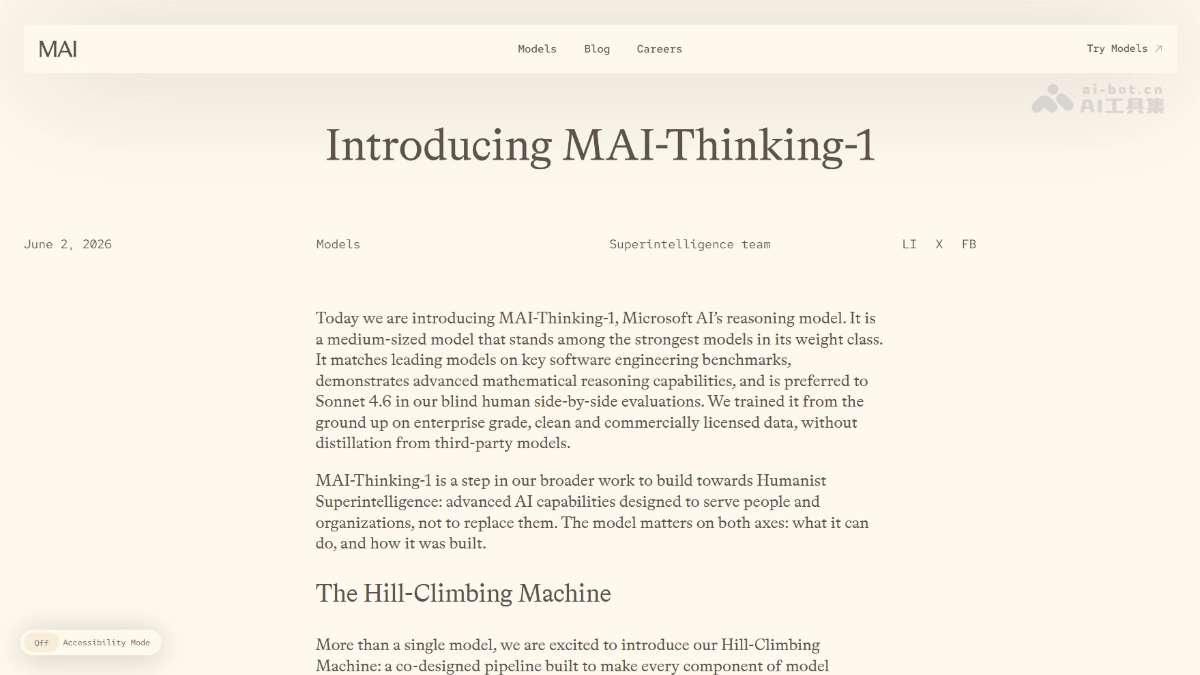
MAI-Thinking-1 is Microsoft's first self-developed advanced reasoning model. The model adopts a sparse MoE architecture with 35B active parameters / approximately 1T total parameters, trained from scratch entirely on clean, commercially licensed data, without using any third-party model distillation. It achieves industry-leading levels on key benchmarks such as SWE-Bench Pro and AIME 2025/2026, on par with Claude Opus 4.6 , and outperforms in blind tests Sonnet 4.6。
Main features of MAI-Thinking-1
-
Advanced mathematical and scientific reasoning: Achieves 97.0% on AIME 2025 and 94.5% on AIME 2026, with extremely strong STEM reasoning capabilities.
-
Intelligent software engineering: Achieves 52.8% on SWE-Bench Pro and 87.7% on LiveCodeBench v6, supporting multi-step code reading, editing, testing, and error recovery.
-
Ultra-long context processing: Supports a context window of up to 256K, capable of processing long documents and large-scale codebases.
-
Tool calling and Agent capabilities: Can call external tools and interact with environments to execute complex multi-step tasks.
-
Balance between safety and helpfulness: Simultaneously optimizes helpfulness and safety during RL training, reducing harmful outputs.
Technical principles of MAI-Thinking-1
- Sparse MoE architecture: MAI-Thinking-1 adopts a 78-layer Decoder-only Transformer, alternating between sparse MoE layers with 8/512 expert activation and dense FFN layers, combined with a 5:1 local/global attention mechanism, achieving performance close to 1T total parameters while maintaining 35B active parameters, significantly reducing KV Cache and computational overhead during inference.
- Data and pre-training: The model is pre-trained from scratch on 30T tokens of clean, commercially licensed data, strictly excluding AI-generated content and open-source training sets, and de-contaminating common benchmarks; mid-training additionally strengthens STEM, mathematics, and code capabilities, ultimately supporting a 256K ultra-long context.
- Reinforcement learning "hill climbing": Microsoft proposes the "Hill-Climbing Machine" concept, learning reasoning chains from scratch through a self-developed RL framework without relying on prior CoT distillation, conducting thousands of steps of continuous log-linear improvement respectively for the three domains of STEM reasoning, Agentic coding, and Helpfulness & Safety.
- Evaluation system: Internally establishes nearly 40 NLL benchmarks covering five major categories: code, STEM, mathematics, general knowledge, and multilingual, prioritizing negative log-likelihood non-multiple-choice evaluation to avoid format bias; simultaneously builds private benchmarks to prevent data contamination, ensuring evaluation results truly reflect model capabilities.
How to use MAI-Thinking-1
The specific usage methods and access channels of MAI-Thinking-1 have not yet been announced.
Core advantages of MAI-Thinking-1
-
Fully self-developed without distillation: Does not inherit design biases from third-party models, with stronger controllability and adaptability.
-
Medium scale, top performance: 35B active parameters can match larger models such as Claude Opus 4.6, with lower inference costs and more flexible deployment.
-
Data is pure and traceable: Excludes AI-generated content, ensuring model behavior is interpretable and improvable.
-
Full-stack autonomous and controllable: From Microsoft's self-developed accelerators to training frameworks and RL environments, all are built internally, enabling end-to-end optimization.
-
Continuous evolution capability: The climbing machine architecture supports absorbing better data, stronger rewards, and more compute, enabling continuous improvement of capabilities.
Project address of MAI-Thinking-1
- Project official website:https://microsoft.ai/news/introducing-mai-thinking-1/
- Technical paper:https://microsoft.ai/wp-content/uploads/2026/06/main_20260602_2.pdf
Comparison of MAI-Thinking-1 with similar competitors
| Dimension | MAI-Thinking-1 | Claude Opus 4.6 | DeepSeek-R1 |
|---|---|---|---|
| Architecture | 35B active / 1T total parameters MoE | Undisclosed (large dense model) | 37B active / 671B total parameters MoE |
| Training method | Trained from scratch, no distillation | Undisclosed | Distilled based on DeepSeek-V3 |
| SWE-Bench Pro | 52.8% | ~52.8% (on par) | About 49-50% |
| AIME 2025 | 97.0% | Not specified | About 79.8% |
| Context length | 256K | 200K | 128K |
| Data strategy | Pure commercial data, no AI-generated content | Not specified | Open source + synthetic data |
| Full-stack autonomy | Yes (Microsoft self-developed hardware to framework) | No (Anthropic) | Partial (depends on NVIDIA ecosystem) |
Application scenarios of MAI-Thinking-1
-
Enterprise-level software development: Assists developers in code review, bug fixing, feature implementation, and automated testing.
-
Scientific research and complex computation: Solves complex reasoning problems in advanced mathematics, physics, chemistry, etc.
-
Long document analysis and knowledge management: Deep understanding and summarization of ultra-long texts such as legal contracts, technical documents, and papers.
-
AI Agent workflows: As a core reasoning engine, drives Agent tasks such as automated office work, data analysis, and system operations and maintenance.