
What is Claude Sonnet 4.6
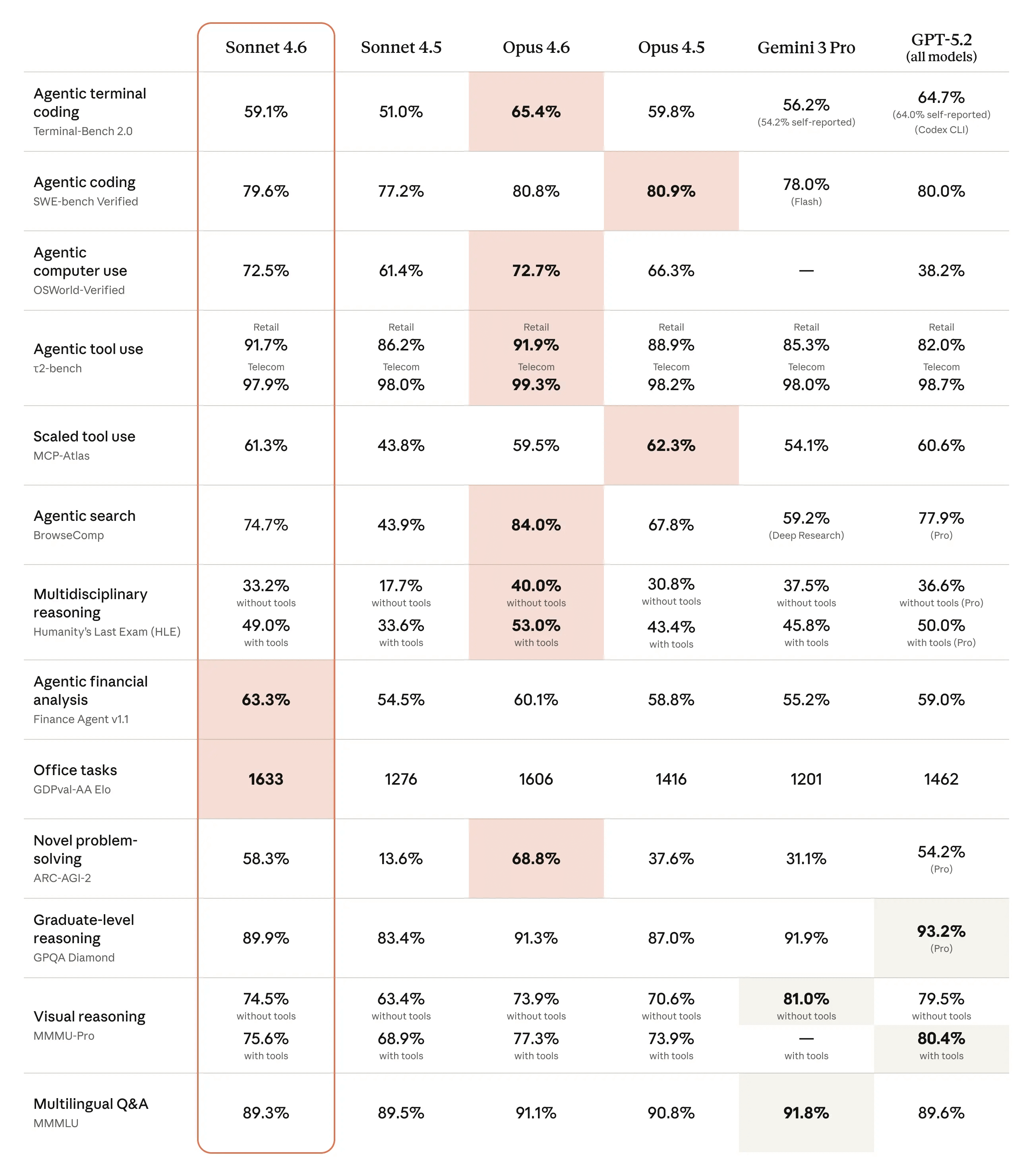
Claude Sonnet 4.6 is the latest generation AI model released by Anthropic, positioned at the balance point of "high performance and high cost-effectiveness." It achieves comprehensive upgrades in core capabilities such as programming, computer operation, long-text reasoning, and agent planning, with performance approaching the flagship Opus 4.6 level, while API pricing is only one-fifth of it. Sonnet 4.6 supports a 1 million token ultra-long context window, can process an entire codebase or dozens of papers in a single pass, and introduces an "adaptive thinking" mechanism that can dynamically allocate reasoning resources according to task complexity. In the OSWorld computer use benchmark, the score jumped from 61.4% in version 4.5 to 72.5%, approaching human level.
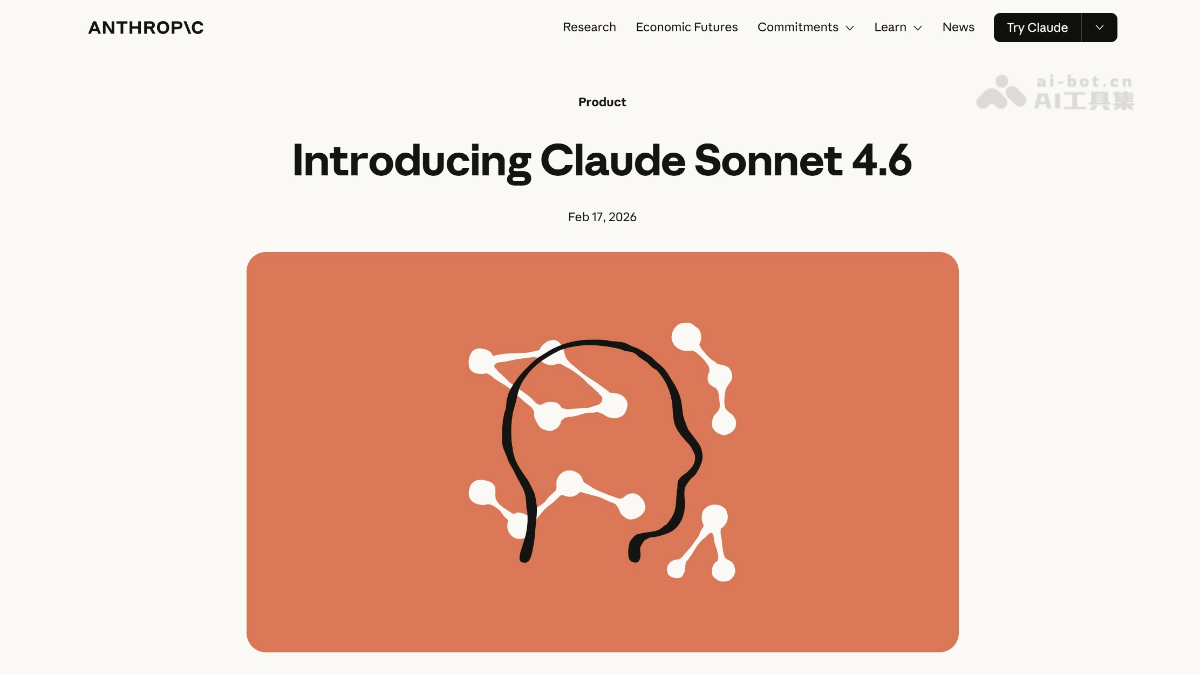
Main features of Claude Sonnet 4.6
- Intelligent programming assistant: Achieves 79.6% on the SWE-bench Verified programming benchmark, supports code generation, debugging, refactoring, and multi-file project understanding, and can handle complex software engineering tasks.
- Computer use capability: Has advanced GUI automation operation capabilities, scoring 72.5% on the OSWorld benchmark, and can perform complex tasks such as filling out web forms, navigating spreadsheets, and cross-application operations.
- Ultra-long context processing: The beta supports a 1 million token context window (twice that of the previous generation), and a single request can analyze an entire codebase, long legal contracts, or dozens of research papers.
- Adaptive thinking reasoning: Introduces the Adaptive Thinking mechanism, allowing the model to automatically allocate computational resources according to task complexity, replacing the fixed-mode "extended thinking" switch.
- Multimodal understanding: Supports visual analysis of images, charts, and documents, and can interpret complex data visualizations and generate structured insights.
- Agent planning and execution: Achieves an Elo score of 1633 on the GDPval office task test, and supports multi-step task decomposition, tool calling, and autonomous decision-making.
-
Long-text reasoning: Scores 58.3%-60.4% on the ARC-AGI-2 reasoning benchmark, achieving a qualitative leap compared with 13.6% in version 4.5.
Technical principles of Claude Sonnet 4.6
-
Mixture of Experts architecture (MoE): Adopts a sparsely activated Mixture of Experts architecture, with a total parameter count of 1 trillion, activating only 32 billion parameters per forward pass, improving inference efficiency while maintaining high performance.
-
Adaptive Thinking mechanism (Adaptive Thinking): Introduces a dynamic computation allocation system, allowing the model to automatically adjust reasoning depth according to task complexity, replacing the fixed-mode "extended thinking" switch and enabling intelligent scheduling of computational resources.
-
Ultra-long context window: The beta supports a 1 million token context, and through optimized attention mechanisms and positional encoding techniques, it achieves efficient processing and memory retention of ultra-long documents.
-
Computer use training: Trained on large-scale GUI interaction data, combined with visual perception and action prediction, enabling the model to understand interface elements and perform precise operations such as mouse clicks and keyboard input.
-
Multimodal fusion architecture: Integrates text, images, and structured data into a unified representation space, supports cross-modal information association and reasoning, and improves understanding of visual content such as charts and screenshots.
-
Agent framework integration: Built-in tool calling interface and task planning module, supporting the autonomous decision-making loop of the ReAct (Reasoning-Acting) paradigm, enabling decomposition and execution of complex multi-step tasks.
Claude Sonnet 4.6 Benchmarks
-
Coding Ability (SWE-bench Verified): Scored 79.6%, a further improvement over Sonnet 4.5's 77.2%, approaching Opus 4.6's level, with excellent performance in code generation, debugging, and software engineering tasks.
-
Computer Use (OSWorld-Verified): Scored 72.5%, a significant increase of nearly 20% over version 4.5's 61.4%, approaching human-level GUI automation capabilities.
-
Reasoning Ability (ARC-AGI-2): Scored 58.3%-60.4%, a qualitative leap over version 4.5's 13.6%, demonstrating strong abstract reasoning and problem-solving abilities.
-
Office Tasks (GDPval): Elo rating reached 1633, a significant improvement over 4.5's 1276, with outstanding performance in document processing, data analysis, and daily office automation.
-
Multimodal Understanding (MMMU): Scored 74.7%, maintaining a leading level in visual question answering and cross-modal reasoning tasks.
-
Developer Preference Testing: 70% of developers reported it outperformed Sonnet 4.5, and it performed better than Opus 4.5 in 59% of tests, receiving high recognition for instruction following and hallucination reduction.
Claude Sonnet 4.6 Project Address
- Project Official Website:https://www.anthropic.com/news/claude-sonnet-4-6
Claude Sonnet 4.6 Model Pricing
-
Standard Input Pricing: $3/million tokens (on par with Sonnet 4.5), applicable to regular context requests within 200K tokens.
-
Standard Output Pricing: $15/million tokens, maintaining the same price level as the previous generation.
-
High-Context Input Pricing(>200K tokens): $6/million tokens, differentiated pricing for ultra-long document processing scenarios (such as 1 million token context).
-
High-Context Output Pricing(>200K tokens): $22.5/million tokens, supporting long-text tasks such as complete codebase analysis and lengthy contract review.
-
Cost-Effectiveness Advantage: Performance is close to the flagship Opus 4.6 (input $15/million tokens, output $75/million tokens), but the price is only one-fifth of it, positioning it as a cost-effective choice in the mid-range market.
-
Available in Free Version: It has become the default model of Claude.ai's free version, allowing individual users to experience core features at no cost.
-
API Model ID:
claude-sonnet-4-6, developers can call it directly through the Anthropic API.
Claude Sonnet 4.6 Application Scenarios
-
Software Development and Programming: Supports code generation, debugging, refactoring, code review, and multi-file project understanding, suitable for full-stack development, automated script writing, and complex software engineering tasks.
-
Intelligent Office Automation: Executes document processing, data analysis, spreadsheet operations, email writing, and schedule management, with an Elo rating of 1633 in the GDPval office task test.
-
Computer Operation and GUI Automation: Automatically completes web form filling, cross-application data migration, interface navigation, and complex multi-step operation workflows, with an OSWorld test score of 72.5%.
-
Long Document Analysis and Knowledge Management: Utilizes a 1 million token context window to process complete codebases, lengthy legal contracts, academic paper collections, and large technical documents, achieving deep content understanding.
-
Intelligent Customer Service and Dialogue Systems: As the default model for Claude.ai Free and Pro, it provides natural language interaction, question answering, and personalized dialogue services.
-
Multimodal Content Analysis: Interprets charts, screenshots, PDF documents, and visual data to generate structured insights, suitable for business report analysis and data visualization understanding.