
What is IQuest-Q1
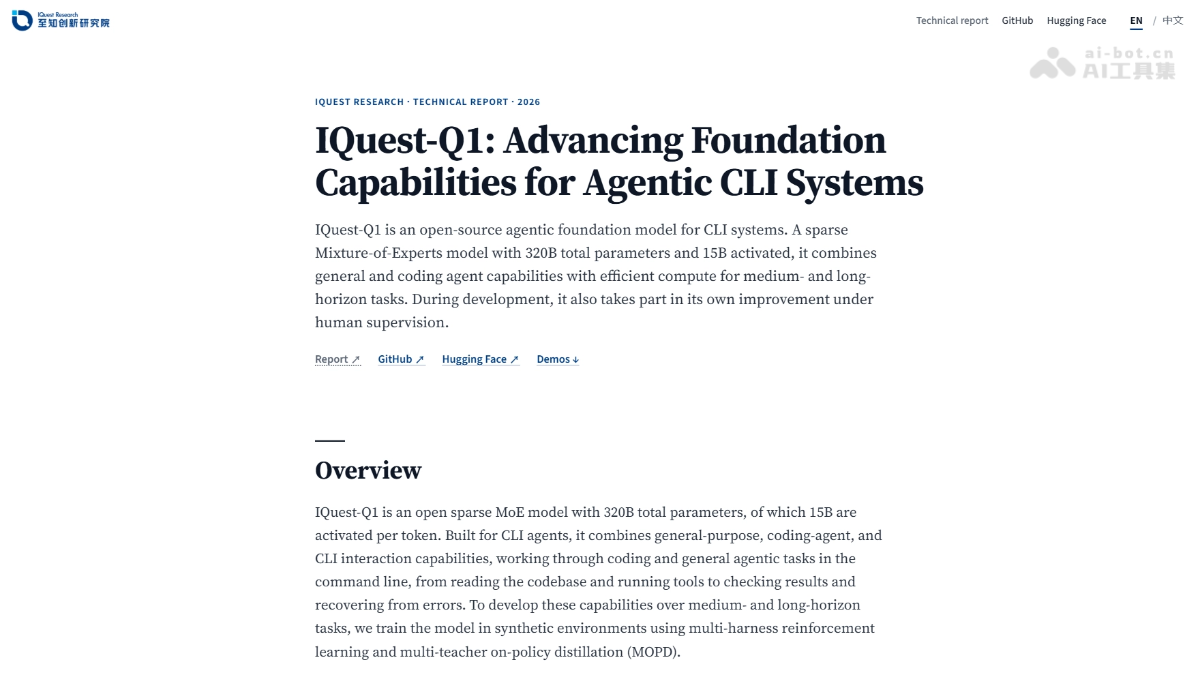
IQuest-Q1 is an Agent foundation model open-sourced by Zhizhi Innovation Research Institute, focusing on code and agent tasks. IQuest-Q1 adopts a sparse MoE architecture, with a total of 320B parameters and only 15B activated per token, resulting in low inference cost. IQuest-Q1 is trained in synthetic environments through multi-harness reinforcement learning and multi-teacher online distillation (MOPD), and can be integrated withClaude CodeorCodex, ranking among the top on benchmarks such as NL2Repo and CyberGym, with balanced overall performance, excelling at frontend generation, office automation, and AI R&D diagnosis.
Main features of IQuest-Q1
-
Repository-level code generation: A one-sentence requirement can generate a complete runnable multi-file project, ranking in the first tier of open-source models on the NL2Repo benchmark.
-
CLI agent operation: It can read and write code repositories, invoke command-line tools, check results, and recover from errors, and can seamlessly integrate with Claude Code and Codex.
-
Frontend interactive application generation: It generates runnable web applications containing 3D scenes, interaction logic, and visual presentation in one pass, such as FPS games, racing games, voxel underwater cities, etc.
-
Full-process office automation: Through Feishu lark-cli, it cross-checks chat records and documents to complete a full closed loop of event grading, report writing, task assignment, and progress tracking.
-
AI R&D self-diagnosis: It can trace anomalies in reinforcement learning training, locate root causes, fix code, and verify results with new metric curves.
-
Multi-step complex task execution: For medium- and long-horizon tasks, it can autonomously advance for hours, covering scenarios such as cybersecurity and terminal operations.
Technical principles of IQuest-Q1
- Sparse MoE architecture: The model adopts a decoder-only Transformer backbone plus a sparse mixture-of-experts structure, with a total of about 320B parameters, but only about 15B parameters activated per token.
- Staged training process: Training is divided into three stages: pretraining, midtraining, and post-training: pretraining establishes general capabilities and world knowledge; midtraining shifts the data distribution toward code and STEM and adds long-context agent trajectories; post-training performs specialized SFT and reinforcement learning convergence around software engineering, long-horizon tasks, and general reasoning.
- Synthetic environments and multi-harness reinforcement learning: The team synthesizes tasks in executable environments built from real APIs, MCP servers, and repositories, allowing a single policy to train across multiple harnesses, preserving their respective tools and context management methods, so that what the model learns is not only problem solving itself, but also behavioral patterns for working in real agent systems; before optimization, failure attribution is performed first, and only the model's own errors become learning signals.
- MOPD multi-teacher online distillation: Reinforcement learning produces specialized models in four directions: agent experience, multi-harness collaboration, long-horizon tasks, and general agent work; MOPD has a student model initialized from an SFT checkpoint learn on its own trajectories, scored token by token by the corresponding experts, and then through staged stable model merging, multiple experts are folded and converged into a single IQuest-Q1.
- Human-machine collaborative self-evolving R&D process: During R&D, the model participates in its own capability diagnosis, training scheme design, and part of experiment execution, while human researchers are responsible for key decisions such as direction adjustment, high-cost experiments, and version adoption; after each round of validation, model updates, training assets, and processes are retained for direct reuse in the next round, forming a closed loop of continuous iteration.

Follow WeChat and reply "Open Source" to jointhe AI Open Source Project Exchange Group
How to Use IQuest-Q1
- Get Model Weights: Download the model weights and inference code from the Hugging Face or GitHub repository. The ModelScope channel will be available soon.
- Deploy Inference Service: Use SGLang or vLLM to launch an OpenAI-compatible inference service. This requires 8-GPU tensor parallelism (TP=8), bfloat16 precision, and loading the IQuest-specific tool-call and reasoning parsers.
- Acceleration and Parameter Tuning (Optional) If higher throughput is needed, enable recursive MTP speculative decoding. To reproduce the official evaluation, temperature=1.0, top-p=0.95, and top-k=20 are recommended.
- Call the Model Directly Send requests directly through the Python API or an OpenAI-compatible interface, using the IQuest-format chat template for tool calling and reasoning.
- Integrate with Agent Tools: Connect through a gateway that supports tool calling Claude Codeor Codex CLI. After setting the gateway address and API Token, IQuest-Q1 can drive agents to complete tasks.
Core Advantages of IQuest-Q1
- Extreme Inference Efficiency: 320B total parameters but only 15B activated per token, achieving flagship-level task capabilities at an inference cost close to that of a small model.
- Balanced and Comprehensive Performance: Ranks consistently high across all eight benchmarks, including DeepSWE, NL2Repo, CyberGym, Terminal-Bench, and JobBench, with no capability gaps.
- Outstanding Code Capabilities: Repository-level generation scores 63.0 on NL2Repo, surpassing DeepSeek-V4-Pro and Hunyuan Hy4, placing it in the first tier of open-source models.
- Real Agent Loop: Not only generates code, but also reads logs, calls tools, recovers from errors, and delivers verifiable final results.
-
One-Click Integration with Mainstream Agents: Provides an OpenAI-compatible interface and official Docker images, and can be directly swapped into Claude Code and Codex.
IQuest-Q1 Project Address
- Project Official Website:https://iquestlab.github.io/
- GitHub Repository:https://github.com/IQuestLab/IQuest-Q1
- HuggingFace Model Library:https://huggingface.co/IQuestLab/IQuest-Q1
Comparison of IQuest-Q1 with Similar Competitors
| Comparison Dimension | IQuest-Q1 (Zhizhi Innovation) | DeepSeek-V4.1-Flash (DeepSeek) |
|---|---|---|
| Architecture | Sparse MoE, decoder-only Transformer | Sparse MoE |
| Total/Activated Parameters | 320B / 15B | Not fully public (Flash is the efficient inference tier) |
| Positioning | Open-source foundation model specialized for CLI agents | Lightweight inference version of a general-purpose flagship |
| DeepSWE v1.1 | 64.3 | 74.2 (Win) |
| NL2Repo | 63.0 (Win) | Not ranked/61.5 (Pro version) |
| CyberGym | 84.5 | 88.1 (Win) |
| Agents’ Last Exam | 29.6 | 31.8 (Win) |
| Humanity’s Last Exam | 39.2 | 38.6 (IQuest slightly ahead) |
Application Scenarios of IQuest-Q1
-
Intelligent Programming Development: Generate a complete runnable multi-file project from a single sentence. It can autonomously read code, fix bugs, and run tests within Claude Code / Codex, delivering verifiable engineering results.
-
Interactive Web Page and Game Generation: Produce 3D games, visualization tools, design pages, and other front-end applications in one go based on text descriptions, covering scene construction, interaction logic, and visual presentation.
-
Office Process Automation: Use Feishu lark-cli to connect chat, documents, spreadsheets, and meetings, completing the full process of cross-verification of information, event grading, report writing, task assignment, and progress tracking.
-
AI R&D and Training Operations: Automatically diagnose model training anomalies, identify root causes and fix code, and assist AI teams in maintaining and optimizing their own R&D pipelines.