
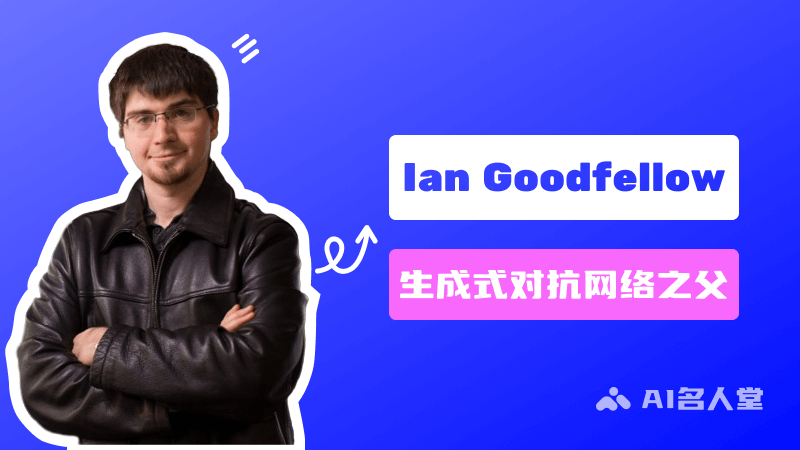
Ian J. Goodfellow (born in 1985 or 1986) is an American computer scientist, engineer, and executive, best known for his work in artificial intelligenceneural networksanddeep learning. He previously served as a research scientist at Google Brain and head of machine learning at Apple, and has made several important contributions in the field of deep learning, includingthe invention of generative adversarial networks (GANs). Goodfellow co-authored the textbook hailed as the AI bible,"Deep Learning"(2016), and wrote the chapter on deep learning in the most popular textbook in the field of artificial intelligence,"Artificial Intelligence: A Modern Approach"(used in more than 1,500 universities in 135 countries).
Education
Ian Goodfellow received his bachelor's and master's degrees in computer science from Stanford University under the supervision of Andrew Ng (co-founder and head of Google Brain, co-founder of Coursera), and in April 2014 received his doctorate in machine learning from the University of Montreal under the supervision ofYoshua Bengioand Aaron Courville. Goodfellow's thesis topic was deep learning of representations and its application to computer vision.
Work Experience
After graduation, Goodfellow joined Google as a member of the Google Brain research team. In March 2016, he left Google to join the newly established OpenAI research laboratory. Just 11 months later, in March 2017, Goodfellow returned to Google Research, but left again in 2019.
In 2019, Goodfellow joined Apple as head of machine learning in the Special Projects Group. He resigned from Apple in April 2022 to protest Apple's plan to require employees to work in person. Goodfellow then joined DeepMind as a research scientist.
Goodfellow is best known for inventing generative adversarial networks (GANs), which use deep learning to generate images. This method uses two neural networks to competitively improve the quality of images. The "generator" network creates synthetic images based on an initial image set (such as a set of faces). The "discriminator" network tries to detect whether the generator's output is real or fake. The generation-detection cycle is then repeated. For each iteration, the generator and discriminator use each other's feedback to improve or detect the generated images, until the discriminator can no longer distinguish between the fakes generated by its opponent and the real ones. The ability to create high-quality generated images improved rapidly. However, so did its malicious abuse, to create deepfakes and generate video-based disinformation.
At Google, Goodfellow developed a system that enabled Google Maps to automatically transcribe addresses in photos taken by Street View cars, and demonstrated security vulnerabilities in machine learning systems.