
What is GPT-5.1-Codex-Max
GPT-5.1-Codex-Max is an intelligent codingcodingmodel introduced by OpenAI, designed specifically for complex, long-horizon development tasks. The model is based on an updated reasoning architecture and, through "compression" technology, spans multiple context windows, enabling it to handle large-scale tasks involving millions of tokens, such as project-level refactoring and deep debugging. The model performs excellently on real software engineering tasks, such as code review and front-end development, and runs well in Windows environments. The model significantly improves token efficiency and reduces development costs. GPT-5.1-Codex-Max has been integrated into Codex , supporting CLI, IDE extensions, cloud, and code review, with API access coming soon.
Main Features of GPT-5.1-Codex-Max
-
Long-horizon task handling: GPT-5.1-Codex-Max is the first model capable of spanning multiple context windows. Through "compression" technology, it maintains coherence in long-horizon tasks, supporting project-level refactoring, deep debugging, and multi-hour continuous development.
-
Efficient code generation: It performs excellently on real software engineering tasks, such as code review, front-end development, and PR creation, generating high-quality code while significantly reducing development costs.
-
Multi-environment support: It supports the Windows environment for the first time, optimizes collaboration capabilities in Codex CLI, and is suitable for a variety of development scenarios.
-
Improved reasoning efficiency: At the same reasoning intensity, compared with previous-generation models, GPT-5.1-Codex-Max uses fewer thinking tokens while providing higher accuracy and performance.
-
Security and trustworthiness: It shows improved performance in long-horizon reasoning tasks such as cybersecurity, enhancing defense capabilities through projects such as Aardvark .
Technical Principles of GPT-5.1-Codex-Max
-
Multi-context window "compression" technology: By compressing historical information, the model can automatically clear space when approaching the context window limit while retaining key context, supporting the continuation of long-horizon tasks.
-
Updated reasoning architecture: Based on OpenAI's latest foundational reasoning model, it has been trained on a large number of software engineering, mathematics, and research tasks, making it perform more intelligently on complex tasks.
-
Efficient token management: By optimizing the reasoning process and reducing unnecessary token usage, it provides higher efficiency and lower cost in non-latency-sensitive tasks.
-
Cross-platform optimization: The model has been specially trained to adapt to the Windows environment and optimizes collaboration capabilities in Codex CLI , making it more suitable for real development scenarios.
Performance of GPT-5.1-Codex-Max
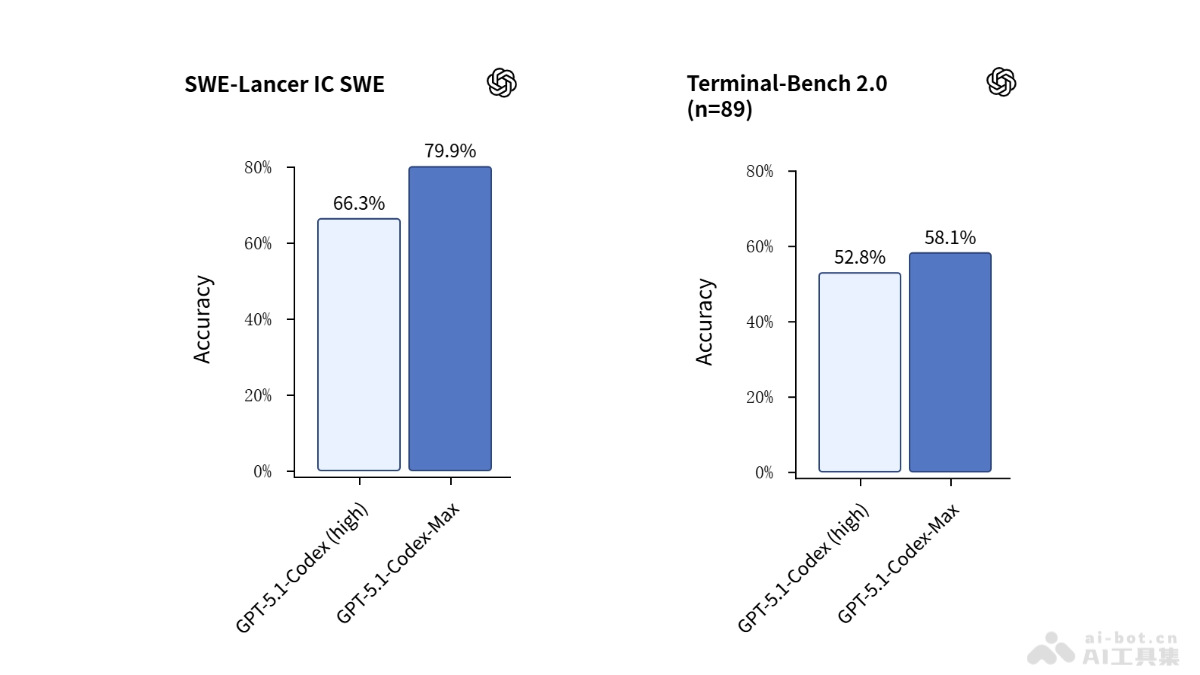
In the SWE-Lancer IC SWE test, the accuracy of GPT-5.1-Codex-Max improved from 66.3% to 79.9%; in Terminal-Bench 2.0, accuracy improved from 52.8% to 58.1%.
Project Address of GPT-5.1-Codex-Max
- Project official website:https://openai.com/index/gpt-5-1-codex-max/
Application Scenarios of GPT-5.1-Codex-Max
-
Code refactoring: The model supports large-scale code refactoring, spanning context windows through compression technology, optimizing code structure, and improving code quality.
-
Code debugging: The model can perform deep code debugging, continuously track and fix complex issues, and reduce debugging time and labor costs.
-
Code generation: The model can generate high-quality front-end and back-end code, optimize code performance, reduce development costs, and improve development efficiency.
-
Code Review: Automatically perform code reviews, provide detailed comments, help developers discover potential issues, and improve code quality.
-
CI/CD Process: Automatically fix code issues in continuous integration and continuous deployment, ensuring code passes tests smoothly and is quickly released.