
What is GPT‑5.3‑Codex‑Spark
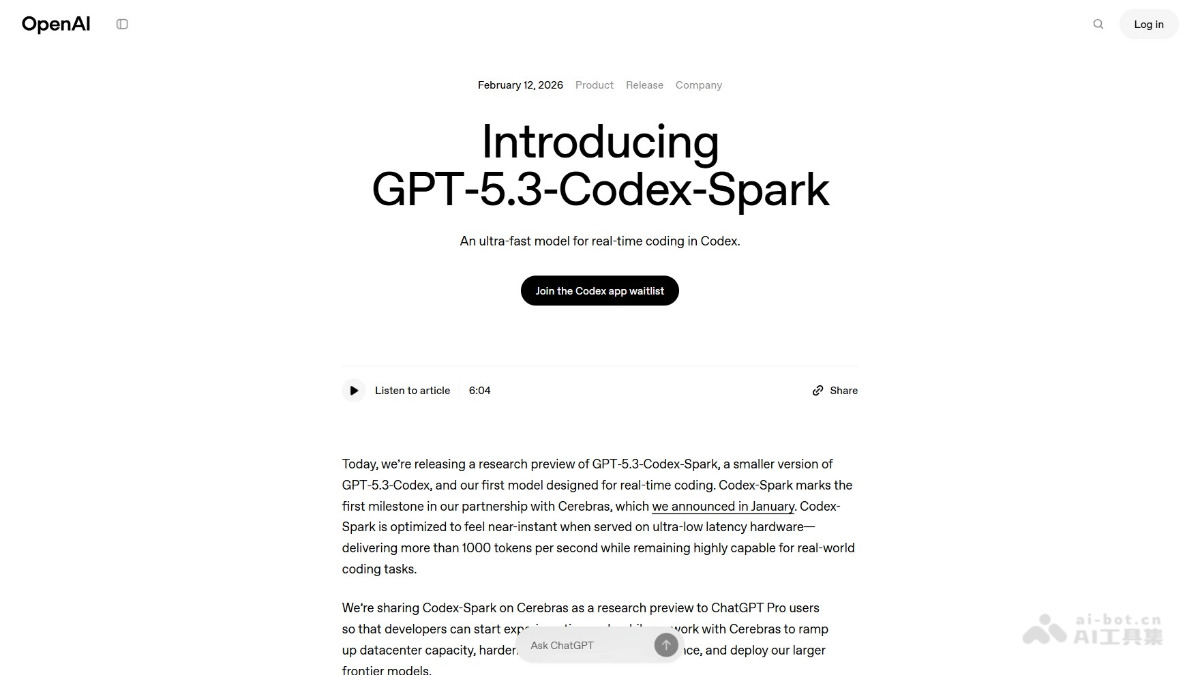
GPT-5.3-Codex-Spark is OpenAI's first model designed specifically for real-timeprogramminglightweight model, focused on extreme speed. The model runs on the Cerebras WSE-3 wafer-scale chip, with inference speeds exceeding 1000 tokens/second and support for a 128k context. Unlike Codex, which excels at long-running autonomous tasks, GPT-5.3-Codex-Spark focuses on instant collaboration scenarios, allowing interruption and correction while output is being generated, making coding interaction more "responsive." OpenAI restructured the underlying inference stack, reducing latency by 80%. Codex-Spark has been launched as a research preview to ChatGPT Pro users and can be used in the latest version of the Codex app, CLI, and VS Code extension.
Main features of GPT‑5.3‑Codex‑Spark
- Real-time coding collaboration: The model allows developers to interrupt, correct, or redirect while observing the model's output, delivering a "responsive" instant interaction experience.
- Ultra-fast inference: Supports running on the Cerebras WSE-3 wafer-scale chip, with inference speeds exceeding 1000 tokens/second, optimized specifically for ultra-low-latency scenarios.
- Precise code editing: By default, the model adopts a lightweight working style, making only minimal, targeted code changes to quickly adjust logic, interfaces, or structure.
- Low-latency architecture optimization: By introducing persistent WebSocket connections, rewriting the inference stack, and optimizing the Responses API, client/server round-trip overhead is reduced by 80%, per-token overhead is reduced by 30%, and time to first token is shortened by 50%.
- Large context handling: Supports a 128k context window, enabling real-time analysis and modification of large codebases.
- Dual-mode collaboration: As OpenAI's first real-time coding model, it will in the future merge with the long-horizon reasoning Codex standard version, enabling real-time interaction and background long-running tasks in parallel, automatically balancing interaction speed and task breadth.
- Multi-platform access: Integrated into the Codex app, CLI command-line tool, and VS Code extension, making it convenient for developers to use in different scenarios.
Technical principles of GPT‑5.3‑Codex‑Spark
- Dedicated AI accelerator architecture: Supports running on the Cerebras Wafer Scale Engine 3 (WSE-3) wafer-scale engine, an AI accelerator designed specifically for high-throughput, low-latency inference, achieving extreme parallel computing capability through full-wafer-scale integration.
- Lightweight model design: As aGPT-5.3-Codexdistilled version, it uses a smaller parameter scale, greatly reducing computational load while maintaining core coding capabilities, achieving a balance between speed and performance.
- End-to-end latency optimization: Restructures the complete request-response chain, introducing persistent WebSocket connections to replace traditional HTTP polling, reducing connection establishment overhead; rewrites key inference stack components to optimize token generation and transmission efficiency; improves the session initialization mechanism to shorten time to first token.
- Streaming response mechanism: Optimizes streaming transmission of responses from server to client, enabling tokens to be pushed in real time, combined with incremental rendering to achieve visually instant feedback.
- Targeted fine-tuning strategy: Trained specifically for real-time interaction scenarios, strengthening efficiency in handling short-cycle tasks such as local code editing and rapid logic adjustment, while weakening the tendency toward long-chain autonomous execution.
Project address for GPT‑5.3‑Codex‑Spark
- Project official website:https://openai.com/index/introducing-gpt-5-3-codex-spark/
Application scenarios of GPT‑5.3‑Codex‑Spark
- Instant code debugging: After developers discover a bug, they can immediately invoke Spark to quickly locate and fix it, without waiting for the model to think for a long time, verifying the effects of modifications while interacting.
- Rapid UI iteration: During UI/UX development, styles, layouts, or interaction logic can be adjusted frequently, shortening the design-feedback loop.
- Code review and optimization: The model can review existing code line by line, and users can immediately receive improvement suggestions and apply targeted refactoring, maintaining full control over the modification process throughout.
- Learning and exploring programming : When programming beginners or those studying new libraries explore API usage and understand code logic through real-time dialogue, the model's instant responses reduce cognitive interruptions.
- Rapid prototype validation: When quickly building an MVP in the early product stage, users can describe requirements while watching code being generated, accelerating the transformation from concept to runnable code.