
What Is GPT-5.3 Codex
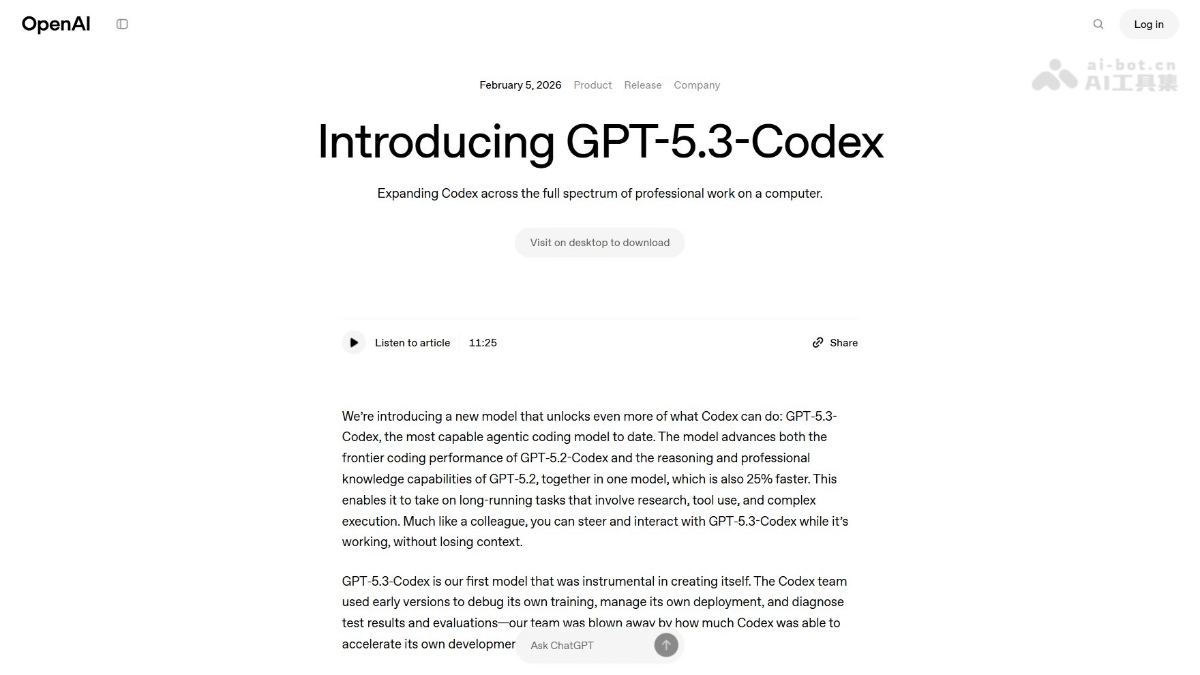
GPT-5.3-Codex is OpenAI's flagship intelligent coding model, integrating programming capabilities with specialized reasoning knowledge, delivering a 25% speed improvement and halving token consumption. The model sets new industry highs on benchmarks such as SWE-Bench Pro and Terminal-Bench 2.0, and supports long-horizon autonomous task execution and real-time human-AI collaboration. For the first time, the model enables AI to participate in its own development and training, marking the evolution of agents from "writing code" to "full-process computer operation," capable of handling the entire software engineering lifecycle, including debugging, deployment, documentation writing, and data analysis.
GPT-5.3 Codex's Main Features
- Coding Development: GPT-5.3-Codex possesses autonomous software engineering capabilities, can complete real development tasks in multilingual environments, and supports long-cycle iteration and complex full-stack project construction.
- Terminal Operation: The model masters strong command-line tool usage skills and can efficiently execute various terminal commands and script operations.
- Visual Computer Operation: Through visual perception of the desktop environment, GPT-5.3-Codex can click, type, and navigate like a human to complete GUI automation tasks.
- Real-Time Collaborative Interaction: It proactively reports progress during work, and users can intervene at any time to discuss and adjust direction, enabling human-AI collaboration without losing context.
- Cybersecurity Capabilities: As the first cybersecurity model to receive a "high capability" rating, it can identify software vulnerabilities and achieve excellent results in capture-the-flag competitions.
- Self-Improvement Development: Early versions have already participated in their own training, debugging, and deployment management, achieving bootstrapped acceleration of model iteration.
- Infrastructure Optimization: Running on NVIDIA GB200 systems, inference speed is increased by 25%, and dynamic GPU scaling is supported to ensure service stability.
How to Use GPT-5.3 Codex
GPT-5.3-Codex is now available to ChatGPT paid plans and supports all Codex-available scenarios: app, command-line interface, integrated development environment extensions, andweb。
GPT-5.3 Codex's Performance
-
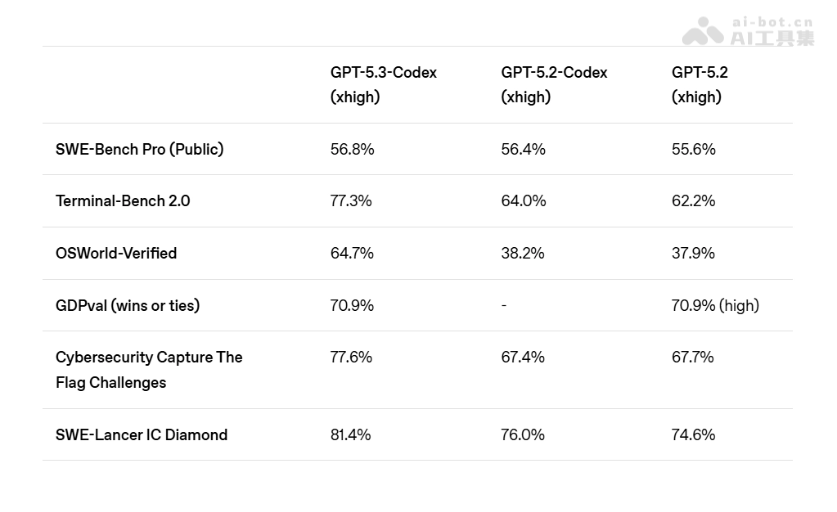
SWE-Bench Pro: It reaches 56.8% on a stricter multilingual real-world software engineering evaluation, surpassing the previous generation model and completing higher-precision tasks using fewer tokens.
-
Terminal-Bench 2.0: With a score of 77.3%, it greatly leads the previous generation's 64.0%, demonstrating outstanding terminal operation and command-line tool usage capabilities.
-
OSWorld-Verified: It achieves a breakthrough of 64.7%, an increase of nearly 26 percentage points over the previous generation's 38.2%, approaching the human level of about 72%, marking a major leap in visual computer operation capabilities.
-
Cybersecurity CTF: With 77.6%, it significantly surpasses the previous generation's approximately 67%, becoming the first model to receive a "high capability" rating on cybersecurity tasks.
-
SWE-Lancer IC Diamond: It reaches 81.4%, an increase of 5.4 percentage points over the previous generation, performing outstandingly in high-end software engineering freelance tasks.
-
Speed and Efficiency: Inference speed is increased by 25% over the previous generation while maintaining higher token efficiency and supporting longer-cycle task execution.
GPT-5.3 Codex's Application Scenarios
-
Full-Stack Software Development: From requirements analysis and architecture design to coding implementation, testing, and deployment, it autonomously completes end-to-end development of complex software projects.
-
Game and Interactive Application Development: Autonomously build fully functional games over several days of iteration (such as racing games, diving exploration games), including complex mechanics such as multiple maps, item systems, and progress management.
-
Web and front-end development: Transform vague requirements into high-quality websites ready for direct production, automatically implementing responsive design, interactive components, and reasonable default feature configurations.
-
Code review and debugging: Assist developers in locating bugs, analyzing root causes, proposing fixes, and monitoring code quality and performance.
-
Terminal and infrastructure management: Execute operations tasks such as server configuration, deployment scripts, log analysis, and system monitoring via the command line.