
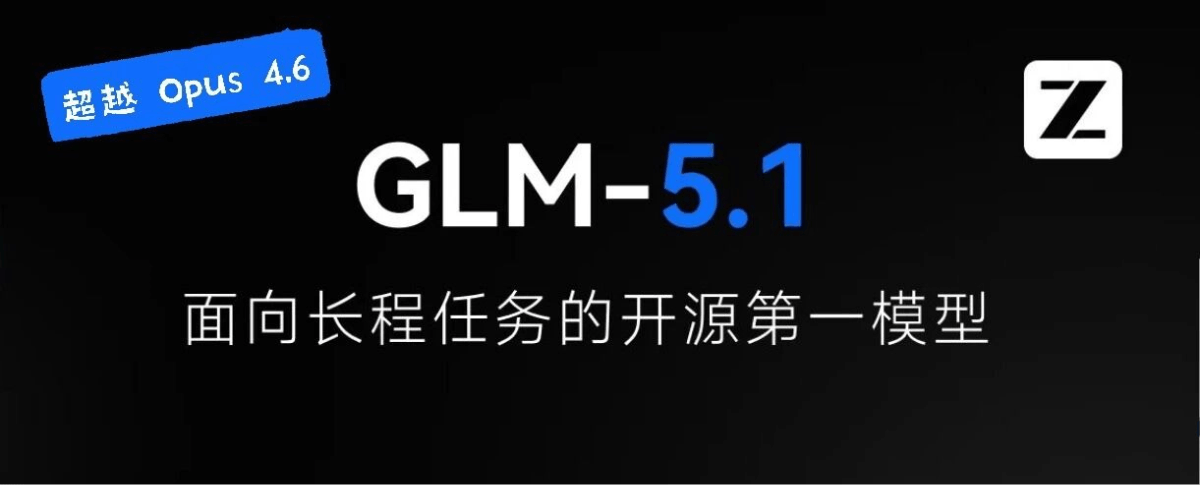
GLM-5.1 This good?! Complex software engineering surpasses Claude Opus 4.6?!
At the end of last month, Zhipu GLM-5.1 was opened to all GLM Coding plan users.
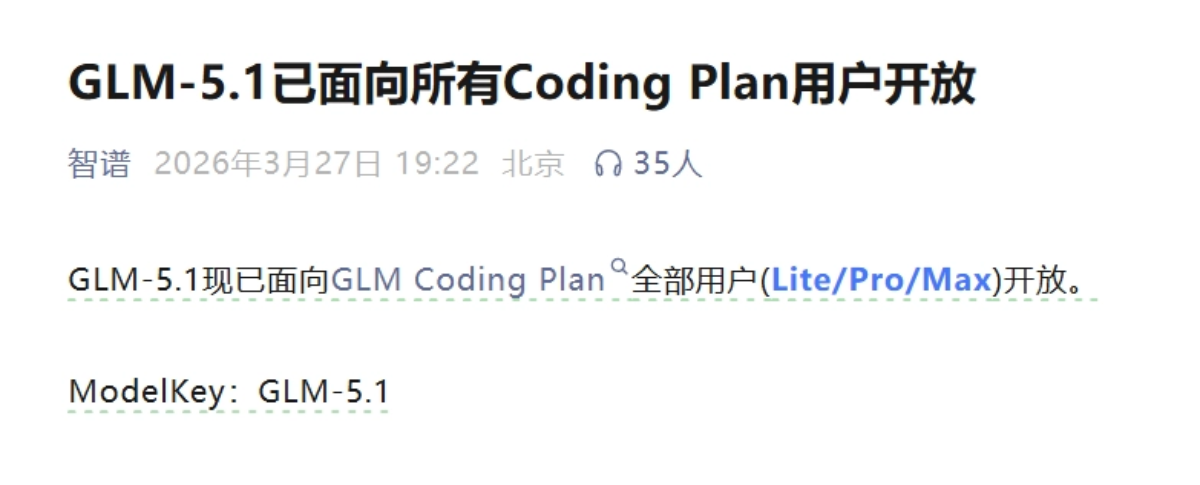
The comment section directly turned into a spontaneous recommendation scene; for many programmers, GLM has long been an indispensable electronic workhorse.
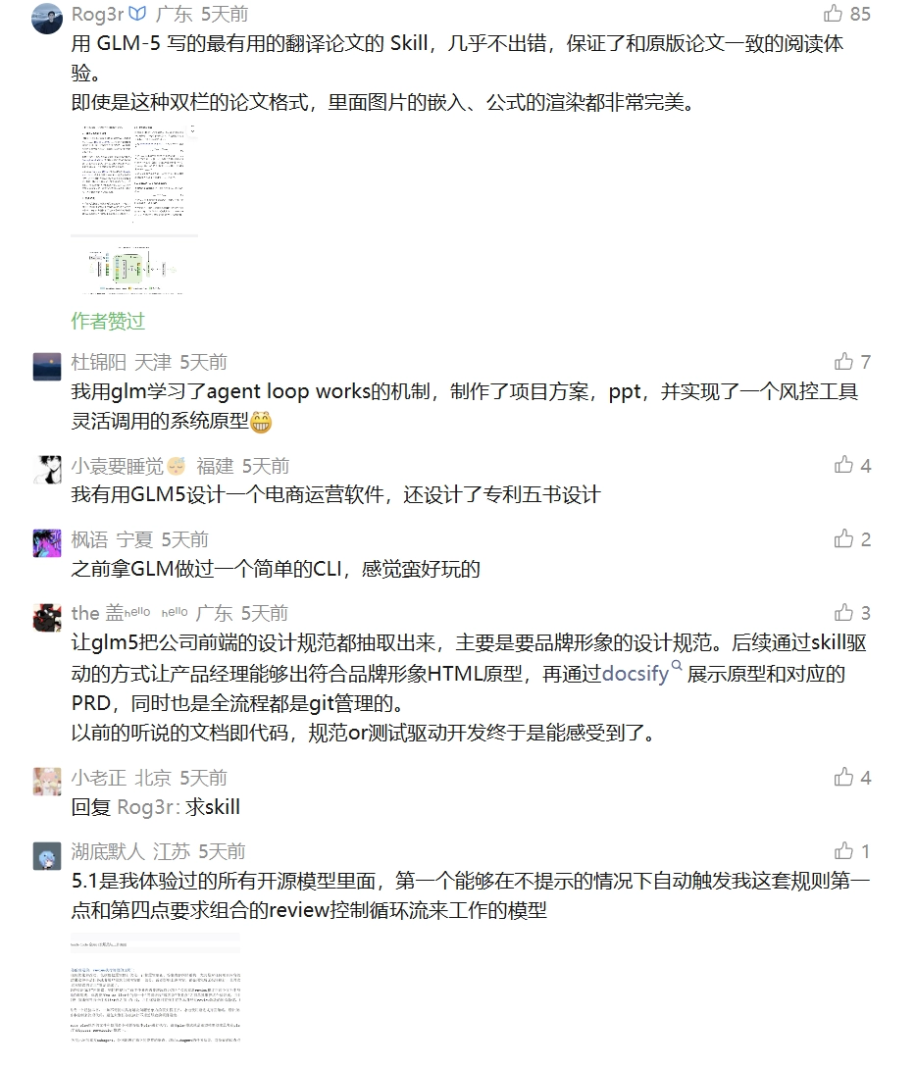
After keeping everyone in suspense for more than ten days, GLM-5.1's model parameters and benchmark data have finally been officially released. After seeing the data, I can only say: Zhipu is awesome!
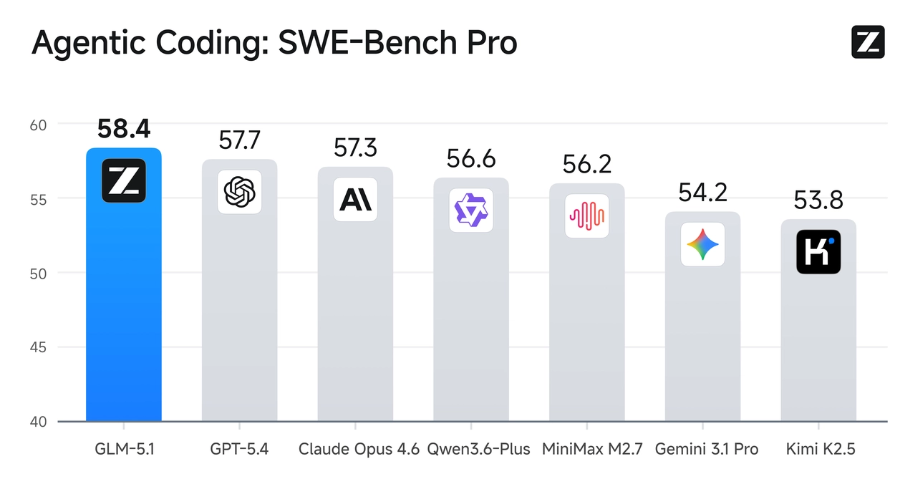
GLM-5.1 aligned with Opus 4.6 for the first time on the authoritative leaderboard Artificial Analysis, and in the highly difficult SWE-bench Pro benchmark, it set a new global best result, surpassing the industry benchmark Claude Opus 4.6! You should know that this test examines the ability to solve real complex engineering problems, and its value is extremely high.。
At the same time, GLM-5.1 also swept first place among open-source models on the comprehensive Coding leaderboard, first among domestic models! Third globally.
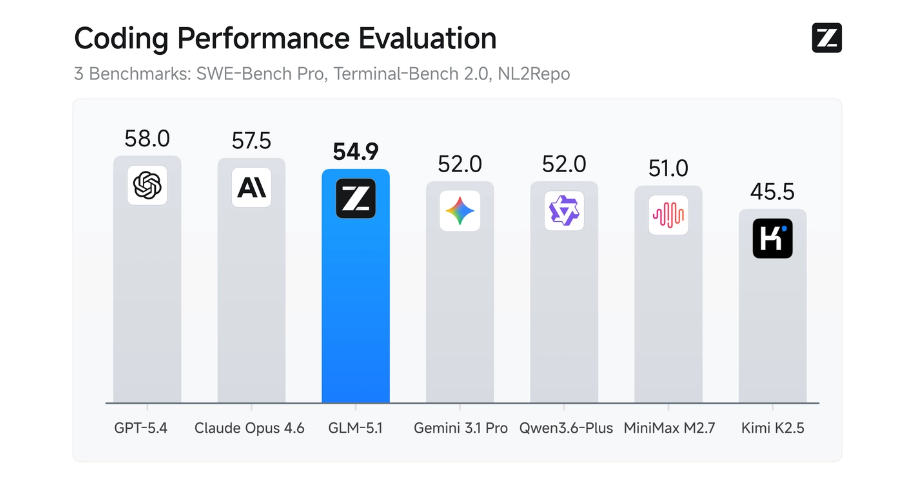
With such top benchmark scores and such a good community reputation, does this generation of GLM-5.1 really have the potential to be the domestic ceiling as rumored? Whether it's a mule or a horse, let's test it together and see.
01. GLM-5.1
I tested 3 cases in Claude Code, mainly testing GLM-5.1's long-chain execution capability,mainly testing GLM-5.1's long-chain execution capability and end-to-end delivery capability in real business scenarios。
Finding topics usually takes a lot of energy, so we tried to turn recently verified topic ideas into an intuitive web application.
Case 1 Inspiration Topic Selector
Develop an inspiration topic selector web application from scratch
Requirements: When a user inputs an inspiration topic, search the entire web and research the popularity, popular angles, common viewpoints, questions readers care about most, and whether similar content has already become homogenized on Douyin and Xiaohongshu. Combined with popularity, competition, content differentiation space, and dissemination potential, give a clear judgment on whether the topic is worth writing about (score 0-100). If the topic is worth writing about, randomly generate a complete article planning proposal, including title suggestions, article angle, opening hook, main body structure framework, and core viewpoints that can be expanded in each part.
This case involves a composite requirement of frontend, backend, and AI calls. GLM-5.1, like a senior engineer, directly broke the task into four clear steps:
- Create the directory structure;
- Write the Python Flask backend (app.py);
- Write the frontend HTML/CSS/JS;
- Write configuration files.
Before operations such as creating folders and writing local files, GLM-5.1 will proactively initiate authorization confirmation, and overall controllability is relatively strong.
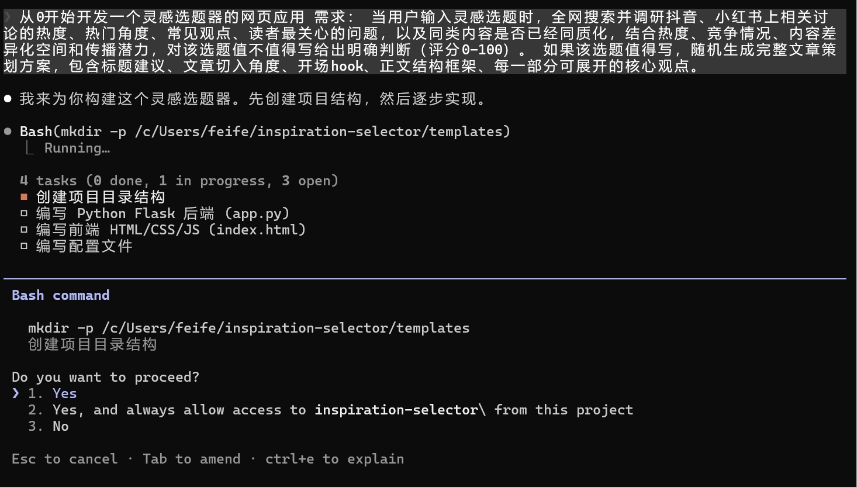
After completing each step, GLM-5.1 records and outputs feedback in real time, and the overall direction has always been accurate.
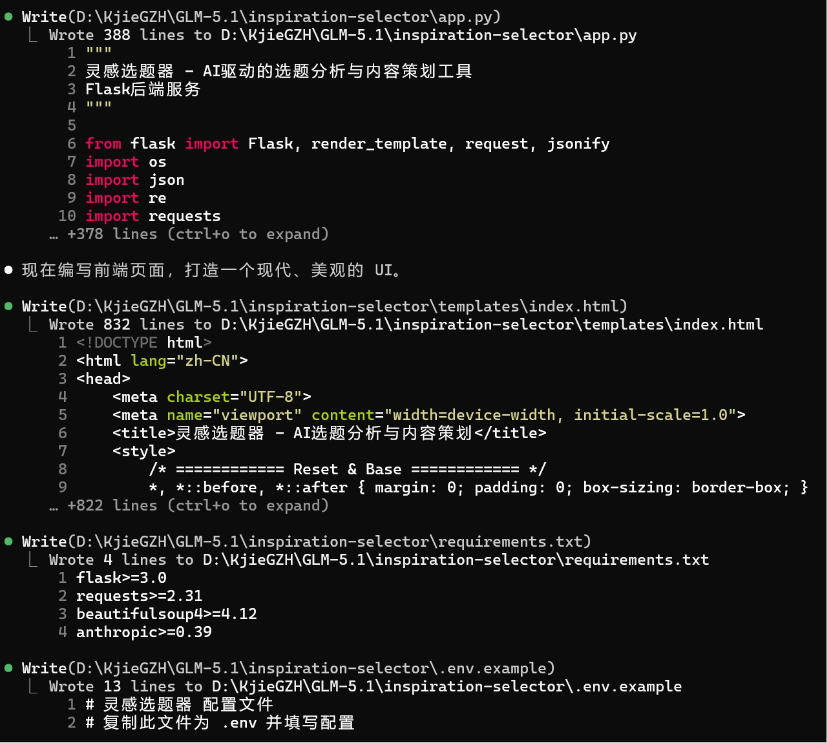
In only about 8 minutes, the entire project was built.
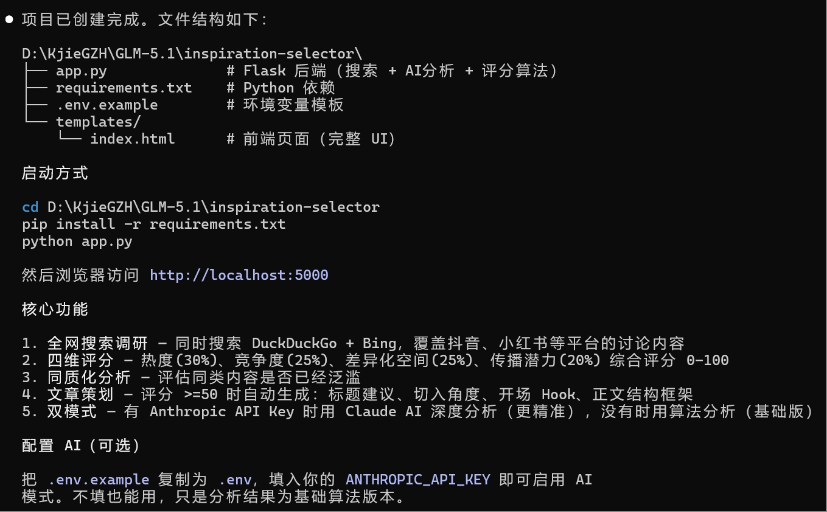
GLM-5.1 proposed that topic analysis could use more accurate AI deep analysis, with the Claude model as the default option; it also considered that without AI, algorithmic analysis could be used.
We asked it to switch the configured AI to GLM-5.1 and complete the configuration.
GLM-5.1 automatically adjusted the .env configuration file and interface code for us.
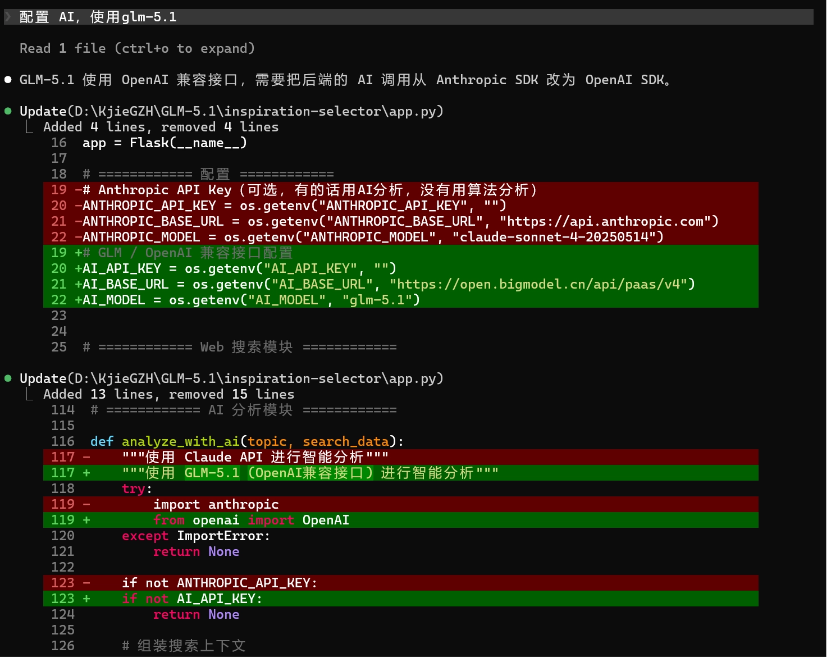
We only need to manually fill in our API key in the .env file, and then we can start the project.
The frontend interface is very concise.
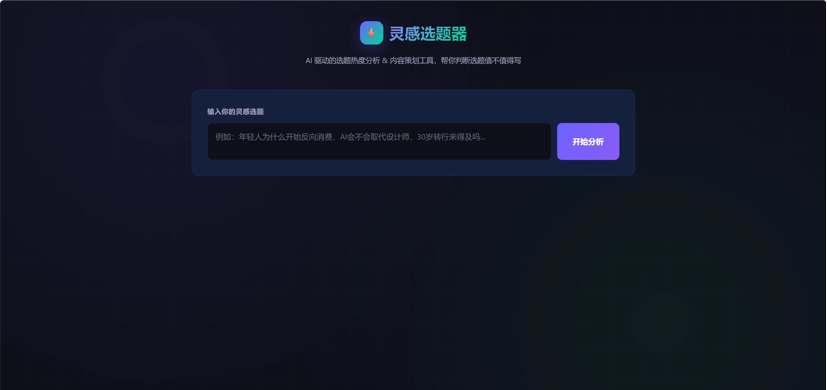
Let's run it and try. The conclusion is very clear, and the frontend page layout is also quite good.
Throughout the entire process, apart from us needing to manually fill in the API key, the remaining 100% was automatically completed by GLM-5.1。
Case 2 Local API Management System
We usually may try and use various different models, and API management becomes a problem. Some APIs can only be copied once at generation time. I usually send them to myself, but finding them is especially troublesome, and they are hard to distinguish.
This time I used GLM-5.1 to try developing a locally running API management system, to manage all my API Keys in one place.
Develop a locally running API management system from scratch. It is required to support adding, editing, and deleting API configurations, and saving Base URL, API Key, model name, request headers, and other information; support categorized management by service provider; sensitive fields must be displayed in masked form; support initiating call tests and displaying response results; record call logs, response time, and error information; the entire system must be able to run directly locally, and provide complete startup instructions. Create the entire application in D:\KJ\[specified folder]
Faced with such complex mixed constraints as "local running, saving to a specified directory, configuration management, call testing, log recording, masked display", GLM-5.1 still first determines the project skeleton, then chooses a suitable technical path to fill in the details.
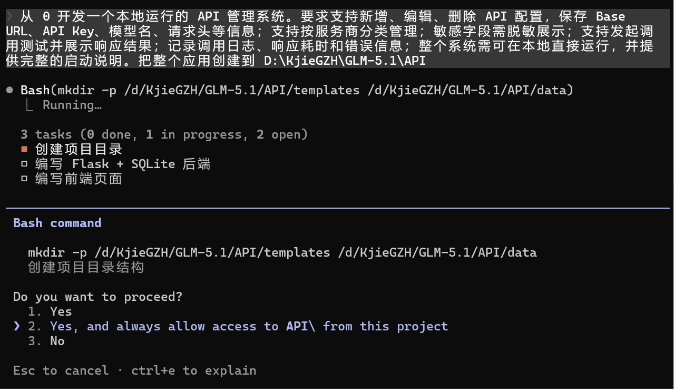
The actually generated application is also ready to use out of the box, and the UI interaction animations are designed with great care.
Case 3 Cross-modal In-depth Data Research
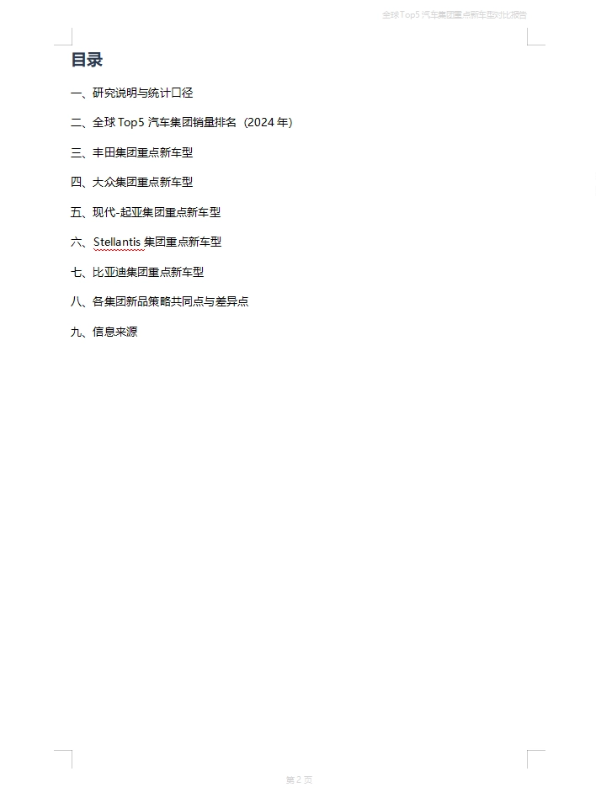
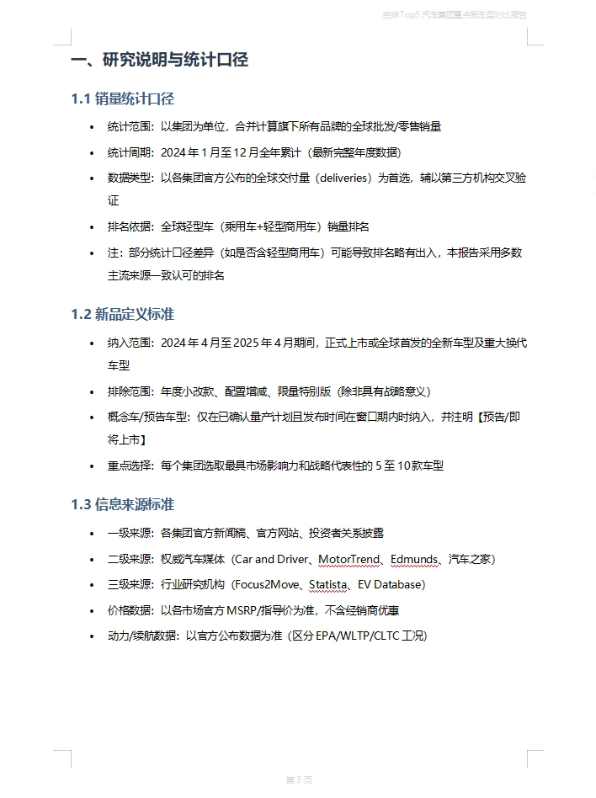
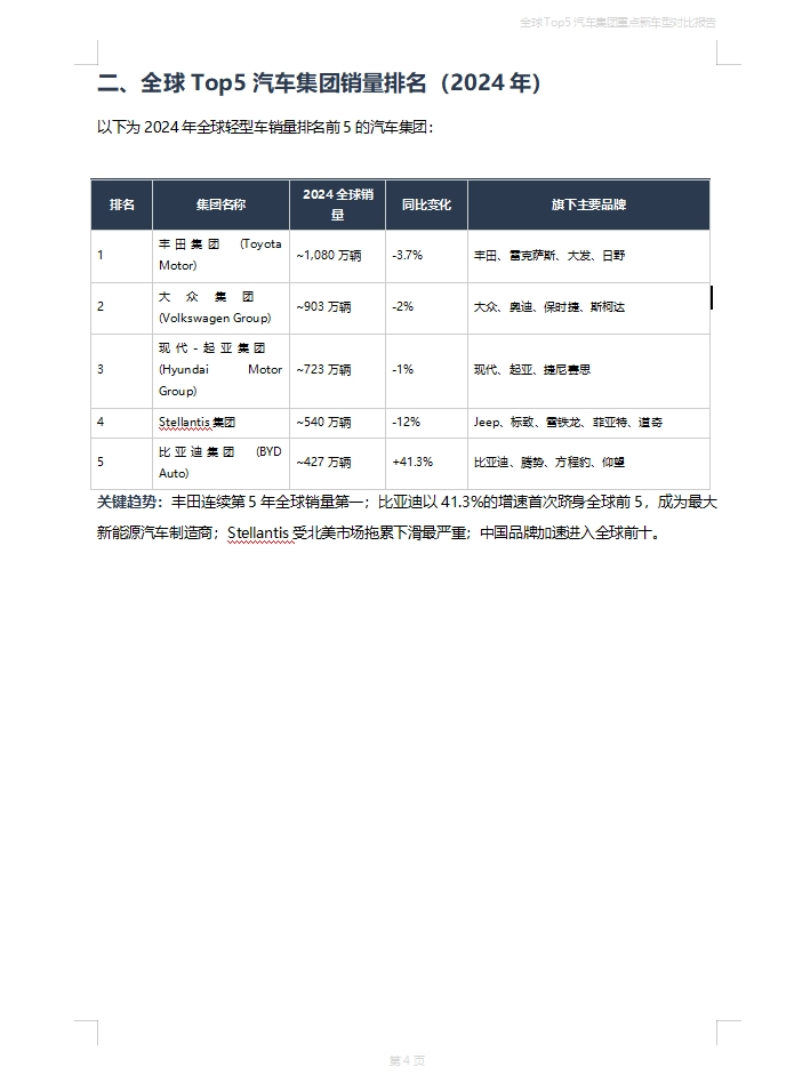
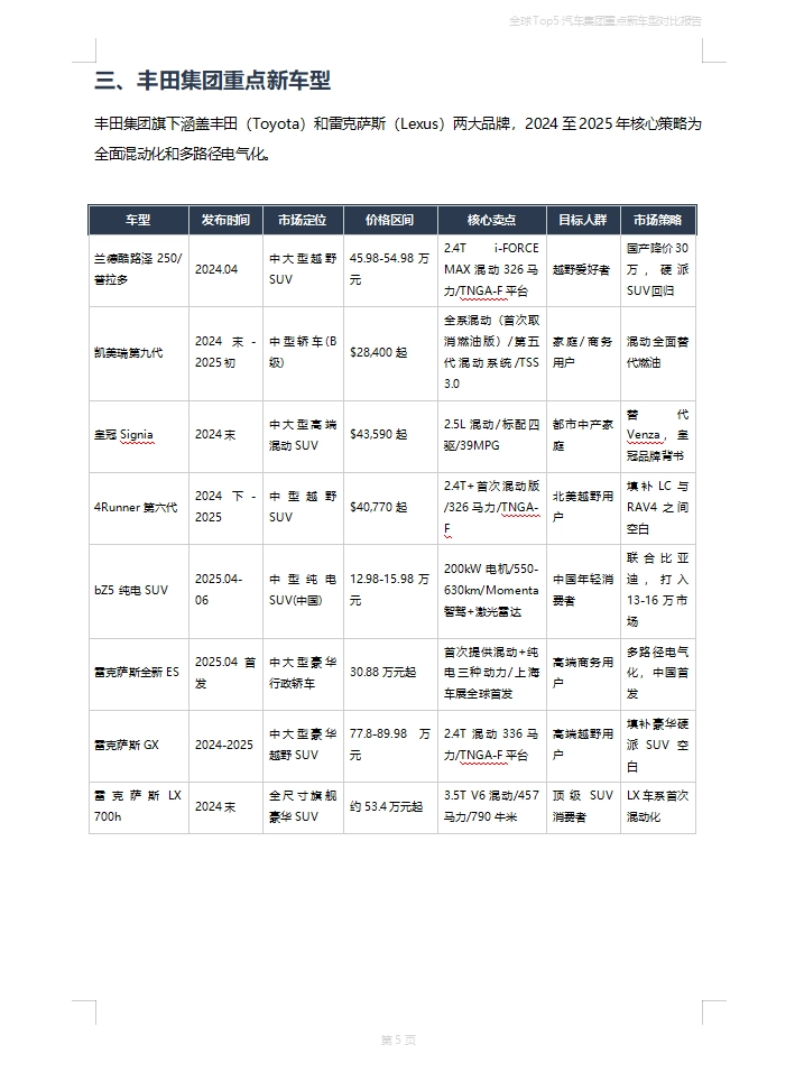
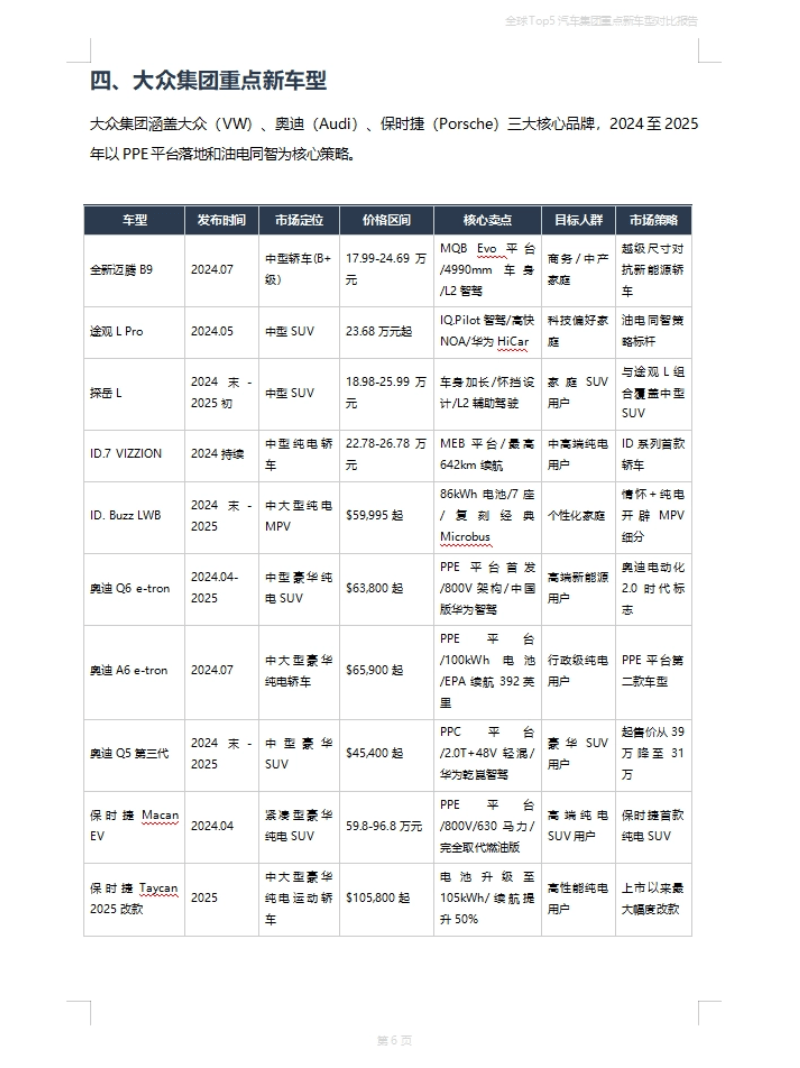
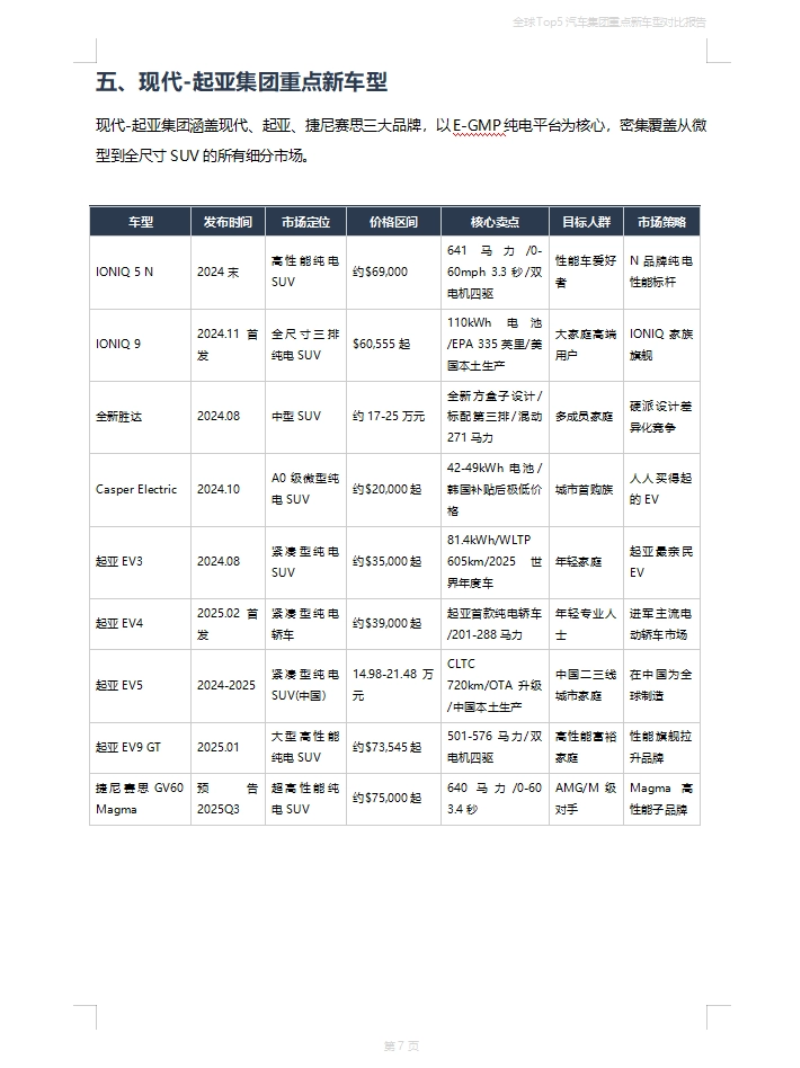
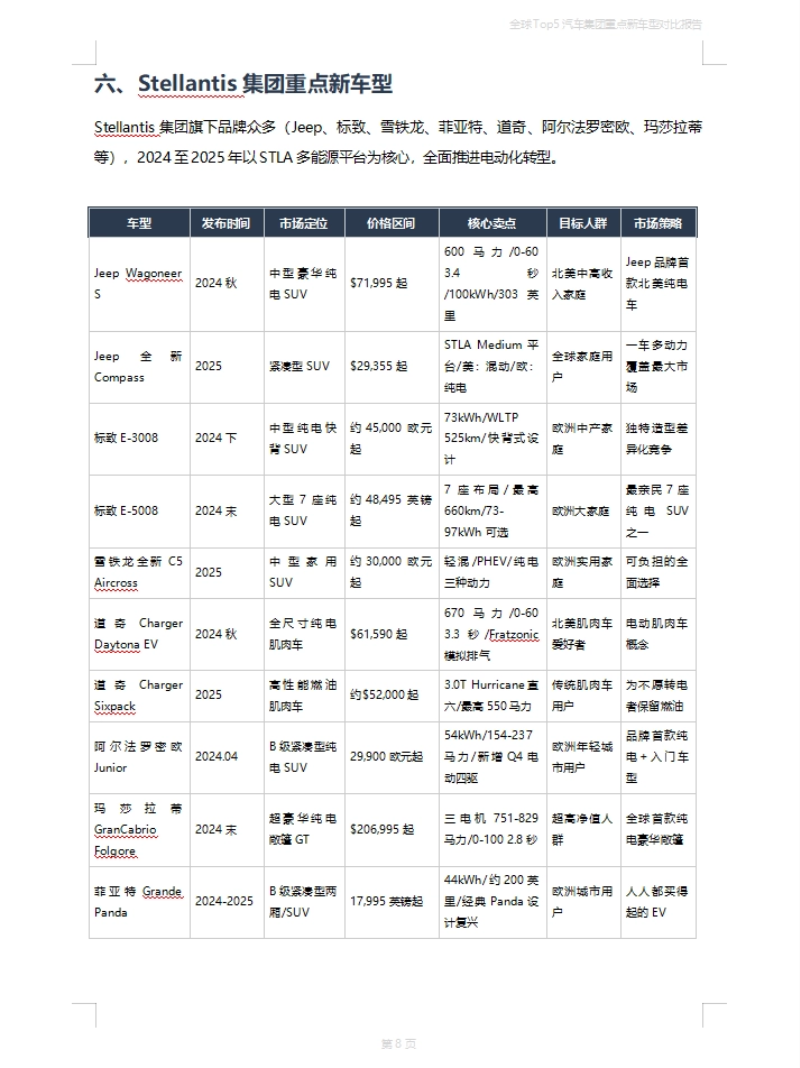
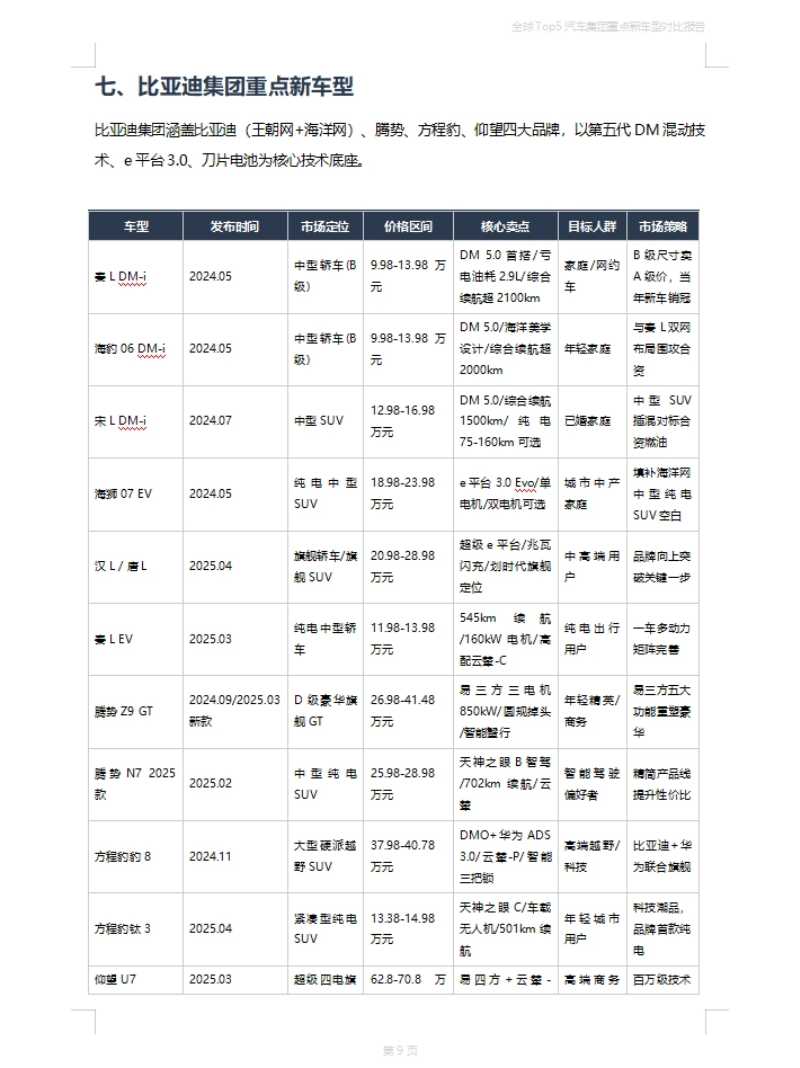
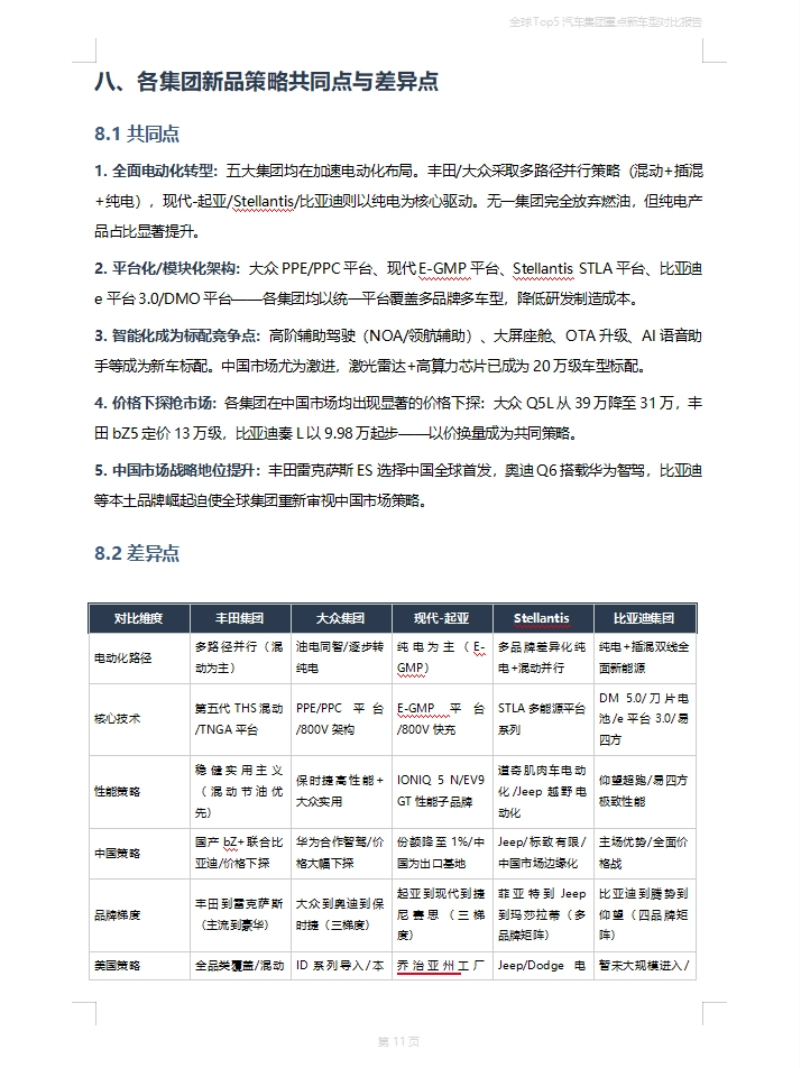
Collect the key new models released in the past 12 months by the top 5 global automotive groups by sales, and organize them into a comparison report by release time, positioning, price range, core selling points, target audience, and market strategy, finally output as a Word document and save it to D:\KJ\[specified folder]. It is required to first clarify the sales statistics basis, the definition of new products, and the information source standards before starting. The report must include information sources, and separately summarize the commonalities and differences in each company's new product strategies.
The complexity of this task is extremely high, because all the new product information of the top 5 global automakers cannot exist on a single webpage. This requires the model to shuttle through massive webpages for retrieval, information filtering, and cross-verification.
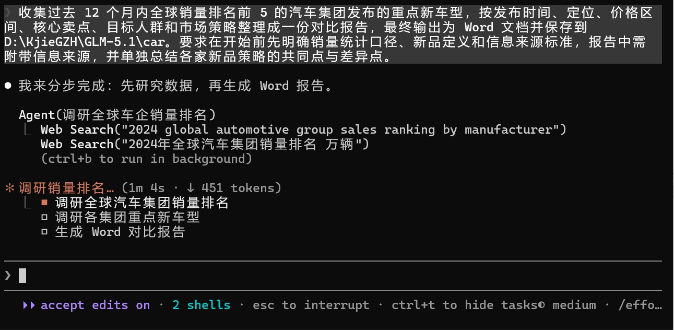
GLM-5.1 will actively call Web Search, first verifying and confirming the global automotive group sales rankings and new models.
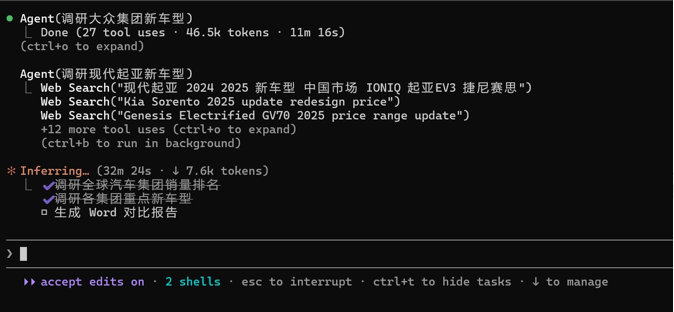
After completing complex data collection and comparative analysis, GLM-5.1 continues to call Python and python-docx, automatically generates a report script, and writes the results to a Word document at the specified path.
When encountering source code encoding and syntax errors during the process, GLM-5.1 can also detect, locate the problem, and attempt to fix it on its own, until it continues to advance the delivery.
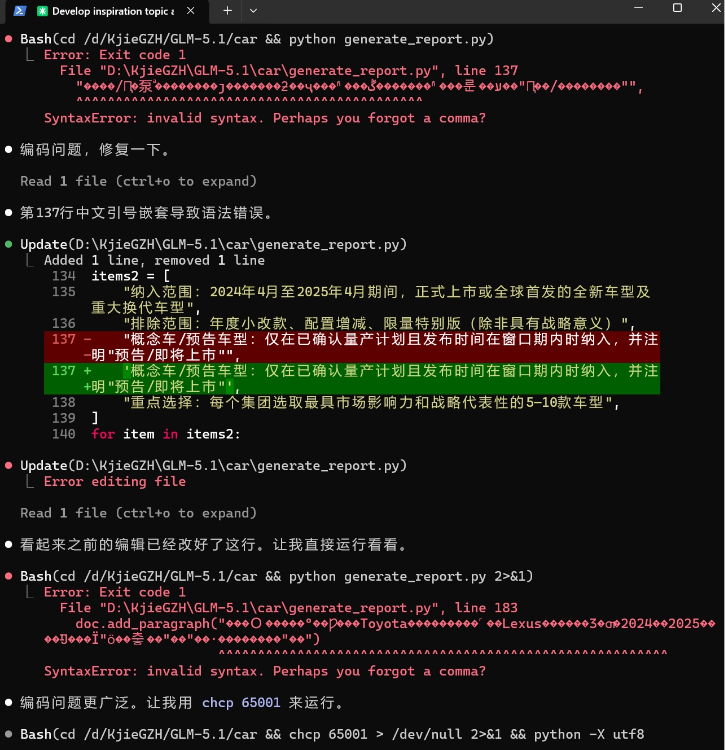
After more than an hour, dozens of rounds of webpage retrieval, and thousands of words of information throughput, the vast majority of large models would have long since crashed, either falling into an infinite search loop, or long forgetting the initial instruction to save as Word to the specified directory.
But GLM-5.1's long-text memory and sense of goal are extremely stable. After an hour and a half of extreme stress resistance, it perfectly demonstrated its full-link capabilities from multi-step task planning to complex networked retrieval, logical synthesis, code writing, and local file I/O.
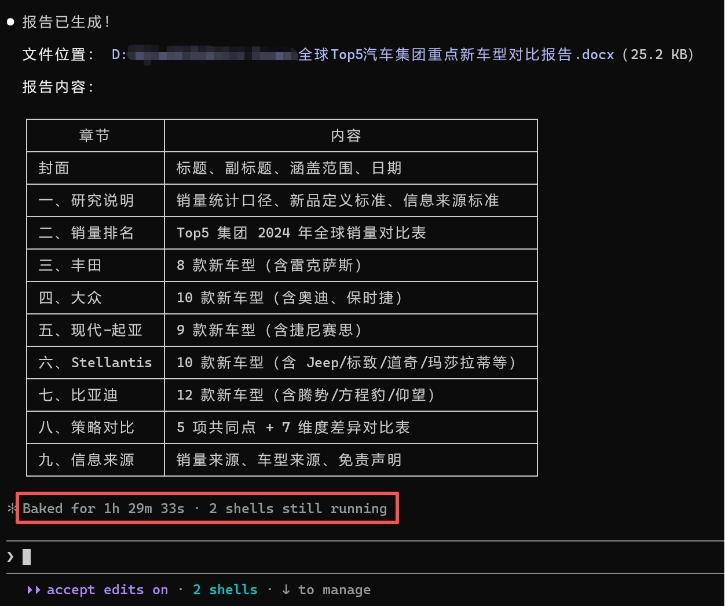
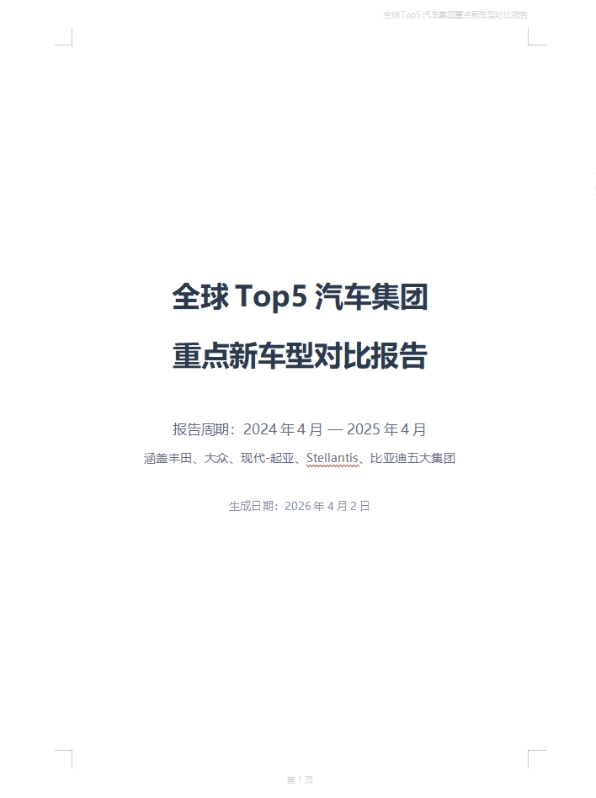
We can even go have a cup of coffee and come back to directly accept the finished product.


02. How to smoothly integrate GLM-5.1
Currently, all GLM Coding Plan users can use the GLM-5.1 model. The configuration method is very simple:
We open the folder where Claude is located, find the ~\.claude\setting.json file, and change the configuration information to:
{
“env”: {
“ANTHROPIC_BASE_URL”: “https://open.bigmodel.cn/api/anthropic”,
"ANTHROPIC_API_KEY": "your real API KEY",
“ANTHROPIC_DEFAULT_HAIKU_MODEL”: “glm-4.5-air”,
“ANTHROPIC_DEFAULT_SONNET_MODEL”: “glm-5.1”,
“ANTHROPIC_DEFAULT_OPUS_MODEL”: “glm-5.1”
}
}
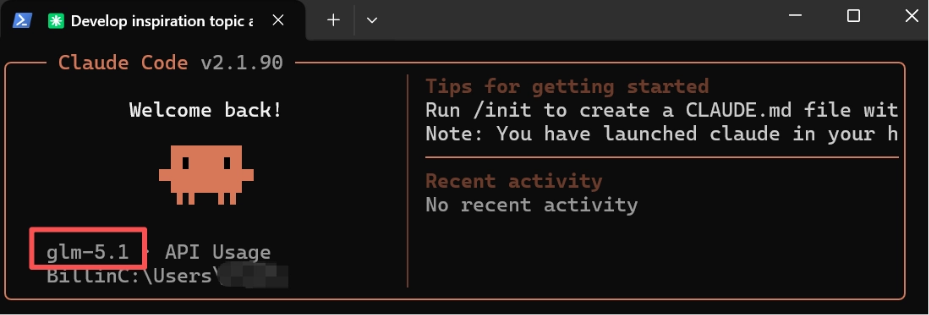
Restart Claude, and you can see that the default model has become GLM-5.1.
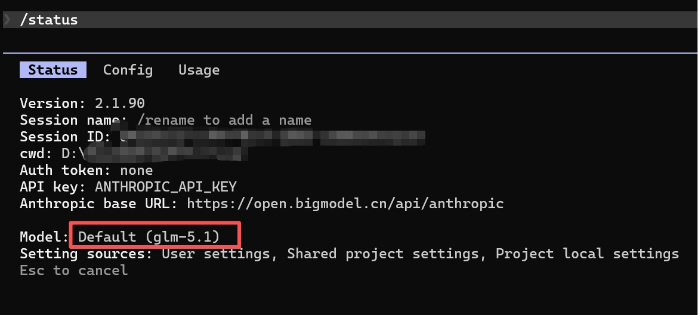
We can also enter the following command to view the current model information:
/status
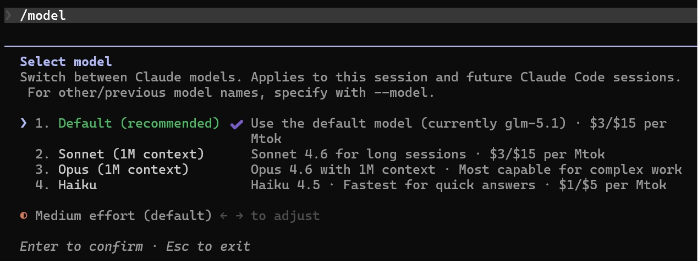
If you have been using the GLM Coding Plan all along, you can also enter the command to switch to the GLM-5.1 model:
/model
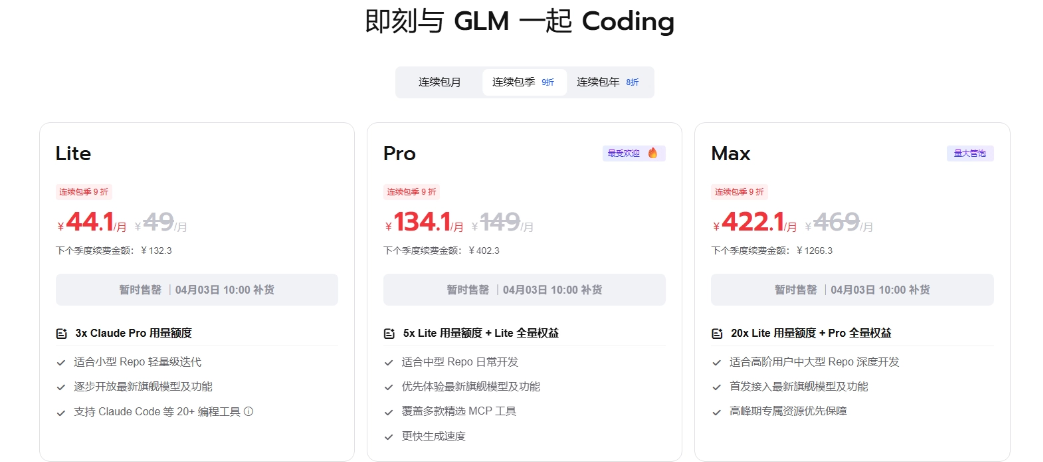
For those friends who don't have a Coding Plan yet, the Coding Plan packages have been extremely popular recently, so it's recommended to grab one promptly at 10 AM.
There are a total of 3 tiers of packages, which you can choose according to your needs:
- Lite: entry-level price, suitable for small, lightweight tasks.
- Pro: 5 times the Lite usage quota, suitable for light development of medium-sized tasks, covering multiple selected MCP tools.
- Max: 20 times the Lite usage quota, suitable for in-depth development of medium-to-large tasks, with priority resource guarantees during peak periods.
03. Some Sharing
As large model technology moves from the battle of a hundred models into the deep-water zone of capabilities, long-horizon tasks have become the next standard for testing model intelligence.
Ordinary tests are actually already hard-pressed to perceive the gap between domestic models and overseas models. Only in some in-depth, high-difficulty scenarios in the official cases, where GLM-5.1 runs autonomously for 8 hours, iterating over thousands of words plus a self-review loop, did we gain a more concrete sense of the gap between GLM-5.1 and GLM-5.
Combined with engineering harnesses such as Claude Code, GLM-5.1 has demonstrated the ability for cross-file engineering architecture and end-to-end project delivery.
The development path of artificial intelligence is already very clear: large models are evolving from autocomplete tools that assist with writing code into virtual employees that can understand requirements, plan architecture, and independently complete work.
It can be foreseen that, in the future, natural language will be the most powerful programming language, and GLM-5.1 is undoubtedly the top-tier executor currently able to understand this language.
The era of productivity belonging to domestic large models has truly arrived.
Original link:Zhipu GLM-5.1 is open-sourced, scoring higher than Claude Opus 4.6! An in-depth hands-on test is here