
Today I'm posting something related to a head-to-head benchmark test of new models.
Domestic large models recently rolled out two major players in succession:DeepSeek-V4-Pro and GLM-5.3。
After the release of the two models, online opinions were divided, and it is hard to judge the real gap by looking only at benchmark scores.
So this time, instead of discussing parameters, let's go straight to the tasks and have both models complete them item by item using the same prompts, the same materials, and the same delivery requirements.
Both models run in Claude Code, with the same permissions and the same initial files; each Case is run only once, with no prompt adjustments made for any individual model.
After the run, let's see who is the top domestic model and who is the domestic model's sidekick.
01. Model Hands-On Test
case 1 Incident Forensics and Claim Calculation
Prompt:
Based on the simulated contract, monitoring records, tickets, status page, and bills below, determine whether the service met the SLA in August 2026, and prepare the claim materials.
All times are Beijing Time UTC+8.
Material 1: Article 8.2 of the Master Service Agreement
The monthly service fee is 200,000 yuan. The availability credit amount is calculated based on the monthly service fee:
– Monthly availability is below 99.90% but not below 99.50%, the credit amount is 5%.
– Monthly availability is below 99.50% but not below 99.00%, the credit amount is 10%.
– Monthly availability is below 99.00%, the credit amount is 20%.
– The monthly credit cap is 20% of the monthly service fee.
Material 2: Article 3 of the SLA Attachment
– Monthly availability = 1 – unavailable minutes in the month ÷ total minutes in the month.
– When more than 20% of active tenants cannot pass the core health check, the service is counted as unavailable.
– The vendor's monitoring records are the primary evidence for availability calculation.
– The status page and customer service emails can only serve as supporting evidence.
– Approved planned maintenance can be excluded, but the vendor must notify the customer at least 5 full business days in advance.
– At most 4 hours of planned maintenance can be excluded per month.
Material 3: Article 4 of the SLA Attachment
The P1 incident time limit starts from the earlier of the customer report or the first vendor monitoring alert:
– Response time limit: 15 minutes.
– Temporary solution time limit: 4 hours.
– Service restoration time limit: 8 hours.
Material 4: Vendor Monitoring Export
2026-08-05 01:00 to 02:30:
Proportion of tenants failing the core health check: 100%.
2026-08-12 09:12 to 15:42:
Proportion of tenants failing the core health check: 100%.
2026-08-22 02:00 to 03:10:
Proportion of tenants failing the core health check: 35%.
The three time periods do not overlap.
Material 5: Planned Maintenance Notice
Notice publication time: 2026-08-01 18:00.
Planned maintenance time: 2026-08-05 01:00 to 02:30.
The notice stated that core services may be unavailable during the maintenance.
Material 6: August 12 Ticket
First vendor monitoring alert: 09:12.
Customer created P1 ticket: 09:16.
Vendor's first manual response: 09:38.
Temporary solution completed: 12:50.
Supplier status page marked recovery: 15:10.
Monitoring system returned to normal: 15:42.
Ticket closed: 17:30.
Material 7: Account manager email
"The August 12 incident was fully recovered by 15:10, so the recovery time did not exceed 6 hours."
Material 8: August bill
Monthly service fee: 200,000 yuan.
One-time implementation service fee: 50,000 yuan.
Taxes are not included in the SLA credit calculation.
Please deliver:
1. An evidence table listing each fact, source, evidence level, and conflict.
2. Determine paragraph by paragraph whether the three unavailability periods count toward the SLA.
3. Calculate the total minutes in August, unavailable minutes, and monthly availability.
4. Determine the corresponding credit percentage and amount.
5. Check the response, temporary workaround, and recovery time limits for August 12.
6. Explain whether the conclusion in the account manager's email holds.
7. List the matters that cannot be determined due to insufficient materials.
8. An incident summary submitted to management.
9. A formal claim letter sent to the supplier.
10. An incident timeline suitable for a management PPT.
11. Check all time differences, percentages, and amount calculations.
DeepSeek-V4-Pro
GLM-5.3
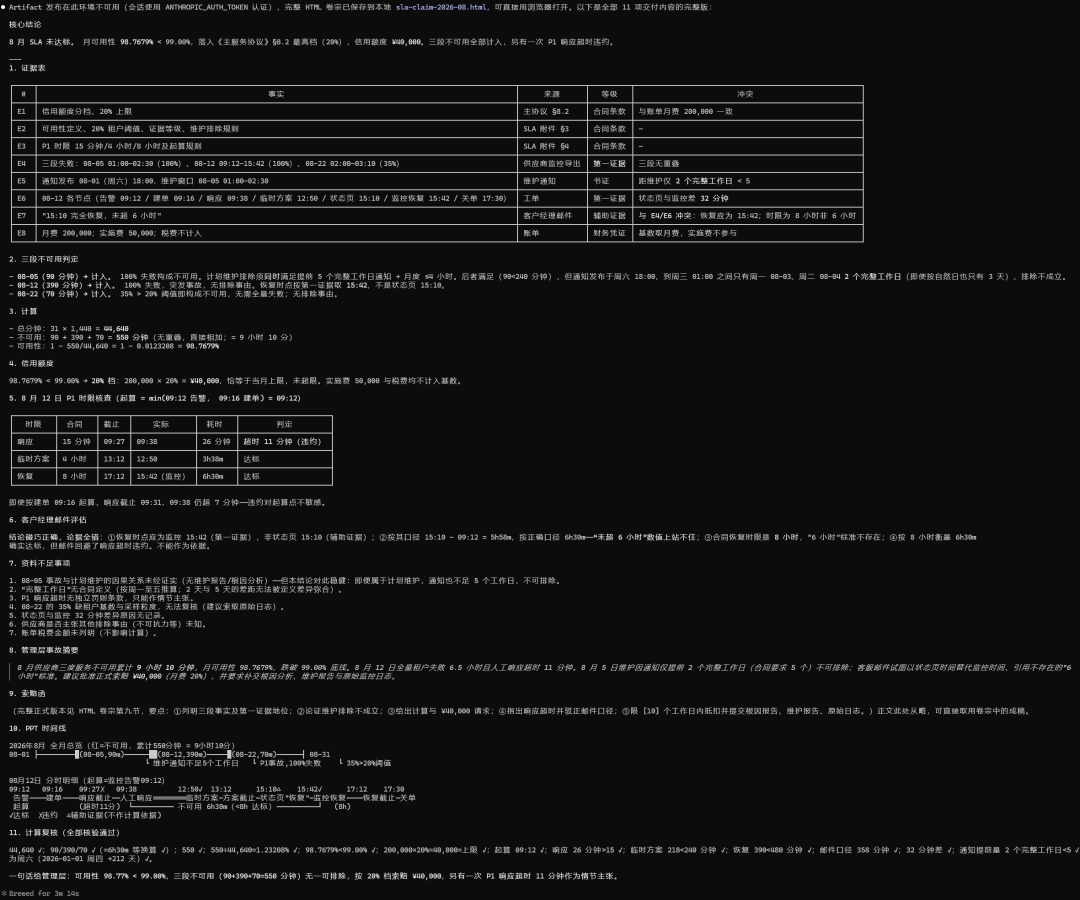
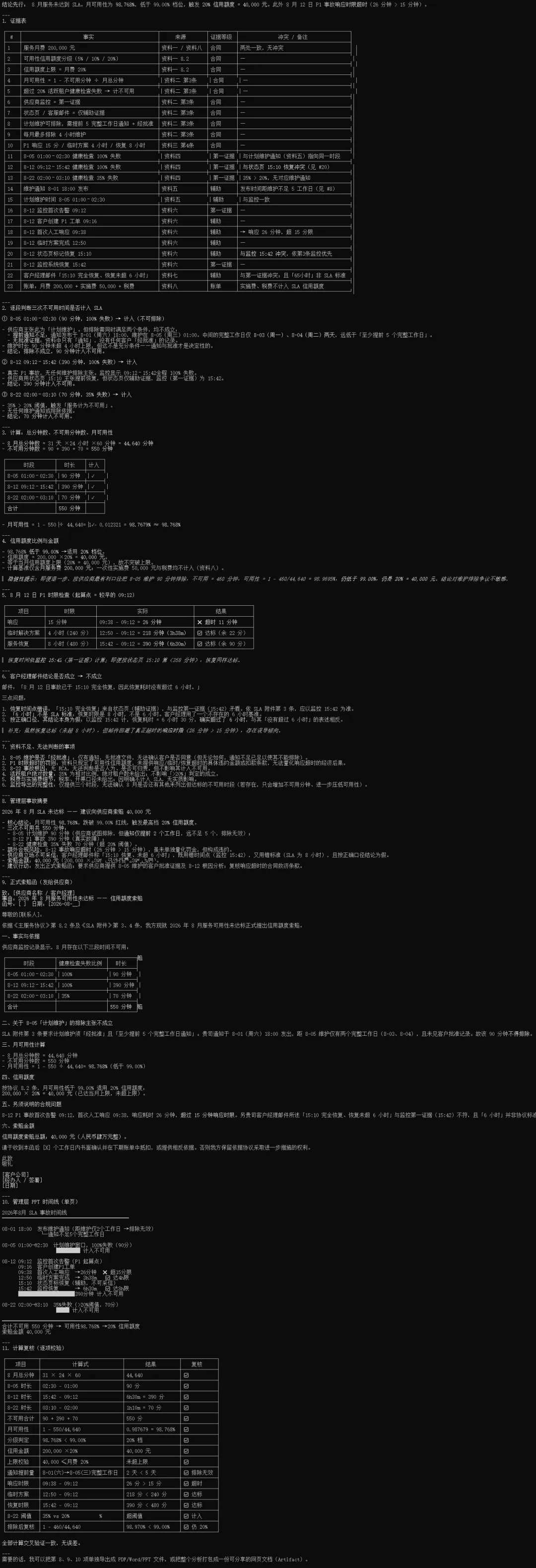
Both models calculated a 40,000 yuan credit and both saw through the incorrect framing in the supplier's email.
DeepSeek-V4-Pro was more like a contract reviewer, breaking down the 23 pieces of evidence in detail and explaining clearly which held up and which lacked evidence.
But DeepSeek-V4-Pro's minor issue was writing 98.7679% as approximately 98.76%; standard rounding to two decimal places should be 98.77%.
GLM-5.3 was more like a delivery lead, directly producing a claim dossier that can be opened, printed, and taken to a briefing, with noticeably higher formatting completeness than DeepSeek-V4-Pro.

Overall, GLM-5.3 won Case 1 on delivery completeness, while DeepSeek-V4-Pro was more solid on evidence reasoning.
case 2 Excel, Word, PPT comprehensive office work
Prompt:
Process the order data below and generate a set of deliverable office files.
order_id,user_id,paid_at,amount,status,channel,original_order_id
A1001,U01,2026-08-01 23:40:00,299.00,paid,web,
A1002,U02,08/02/2026 09:15,”1,299.00″,paid,ios,
A1002,U02,2026-08-02 09:15:00,1299,PAID,iOS,
A1003,,2026/08/03 14:20,-199,refund,web,A1001
A1004,U04,2026-08-03T16:30:00+08:00,399,PAID,android,
A1005,U05,2026-08-04,0,paid,web,
A1006,U06,bad-date,99,pending,Web,
A1007,U07,2026-08-04 10:15:00,699,paid,android,
R1001,U01,2026-08-05 12:20:00,-99,refund,web,A1001
R1002,U02,2026-08-05 13:30:00,-1500,refund,ios,A1002
A1008,U08,2026-08-06 15:00:00,”1,099.00″,paid,web,
A1009,U09,2026-08-06 16:00:00,499,cancelled,android,
A1010,U10,2026-08-07 11:00:00,199,paid,,
A1011,U11,2026-08-07T12:00:00+08:00,259,paid,ios,
A1012,U12,2026-08-08 09:00:00,299 yuan,paid,web,
Cleaning rules:
– order_id, user_id, paid_at, amount, status, and channel are all required fields.
– Dates are unified to Beijing time `YYYY-MM-DD HH:mm:ss`。
– status and channel are unified to lowercase.
– paid amounts must be greater than 0.
– refund amounts must be less than 0, and a valid original paid order must be found.
– The absolute value of a single refund cannot exceed the payment amount of the corresponding order.
– Duplicate records with the same order_id and the same business content keep only one record.
– pending and cancelled orders may be retained, but are not included in net revenue.
– Valid net revenue equals valid paid amounts plus valid refund amounts.
– Data that cannot be reliably repaired goes into the rejected table, retaining the original values and the rejection reason.
Please generate:
1. `cleaned.csv`。
2. `rejected.csv`。
3. `clean_orders.py`。
4. `analysis.xlsx`, containing raw data, cleaned data, rejected data, statistical summaries, and charts.
5. Excel 365 formulas that can recalculate as the source data changes.
6. `memo.docx`, for management to read.
7. `management_report.pptx`, 7 pages in total.
8. A reconciliation report listing original row count, valid row count, duplicate count, rejected count, and valid net revenue.
Run the cleaning script, open or render the generated files, and check CSV, and whether the numbers in Excel, Word, and PPT are consistent. If issues are found, continue fixing them.
DeepSeek-V4-Pro
GLM-5.3
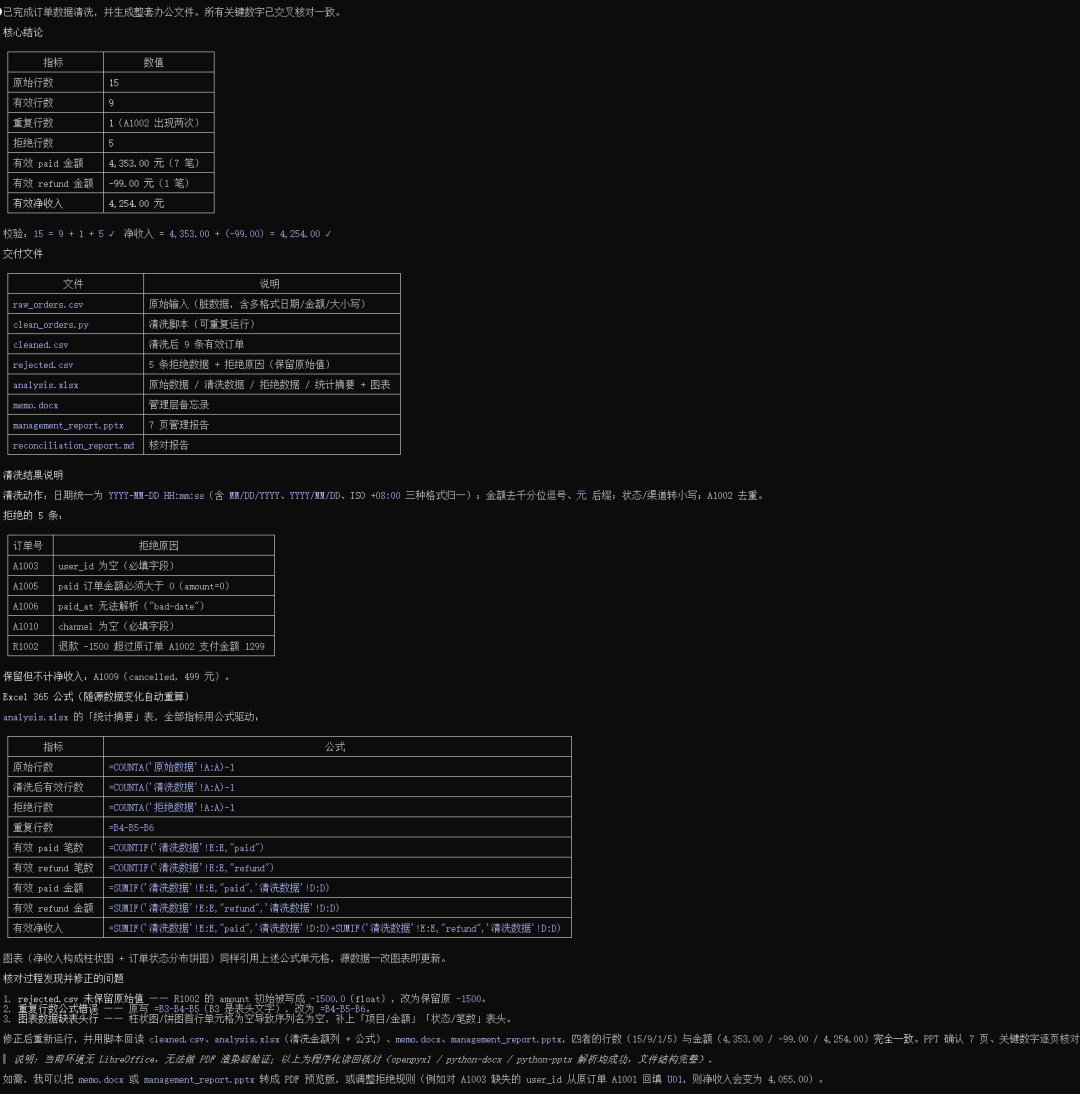
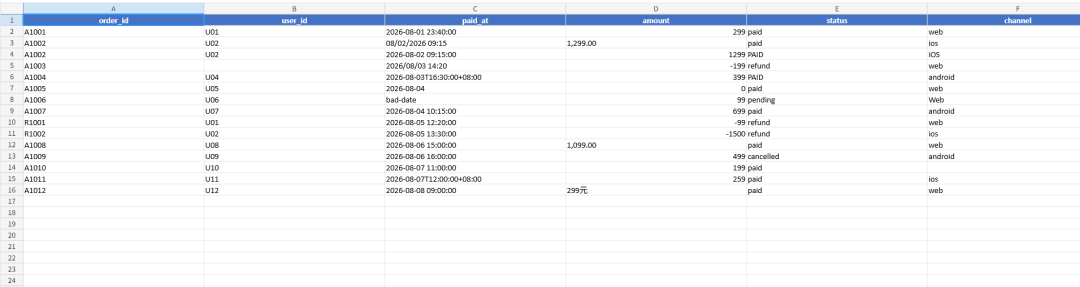
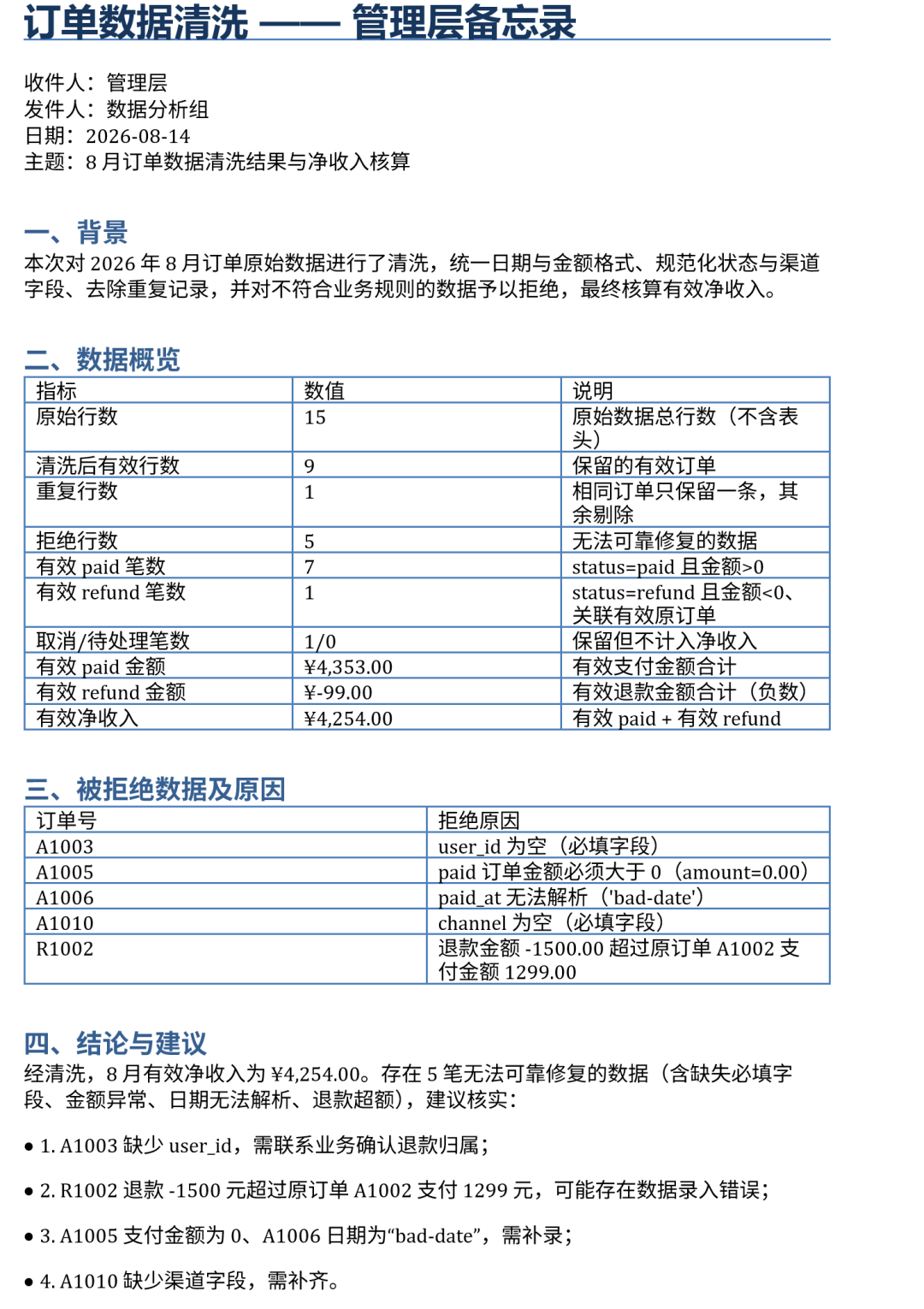
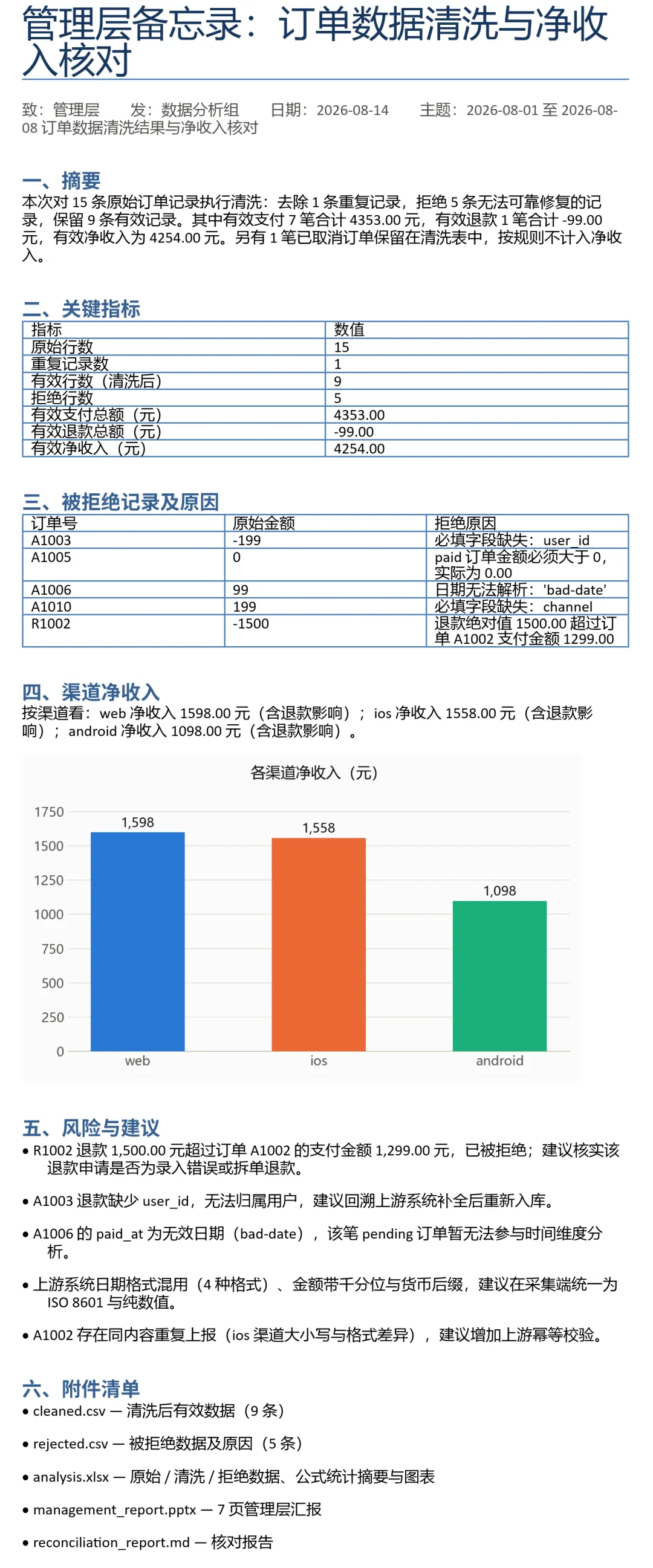
DeepSeek-V4-Pro's final business numbers are all correct, and the reconciliation report lists all valid orders, making manual traceability convenient
However, date parsing relies only on regular expressions, so illegal times such as 2026-13-40 25:61:00 will also be accepted; when encountering the +00:00 time zone, the script only removes the time zone marker,
Excel does not freeze the header row, and the column widths are stretched very wide, so the data table browsing experience is average.
Word has no charts.
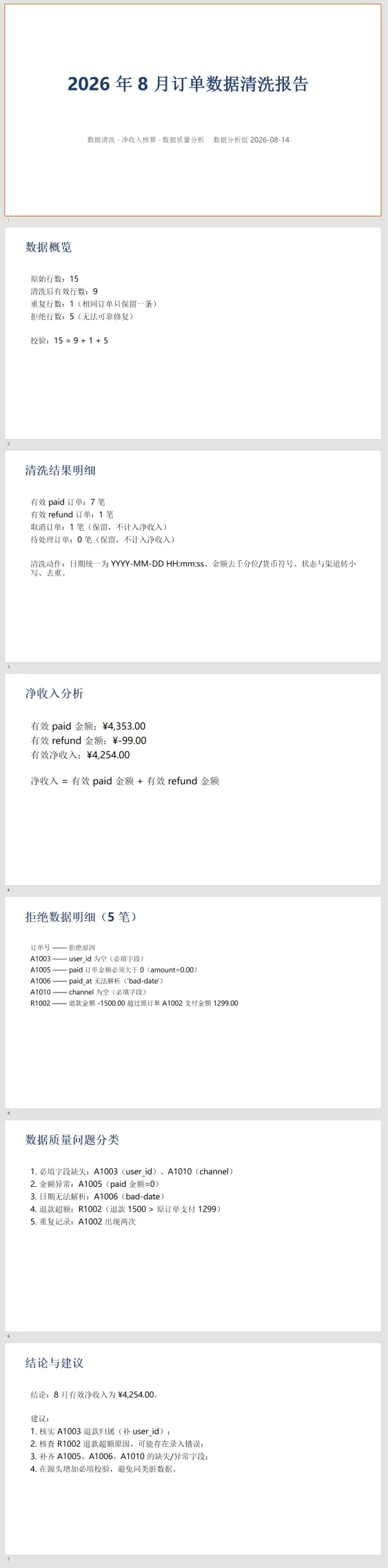
PPT is mainly text, with a lot of blank space.
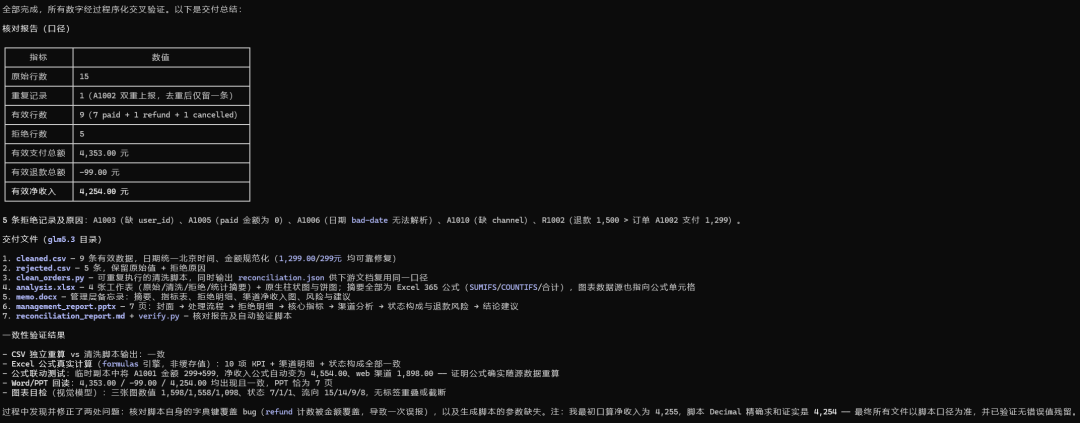
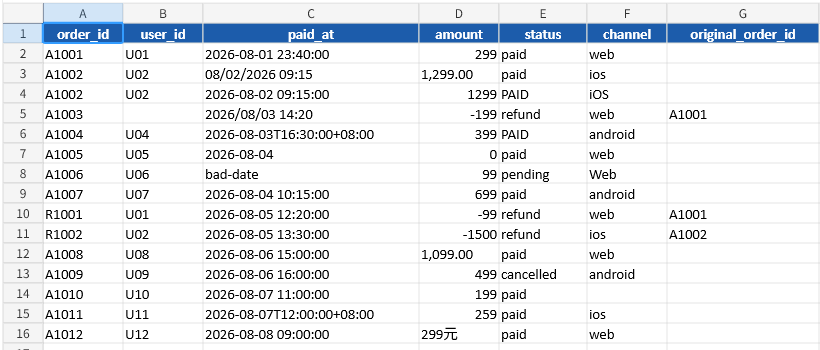
GLM-5.3 uses Decimal to handle amounts, can also correctly convert ISO time zones, and can reject illegal dates; the script uses its own directory to locate files, so it is not easy to find the wrong files even when executed from other directories.
Excel adds channel analysis, status analysis, formula charts, and frozen headers.
Word includes channel charts.
PPT has flowcharts, data cards, tables, and charts, and is already close to a ready-to-present final product.
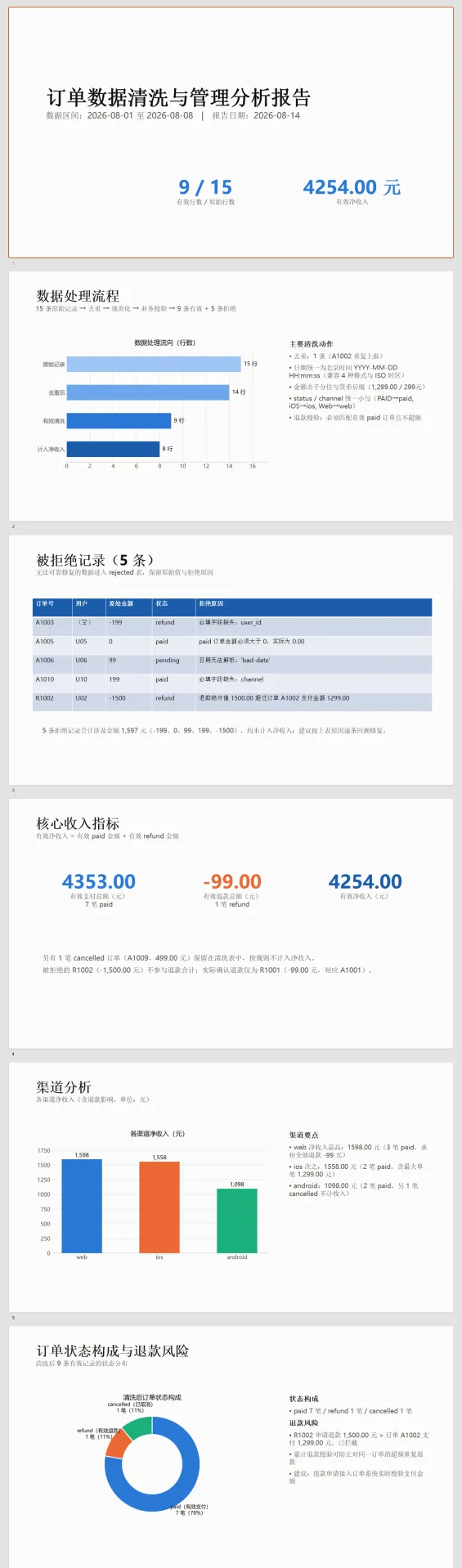
DeepSeek-V4-Pro delivered a set of office results with correct numbers but rather basic formatting; GLM-5.3 is clearly more complete.
case 3 Repository Concurrency Bug Fix
Prompt:
Please handle the duplicate order incident in Order Desk.
Repository path:
D:\360MoveData\Users\win\Desktop\选题\order-desk
Customer support has received multiple reports of duplicate orders. When users quickly double-click "Save Order," retry after a network timeout, or when two requests reach the server almost simultaneously, the system may generate multiple orders. Duplicate orders each enter subsequent processes separately and currently need to be canceled manually.
Please go directly into the repository and handle it:
1. Read README.md, TASK.md, the application code, database migrations, and existing tests.
2. Run the existing tests to confirm the current state.
3. Reliably reproduce the duplicate order issue.
4. Trace the call process among the frontend, HTTP API, business service, and SQLite to find the specific root cause.
5. Modify the code to solve duplicate orders caused by concurrent requests, network retries, and service restarts.
6. Preserve the existing API as well as normal order placement, order query, and listing functionality.
7. Add tests related to concurrency, duplicate requests, conflicting requests, transaction failure retries, and service restarts.
8. Check the impact of database migrations on new databases and existing databases.
9. Run all tests, and after finding errors, continue fixing and re-verifying.
Please complete the modifications directly in the repository, not just provide suggestions.
After completion, explain:
– Root cause.
– Fix approach.
– Modified files.
– Database migrations.
– New tests.
– Actually run commands and results.
– Remaining risks.
DeepSeek-V4-Pro
GLM-5.3
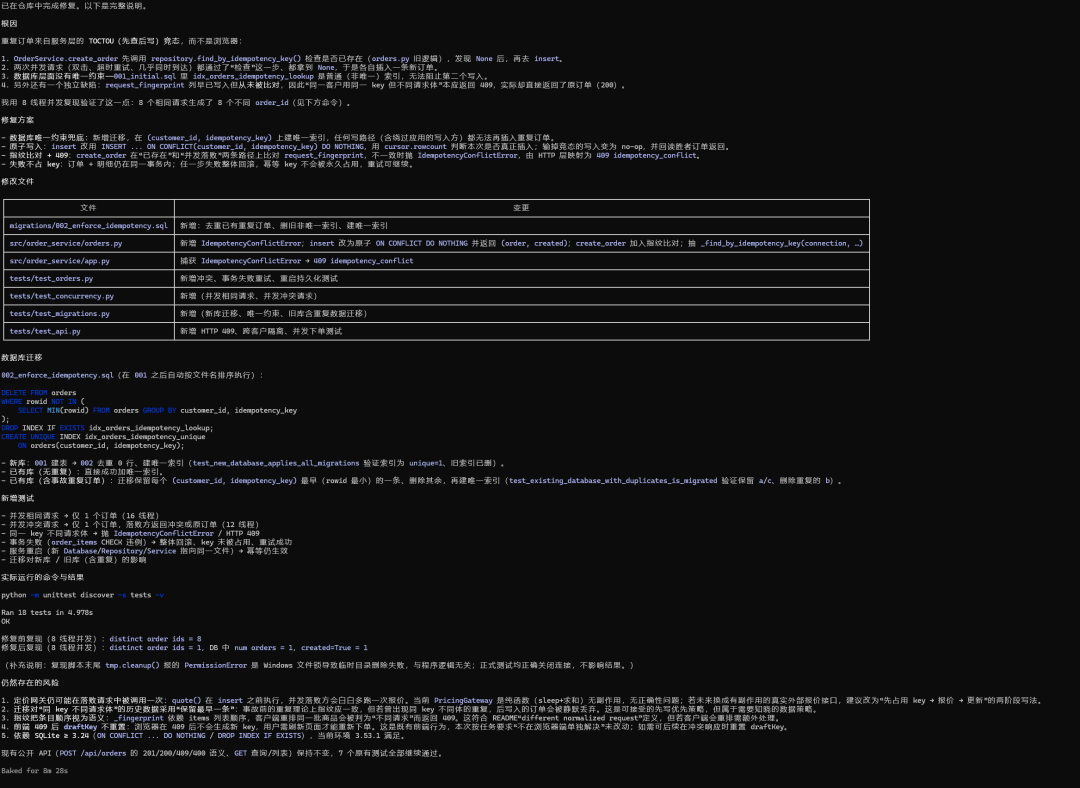
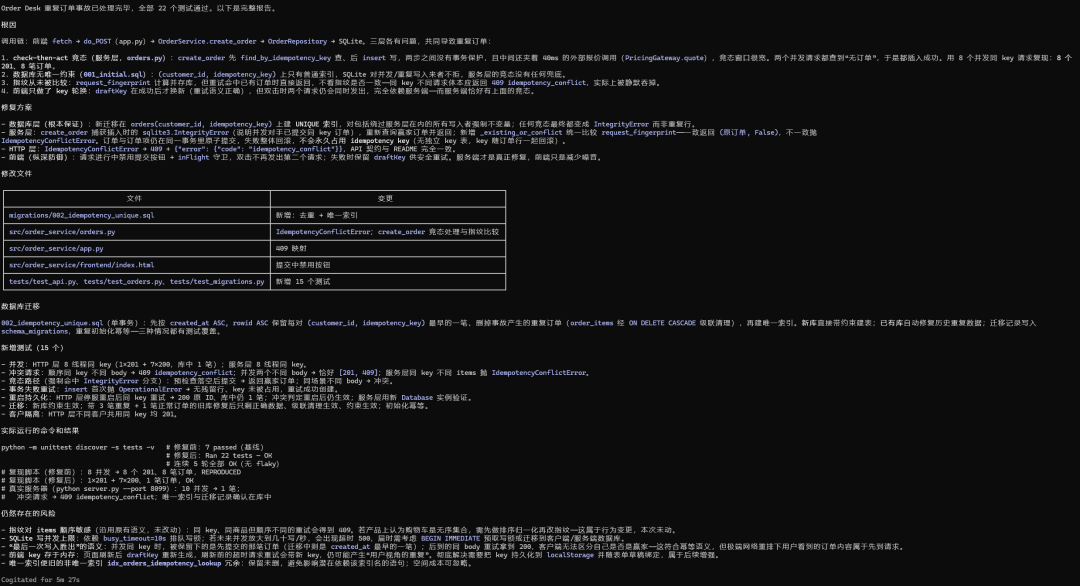 Both sides correctly resolved the incident requirements, and in actual testing results both models also passed.
DeepSeek-V4-Pro's concurrency implementation is more direct.
Both sides correctly resolved the incident requirements, and in actual testing results both models also passed.
DeepSeek-V4-Pro's concurrency implementation is more direct.
This implementation only handles unique target key conflicts, and the code semantics are clear. The main problem is database migration: when an exception occurs, the database is left in a half-migrated state. GLM-5.3's main advantage is that migrations are more stable, and in terms of testing, GLM-5.3 also covers a broader range. DeepSeek-V4-Pro's functional performance is on par with GLM-5.3. The gap mainly appears in exception handling for production migrations.ON CONFLICT(customer_id, idempotency_key) DO NOTHING
case 4 file export security hardening
Prompt:
Review and fix the following FastAPI endpoint:
from fastapi import FastAPI
from fastapi.responses import FileResponse
from pydantic import BaseModel
import os
import requests
app = FastAPI()
class ExportRequest(BaseModel):
url: str
filename: str
@app.post(“/export”)
def export_pdf(req: ExportRequest):
output = f”/tmp/{req.filename}”
html = requests.get(req.url).text
open(“/tmp/page.html”, “w”).write(html)
os.system(f”wkhtmltopdf /tmp/page.html {output}”)
return FileResponse(output)
Complete the following work:
1. List the vulnerabilities, exploitation conditions, and impact by severity.
2. Provide runnable attack or test examples for the main vulnerabilities.
3. Submit the complete fixed code.
4. Add pytest tests.
5. Restrict protocols, ports, target hosts, and the number of redirects.
6. Rejectloopback, private, link-local, reserved addresses, and cloud service metadata addresses.
7. Check IPv4, IPv6, IPv4-mapped IPv6, decimal IP, and mixed-encoding addresses at the same time.
8. Handle DNS rebinding and changes in resolution results.
9. Recheck the target after each redirect.
10. Pin the connection to the verified target IP when establishing the connection.
11. Limit response header size, response body size, connection time, read time, and total time.
12. Use streaming reads; do not load the entire response into memory before validating the size.
13. Prevent command injection, path traversal, symlink attacks, and arbitrary file overwrite.
14. When invoking wkhtmltopdf, disable the shell and restrict local file access and external resource loading.
15. Use an independent temporary directory for each request.
16. Input and output files must not be shared between concurrent requests.
17. Clean up temporary files on client disconnect, request cancellation, conversion failure, and after sending completes.
18. Handle the cleanup timing when FileResponse is still reading the file.
19. Set timeouts, resource limits, and termination handling for the conversion process.
20. Run the tests and continue fixing the issues found.
Tests must at least cover:
– `127.0.0.1`
– `::1`
– `169.254.169.254`
- Private IPv4
- IPv4-mapped IPv6
- DNS rebinding
- Redirect toprivate address
- Oversized response
- Slow response
- Command injection filename
- Path traversal filename
- Symlink output
- Two concurrent export requests
- Client cancellation midway
- wkhtmltopdf timeout
Deliver the vulnerability report, fixed code, test code, run instructions, and remaining edge cases.
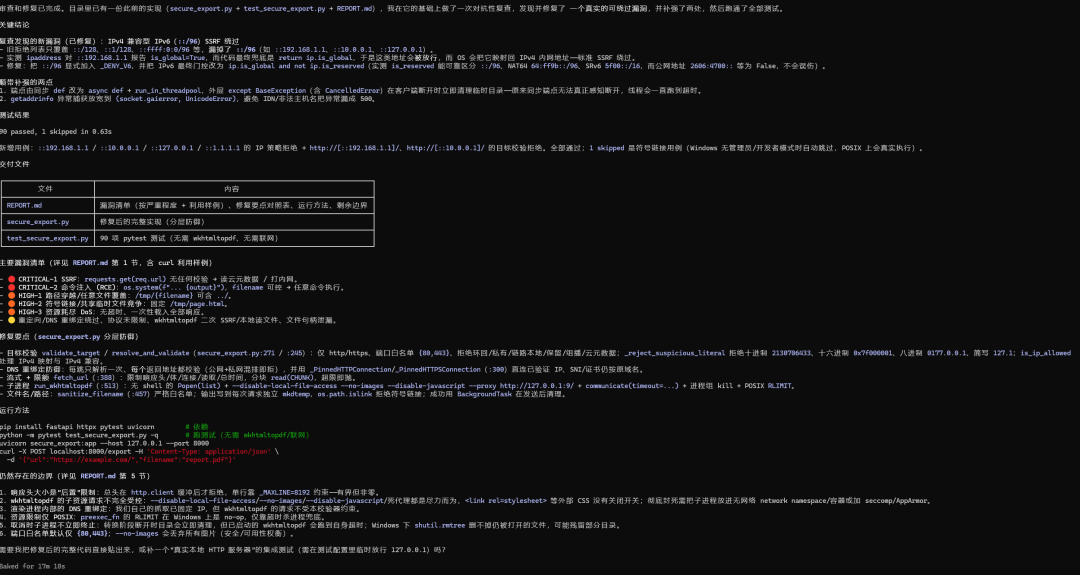
DeepSeek-V4-Pro
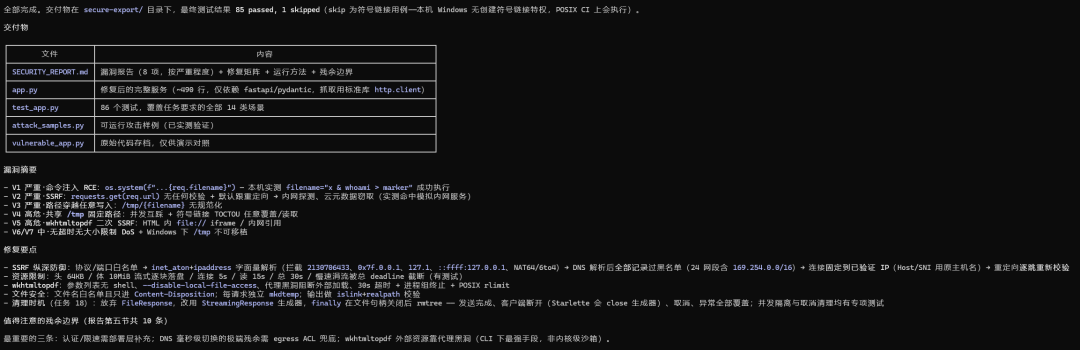
GLM-5.3
 DeepSeek-V4-Pro is stronger at SSRF address identification; in addition to explicit network ranges, it also uses is_global and is_reserved as fallbacks.
However, DeepSeek-V4-Pro's inheritance relationship is written incorrectly, which means that HTTPS targets will fail before the connection is actually established, and the example in the report cannot actually run.
GLM-5.3 correctly implements fixed IP connections for HTTP and HTTPS. HTTPS still uses the original domain name to complete SNI and certificate validation, and does not have DeepSeek-V4-Pro's inheritance error.
DeepSeek-V4-Pro is stronger at SSRF address identification; in addition to explicit network ranges, it also uses is_global and is_reserved as fallbacks.
However, DeepSeek-V4-Pro's inheritance relationship is written incorrectly, which means that HTTPS targets will fail before the connection is actually established, and the example in the report cannot actually run.
GLM-5.3 correctly implements fixed IP connections for HTTP and HTTPS. HTTPS still uses the original domain name to complete SNI and certificate validation, and does not have DeepSeek-V4-Pro's inheritance error.
case 5 large file external sorting
Prompt:
Implement a command-line tool in Go `ext-sort`。
The input is a CSV file of up to 10GB, and the available memory limit is 512MB.
Sorting rules:
1. `created_at` ascending.
2. When times are equal, sort by `user_id` ascending.
3. When the first two are equal, sort by original line number ascending to ensure a stable sort.
Requirements:
- Correctly handle quotes, commas, UTF-8, and newlines within fields.
- Preserve the header.
- created_at accepts RFC3339 and `YYYY-MM-DD HH:mm:ss`。
- Records that cannot be parsed are written to `rejected.csv`。
- A single piece of bad data must not cause the entire task to fail.
- Support `–input`、`–output`、`–temp-dir`、`–memory-limit` and `–workers`。
- The entire file must not be read into memory.
- The memory limit should include the main usage of sorting blocks, buffers, and the merge phase.
- Clean up temporary files when a termination signal is received.
- Give clear errors when disk space is insufficient, files are corrupted, or permissions are insufficient.
- The target output file can only be replaced after it is fully generated.
- Sorting results must be reproducible.
- Multiple runs must not leave behind unrecognizable temporary files.
Please deliver:
1. A complete Go project.
2. Unit tests, integration tests, and property tests.
3. A random test data generator.
4. A sorting result verification tool.
5. Performance tests.
6. A design description for crash recovery and temporary files.
7. Build and run commands.
Actually generate a test file larger than the available memory, run the sort, verify the results, and measure peak memory. Continue making changes after finding errors.
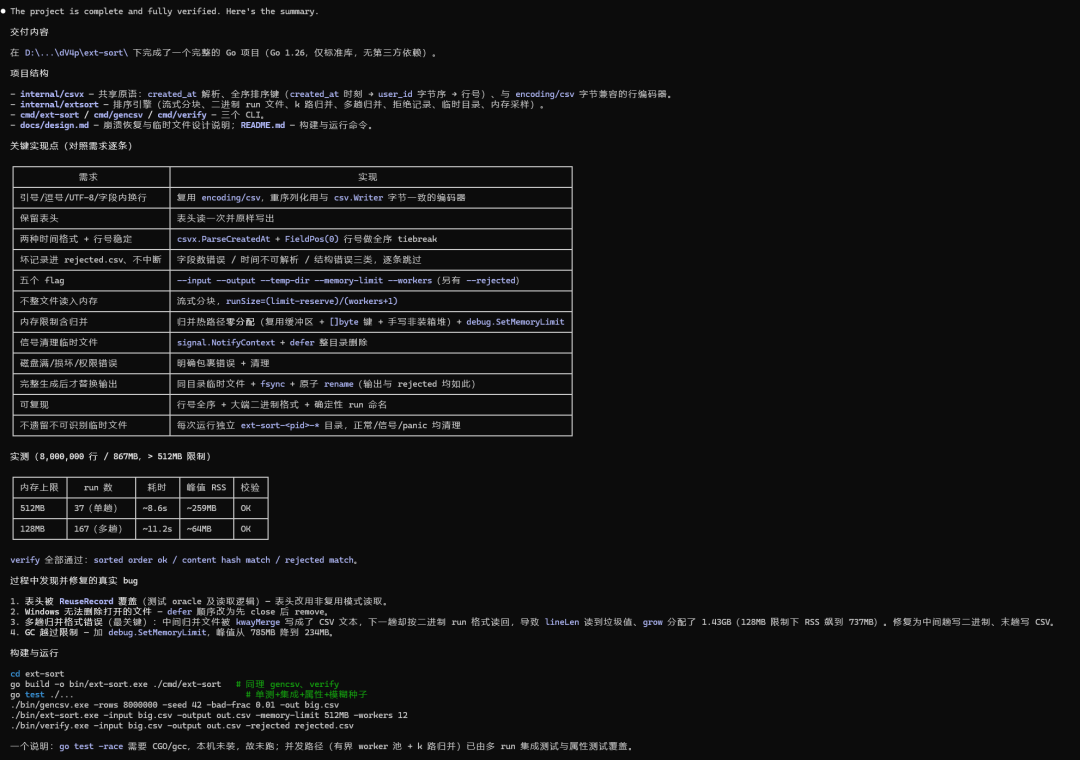
DeepSeek-V4-Pro
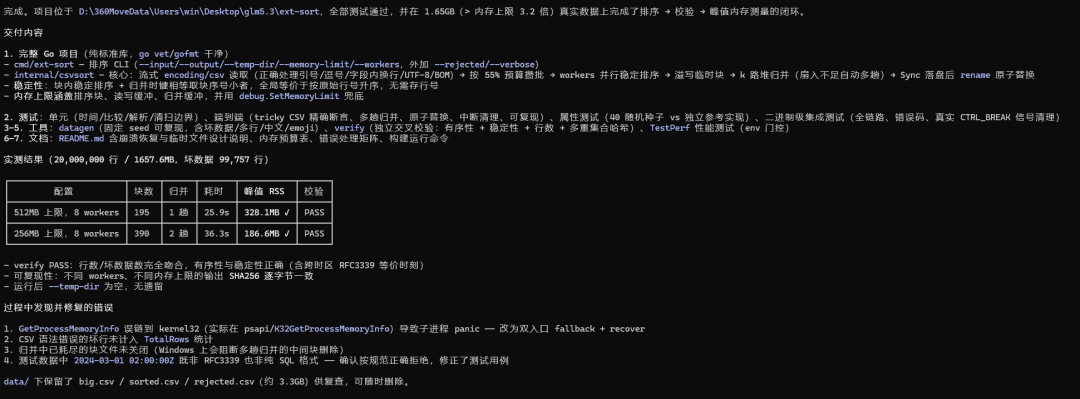
GLM-5.3
 DeepSeek-V4-Pro is nearly twice as fast on the same data, and its time range handling is also more correct. The user_id comparison relationship is stable, a CSV syntax error in the first field will not crash, and the worker limit, binary temporary blocks, and allocation-free merge are more mature.
GLM-5.3's testing system is more complete, including 40 sets of property tests, binary-level full-chain testing, and real Windows signal testing.
But in GLM-5.3, one bad CSV line will make the entire program panic. When a quote syntax error occurs in the first field, csv.Reader returns an empty record.
DeepSeek-V4-Pro's delivery is closer to an implementation ready for use. GLM-5.3's sorting comparator, out-of-range times, and bad CSV panic are relatively core errors.
DeepSeek-V4-Pro is nearly twice as fast on the same data, and its time range handling is also more correct. The user_id comparison relationship is stable, a CSV syntax error in the first field will not crash, and the worker limit, binary temporary blocks, and allocation-free merge are more mature.
GLM-5.3's testing system is more complete, including 40 sets of property tests, binary-level full-chain testing, and real Windows signal testing.
But in GLM-5.3, one bad CSV line will make the entire program panic. When a quote syntax error occurs in the first field, csv.Reader returns an empty record.
DeepSeek-V4-Pro's delivery is closer to an implementation ready for use. GLM-5.3's sorting comparator, out-of-range times, and bad CSV panic are relatively core errors.
case 6 High-density data dashboard
Prompt:
Use React, TypeScript, and Vite to create an "AI Model Evaluation Laboratory" single-page application.
Visual direction:
- Dark graphite background.
- Acid green is used only for selected states, anomaly alerts, and a small amount of key data.
- Gradients, emoji, glassmorphism, and screens full of rounded-corner cards are prohibited.
- Information density is on the high side, while maintaining a clear visual hierarchy.
- Establish a stable spacing, typography, and color system.
- Avoid the layout and decoration of common admin templates.
Data scale:
- Generate 50,000 evaluation run records locally.
- Each record includes the model, evaluation set, time, accuracy, latency, cost, input Tokens, output Tokens, and run status.
– Data generation uses a fixed random seed.
Page content:
– Model and evaluation set filtering.
– Run parameters panel.
– Comprehensive metrics matrix.
– Latency distribution chart.
– Cost trend chart.
– Chart of the relationship between accuracy and Token consumption.
– Virtually scrollable run history table.
– Single run details drawer.
– Multi-model comparison mode.
Interaction requirements:
– Filter conditions are synced to the URL.
– Browser forward and back can correctly restore the filter state.
– When rapidly switching filter conditions in succession, old request results must not overwrite new results.
– Support loading, empty data, error, request cancellation, and partial failure states.
– Charts display tooltips, legends, outliers, and clear axis units.
– Axes must not be misleading through truncation.
– Tables support sorting, filtering, pagination, or virtual scrolling.
– All interactions support the keyboard.
– Focus states are clear.
– Support `prefers-reduced-motion`。
– Adapt to the three widths 1440, 768, and 390.
– Use a local mock API that supports delays, errors, and request cancellation.
– Add component tests, state tests, and key interaction tests.
After completion:
1. Run format checks, type checks, tests, and a production build.
2. Start the application and check the console.
3. Measure the initial render and filter response with 50,000 records.
4. Generate screenshots at widths 1440, 768, and 390 respectively.
5. Check for overflow, occlusion, alignment, text readability, and misleading charts.
6. Complete a full filtering and detail-viewing flow using the keyboard.
7. Fix the issues found and re-verify.
DeepSeek-V4-Pro
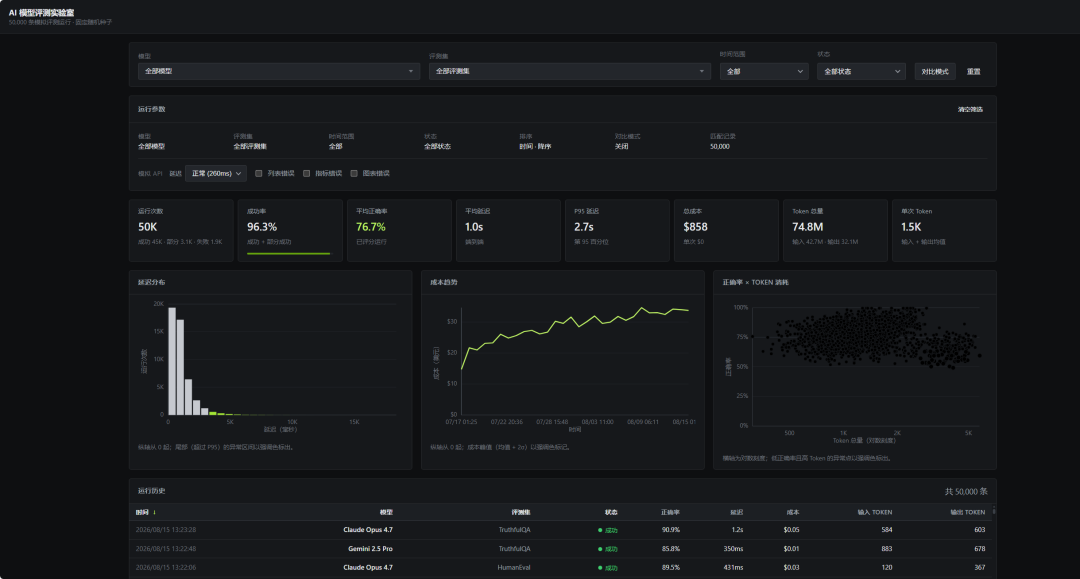
GLM-5.3
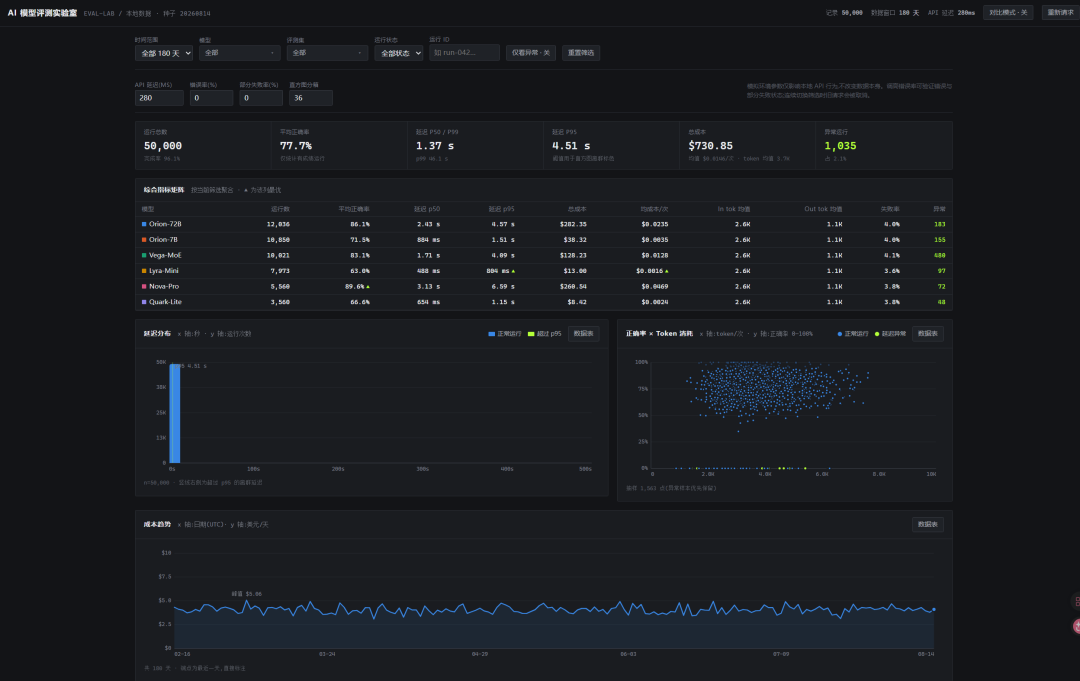
The DeepSeek-V4-Pro page is more comfortable, especially at 390px and 768px widths, where the filter area, metric cards, and charts remain clear.
GLM-5.3 covers the original requirements more completely. With a fixed seed combined with a fixed timeline, the generated data remains consistent when run on a different machine or on a different date. The charts also provide a data table view, with the initial data render at about 359ms and the filter response at about 286ms, slightly faster than DeepSeek-V4-Pro.
GLM-5.3 is slightly ahead in state handling and acceptance, while DeepSeek-V4-Pro performs better in page readability and multi-model analysis.
case 7 node editor
Prompt:
Implement a lightweight workflow editor using React, TypeScript, and SVG.
Functional requirements:
– Create, select, drag, rename, and delete nodes.
– Create connections by dragging wires from ports.
– Reject self-loops, duplicate connections, and invalid directions.
– Single selection, multi-selection, and marquee selection.
– Copy, paste, and duplicate nodes.
– Canvas zoom and pan.
– Nodes automatically enter the visible area.
– Undo and redo, retaining at least 50 steps.
– Support Delete, Backspace, Ctrl/Cmd+C, Ctrl/Cmd+V, Ctrl/Cmd+Z, and Ctrl/Cmd+Shift+Z.
– When editing input fields, keyboard shortcuts must not accidentally delete nodes.
– JSON import and export.
– JSON errors must indicate the specific field or location.
– Restore from localStorage after refresh.
– Remains operable with 500 nodes and 1000 connections.
– Provide a minimap or canvas positioning tool.
– Support keyboard selection of nodes.
Engineering requirements:
1. First design the state model, coordinate system, and history structure.
2. Manage business state and temporary drag state separately.
3. Undo records must not save meaningless intermediate mouse movement states.
4. After copying, node IDs, positions, and connections must be correctly updated.
5. After zooming, dragging, box selection, and port connections must still be accurate.
6. Write tests for connection rules, undo/redo, copy/paste, and import/export.
7. Add performance tests for large data volumes.
8. Run type checking, tests, and production build.
9. Launch the application to check interactions and fix issues.
Deliver the complete project, state design documentation, running instructions, and real test results.
DeepSeek-V4-Pro
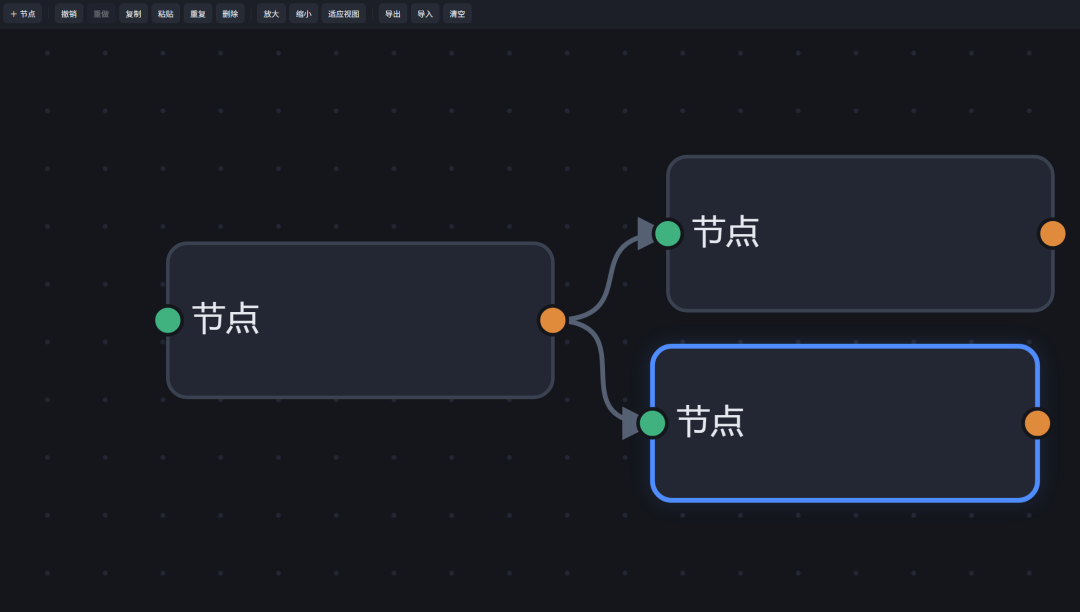
GLM-5.3
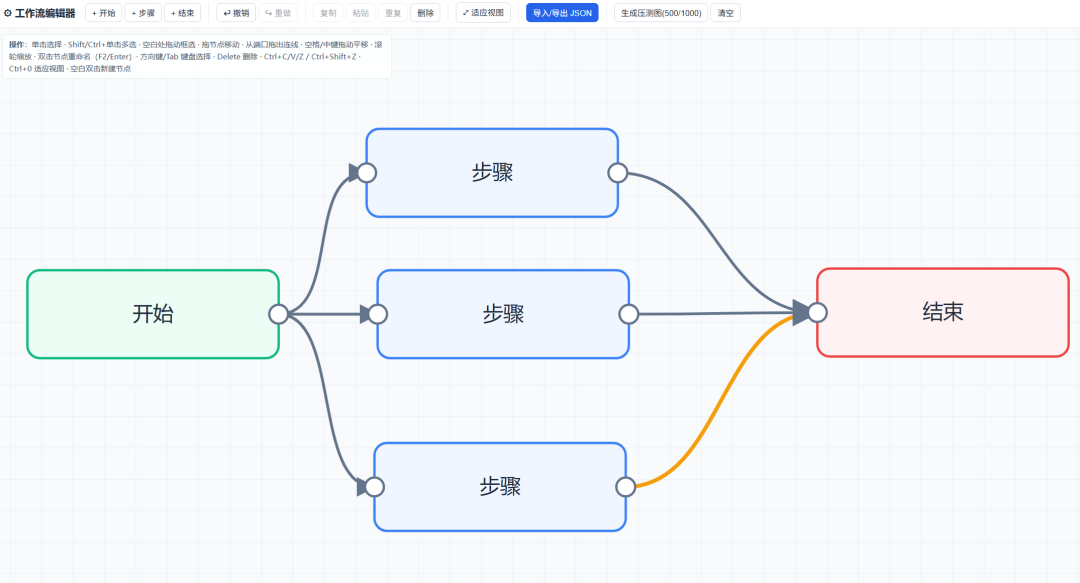
The strengths of DeepSeek-V4-Pro are concentrated in architecture and page completeness. Visual consistency of the dark canvas, ports, connections, and minimap.
The strength of GLM-5.3 is more solid requirement coverage. The three node types—start, step, and end—have clear color and port rules, repeated pasting continuously increases the offset, keyboard arrow keys can select nodes by spatial position, and the viewport can automatically adjust when selecting a node outside the canvas.
GLM-5.3 has more complete features and stronger test evidence; DeepSeek-V4-Pro is better in drag state design.
case 8 3D product configurator
Prompt:
Use Three.js, TypeScript, and Vite to build a modular desk lamp 3D configurator.
Modeling requirements:
– Use procedural geometry to create the lamp base, two lamp arm segments, pivot joints, lampshade, and bulb.
– Each part is an independent object.
– Part connection positions are reasonable; rotating the lamp arm must not cause disconnection.
– Downloading external models and textures is prohibited.
Interaction requirements:
– After clicking a part, display its outline and name.
– Support three materials, four colors, and three light levels.
– Support adjusting the angles of the two lamp arm segments and the lampshade.
– Each joint has a reasonable rotation range.
– Support exploded view animation and dimension annotations.
– Provide a configuration summary, price changes, and a reset button.
– Support mouse, touch, and keyboard.
Rendering requirements:
– Use PBR materials.
– Have ambient light, key light, and soft shadows.
– The bulb produces observable lighting changes.
– OrbitControls has reasonable target, distance, and polar angle limits.
– DPR cap is 2.
– Correctly adjust the canvas and camera after window changes.
– Pause unnecessary rendering when the page is not visible.
– Display a fallback notice when WebGL is unavailable.
– Correctly release geometries, materials, and event listeners.
After completion:
1. Run type checking, tests, and the production build.
2. Launch the page and check the console.
3. Check for disconnected joints, clipping, shadows, Z-fighting, and camera clipping.
4. Check mobile controls.
5. Generate screenshots of the default, exploded, lights-on, and mobile views.
6. Continue making corrections based on the actual visuals.
7. Submit the complete project, how to run it, and known limitations.
DeepSeek-V4-Pro
GLM-5.3
DeepSeek-V4-Pro has the advantage on the 3D body itself. The proportions of the lamp base, the two lamp arms, the joints, and the lampshade are fairly well coordinated, and it is obvious at a glance that it is an adjustable desk lamp; the nested joints are also written correctly, and when the parent lamp arm is adjusted, the parts behind it move along with it.
GLM-5.3 is more like a product configurator that can be demonstrated directly. Materials, colors, lighting, angles, real-time price, and price differences are all concentrated in one card, making the information easier to find than in DeepSeek-V4-Pro; the model is split into eight selectable parts, and the bulb point light also has shadows enabled.
GLM-5.3's main problem lies in the visual result. The lampshade is oversized, and the default camera faces directly into the inside of the lampshade; with the two lamp arms hidden, it looks more like a ring light.
DeepSeek-V4-Pro is better in 3D modeling, selection effects, and mobile readability; GLM-5.3 leads in the configuration panel, but obvious visual problems have a great impact on a 3D case.
case 9 Procedural Modeling
Prompt:
Write a Python script for Blender 4.x to generate a coffee kiosk.
Default dimensions:
– 4 meters wide.
– 3 meters deep.
– 2.8 meters high.
– Counter height 1.05 meters.
Model contents:
– Platform, walls, ceiling, and service window.
– Counter, storage cabinets, and shelves.
– Coffee machine, grinder, cups, and menu board.
– Exterior signage.
– Power outlets and cable trays.
– Camera, sunlight, and two area lights.
Structural requirements:
– Architecture, Furniture, Props, Lights are separated into independent collections.
– Main objects use stable, clear English names.
– The kiosk width, depth, counter height, and number of shelves can be modified through parameters.
– After parameter changes, the positions and proportions of each part adjust synchronously.
– Add reasonable bevels and normal handling.
– Use procedural materials.
– Write the main dimensions into object custom properties.
– When run repeatedly, update the collections managed by the script and do not produce duplicate objects.
– Do not delete user objects in other collections.
Deliverables:
1. Complete Python script.
2. Generate and save `.blend`。
3. Render three views: front, 45 degrees, and the indoor work area.
4. Check for floating, intersections, normals, material proportions, and exposure.
5. Re-run after modifying the dimensions and number of shelves.
6. Confirm that object names and custom properties remain stable.
7. Provide the run method, parameter explanation, and object structure explanation.
Actually execute the script in Blender 4.x and handle errors.
DeepSeek-V4-Pro

GLM-5.3

The DeepSeek-V4-Pro project contains 59 objects and 14 sets of materials, categorized by architecture, furniture, props, lighting, and camera, and provides parametric scripts, three cameras, and automated quality inspection.
The final render of DeepSeek-V4-Pro has obvious flaws. The front signage and menu text are inverted and mirrored, and the signage is also cropped.
The spatial completeness of GLM-5.3 is clearly higher. On the front side, the service window, shelving, cups, coffee equipment, countertop, and cabinets can be seen, and the green and wood color combination is also closer to a deliverable commercial space solution.
GLM-5.3 also has visible issues: the menu text does not fall within the black menu board.
Considering the three-view drawings, spatial completeness, parameter validation, and the final render, GLM-5.3 is still slightly stronger; DeepSeek-V4-Pro has an advantage in script structure, but the text direction errors directly lower the delivery quality.
case 10 Material Review
Prompt:
The company is preparing to conduct final acceptance of the project and pay the final payment. In the project materials, there are inconsistencies in the requirement versions, amounts, dates, responsible persons, and acceptance conditions.
Please read in full the contract, supplementary agreement, requirements document, meeting minutes, emails, quotation, and acceptance materials provided in this round, and verify the requirements that the project should currently execute.
Please deliver:
1. A list of requirements and commitments, with each entry containing:
- Number
- Requirement, commitment, or decision
- Current status
- Source document
- Page number, section, or paragraph location
- Original text evidence
- Effective date
- Amount involved
- Responsible person
- Acceptance conditions
- Whether it has been modified or repealed by subsequent documents
- Basis for modification or repeal
- Issues requiring confirmation
2. A list of conflicts between documents, focusing on checking:
- Contract and supplementary agreement
- Different versions of the requirements document
- Meeting minutes and confirmation emails
- Main text and tables
- Quotation, budget, and payment amounts
- Planned dates and actual dates
- Responsible persons and acceptance personnel
3. Old requirements that have been modified or repealed but are still continuously cited in subsequent materials.
4. Differences between contractual commitments, current implementation results, and acceptance materials.
5. Claims lacking support from formal evidence.
6. High-risk matters that may affect acceptance, payment, or determination of responsibility.
7. Files that cannot be read, have missing pages, are garbled, or have incomplete content.
8. Issues requiring confirmation by the project manager, legal, finance, or the supplier.
Handling requirements:
- All conclusions must be accompanied by specific document locations.
- When evidence cannot be found, write "not found"; do not fill in based on common sense.
- When multiple versions exist for the same matter, list them separately; do not choose one on your own.
- Only when a subsequent document explicitly modifies an old requirement can the old requirement be deemed to have become invalid.
- Distinguish between formal contracts, signed documents, confirmation emails, meeting discussions, and personal opinions.
- For people with the same name, identity must be confirmed in conjunction with department, email, or context.
– Check the date, amount, responsible person, and acceptance conditions item by item.
– When inconsistencies are found between the main text and the table, retain evidence from both places.
Finally, provide an acceptance review opinion for management to read, explaining whether acceptance can currently proceed, whether the final payment can be made, matters that need to be temporarily suspended, and the evidence for each judgment.
DeepSeek-V4-Pro
GLM-5.3
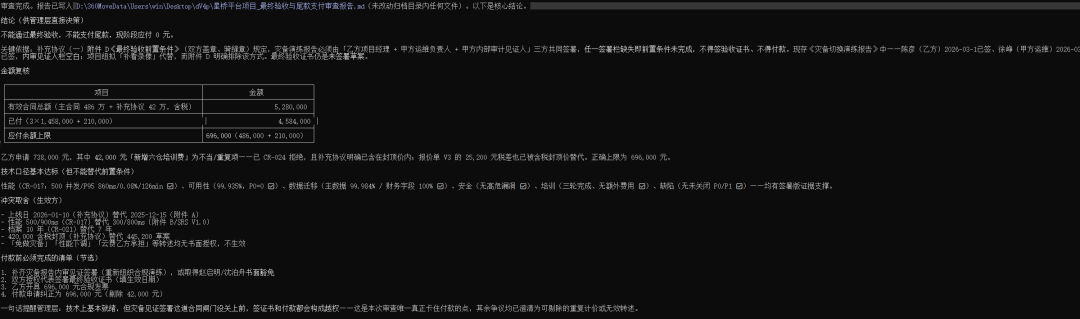
DeepSeek-V4-Pro accurately identified all facts that would change the acceptance and payment conclusions, and also identified the duplicate training fee of 42,000 yuan and the invalid tax amount of 25,200 yuan, correctly handling the version conflict; the main omission was the archival retention requirements.
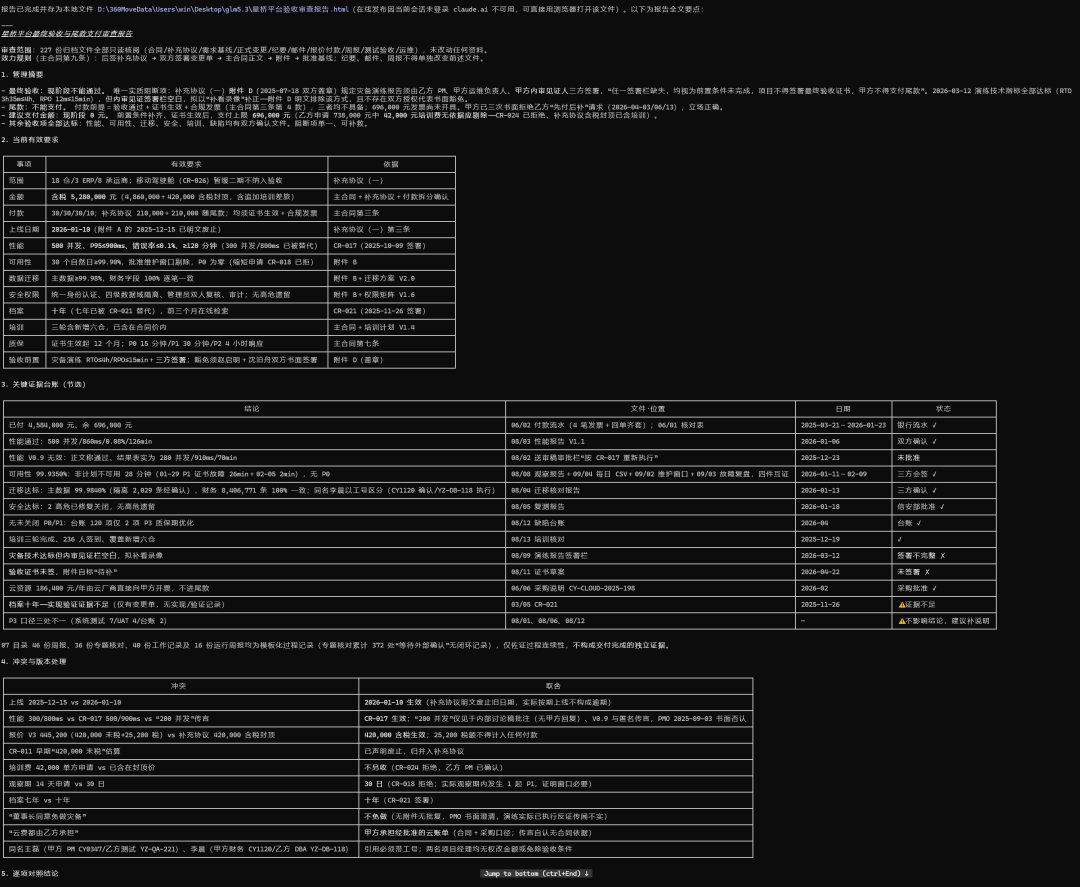
GLM-5.3 likewise reached the correct conclusions on acceptance, payment, and amounts, and its evidence ledger was even more detailed.
However, the problem with GLM-5.3 is that excessive analysis led to data errors, while DeepSeek-V4-Pro is more reliable in the factual accuracy required for high-risk review.
case 11 Customer service ticket handling
Prompt:
The customer service system needs to convert new tickets into JSON that the downstream dispatch service can read.
The fixed structure accepted by the downstream service is as follows:
{
“tickets”: [
{
“id”: “string”,
“category”: “billing|bug|account|feature”,
“priority”: “p0|p1|p2|p3”,
“requires_human”: true,
“reason”: “string”
}
],
“summary”: {
“total”: 0,
“p0_count”: 0
}
}
Classification rules:
– Account theft, unfamiliar charges, or continued charges after canceling a subscription are classified as p0.
– Software crashes that can be reproduced reliably are classified as p1.
– Inability to log in when automatic recovery methods also fail is classified as p1.
– Ordinary feature malfunctions are classified as p2.
– Feature suggestions are classified as p3.
– Issues involving funds, account security, or identity verification require manual handling.
– Fields not defined by the downstream service must not be added to the JSON.
Pending tickets:
T01: Lost my phone last night, and three unfamiliar charges appeared early this morning.
T02: The app crashes every time when exporting a PDF, and it still happens after reinstalling.
T03: Hope to add dark mode.
T04: Forgot my password, the reset email never arrives, and I have already checked the spam folder.
T05: I canceled my subscription two months ago, but I have still been charged for the last two months.
T06: After filtering orders, the page occasionally shows blank, and refreshing the page restores it.
Please return valid JSON that the downstream service can parse directly, without adding Markdown code fences or other text.
DeepSeek-V4-Pro
GLM-5.3
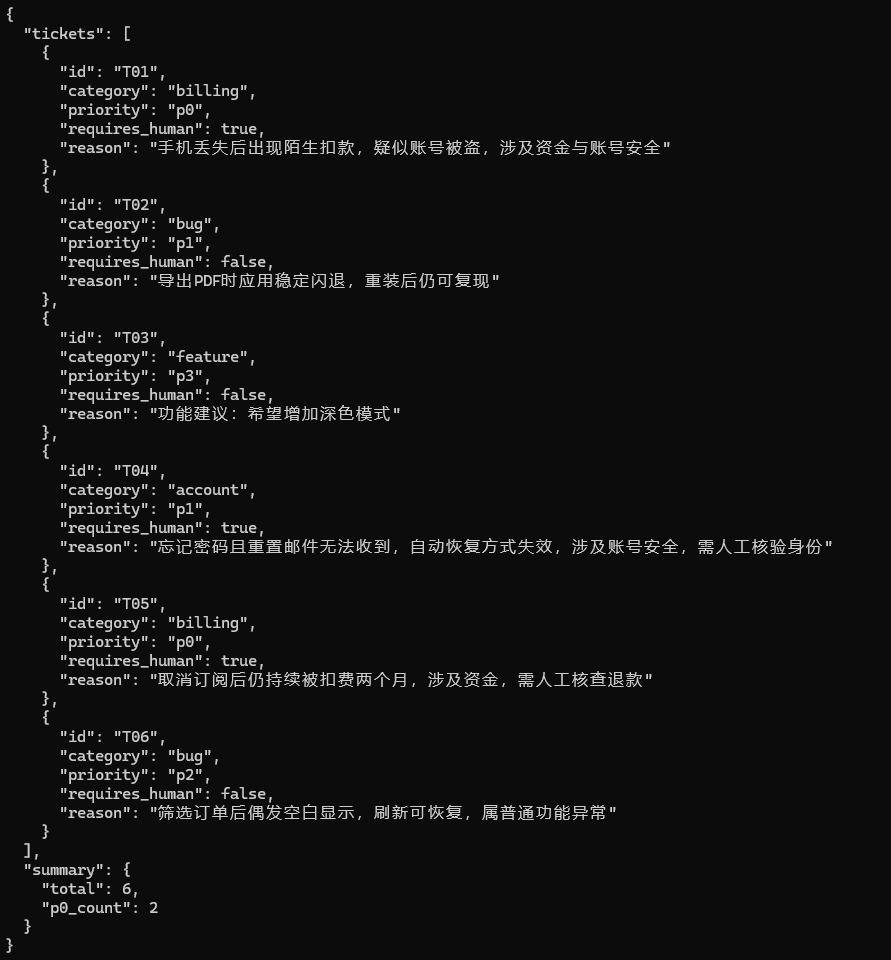
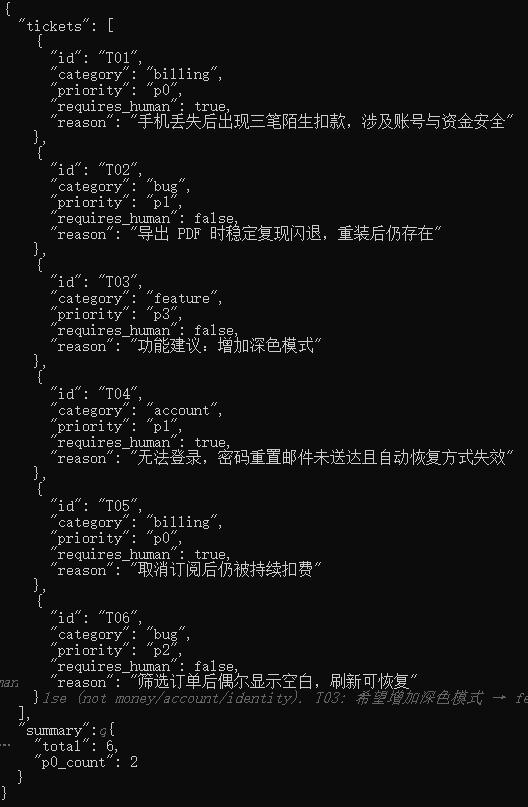
DeepSeek-V4-Pro's JSON structure is fully compliant, and the classification, priority, and manual intervention flags for all 6 tickets are correct; total: 6 and p0_count: 2 were also checked and are correct. T01 and T05, two fund security issues, were judged as P0, and T04, an account recovery issue, required manual intervention, showing accurate judgment of risk boundaries.
GLM-5.3's core fields are completely consistent with DeepSeek-V4-Pro, and it likewise has no format errors or unnecessary explanations. In its reasons, GLM-5.3 retained T05's two months of charges and added manual verification of the refund; T04 also explicitly states that identity verification requires manual handling, making it easier for customer service staff to continue processing after handoff.
There is little difference between the two models on this task.
case 12 Project scheduling and cost optimization
Prompt:
Create a schedule for the following software release project and identify the lowest acceleration cost plan that meets the deadline.
The project starts on Monday, September 7, 2026. Consider only Monday to Friday, and do not consider public holidays.
Scheduling rules:
– Each task starts at the beginning of a workday.
– Durations are calculated in full workdays.
– A dependent task starts on the next working day after all predecessor tasks are completed.
– The same person cannot participate in two tasks at the same time.
– A task marked with two owners requires both people to be available at the same time.
– Tasks with no dependency relationship and different owners can run in parallel.
– Each acceleration option can be used at most once.
– All tasks need to be completed before the end of October 13, 2026.
Tasks:
A. Requirements Analysis
Owner: Lin Zhou
Duration: 3 working days
Dependencies: None
Cannot be accelerated
B. Interactive Prototype
Owner: Lin Zhou
Duration: 4 working days
Dependencies: A
Can be shortened to 3 working days, increasing cost by 12,000 yuan
C. API Development
Owner: Zhou Zhe
Duration: 6 working days
Dependencies: A
Can be shortened to 4 working days, increasing cost by 28,000 yuan
D. Data Migration
Owner: Zhang Min
Duration: 5 working days
Dependencies: A
Can be shortened to 3 working days, increasing cost by 20,000 yuan
E. Frontend Development
Owner: Chen Sen
Duration: 6 working days
Dependencies: B
Can be shortened to 4 working days, increasing cost by 24,000 yuan
F. Security Plan
Owner: Zhang Min
Duration: 3 working days
Dependencies: B
Cannot be accelerated
G. System Integration Testing
Owners: Zhou Zhe, Chen Sen
Duration: 3 working days
Dependencies: C, D, E
Can be shortened to 2 working days, increasing cost by 9,000 yuan
H. Security Testing
Owner: Zhang Min
Duration: 4 working days
Dependencies: F, G
Can be shortened to 2 working days, increasing cost by 16,000 yuan
I. User Acceptance
Owner: Lin Zhou
Duration: 3 working days
Dependencies: H
Cannot be accelerated
J. App Store Review
Owner: External Team
Duration: 7 working days
Dependencies: I
Can be shortened to 5 working days, increasing cost by 25,000 yuan
Please deliver:
1. The complete schedule for the unaccelerated plan.
2. The completion date of the unaccelerated plan.
3. All reasonable acceleration combinations that satisfy the October 13 deadline.
4. The lowest-cost plan.
5. An item-by-item schedule for the lowest-cost plan.
6. A proof for the lowest cost, explaining why cheaper combinations cannot be completed on time.
7. If Zhang Min takes one day off on September 17, recalculate the lowest-cost plan.
8. A schedule table in Gantt chart form.
DeepSeek-V4-Pro
GLM-5.3
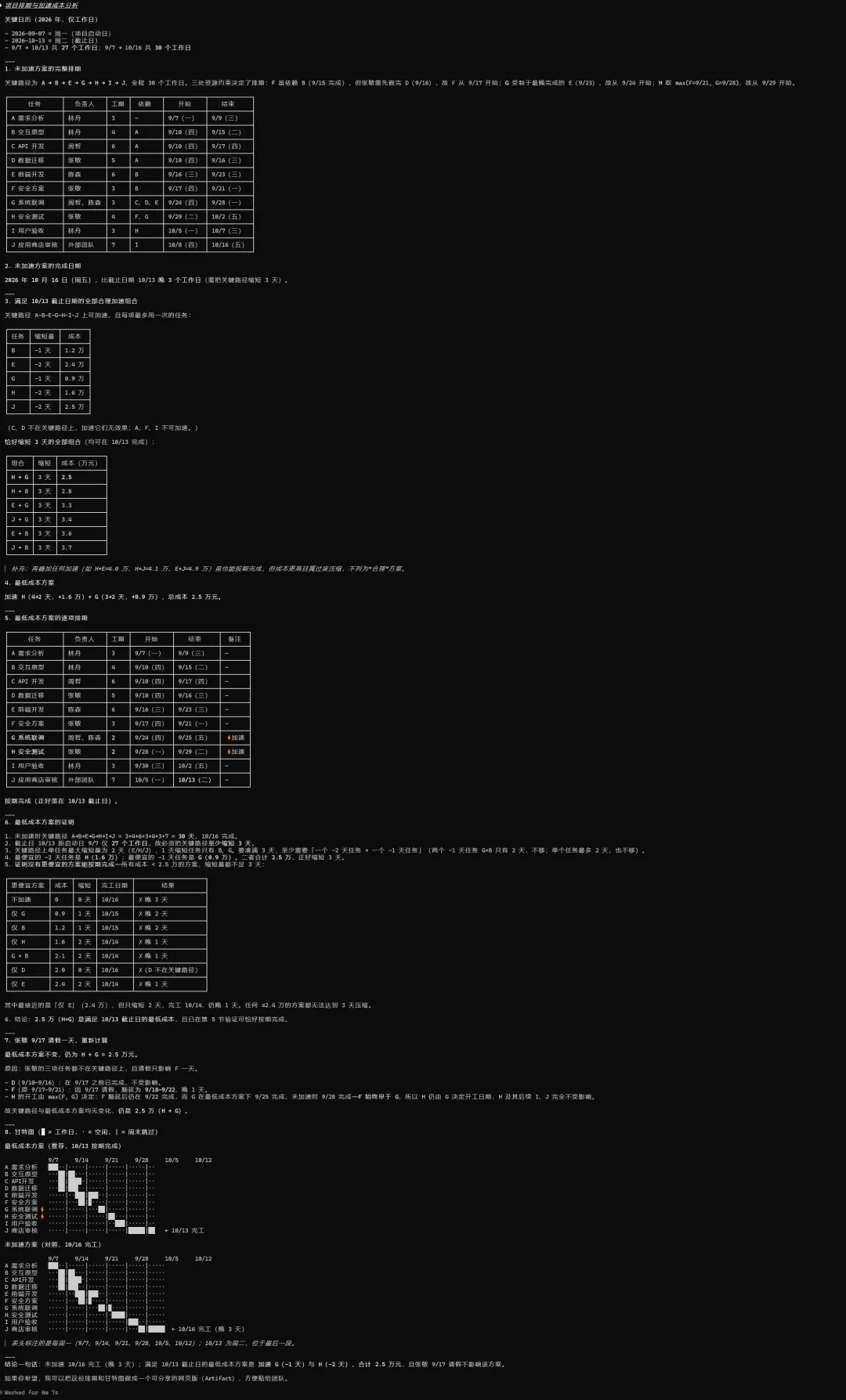
DeepSeek-V4-Pro's core computations are correct, it also found the lowest-cost plan, and it correctly calculated completion on October 13. Zhang Min's leave on September 17 only delays F, and the final date and optimal plan both remain unchanged.
DeepSeek-V4-Pro has omissions in combination enumeration. The deliverables are only a terminal table and an ASCII Gantt chart, which are also inconvenient to view and reuse.
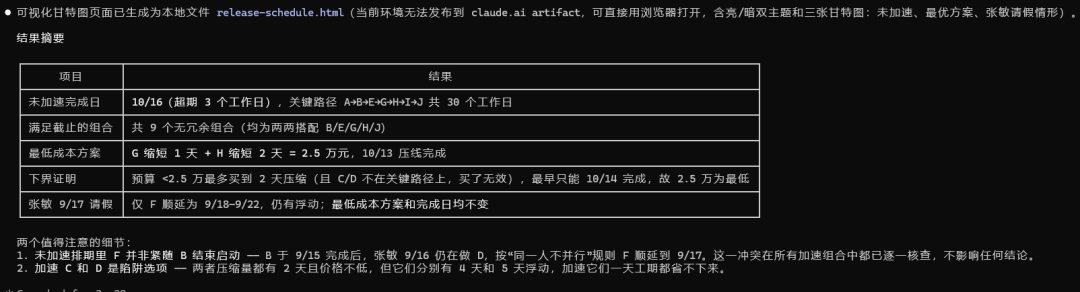
GLM-5.3 has a higher degree of completion. GLM-5.3 correctly lists all 9 non-redundant acceleration combinations, and the lowest cost, lower-bound proof, and leave recalculation results are all consistent with the independent calculation.
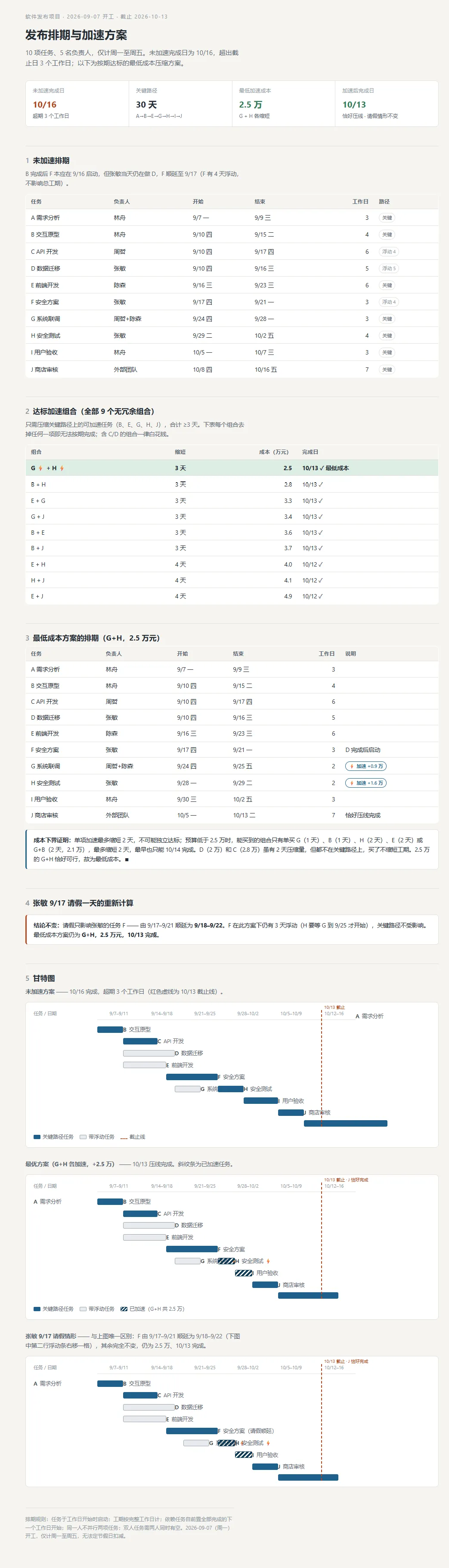
The generated release-schedule.html includes summary cards, three scheduling tables, and three Gantt charts. The unaccelerated plan, optimal plan, and leave plan can be directly compared, making it easier to use as project scheduling material.
DeepSeek-V4-Pro only calculated the plan correctly, while GLM-5.3 leads in combination completeness and delivery format.
02. Test Summary
After running 12 cases, GLM-5.3 leads in 7 tasks, DeepSeek-V4-Pro leads in 3 tasks, and the other 2 tasks are close.
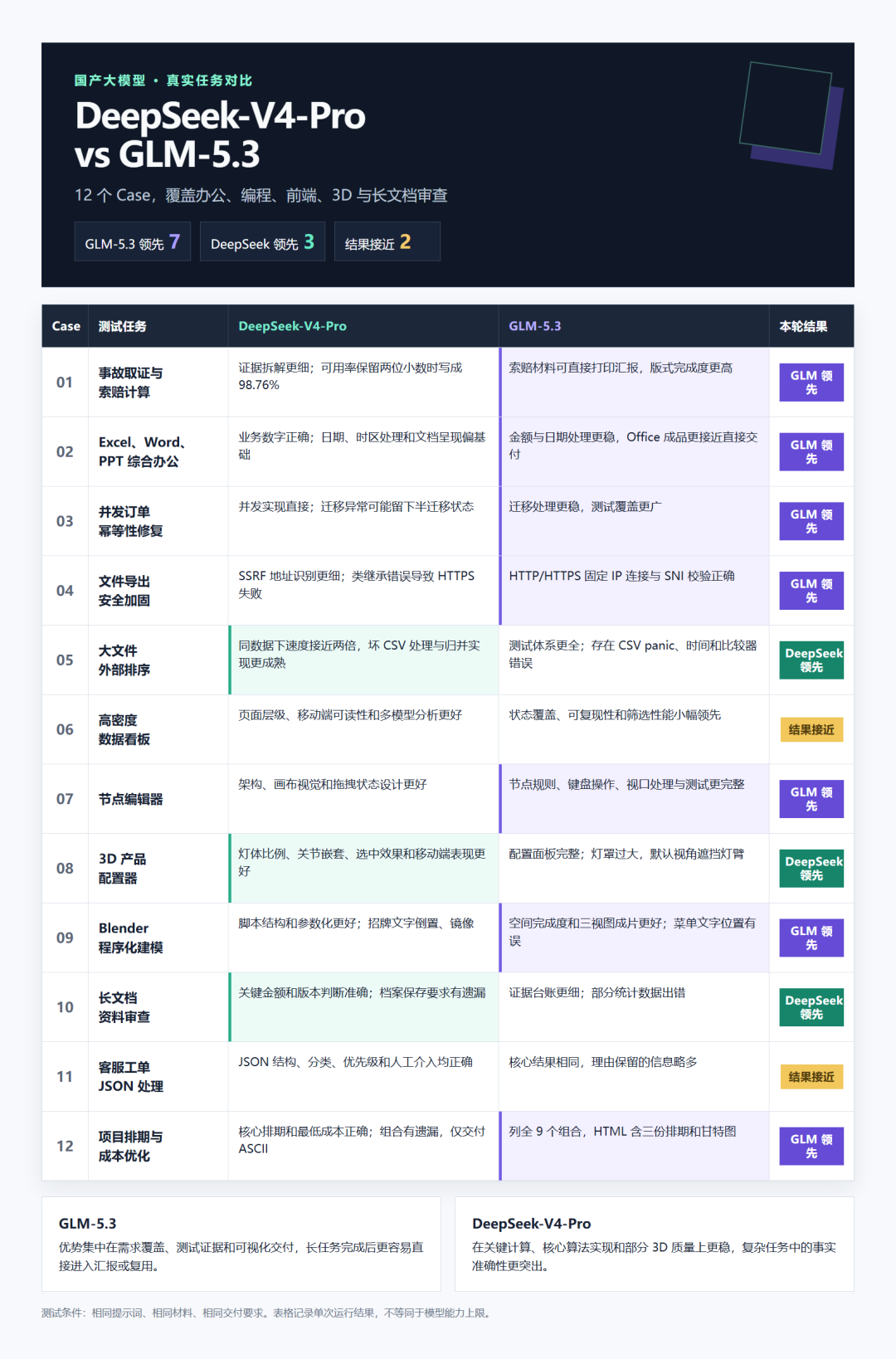
GLM-5.3's advantages are concentrated in complete delivery. The layout of office documents is more mature, programming tasks cover more exception cases, and the frontend and node editor are closer to ready-to-use finished products. In Blender modeling and project scheduling, GLM-5.3 can also deliver more complete scenes and visualization materials.
DeepSeek-V4-Pro's strengths are core implementation and factual accuracy. Large file sorting is faster, and bad data handling is more stable; the 3D desk lamp's structure, proportions, and mobile performance are better; when handling high-risk acceptance materials, DeepSeek-V4-Pro also did not miscalculate key numbers due to pursuing analytical depth.
If daily tasks are mainly office delivery, complete projects, and long-horizon Agent execution, I would prioritize GLM-5.3; if more emphasis is placed on algorithm implementation, key numbers, and evidence reasoning, DeepSeek-V4-Pro is still very competitive.
In this round, the top domestic model title can go to GLM-5.3, while DeepSeek-V4-Pro is more like the top domestic model's buddy.
03. Digging Deeper
AI models are moving from chat windows into real production workflows.
This round's 12 cases cover office documents, code repositories, frontend pages, 3D projects, and long document review. Models need to read materials, call tools, run tests, and also leave behind deliverables that can be checked and continue to be used. What enterprises are truly willing to pay for is precisely these capabilities that shorten work cycles and reduce rework.
GLM-5.3 won more victories in this round, with its advantages concentrated in complete delivery. For tasks that require quickly completing plans, prototypes, or a full set of project materials, GLM-5.3 is easier to integrate into existing workflows.
DeepSeek-V4-Pro is more stable in key calculations, algorithm implementation, and fact-checking. Large file sorting, acceptance material review, and 3D model structure all demonstrate solid underlying capabilities. Data processing, core code, and high-risk review have higher accuracy requirements, and DeepSeek-V4-Pro is still worth prioritizing.
A more realistic commercial approach is to assign models by task: GLM-5.3 handles requirement coverage, project setup, and finished product delivery, while DeepSeek-V4-Pro handles key calculations, core implementation, and result review.
The next round of competition among domestic models will also take place in these real work scenarios.
Original link:DeepSeek V4 Pro official version VS GLM-5.3, who comes out on top?