
What is DeepSeek Harness
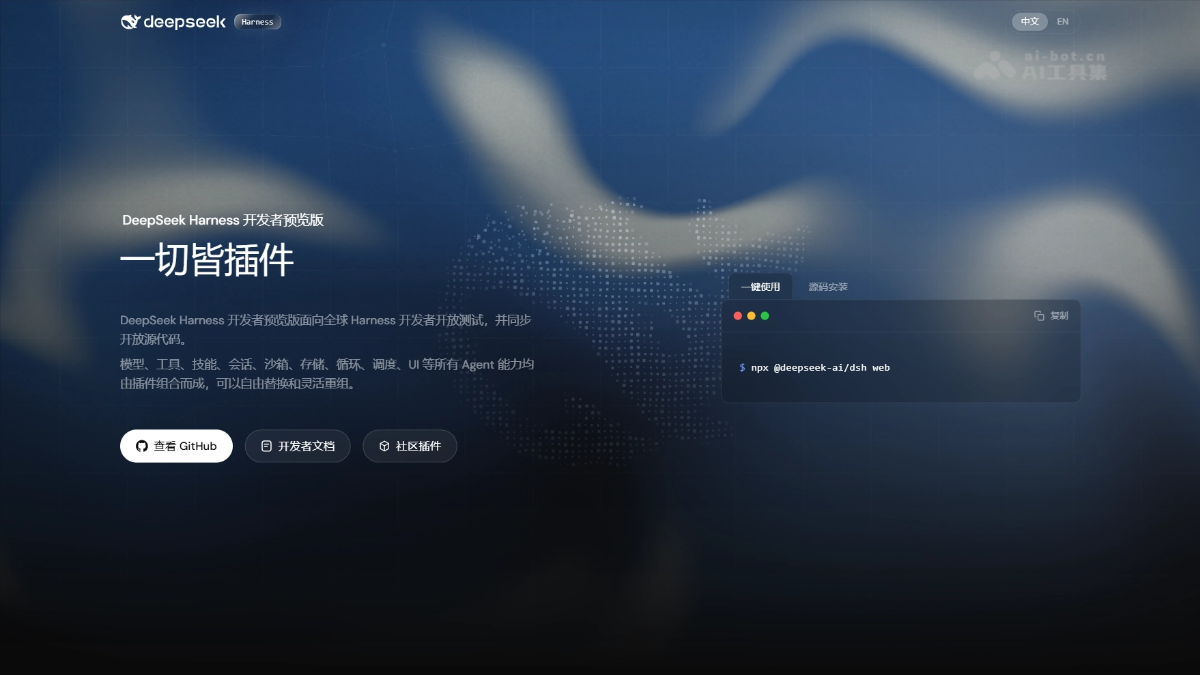
DeepSeek Harness is an AI agent runtime framework launched by DeepSeek, adopting the "everything is a plugin" philosophy and built on the Cordis system. All capabilities—models, tools, skills, sessions, sandboxes, storage, scheduling, UI, and more—are plugins that can be freely combined and replaced. DeepSeek Harness provides four runtime modes: Standard, PTC, Minimal, and Create, and supports full trajectory tracking and replay. DeepSeek Harness benchmarks against OpenAI Codex and Anthropic Claude Code, focusing on programming and office scenarios, achieving a complete closed loop from requirements understanding to code delivery.
Main features of DeepSeek Harness
- An agent framework where everything is a plugin: All agent capabilities such as models, tools, skills, sessions, sandboxes, storage, loops, scheduling, and UI are implemented as plugins, allowing developers to replace or extend any component without modifying the source code.
- Four runtime modes
-
Standard mode: A full coding agent supporting file editing, Shell, web search, Skills, planning, sub-agents, and workflows
-
PTC mode: Building on Standard mode, the Code Mode SDK lets the model compose multi-step tool calls with TypeScript programs
-
Minimal mode: Retains only two tools, bash and file editing, for model benchmarking
-
Create mode: Supports runtime inspection, plugin experimentation, and the creation of custom Agent presets
- Trajectory tracking and session management Uses an append-only session log design, fully recording all events such as system prompts, chains of thought, tool calls, sub-agent scheduling, and context injection. It supports session resumption, forking, retrieval, and replay, thoroughly solving the agent black-box problem.
-
- Multi-agent collaboration: The main Agent can delegate tasks to sub-agents, supporting parallel execution, workflow orchestration, planning mode, goal tracking, to-do items, and background task management, covering long tasks and complex automation scenarios.
- Security and permission control: By default, workspace-write mode is used to limit the scope of file/command execution; tool calls go through a pipeline of pre-policies, safety guards, execution wrapping, and post-processing; permission switches and approval requests are all recorded in the session log, supporting post-hoc auditing.
- Multiple interaction entry points: Provides a Web UI (default
localhost:3080), TUI terminal interface, Headless script mode, ACP service, and JSON-RPC/Python SDK. The same core capabilities can be assembled into different product forms through different configurations. - RC.8 version:
- Multimodal input enhancements: DeepSeek Harness v0.1.0-rc.8 enhances multimodal support; the model adapter can enable native image requests, core commands support mixed text-and-image input, and the
@menu can reference files and historical sessions. - Unified sub-agent orchestration: Claude Code and Codex are brought into the sub-agent orchestration system, supporting on-demand installation and invocation as Profile Bundles; Codex adds non-interactive permissions and multi-named-instance running capabilities.
- Tool and terminal experience optimization: Optimizes the tool calling and terminal experience,
web_searchsupports concurrent queries, the Windows PTY terminal adds persistent PowerShell sessions, and the local installation and startup process has been simplified.
- Multimodal input enhancements: DeepSeek Harness v0.1.0-rc.8 enhances multimodal support; the model adapter can enable native image requests, core commands support mixed text-and-image input, and the
Technical Principles of DeepSeek Harness
- Based on the Cordis plugin meta-framework: Cordis is the underlying plugin system of Harness, responsible only for plugin loading, unloading, and dependency management. Each plugin registers services, typed events, and reversible side effects with a shared Context, and automatically revokes registrations upon unloading to avoid residual state in the system. At runtime, Harness is essentially a Cordis Context, into which different packages register services and capabilities, ultimately composed by configuration files into a runnable agent.
- Plugin tree and configuration layer composition: At runtime, the
dshis a plugin tree stacked layer by layer. Configuration is stacked in order through Profile (named assembly) + Bundle (configuration lines and code distribution unit) +cordis.patch.yml(user patches), and later layers can replace or insert new configurations. The same set of code can be assembled into completely different product forms. - Capability Seam three-layer separation:Any capability is split into interface definition (service definition), implementation provider (concrete execution), and consumer (model-facing toolkit). For example, for the Bash capability, the interface defines "execute command", the local implementation creates a process, and the toolkit converts it into a schema the model can understand. Replacing the implementation layer (e.g., local Shell → remote container) requires no rewriting of model tools or the Agent Loop.
- Agent Loop lifecycle:
-
Turn: a complete round initiated by a single user input
-
Step: one model request + subsequent tool calls
-
- The flow is strictly event-driven: input → assemble prompt and tool Schema →
agent/pre-step→ model request → streaming output → tool call →tools/pre-execute→tools/execute→tools/post-execute→ hand back to the subsequent Step. Tool execution supports concurrency safety detection, barrier isolation, and timeout retries. - Session Log as the authoritative event source: Core design principle: anything visible to the model must be reconstructable from the log. User messages, assistant outputs, tool calls and results, context compression, permission changes, cancellation reasons, etc. all enter the append-only session stream as events. Interface display, persistence, recovery, Fork, telemetry, and replay are all derived from the same event source, rather than each maintaining its own state. This ensures the reliability of debugging, auditing, and reproduction.
- Separation of responsibilities among core packages:
-
core/session: append-only session event log -
core/system-prompt: assembles prompt fragments and tool Schema -
core/tools: tool registration and controlled execution pipeline -
core/agent: Agent interface and active instance registry -
core/agent-loop: default driver -
llm/llm: messages, streaming output, and model adapter seam
-
- Self-reference and dynamic extension: Creation mode provides self-referential Cordis tools, supporting the Agent in inspecting the current runtime plugin tree and dynamically mounting/unmounting temporary plugins. Dynamic plugins still run under Cordis's Context and Effect mechanisms, and registered items have clear cleanup paths.
- Security pipeline: goes through the complete pipeline: pre-policy → irreversible security guard → actual execution → post-processing → content organization → result notification. Operations rejected by the guard cannot be re-allowed by subsequent plugins; the system adopts the "fail-closed" principle.

Follow WeChat and reply "open source" to join theAI open source project exchange group
How to use DeepSeek Harness
- Install and start:
- Quick Start(Node.js must be installed):
npx @deepseek-ai/dsh web-
- Install from Source:
git clone https://github.com/deepseek-ai/deepseek-harnessComplete dependency installation according to the repository README, then start.
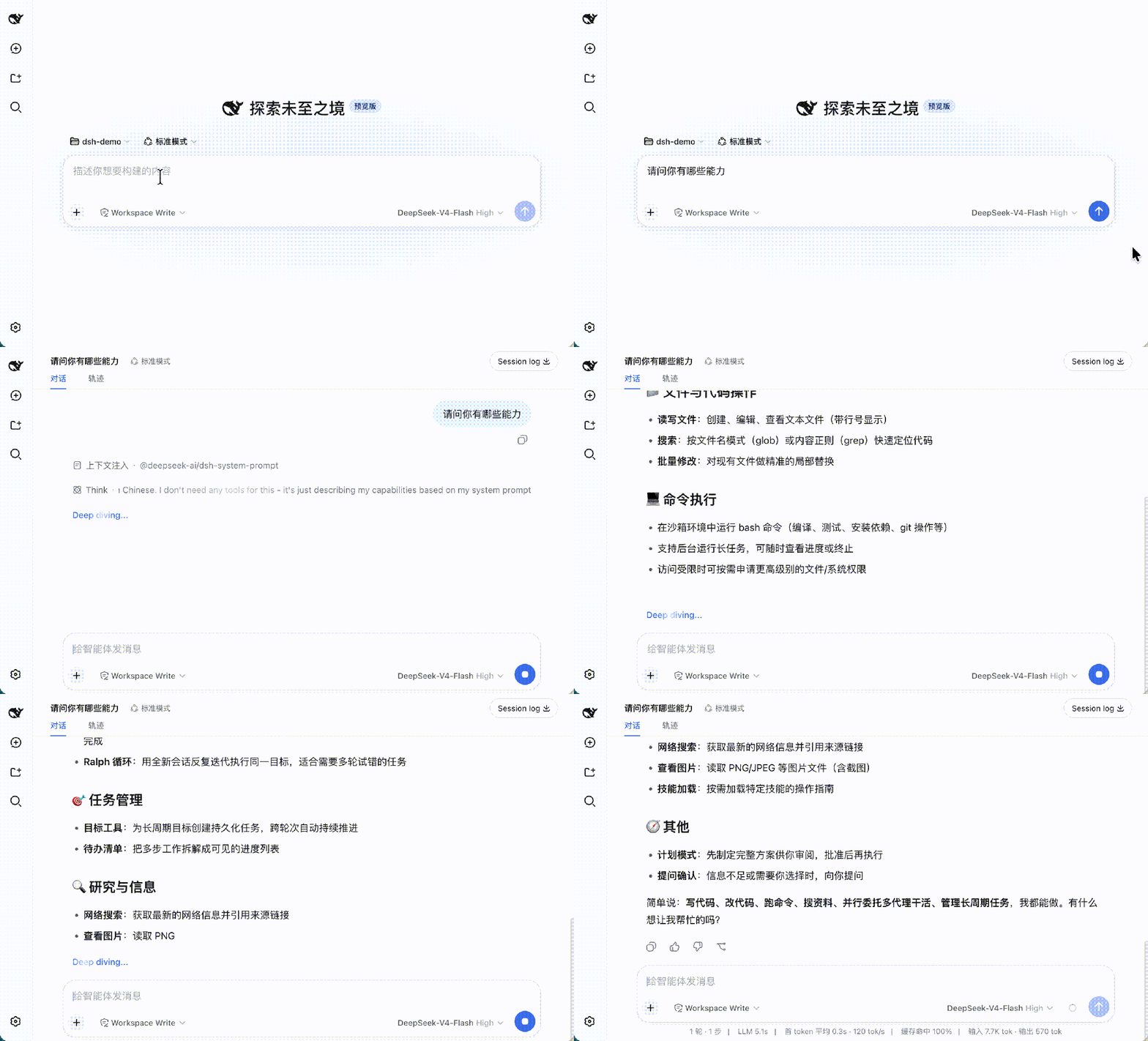
- Configure Model: Open the Web UI (default
localhost:3080), you need to fill in the model API Key. Supports connecting to DeepSeek models (requires purchase on the DeepSeek developer platform) or other third-party models. - Select Workspace and Preset:
-
Select a local working directory (project folder)
-
Select Agent Preset:
-
Standard Mode: Full coding Agent, supports file editing, Shell, retrieval, Skills, planning, sub-agents
-
PTC Mode: Standard Mode + Code Mode SDK, the model uses TypeScript programs to compose multi-step operations
-
Minimal Mode: Only bash + file editing, used for benchmarking
-
Creation Mode: Supports custom Agent preset, can inspect the plugin tree at runtime and dynamically extend
-
-
- Start Interacting: Describe your requirements in the input box, and the Agent will automatically perform tasks such as code writing, file operations, and web retrieval. Through the "Trajectory" view, you can view raw event-level run logs, supporting session replay and forking.
- Plugin Management View/enable/disable 100+ built-in plugins in settings, or customize plugin combinations through configuration files. Any capability component can be replaced without modifying source code.
Core Advantages of DeepSeek Harness
-
Open Ecosystem: Not limited to connecting to DeepSeek's own models; plans to support multi-model access through standardized interfaces, forming a clear differentiation from Claude Code's closed strategy.
-
Extreme Cost-Effectiveness: Combined with DeepSeek's low-cost caching mechanism, community testing shows the average cost of a single real programming task is only about $0.028, about one-seventh that of Claude Code.
-
Security and Compliance: The domestically developed framework has no backdoor risks, coinciding with the replacement window period in which Claude Code has been confirmed by the Ministry of Industry and Information Technology to have serious security backdoors and major domestic companies are accelerating investigation and control.
-
System Reliability: Team lead Cui Tianyi has nine years of quantitative trading background at Jane Street, long-term focused on "how to make complex systems operate stably", bringing financial-grade execution reliability into Agent engineering.
-
Model Decoupling: The Harness team and the model team operate independently and register independent official accounts, advancing as a business form independent of large models, with significantly stronger ecosystem cooperation flexibility and scalability.
-
Harness Effectiveness: The same model can differ by 53 percentage points under different Harnesses. DeepSeek Harness enables medium-strength models to complete most standardized tasks at extremely low cost, achieving "cheap models delivering luxury performance".
-
End-to-End Closed Loop: Covers five core modules: context management, tool call orchestration, execution sandbox, feedback loop, and session persistence, realizing a complete automated closed loop from requirement understanding to code delivery.
DeepSeek Harness Project Address
- Project Official Website:https://www.deepseek.com/harness/
- GitHub Repository:https://github.com/deepseek-ai/deepseek-harness
Comparison of DeepSeek Harness with Similar Competitors
| Comparison Dimension | DeepSeek Harness | Codex | Claude Code |
|---|---|---|---|
| Developing Company | DeepSeek | OpenAI | Anthropic |
| Product Positioning | AI agent runtime framework | Terminal-native coding agent | Terminal-native coding agent |
| Model Integration Strategy | Open to multiple models, plans to support third-party model integration | Limited to official OpenAI models | Limited to official Claude models, once used steganographic means to restrict non-official endpoints |
| Ecosystem Openness | Open co-building, globally soliciting plugins, Skills, MCP, and third-party interface ecosystem partners | Closed-source operation, ecosystem controlled by the official team | Closed ecosystem, officially restricted after reverse engineering modified tokens |
| Security and Compliance | Domestically developed, no backdoor risks, compliant with domestic regulatory requirements | US company, cross-border data risks exist | Confirmed by MIIT NVDB to have security backdoor risks (versions 2.1.91–2.1.196) |
| Cost per Task | Approximately $0.028(with low-cost caching mechanism) | Relatively high | Relatively high (Claude Code annualized revenue has reached the $2.5 billion level) |
| Core Architecture | Five major modules: context management, tool invocation orchestration, execution sandbox, feedback loop, session persistence | Built-in tool invocation and code execution environment | Built-in tool invocation and code execution environment |
| Team Background | Lead Cui Tianyi, with nine years of quantitative trading and systems development background at Jane Street | OpenAI internal research team | Anthropic internal research team |
Application Scenarios of DeepSeek Harness
-
Intelligent Programming Development (VibeCoding): Developers describe requirements in natural language, and Harness automatically completes the full closed loop from code generation, running tests, error capture to self-correction, achieving end-to-end software delivery.
-
Office Automation: Harness invokes the file system, browser, and various APIs to automatically complete daily office tasks such as document processing, data analysis, email classification and replies, and scheduling, replacing repetitive manual operations.
-
System Operations and DevOps: Executes server deployment, monitoring configuration, log analysis, and troubleshooting through terminal commands, integrated into CI/CD pipelines to achieve automatic code building, testing, and release.
-
Multi-Agent Collaboration Projects: Coordinates Agents in different roles such as product managers, architects, development engineers, and test engineers to divide work and cooperate, with unified scheduling to complete the decomposition and delivery of large, complex projects.
-
Enterprise Private Deployment: Deployed in local environments of security-sensitive industries such as finance, government affairs, and healthcare, connecting to private systems such as internal ERP, CRM, and databases to achieve secure and controllable intelligent transformation.
Challenges Facing DeepSeek Harness
-
Squeezing by First-Mover Giants: OpenAI Codex and Anthropic Claude Code already occupy the leading position in the agent code market. Claude Code's annualized revenue has reached $2.5 billion and accounts for 4% of public GitHub commits. As a latecomer, DeepSeek Harness needs to achieve breakthroughs in ecosystem and user habits.
-
Cold Start of Developer Ecosystem: Harness's core value is highly dependent on the richness of ecosystem partners such as plugins, Skills, MCP, and third-party interfaces, while ecosystem building requires long-term accumulation and is difficult to compete with already mature competitors in the short term.
-
Long-horizon task reliability verification: Agent frameworks need to handle complex scenarios such as multi-turn reasoning, tool invocation, and failure retries. From internal testing to proving stable delivery of long-horizon tasks in real production environments, there is still a large amount of engineering verification work.
-
Engineering complexity of multi-model adaptation: Although open support for multi-model integration is a differentiating advantage, different models have different context mechanisms, tool invocation formats, and reasoning characteristics, and the cost of adaptation and maintenance will increase significantly.
-
User migration costs and habit barriers: Developers are already deeply accustomed to the workflows and interaction paradigms of existing tools such as Claude Code and Cursor, and switching to a new framework faces learning costs and resistance to toolchain restructuring.