
What is Coral NPU
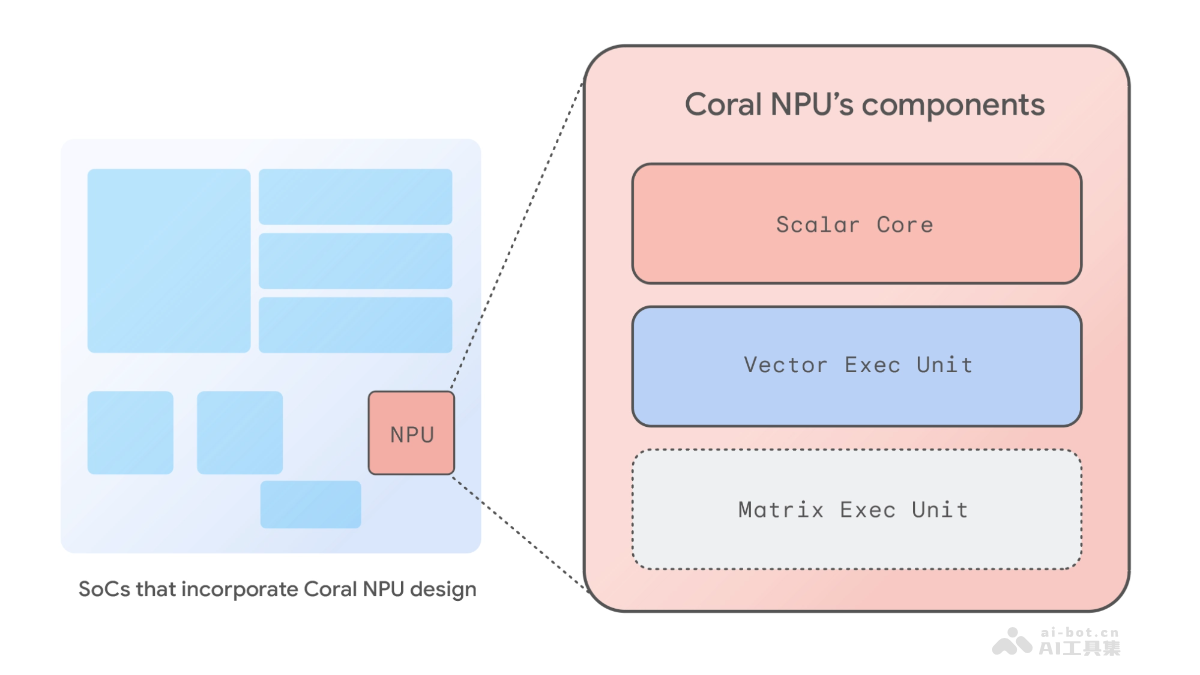
Coral NPU is a full-stack open-source AI platform launched by Google, designed specifically for low-power edge devices (such as smartwatches, AR glasses, etc.), addressing three major challenges: performance, fragmentation, and privacy. Coral NPU is based on the RISC-V instruction set and includes a scalar core, vector execution unit, and matrix execution unit, enabling efficient support for machine learning inference tasks. Coral NPU provides a unified developer experience, supporting TensorFlow、JAX and PyTorch and other frameworks, protecting user privacy through hardware-enforced security. Coral NPU aims to enable all-day AI experiences while minimizing battery consumption.
Main Features of Coral NPU
- Efficient Machine Learning Inference: Coral NPU is a neural processing unit (NPU) designed for low-power edge devices, capable of efficiently executing inference tasks for machine learning (ML) models. It supports a variety of ML applications, including image classification, person detection, pose estimation, and Transformers.
- Ultra-Low Power Operation: By optimizing the hardware architecture, it can operate at extremely low power consumption (just a few milliwatts), suitable for enabling all-day AI functionality on wearables, smartwatches, and Internet of Things (IoT) devices.
- Unified Developer Experience: Provides a complete software toolchain, supporting mainstream ML frameworks such as TensorFlow, JAX, and PyTorch. Models are optimized into compact binaries through compilers like IREE and TFLM, facilitating efficient execution on edge devices.
- Hardware-Enforced Privacy Protection: Supports hardware-level security mechanisms, such as CHERI technology, which can isolate sensitive AI models and personal data in hardware-enforced sandboxes, protecting user privacy.
- Customizable Architecture: Based on the RISC-V instruction set, Coral NPU offers an open and extensible architecture, supporting developers in customizing and optimizing according to specific needs.
Technical Principles of Coral NPU
- AI-First Hardware Design: Based on an AI-centric hardware architecture, it prioritizes the optimization of the Matrix Engine, which is a common computationally intensive task in deep learning. By reducing the overhead of scalar computation and allocating more resources to AI tasks, it achieves efficient inference.
- RISC-V Instruction Set: Coral NPU is based on the open-source RISC-V instruction set architecture, supporting a 32-bit address space and various extensions (such as integer, floating-point, and vector operations). The openness and extensibility of RISC-V allow Coral NPU to be customized for different application scenarios.
- Multi-Component Collaboration:
- Scalar Core: Manages data flow to the backend cores, implementing low-power traditional CPU functions.
- Vector Execution Unit: Supports SIMD (Single Instruction, Multiple Data) operations, enabling efficient processing of large datasets.
- Matrix Execution Unit: An efficient quantized outer product multiply-accumulate (MAC) engine, designed specifically to accelerate neural network operations.
- Compiler Toolchain: Provides a complete toolchain from model development to device deployment. It supports optimizing models from frameworks such as TensorFlow and JAX through the MLIR intermediate representation, and generating hardware-optimized binaries via the IREE compiler.
- Hardware Security Mechanisms: Supports hardware-enforced security technologies such as CHERI, isolating sensitive data and models in hardware sandboxes through fine-grained memory-level security and software partitioning, preventing memory attacks and protecting user privacy.
Coral NPU project address
- Project website:https://research.google/blog/coral-npu-a-full-stack-platform-for-edge-ai/
- GitHub repository:https://github.com/google-coral/coralnpu
Coral NPU application scenarios
- Context awareness: Detects user activity (such as walking, running), distance, or environment (such as indoors/outdoors, on the move), enables "Do Not Disturb" mode or other context-aware functions, and provides users with a more intelligent interactive experience.
- Audio processing: Supports voice and sound detection, keyword recognition, real-time translation, transcription, and audio-based accessibility functions, enhancing the device's voice interaction capabilities.
- Image processing: Enables person and object detection, facial recognition, gesture recognition, and low-power visual search, helping devices perceive the environment more intelligently in visual terms.
- User interaction: Performs device control through gestures, audio prompts, or other sensor-driven input, providing users with a more natural and convenient way to interact.