
What is Composer 2.5
Composer 2.5 is a self-developed Agentic coding model launched by Cursor . It shows substantial improvement over Composer 2 in intelligence and behavioral performance, and on core benchmarks such as SWE-Bench Multilingual(79.8%) and CursorBench v3.1(63.2%) , it is in the same tier as Claude Opus 4.7 and GPT-5.5, but the cost per task is only about 1/10of its competitors, earning it the title of "king of cost-effectiveness." The model is continuously trained based on Moonshot's open-source Kimi K2.5 checkpoint, and is currently only available through the Cursor IDE and SDK.
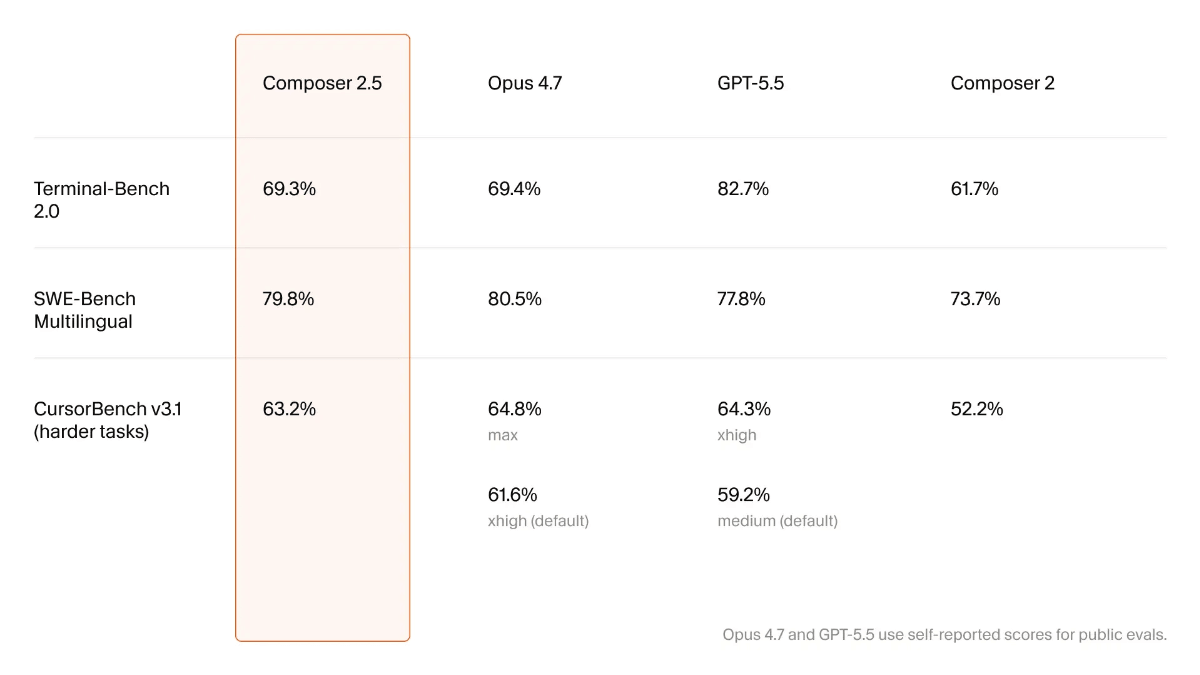
Composer 2.5's main features
-
Sustained work on long-horizon tasks: Deeply optimized for long-running Agent sessions, it can stay focused across multi-step tool calls and significantly reduces mid-task hallucinations or premature termination.
-
Reliable adherence to complex instructions: Reliability in following complex instructions such as cross-file refactoring, terminal command execution, and test-driven development is greatly improved over Composer 2.
-
Dynamic calibration of effort level: The model can automatically allocate compute based on task difficulty, completing simple tasks quickly and thinking deeply on complex tasks, avoiding "spinning idle on small things and underthinking big things."
-
Optimized communication style: Replies are more concise and structured, reducing unnecessary lengthy explanations and providing a clearer reasoning process for multi-file changes.
-
Improved tool-calling precision: Significantly reduces ineffective terminal commands or redundant searches, improving code retrieval and terminal operation efficiency.
-
Flexible adaptation with two versions: Offers Standard (standard version, $0.50/$2.50 per M tokens) and Fast (fast version, $3.00/$15.00 per M tokens), with the same level of intelligence, respectively suited to background batch tasks and interactive real-time programming.
How to use Composer 2.5
-
Enable in Cursor IDE: Update Cursor to the latest stable version from May 2026, open the Composer panel (
Cmd+I/Ctrl+I), and click the model selector to switch to Composer 2.5 -
Choose a speed tier: For interactive development, use the Fast versionby default (fast response, low latency); for background Agents or batch tasks, you can switch in Settings > Models to the Standard version(low cost, same level of intelligence)
-
Programmatic invocation via SDK:
import { Agent } from "@cursor/sdk";
const agent = await Agent.create({
  model: "composer-2.5",        // Standard 版
  // model: "composer-2.5-fast", // Fast 版
  workspace: "./",
  tools: ["edit", "shell", "search", "browser"],
});-
Set limits for long-horizon tasks: Set an upper limit on iterations and maximum elapsed time for unattended long-running Agent sessions, to prevent the model from reward hacking through "shortcuts" such as caching
-
Claim launch benefits: Double usage quota is provided in the first week of release; you can check quota consumption in the backend
-
Multi-model routing strategy: Hand 90% of daily tasks to Composer 2.5; route only architecture-review tasks to Claude Opus 4.7, and heavy terminal Shell tasks to GPT-5.5
Composer 2.5's core advantages
-
Extreme cost-effectiveness: Standard version input $0.50/M, output $2.50/M; Fast version input $3.00/M, output $15.00/M, about 10~30 times cheaper than Claude Opus 4.7.
-
Frontier-level benchmark performance: SWE-Bench Multilingual 79.8% (Opus 4.7 at 80.5%, GPT-5.5 at 77.8%), CursorBench v3.1 63.2% (roughly on par with Opus 4.7's 64.8% and GPT-5.5's 64.3%).
-
Deep behavioral optimization: In addition to scaling up training, the communication style and effort-level calibration were improved; although these dimensions are hard to fully reflect in benchmarks, they are crucial to the actual user experience.
-
Flexible choice of two versions: Standard is suited for backend Agents and batch tasks, while Fast (the default) is suited for real-time coding in interactive IDEs; both have exactly the same level of intelligence.
-
Double usage allowance at launch: Double usage quota is provided during the first week of release.
Comparison of Composer 2.5 with similar competitors
| Comparison dimension | Composer 2.5 | Claude Opus 4.7 | GPT-5.5 |
|---|---|---|---|
| Vendor / Platform | Cursor | Anthropic | OpenAI |
| Product positioning | In-house Agentic coding model | Flagship reasoning model | Flagship multimodal model |
| Base model | Moonshot Kimi K2.5 (continuous training on open-source checkpoints) | Claude 4 series | GPT-5 series |
| Release date | 2026.05.18 | Q2 2026 | Q2 2026 |
| SWE-Bench Multilingual | 79.8% | 80.5% | 77.8% |
| Terminal-Bench 2.0 | 69.3% | 69.4% | 82.7% |
| CursorBench v3.1 (hard tasks) | 63.2% | 64.8% (max) / 61.6% (default xhigh) | 64.3% (xhigh) / 59.2% (default medium) |
| Input price (/M tokens) | $0.50(Standard)< $3.00(Fast) |
Not disclosed (industry reference about $15) | Not disclosed (industry reference about $3–$5) |
| Output price (/M tokens) | $2.50(Standard)< $15.00(Fast) |
Not disclosed (industry reference about $75) | Not disclosed (industry reference about $15–$30) |
| Relative cost per task | Baseline (about $1–$2 / task) | about 10–30 times | about 3–10 times |
| Context window | ~200K (refer to Kimi K2.5) | 200K | 128K–1M |
| Weight openness | Closed source (Cursor infrastructure only) | Closed source | Closed source |
| Access methods | Cursor IDE / CLI / @cursor/sdk |
API / Claude Code / third-party platforms | API / ChatGPT / GitHub Copilot |
Application scenarios of Composer 2.5
-
Multi-file refactoring: The cost advantage is obvious and the accuracy is on par with frontier models, making it suitable for large-scale codebase migration.
-
Interactive pair programming: The Fast version responds quickly and is suitable for real-time IDE collaboration.
-
Backend scheduled tasks / cloud Agents: The Standard version is extremely cost-effective and is suitable for batch code review and fixes.
-
Test-driven development: Reliability on long-running tasks is better than the previous generation, and it can stably complete multiple rounds of test-fix cycles.
-
Complex terminal automation: Terminal-Bench 2.0 score is 69.3%, on par with Opus 4.7 (69.4%), but in heavy Shell scenarios it is still slightly behind GPT-5.5 (82.7%).