
What is Claude Haiku 5.5
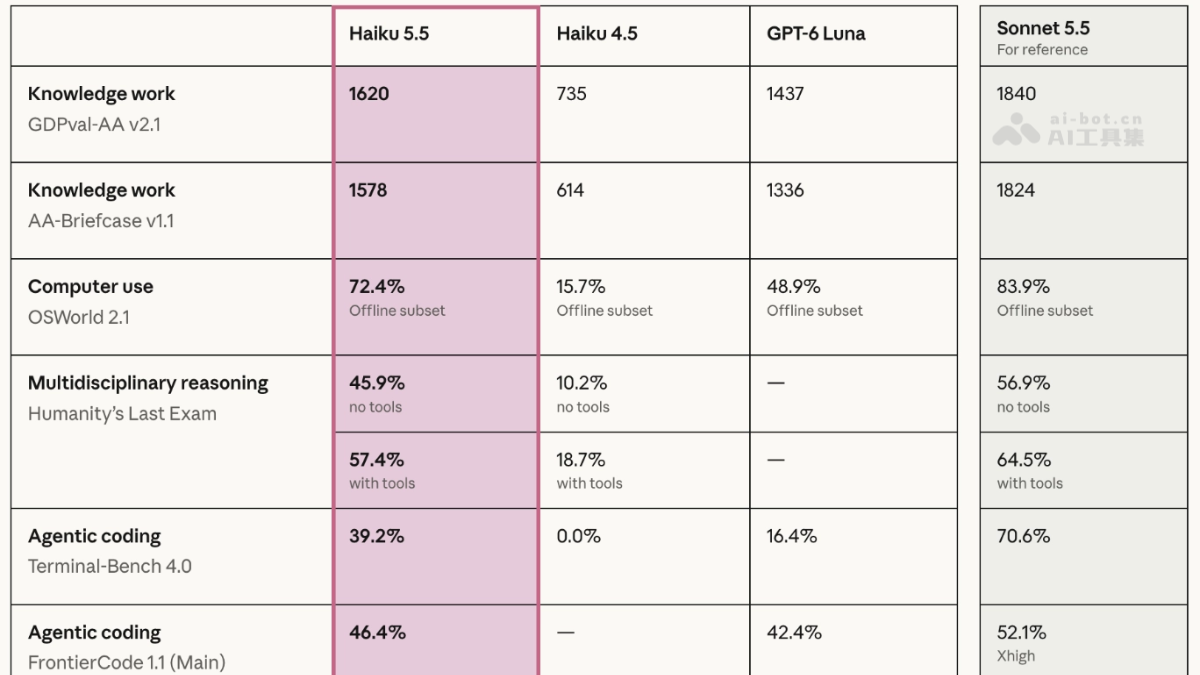
Claude Haiku 5.5 is Anthropic's latest small model, billed as "the cheapest, fastest, and most capable." Claude Haiku 5.5's input price has dropped to $0.10 per million tokens, with overall costs about 75% lower; computer operation capability jumped from 15.7% to 72.4%, and terminal programming went from 0 to 39.2%. Claude Haiku 5.5 supports a 1 million token context and five levels of thinking adjustment, making it suitable for summarization, classification, real-time customer service, and serving as a sub-agent for larger models.
Claude Haiku 5.5's main features
-
Intelligent summarization and context compression: Low-cost summarization and context compression for long documents and long conversations, suitable for high-frequency call scenarios.
-
Data querying and classification: Can handle database queries, tagging, content classification, and other high-volume, cost-sensitive tasks at scale.
-
Real-time customer service and conversation: As the fastest model in the Claude series, it is suitable for latency-sensitive real-time interaction scenarios.
-
Computer and browser operation: Achieves 72.4% on OSWorld computer operation, and can perform GUI automation tasks such as clicking, form filling, and cross-application operations.
-
Terminal programming: Achieves 39.2% on Terminal-Bench, and can independently complete command-line coding and debugging tasks.
-
Multi-agent collaboration (sub-agents): Acts as the execution layer for Opus/Sonnet in an Agent system, with large models making decisions and groups of Haikus running tasks in parallel.
-
Chart and multimodal understanding: Chartography chart reading improved from 6.4% to 46.4%, and it can parse information such as charts and images.
Claude Haiku 5.5's technical principles
- Adaptive thinking + five-level adjustment mechanism: Haiku 5.5 introduces configurable thinking levels to the Haiku series for the first time, allowing the model to adaptively allocate reasoning computation based on task difficulty. The API defaults to the Med level, and developers can make trade-offs along the "score-cost" curve according to their needs; the higher the level, the higher the scores on tests such as OSWorld, GDPval-AA, and HLE, and the cost per call rises logarithmically.
- Tokenizer unified with the flagship and architectural inheritance: The model switches to the same tokenizer as Opus 5.5, meaning the entire Claude 5.5 family shares a unified tokenization scheme, and the same text consumes about 30% more tokens than with Haiku 4.5.
- Multi-agent division-of-labor paradigm under large-model supervision: Opus/Sonnet is responsible for task decomposition and decision-making, while multiple Haiku 5.5 instances execute subtasks in parallel. In the official demo, 10 Haiku sub-agents tried 86 approaches in 58 seconds, reducing cost from $0.47 to $0.14, embodying the parallelized agentic principle of trading depth for breadth.
- Safety alignment and safeguard downgrade mechanism: Official evaluation confirms that it does not cross the CB-2 and Autonomy-2 thresholds, so for chemical/biological risks it reuses the narrow-scope classifiers at the Sonnet 5/Opus 5 level; cyber abuse protection also targets only specific harmful activities, with a narrower trigger scope than the flagship models. On agentic safety, it is the strongest Haiku-level model against prompt injection, with a refusal rate even higher than Sonnet 5.5 and Opus 5.5.
How to use Claude Haiku 5.5
- Confirm the access channel: Visit Claude Platform (console.claude.com),Claude Code。
- Obtain an API key: Create a key on the API Keys page of Claude Platform, or enable model access through the AWS/GCP/Azure console.
- Specify the model ID: When calling, write the model name as
claude-haiku-5-5, replacing the oldclaude-haiku-4-5-20251001and other IDs. - Configure thinking levels: Set the effort parameter to low / medium / high / xhigh / max as needed; if not set, it defaults to medium.
- Adjust sampling and output: Remove old sampling parameters such as temperature, top_p, and top_k, switch to structured output constrained formats, and re-estimate max_tokens.
- Upgrade the toolset: For computer operation scenarios, switch the toolset to
computer_toolset_20260801; for browser operations, use the new beta tools in the SDK. - Cost optimization (optional): Enable prompt caching or use the Batch API for offline tasks to get another 50% off.
- Automatic migration (the lazy way): Run
/claude-api migrate this project to claude-haiku-5-5in Claude Code and let the Agent automatically complete the above changes. - Validation and stress testing: Use the official "score-cost" tier curve to run a small-scale canary test, and after confirming the results, switch over fully.
Core advantages of Claude Haiku 5.5
-
Extremely cheap: Input is $0.10 per million tokens for the ≤100K token tier, 90% cheaper than the previous generation, with overall costs about 75% lower, precisely aligned with GPT-6 Luna pricing.
-
Fastest: It is the fastest model in the Claude series (except when Opus is in fast mode), suitable for real-time scenarios.
-
Leap in capability: OSWorld went from 15.7% to 72.4%, and Terminal-Bench from 0 to 39.2%; for the first time, a small model has usable computer operation and terminal programming capabilities.
-
Adjustable tiers: Haiku supports five thinking tiers for the first time, allowing developers to precisely trade off between score and cost as needed.
-
Long context and large output: 1 million token context + 128K token output per call, rare among small models.
-
Mainstay for multi-agent: It performs excellently as a sub-agent and is the core execution layer in architectures where a large model decides and a small model executes.
Comparison of Claude Haiku 5.5 with similar competitors
| Comparison dimension | Claude Haiku 5.5 | GPT-6 Luna |
|---|---|---|
| Product positioning | The cheapest, fastest, and most capable small model | A cost-effective model focused on high-concurrency tasks (summarization, extraction) |
| Input price (short context) | $0.10/million (≤100K tokens) | $0.10/million (≤272K tokens) |
| Input price (long context) | $0.50/million (>100K tokens) | $0.20/million (>272K tokens) |
| Output price | $0.50 (short) / $2.50 (long) | $0.50 (short) / $0.75 (long) |
| Cache read / write | $0.01 / $0.125 | $0.01 / $0.125 |
| Context window | 1 million tokens | 1.05 million tokens (single-input limit 922K) |
| Maximum output | 128K tokens | 128K tokens |
| Thinking tiers | 5 tiers: Low/Med/High/Xhigh/Max (default Med) | 6 tiers: none/low/medium(default)/high/xhigh/max |
| Computer operation | OSWorld 72.4% (previous generation 15.7%) | Official published benchmark scores are mainly for Sol; Luna has no public OSWorld score |
Application scenarios of Claude Haiku 5.5
- Real-time customer service and conversational bots: The fastest response speed in the Claude series, handling high-concurrency online customer service, pre-sales consultation, and other real-time interaction scenarios, with the cost per conversation turn able to be pushed extremely low.
- Large-scale document processing pipelines: Summarizing, classifying, tagging, and extracting information from massive reports, emails, and web pages, suitable for enterprise-level content platforms.
- Sub-agents in agent systems (core scenario): In the "large model decision-making + small model execution" architecture, Opus/Sonnet decomposes tasks, and dozens of Haiku 5.5 instances run subtasks such as retrieval, form filling, and code modification in parallel.
- Computer/browser automation operations: Its computer operation capability, with OSWorld reaching 72.4%, enables it to perform web form filling, cross-application data transfer, and GUI process automation, replacing traditional RPA solutions.