
What is AutoAgent
AutoAgent is a zero-code, automated LLM agent framework launched by the University of Hong Kong. Based on natural language interaction, it allows users to create intelligent assistants without programming, suitable for intelligent search,data analysis, report generation, and other scenarios. AutoAgent's core functions include three usage modes: User Mode, Agent Editor, and Workflow Editor, adapting to different user needs. AutoAgent supports multiple LLM models, is easy to install and deploy, and provides Docker support. AutoAgent performs excellently on the GAIA benchmark and is an Manus and Deep Research open-source alternative.
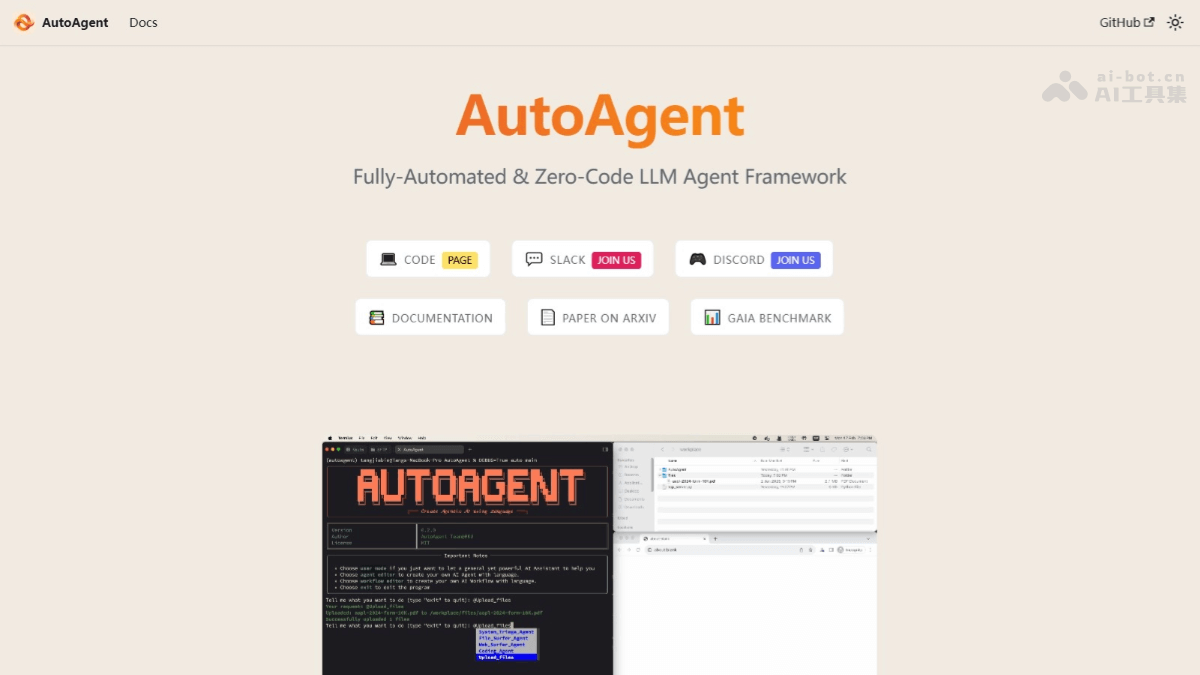
AutoAgent's main features
- Three usage modes:
- User Mode: Users directly experience intelligent web search, data analysis, information processing, and other functions without any configuration.
- Agent Editor: Configure AI assistants through conversation, adjust parameters, instructions, and task logic without writing code.
- Workflow Editor: Describe tasks in natural language, create automated workflows, and let AI agents execute complex tasks.
- Dual interaction modes:
- ReAct Mode: AI dynamically adjusts strategies, suitable for complex reasoning tasks.
- Function Calling Mode: AI calls APIs or databases to complete specific tasks, such as web search, data query, etc.
- Built-in self-managed vector database:
- Long-term AI memory: AI can remember past interactions, improving contextual understanding.
- Knowledge-enhanced retrieval (RAG): AI retrieves information from a local database, improving accuracy.
- Data-driven AI: AI agents can learn and optimize their own strategies, improving task processing capabilities.
AutoAgent's technical principles
- Natural language-driven multi-agent construction: Agent Profiling Agent analyzes user needs and generates structured agent forms. Tool Editor Agent creates tools according to needs, supporting third-party API integration. Agent Editor Agent creates agents based on the forms, supporting multi-agent collaboration.
- LLM-powered action engine: Direct Tool-Use Paradigm directly uses LLM's tool-use capabilities to generate the next action. Transformed Tool-Use Paradigm transforms tool use into a structured XML code generation task, which is parsed and then executed.
- Self-managed file system: The vector database converts files into a vector database, supporting efficient retrieval. Tools automatically store files in the vector database, supporting multiple file formats.
- Self-developed agent customization: Transform natural language requirements into executable agents and tools. Based on self-debugging and optimization, generate efficient agents and workflows.
- Multi-agent collaboration: The Orchestrator agent decomposes tasks and assigns them to Worker agents. Based on event listening and triggering mechanisms, flexible agent collaboration is achieved.
- Technical architecture: Agentic System Utilities provides a foundational multi-agent architecture. The LLM-powered action engine supports multiple LLM providers and dynamically generates actions. The self-managed file system manages users' multimodal data and supports efficient retrieval. Generate and optimize agents using natural language.
AutoAgent's project address
- Project official website:https://autoagent-ai.github.io/
- GitHub repository:https://github.com/HKUDS/AutoAgent
- arXiv technical paper:https://arxiv.org/pdf/2502.05957
AutoAgent's application scenarios
- Intelligent web search: Autonomously searches for information on the internet, filters and summarizes key content, and helps users quickly obtain the information they need.
- Data analysis and processing: Parses data files in multiple formats, automatically organizes them, and generates detailed data analysis reports.
- Automatic report generation: Generates professional-grade reports based on user requirements or data input, such as market research or industry analysis.
- Intelligent AI agent: Independently performs various tasks, such as finding information, sending emails, processing documents, etc., improving work efficiency.
- AI office assistant: Automatically organizes schedules, emails, and task lists, provides intelligent reminders, and optimizes office workflows.