
What is Deep Research
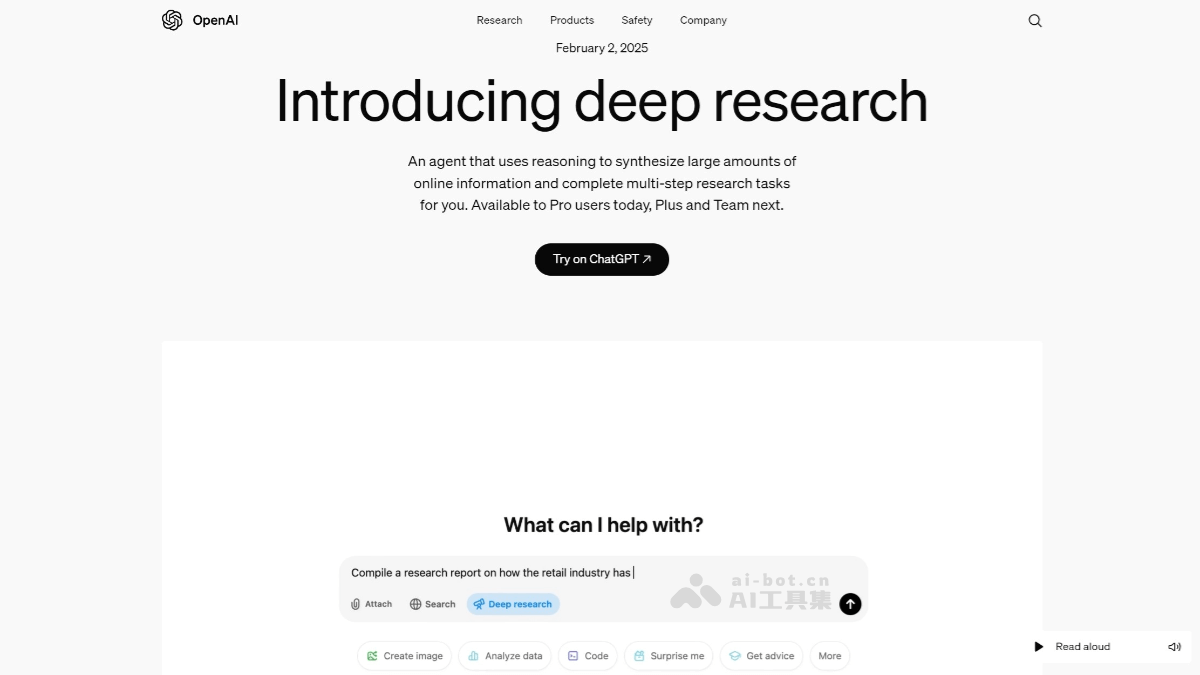
Deep Research is a new AI deep search research tool launched by OpenAI, designed specifically for users who need in-depth, complex research. It can complete research tasks that would take human experts hours or even days in a short time (5 to 30 minutes). Users only need to provide a prompt, and Deep Research, based on reasoning capabilities, searches, analyzes, and integrates large amounts of information on the internet, ultimately generating an expert-level research report. The tool is supported by OpenAI's o3 model and has been trained through end-to-end reinforcement learning, enabling it to plan and execute multi-step research tasks. It is suitable for knowledge-intensive work in fields such as finance, science, policy, and engineering, as well as for consumers who need personalized advice.
Main features of Deep Research
- Multi-step autonomous research: Users only need to provide a prompt, and Deep Research can complete manual research tasks that would take hours within tens of minutes, covering multiple fields such as finance, science, policy analysis, and consumer decision-making.
- Reinforcement learning and reasoning: Based on OpenAI's latest o3 model, Deep Research is trained through end-to-end reinforcement learning, enabling it to autonomously plan and execute multi-step research trajectories and respond to information in real time.
- Deep information integration: It can browse large amounts of text, images, and PDF files on the internet, integrate information from different channels, and generate comprehensive research reports.
- Generate detailed reports: The output of Deep Research includes clear citations and a summary of its thought process, making it easy for users to consult and verify information.
- Handle complex queries: It performs better in handling ambiguous queries and providing detailed information. For example, in the "Humanity's Last Exam," its accuracy reached 26.6%, far exceeding other models.
Technical principles of Deep Research
- End-to-end reinforcement learning: Deep Research is trained through end-to-end reinforcement learning, enabling it to plan and execute multi-step research trajectories in complex tasks. The model can adjust research directions and strategies based on real-time information like a human researcher.
- Multi-module collaborative work: Deep Research consists of multiple modules, including an information discovery module, an information synthesis module, and a reasoning module. The information discovery module can quickly locate various information sources and extract clues; the information synthesis module can integrate information from different channels and distill key points; the reasoning module has human-like thinking and judgment capabilities and can perform logical reasoning and self-correction.
- Long-duration deep thinking: Unlike traditional models that pursue rapid responses, Deep Research supports 5 to 30 minutes or even longer to process problems. The model can dig deep into online information and generate more comprehensive and in-depth research results.
- Optimized o3 model: Deep Research is developed based on OpenAI's o3 model. The model has been optimized for web browsing and data analysis and can handle data in multiple formats such as text, images, and PDFs.
- Real-time information response and adjustment: Deep Research can make decisions and adjustments based on real-time information and can efficiently complete complex research tasks.
- Citations and verification: The output of Deep Research includes clear citations and a summary of its thought process, making it easy for users to consult and verify information.
Deep Research project address
- Project official website:https://openai.com/index/introducing-deep-research/
How to use Deep Research
- Select the feature: InChatGPT, click the "Deep Research" button below the message input box.
- Enter your query: Clearly tell ChatGPT what you need, for example, asking for a competitive analysis of a certain industry or generating a personalized report on a certain topic. You can also attach files or spreadsheets to provide additional context for the question.
- Confirm the research plan: Deep Research will generate a research plan, and you can choose to approve or modify the plan to ensure the research direction meets your expectations.
- Wait for execution: Once it starts running, Deep Research will display in the sidebar a summary of the steps taken and the sources used. It may take 5 to 30 minutes to complete the task, requiring in-depth exploration of online information. You will be notified when it is complete.
- View the results: The final results will appear in the chat in the form of a report. The report will include clear citations and a summary of its thought process, making it easy to review and verify the information.
- Usage tips
- Make questions specific: Try to break the question down into more specific smaller questions, so you can get more precise research results. For example, instead of asking "the development of blockchain," ask "specific application cases and challenges faced by blockchain technology in the financial sector."
- Adjust the research plan: Do not rush to confirm the research plan; reviewing and adjusting the plan can yield a research report that better meets your needs.
- Notes
- Task time: Deep Research needs a certain amount of time to complete the task, depending on the complexity of the task and the amount of information required.
- Formatting issues: In the early release period, some formatting errors may appear in the reports and citations.
- Limitations: It is currently in an early stage and may have limitations, such as sometimes producing hallucinations or making incorrect inferences in responses.
Application scenarios of Deep Research
- Literature review: In academic research, researchers need to extensively collect and analyze relevant literature. Deep Research can quickly locate papers, research reports, expert opinions, and other information on multiple platforms such as academic databases, research institution websites, and medical forums.
- Trend analysis: Researchers can use Deep Research to analyze the development trends of a specific discipline or technology and, by synthesizing a large amount of literature, uncover potential connections between different studies.
- Industry reports: Companies can use Deep Research to generate comprehensive reports on a specific industry or market, including market size, growth trends, and analysis of major participants.
- Product comparison: When purchasing high-value goods such as cars and home appliances, consumers can use Deep Research to conduct product comparisons and market analysis.
- Personalized recommendations: Deep Research can provide personalized shopping suggestions based on consumers' specific needs and preferences.
- Investment research: Financial analysts can use Deep Research for company financial analysis, market trend forecasting, and investment risk assessment.