
In today's digital age, artificial intelligence is changing our lives and the way we work at an unprecedented speed. As an important branch of the field of artificial intelligence, large AI reasoning models have attracted great attention from global technology companies and research institutions with their excellent performance and broad application prospects. This article will introduce 13 AI reasoning models that support deep thinking, thinking deeply like scientists. Through deep learning and big data analysis, the models can quickly and accurately handle complex problems, providing strong decision support for various industries. As technology continues to advance, it provides developers and enterprises with more choices and opportunities.
1. DeepSeek-R1
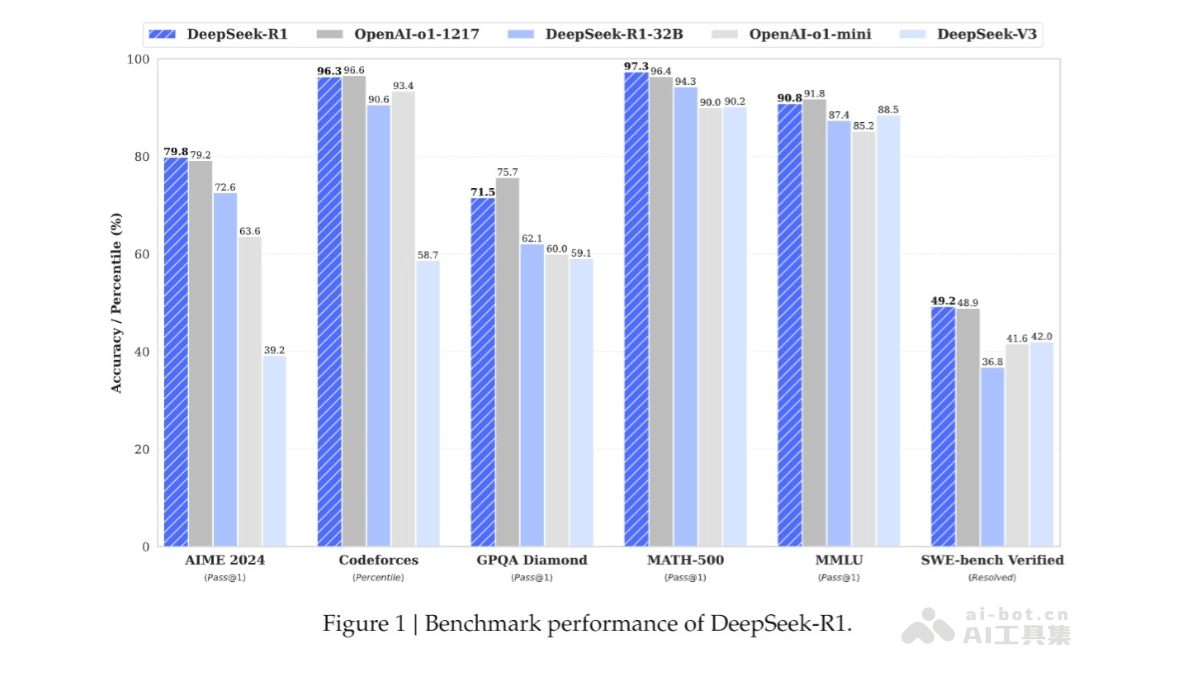
DeepSeek-R1It is a high-performance AI reasoning model launched by Hangzhou DeepSeek. It is trained based on large-scale reinforcement learning technology and does not require a large amount of labeled data. The model performs excellently on tasks such as mathematics, code, and natural language reasoning, comparable to OpenAI's o1 model. DeepSeek-R1 has open-sourced the model weights and provides multiple distilled versions, suitable for developers of different scales.
🚀Model Highlights
- Reinforcement learning-driven reasoning capability: DeepSeek-R1 uses a unique multi-stage reinforcement learning (RL) process to refine its reasoning capability. Unlike its predecessor DeepSeek-R1-Zero, R1 combines supervised fine-tuning (SFT) and carefully curated "cold start" data, improving coherence and user consistency. It performs excellently in multiple benchmark tests, such as a 97.3% pass rate on Math-500, a 96.3% ranking percentile in Codeforces competitive programming with an Elo score of 2029, a 90.8% pass rate on MMLU, and AIME 2024 surpassing OpenAI-o79.8 with a 1% pass@1 score.
- Long-chain reasoning and model distillation: Based on long-chain reasoning (Chain-of-Thought, CoT) technology, it can break down complex problems step by step and perform multi-step logical reasoning. It supports model distillation, and developers can transfer its reasoning capability to smaller models to meet the needs of specific scenarios.
- Open source and flexible license: DeepSeek-R1-Zero and six streamlined models (with parameter counts ranging from 150 million to 7 billion) are publicly available, follow the MIT license, and support global developers in freely using, modifying, and commercializing them.
- High cost-effectiveness: The API call price of DeepSeek-R1 is far lower than OpenAI's o1 model, costing only 1 yuan per million input tokens.
🌏Model Official Website:DeepSeek-R1
2. OpenAI o3
OpenAI o3It is a new generation of reasoning models launched by OpenAI, including two versions, o3 and o3-mini. o3 performs excellently in multiple benchmark tests, scoring as high as 87.5% on the ARC-AGI benchmark test, far exceeding the human average. In mathematics and programming tasks, it scored 96.7% in the 2024 American Invitational Mathematics Examination (AIME) and reached 2727 points in the Codeforces rating. o3 can self-fact-check and reason through a "private chain of thought" to improve the accuracy of answers. o3 is the first model trained using "deliberative alignment" technology and complies with safety principles.

🚀Model Highlights
-
Enhanced reasoning capability: o3 adopts a more structured reasoning approach, breaking problems down into small steps that can be solved step by step. It is suitable for solving difficult problems that require rigorous logical reasoning, such as advanced mathematical formulas, programming debugging, or scientific prediction.
-
Outstanding performance metrics:
-
In the ARC-AGI benchmark test, o3 achieved a score of 87.5% under the high reasoning capability setting, and its score under the low reasoning capability setting was also as high as 3 times that of o1.
-
In the SWE-Bench Verified benchmark test, the accuracy of the o3 model is about 71.7%, more than 20% higher than the o1 model.
-
In Codeforces programming competitions, o3 can achieve a score of 2727 under high reasoning settings, and its score under low reasoning settings also surpasses o1.
-
On the math benchmark AIME 2024, o3 achieved an accuracy of 96.7%, missing only one problem.
-
On GPQA Diamond, a rigorous benchmark measuring doctoral-level science questions, o3 achieved an accuracy of 87.7%, an improvement of about 10% over o1's 78%.
-
On the EpochAI Frontier Math benchmark, o3 set a new record of 25.2, while no other model exceeded 2.0.
-
-
Adjustable thinking time: o3 can adjust reasoning time according to task complexity, and users can choose low, medium, or high compute modes to balance speed and accuracy.
-
Self-verification mechanism: o3 integrates self-verification functionality, enabling it to verify information in real time during reasoning and ensure that every step of reasoning is based on accurate facts.
-
Safety and alignment: OpenAI introduced the Deliberative Alignment mechanism to ensure that the model's decision-making process conforms to human values and takes safety issues into account at every stage.
🌏Model official website:OpenAI o3
3. Gemini 2.0 Flash Thinking
Gemini 2.0 Flash Thinking is an enhanced experimental reasoning model launched by Google. It supports multimodal input (text and images), can quickly provide answers, and clearly displays the reasoning process, solving the "black box" problem of traditional AI models. The model performs excellently in multiple fields, including mathematics, physics, creative writing, etc., and its reasoning speed is more than 5 times faster than other models. It has a transparent reasoning process, and users can view the model's step-by-step reasoning logic through a drop-down menu.
🚀Model highlights
-
Transparent reasoning process: The model can clearly display the thinking process, and users can view the model's step-by-step reasoning logic through a drop-down menu.
-
Multimodal capabilities: It supports multiple input forms such as text and images and can handle complex multimodal tasks. For example, it can analyze or describe based on image content.
-
Ultra-long context processing capability: It supports long-context understanding of up to 1M tokens and can conduct more in-depth analysis of long texts. This enables the model to maintain coherent thinking when processing long content.
-
Fast response and efficient reasoning: The model has lightning-fast thinking speed and can complete the processing of complex problems within 1-3 seconds. Its reasoning speed is twice that of the previous generation model.
-
Performance across multiple domains: It performs excellently in multiple fields such as mathematics, physics, programming, and creative writing, and is fast and high-quality in mathematical reasoning and complex problem solving.
-
Improved thinking and tool use: The model is more consistent between ideas and answers and can initiate code execution through thinking.
🌏Model official website:Gemini 2.0 Flash Thinking
4. k1.5
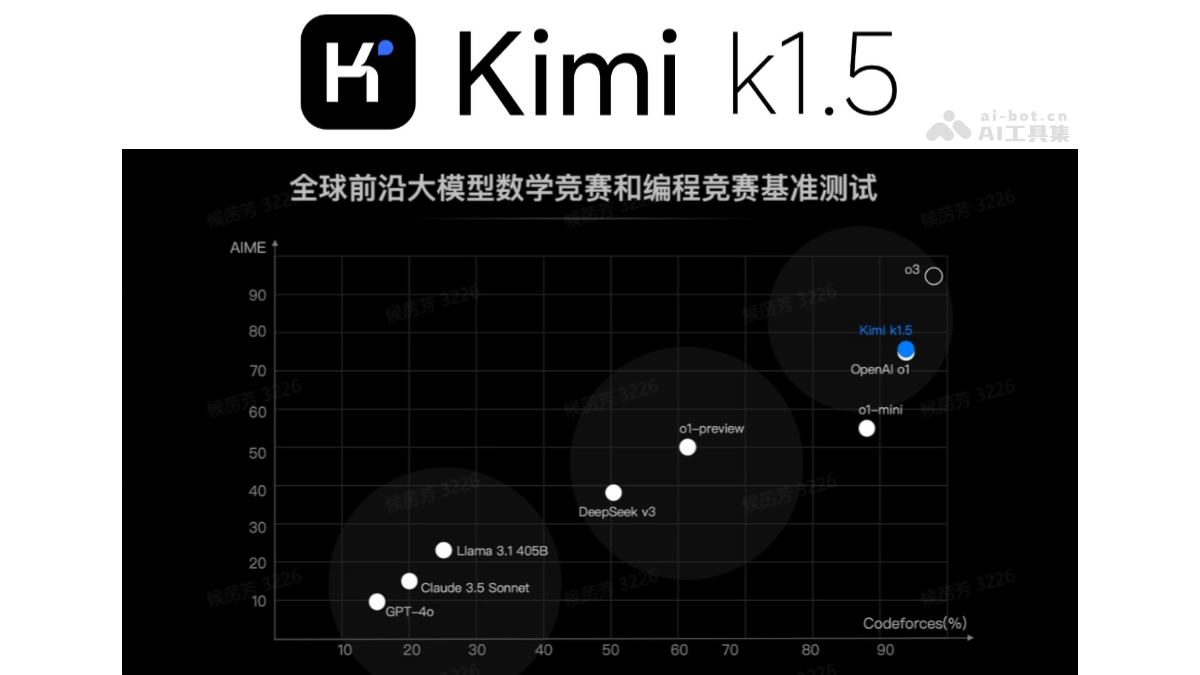
k1.5is the latest multimodal thinking model launched by Moonshot AI's Kimi, with powerful reasoning and multimodal processing capabilities. In short-CoT mode, the model greatly surpasses the globally leading short-thinking SOTA models GPT-4o and Claude 3.5 Sonnet in mathematics, code, visual multimodality, and general capabilities, with a lead of up to 550%. In long-CoT mode, k1.5's performance reaches the level of the official version of OpenAI o1, becoming the first multimodal model globally to reach this level.
🚀Model highlights
- Long context extension: k1.5 expands the context window to 128k and improves training efficiency through partial rollout techniques. As context length increases, model performance continues to improve, laying the foundation for complex reasoning tasks.
- Improved Policy Optimization: k1.5 derives a reinforcement learning formulation based on long chain-of-thought and adopts a variant of online mirror descent for robust policy optimization. The algorithm is further improved through effective sampling strategies, length penalties, and optimization of data methods.
- Concise Framework: The combination of long-context extension and improved policy optimization methods builds a simple reinforcement learning framework for large language model learning. It achieves strong performance without relying on more complex techniques such as Monte Carlo tree search, value functions, and process reward models.
- Multimodal Capabilities: k1.5 is jointly trained on text and visual data and has the ability to perform joint reasoning over both modalities. Across multiple benchmarks, k1.5's multimodal reasoning capability performs excellently, reaching a pass rate of 74.9 on the MathVista test.
- Long2Short Technology: k1.5 proposes methods to transfer the reasoning capabilities of long chain-of-thought models to short chain-of-thought models, including model merging, shortest rejection sampling, DPO, and Long2Short RL. It significantly improves the performance and token efficiency of short chain-of-thought reasoning models.
🌏Model Official Website:k1.5
5. QwQ-32B-preview
QwQ-32B-Previewis an experimental research model developed by the Alibaba Qwen team, focusing on improving AI reasoning capabilities. The model has 32.5 billion parameters and can handle contexts up to 32,000 tokens. It performs excellently in mathematics and programming, achieving 90.6% accuracy on the MATH-500 test.

🚀Model Highlights
-
Powerful Reasoning Capabilities: QwQ-32B-Preview performs excellently in solving complex problems in mathematics and programming. On the MATH-500 test, it scores as high as 90.6%, far surpassing similar models. On the AIME test, the model scores 50.0%, demonstrating outstanding mathematical problem-solving ability.
-
Long Text Processing Capability: The model can process prompts up to 32,000 tokens long, making it suitable for long-text generation and understanding.
-
Transparent Reasoning Process: QwQ-32B-Preview can generate detailed reasoning processes, helping users understand the entire process of its generated content, improving the model's interpretability and transparency.
-
Open Source and Flexibility: QwQ-32B-Preview uses the Apache 2.0 license and is fully open source. Developers can freely download the model weights, perform local deployment or online trials, and test and optimize it.
-
Advanced Technical Architecture: The model has 32.5 billion parameters and is based on deep learning technology, learning complex language patterns and logical relationships from large amounts of data. The attention mechanism adopted makes it particularly outstanding when processing long texts.
🌏Model Official Website:QwQ-32B-Preview
6. QVQ-72B-Preview
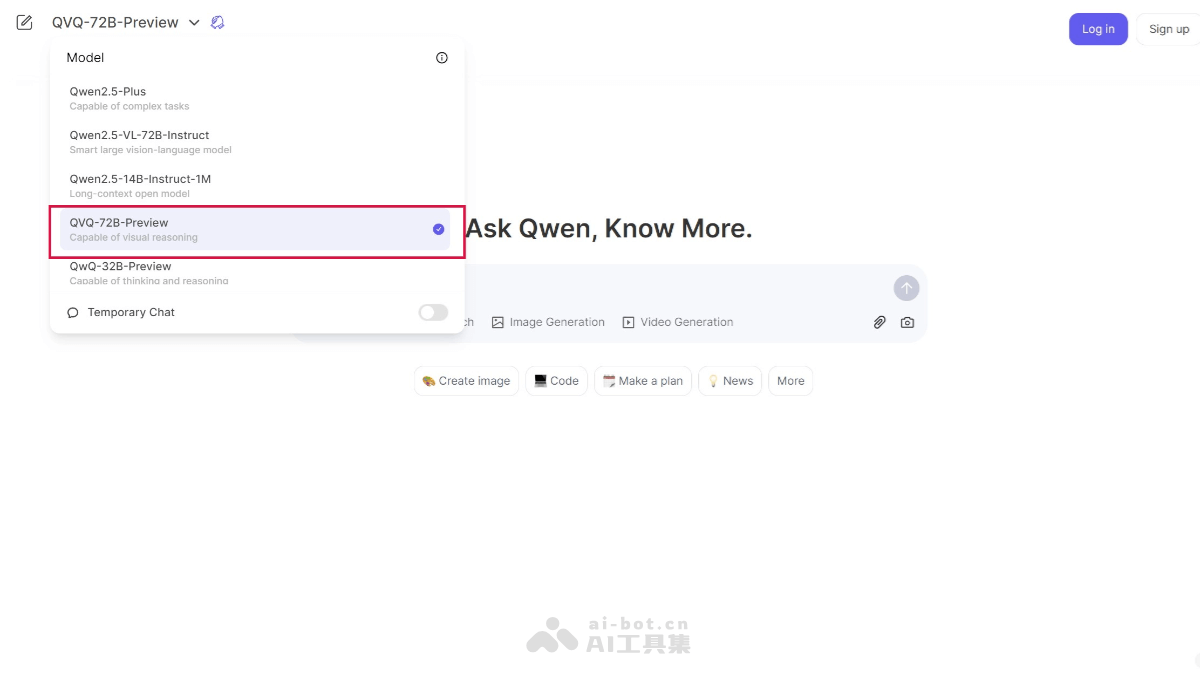
QVQ-72B-Preview is an open-source multimodal reasoning model developed by the Alibaba Tongyi team, focusing on improving visual reasoning capabilities. Built on Qwen2-VL-72B, it has 73.4 billion parameters and can solve complex visual-related problems through step-by-step reasoning. On the MMMU benchmark, QVQ-72B-Preview achieves an excellent score of 70.3, significantly surpassing Qwen2-VL-72B-Instruct. The model has powerful visual understanding and multimodal processing capabilities, can accurately understand image content, and seamlessly connect with language information.
🚀Model Highlights
- Powerful Visual Reasoning Capabilities: QVQ-72B-Preview can accurately understand image content and perform complex step-by-step reasoning. It supports inferring specific information such as the height and quantity of objects from images, and can identify the deeper meaning of images, such as the connotations of "memes."
- Outstanding scientific and mathematical reasoning performance: In benchmark tests for math and science problems, it surpasses OpenAI's o1 model in the MathVista and MathVision tests. In the OlympiadBench test, the model can effectively solve challenging problems and performs better than other similar models.
- Multimodal processing capability: QVQ-72B-Preview can simultaneously process image and text information, seamlessly connecting language information with visual information, making AI reasoning more efficient.
- Open ecosystem support: The model has been open-sourced on the ModelScope community and the HuggingFace platform, allowing developers to quickly experience and integrate it.
🌏Model official website:QVQ-72B-Preview
7. GLM-Zero-Preview
GLM-Zero-Preview is a deep reasoning model launched by Zhipu AI, developed based on extended reinforcement learning technology. It focuses on improving the model's reasoning ability and excels at handling mathematical logic, code writing, and solving complex problems. In evaluations such as AIME 2024, MATH500, and LiveCodeBench, GLM-Zero-Preview's performance is comparable to OpenAI's o1-preview. The model can simulate the learning mechanisms of the human brain and improve its reasoning ability through self-learning, self-reflection, and self-criticism. It supports multimodal input and output; users can input questions through text and images, and the model will output the complete reasoning process.

🚀Model highlights
-
Powerful reasoning ability: GLM-Zero-Preview performs excellently in logical reasoning, can quickly identify logical loopholes, and simulate multiple assumptions and possibilities.
-
Outstanding mathematical ability: The model performs excellently in mathematical problem-solving, can handle complex problems in algebra, calculus, probability and statistics, and provide detailed solution processes.
-
Efficient programming support: GLM-Zero-Preview can skillfully use multiple programming languages, help developers quickly write code, and provide detailed repair suggestions for code debugging.
-
Expert-level task handling: Compared with the base model, GLM-Zero-Preview has significantly improved efficiency in handling expert-level tasks, and can make autonomous decisions, break down problems, and try multiple ways to solve problems.
-
Multimodal input and output: Users can input questions through text and images, and the model will output the complete reasoning process.
-
Free and open for use: GLM-Zero-Preview is already available on the Zhipu Qingyan platform, and users can experience it for free. Developers can also make API calls through the Zhipu Open Platform.
🌏Model official website:GLM-Zero
8. iFlytek Spark X1
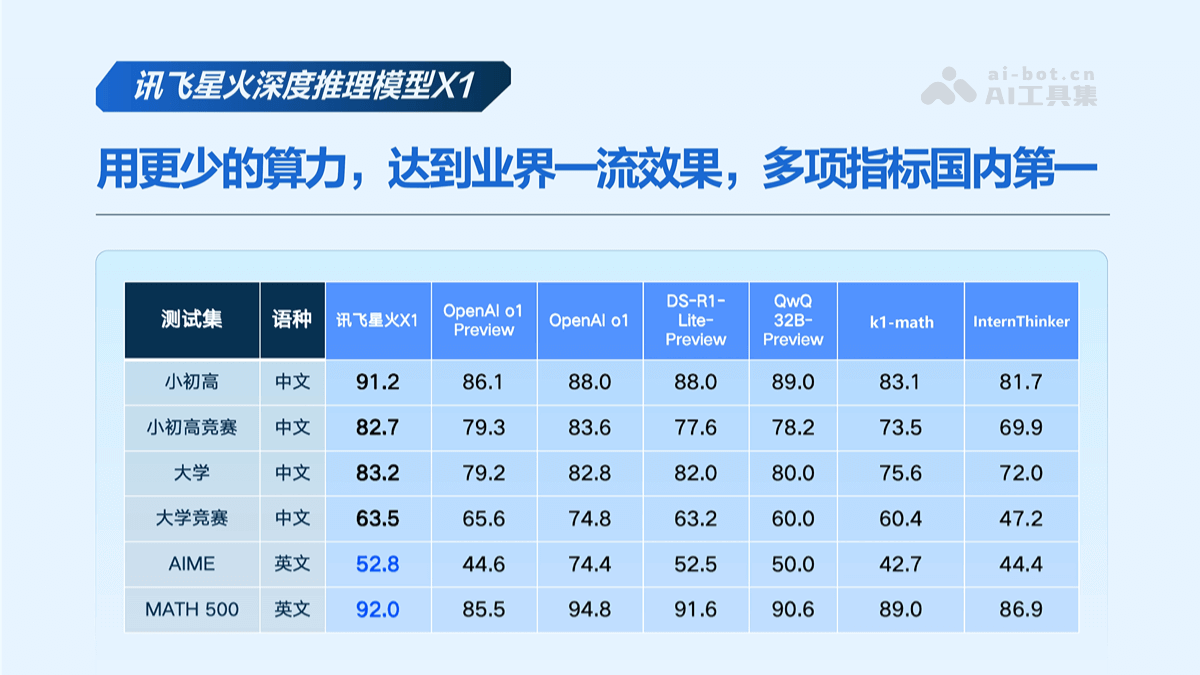
iFlytek Spark X1is a deep reasoning model launched by iFlytek, and it is China's first large model trained on a fully domestic computing power platform with deep thinking and reasoning capabilities. It has reached the domestic leading level in Chinese mathematical ability, can simplify the complex, break down and simplify complex problems step by step, and conduct self-exploration and reflective verification. X1 has taken the lead in achieving application implementation in the education and healthcare fields.
🚀Model highlights
-
Powerful deep reasoning ability: iFlytek Spark X1 can break down and simplify complex problems step by step, simulate the human way of "slow thinking," and gradually solve complex problems. It performs excellently when handling complex mathematical problems, gives correct answers, and can display solution ideas and steps in detail.
-
Outstanding Chinese Mathematical Ability: In the field of Chinese mathematics, iFlytek Spark X1 performs outstandingly, ranking first domestically in multiple indicators. It can provide multiple solutions for high-difficulty mathematics problems such as those in the college entrance examination and competitions, helping students gain a deeper understanding of the problems.
-
Self-Exploration and Reflective Verification: The model possesses the ability for self-exploration and reflective verification. During the problem-solving process, it will try multiple methods, verify the result of each step, and optimize its problem-solving strategy.
-
Reinforcement Training Based on Feedback: iFlytek Spark X1 can make self-adjustments and optimizations based on whether the problem-solving results are correct or not, continuously strengthening training through high-quality feedback information to improve performance.
-
Efficient Operation with Low Computing Power: The model can also operate efficiently in a low-computing-power environment, achieving industry-leading results with less computing power.
🌏Model Official Website:iFlytek Spark X1
9. Step R-mini
Step R-miniis a reasoning model released by StepFun and is the first reasoning model in the Step series model family. It excels at proactive planning, experimentation, and reflection, and provides users with accurate and reliable responses through the logical mechanism of slow thinking and repeated verification. Step R-mini performs excellently in mathematics, logical reasoning, and code generation, while also being able to handle liberal arts tasks such as literary creation, achieving "proficiency in both arts and sciences."

🚀Model Highlights
-
Proficiency in Both Arts and Sciences: Step R-mini performs excellently in science fields such as mathematics, logical reasoning, and code generation, and can also engage in literary creation and daily conversation, making up for the shortcomings of most reasoning models in liberal arts abilities.
-
Large-Scale Reinforcement Learning: Through large-scale reinforcement learning training, using the On-Policy reinforcement learning algorithm, it achieves balanced development in arts and sciences, ensuring efficient performance in multiple fields.
-
Outstanding Reasoning Ability:In scenarios such as mathematics problems, code, and logical reasoning, it can perform deep thinking and self-verification, provide multiple solutions, and optimize results.
-
Adherence to the Scaling Law Principle:
-
Scaling Reinforcement Learning: From imitation learning to reinforcement learning, from human preferences to environmental feedback, using reinforcement learning as the core training stage for model iteration.
-
Scaling Data Quality: On the premise of ensuring data quality, continuously expand the data distribution and scale, providing support for reinforcement learning training.
-
Scaling Test – Time Compute: It also takes into account compute expansion during the testing phase. The System 2 paradigm enables Step-Reasoner mini to conduct deep thinking with up to 50,000 tokens on extremely complex task reasoning.
-
Scaling Model Size: Adhering to model scale expansion is the core of System-2, and we are developing a more intelligent, more general, and more comprehensively capable Step Reasoner reasoning model.
-
🌏Model Official Website:Step R-mini
10. Baichuan-M1-preview
Baichuan-M1-preview is the first full-scenario deep thinking model launched by Baichuan Intelligence in China. The model has reasoning capabilities in three major fields: language, vision, and search. It performs excellently in multiple authoritative evaluations such as mathematics and code, surpassing o1-preview. It has unlocked the "medical evidence-based mode," and through its self-built evidence-based medicine knowledge base with hundreds of millions of entries, it can quickly and accurately answer medical clinical and scientific research questions.

🚀Model Highlights
-
Multi-Domain Reasoning Ability:
-
Language Reasoning: Its scores on mathematical benchmarks such as AIME and Math as well as code tasks such as LiveCodeBench all surpass models such as o1-preview.
-
Visual Reasoning: In authoritative evaluations such as MMMU-val and MathVista, it outperforms leading models at home and abroad, including GPT-4o, Claude3.5 Sonnet, and QVQ-72B-Preview.
-
Search Reasoning: Possesses powerful information retrieval and integration capabilities.
-
-
Medical Evidence-Based Mode:The model unlocks the "Medical Evidence-Based Mode." Through its self-built evidence-based medicine knowledge base with hundreds of millions of entries, it can quickly and accurately answer clinical and scientific research medical questions.During the reasoning process, the model applies medical knowledge and evidence evaluation standards to grade and judge evidence, avoiding misjudgment caused by mixed information and providing reliable, accurate medical reasoning.。
-
Deep Thinking Mode:Baichuan-M1-preview can accurately solve problems in mathematics, code, logical reasoning, and more. Like a senior medical expert, it constructs a rigorous medical reasoning process through deep thinking, providing users with comprehensive disease analysis and personalized health management suggestions.
🌏Model Official Website:Baichuan-M1-preview
11. InternThinker
InternThinkeris a strong reasoning model launched by Shanghai AI Laboratory, with the ability to autonomously generate high-intelligence-density data and meta-action thinking. The model adopts long-term thinking ability, can conduct self-reflection and correction during the reasoning process, and performs excellently on various complex reasoning tasks such as mathematics, code, and reasoning puzzles. The design of InternThinker is inspired by metacognition theory. By designing a series of "meta-actions" (such as understanding the problem, recalling knowledge, planning, execution, reflection, and summarization) to guide the model in solving problems, it is closer to the way humans learn and think.

🚀Model Highlights
-
Meta-Action Thinking Ability: Inspired by metacognition theory, InternThinker designed a "meta-action" thinking paradigm, such as understanding the problem, recalling knowledge, planning, execution, reflection, and summarization. When facing complex tasks, the model dynamically selects combinations of meta-actions, significantly improving the efficiency of acquiring reasoning strategies.
-
Long-Term Thinking Ability and Self-Correction: Possesses long-chain logical reasoning ability, can conduct self-reflection and correction during the reasoning process, and performs excellently on complex tasks such as mathematics, code, and reasoning puzzles.
-
General-Specialized Integration Technology: Adopts a general-specialized integration approach for data synthesis. Through collaboration between general models and specialized models, it synthesizes high-density supervision data, builds a large-scale sandbox environment to obtain feedback signals, and improves the model's performance on complex tasks.
-
High-Intelligence-Density Data Generation: Can autonomously generate complex information at multiple levels and dimensions, providing richer data support for the model's reasoning ability.
🌏Model Official Website:InternThinker
12. TeleAI-t1-preview
TeleAI-t1-previewis a "complex reasoning large model" released by China Telecom Artificial Intelligence Research Institute. It adopts reinforcement learning training methods and introduces thinking paradigms such as exploration and reflection, significantly improving the accuracy of mathematical derivation and logical reasoning. In international authoritative evaluations, it scored 60 and 93.8 on the American Mathematics Competition AIME 2024 and MATH500, respectively, surpassing benchmark models such as OpenAI's o1-preview and GPT-4o. In the graduate-level question-answering test GPQA Diamond, TeleAI-t1-preview also scored higher than GPT-4o. When handling complex problems, it provides a complete presentation of the thinking process when giving answers. TeleAI-t1-preview can accurately understand and simplify classical Chinese, convert it into modern Chinese, and perform detailed mathematical derivations.

🚀Model Highlights
-
Reinforcement Learning and Innovative Training Methods: TeleAI-t1-preview adopts a reinforcement learning training method, introducing thinking paradigms such as exploration and reflection to improve the model's accuracy on complex problems such as mathematical derivation and logical reasoning.
-
Outstanding evaluation performance: In two authoritative mathematics benchmark evaluations, the American Invitational Mathematics Examination (AIME) 2024 and MATH500, it scored 60 points and 93.8 points respectively, surpassing benchmark models such as OpenAI's o1-preview and GPT-4o.
-
Presentation of the complete reasoning process: When answering questions, TeleAI-t1-preview not only gives conclusions but also fully presents the thinking and analysis process, helping users better understand the logic behind the problem.
-
High-quality reasoning dataset: In the data preparation stage, the model built a high-quality reasoning dataset centered on mathematics and supplemented by multiple disciplines, ensuring that it can adapt to different types of reasoning tasks.
-
Combining figurative and abstract thinking: TeleAI-t1-preview can combine figurative thinking with abstract thinking, concretize complex scenarios to assist understanding of the problem, and rigorously perform conversions between ancient and modern units.
-
Innovative supervised fine-tuning strategy: In the supervised fine-tuning stage, the model uses Monte Carlo Tree Search (MCTS) to construct high-quality long reasoning data, and combines a Judge Model to analyze the correctness of the reasoning chain, guiding the model to reflect on and correct errors.
🌏Model official website:TeleAI-t1-preview
13. Ziyue-o1
Ziyue-o1is the first reasoning model in China launched by NetEase Youdao that outputs step-by-step explanations. It adopts a 14B lightweight architecture and is specifically designed for consumer-grade graphics cards, enabling stable operation on devices with low VRAM. Through chain-of-thought technology, the model outputs detailed problem-solving steps in a manner of “talking to itself” and self-correction, making it suitable for educational scenarios and helping students better understand and master knowledge. Ziyue-o1 is applied to the AI all-subject learning assistant “Youdao Xiaop”, supporting a question-answering process that “first provides analysis ideas, then provides the answer”.

🚀Model highlights
-
Step-by-step explanations: It adopts chain-of-thought technology and outputs detailed problem-solving steps in a manner of “talking to itself” and self-correction, helping users better understand and master knowledge.
-
Lightweight design: A lightweight single model with a parameter scale of 14B, specifically designed for consumer-grade graphics cards, capable of stable operation on devices with low VRAM, lowering the hardware threshold.
-
Strong logical reasoning: It has strong logical reasoning capabilities and can provide highly accurate problem-solving ideas and answers, especially in mathematical reasoning.
-
Optimized for educational scenarios: Deeply optimized based on data in the education field, using a large number of student exam papers and exercises as training samples to improve its application effectiveness in educational scenarios.
-
Heuristic learning: It supports a question-answering process that “first provides analysis ideas, then provides the answer”, guiding students to think actively and improving their independent learning ability.
🌏Model official website:Ziyue-o1