
What is k1.5
k1.5 is the latest multimodal reasoning model launched by Moonshot AIKimi, with powerful reasoning and multimodal processing capabilities. In short-CoT (short chain-of-thought) mode, the model's mathematics, coding, visual multimodal, and general capabilities greatly surpass the globally leading short-thinking SOTA models GPT-4o and Claude 3.5 Sonnet, with a lead of up to 550%. In long-CoT (long chain-of-thought) mode, k1.5's performance reaches the level of the official version of OpenAI o1, becoming the first multimodal model worldwide to reach this level.
The design and training of k1.5 include four key elements: long context scaling, improved policy optimization, a simplistic framework, and multimodal capabilities. By extending the context window to 128k and partial rollout techniques, the model significantly improves reasoning depth and efficiency. Through long2short technology, k1.5 transfers the advantages of long chain-of-thought to short chain-of-thought models, further optimizing performance.
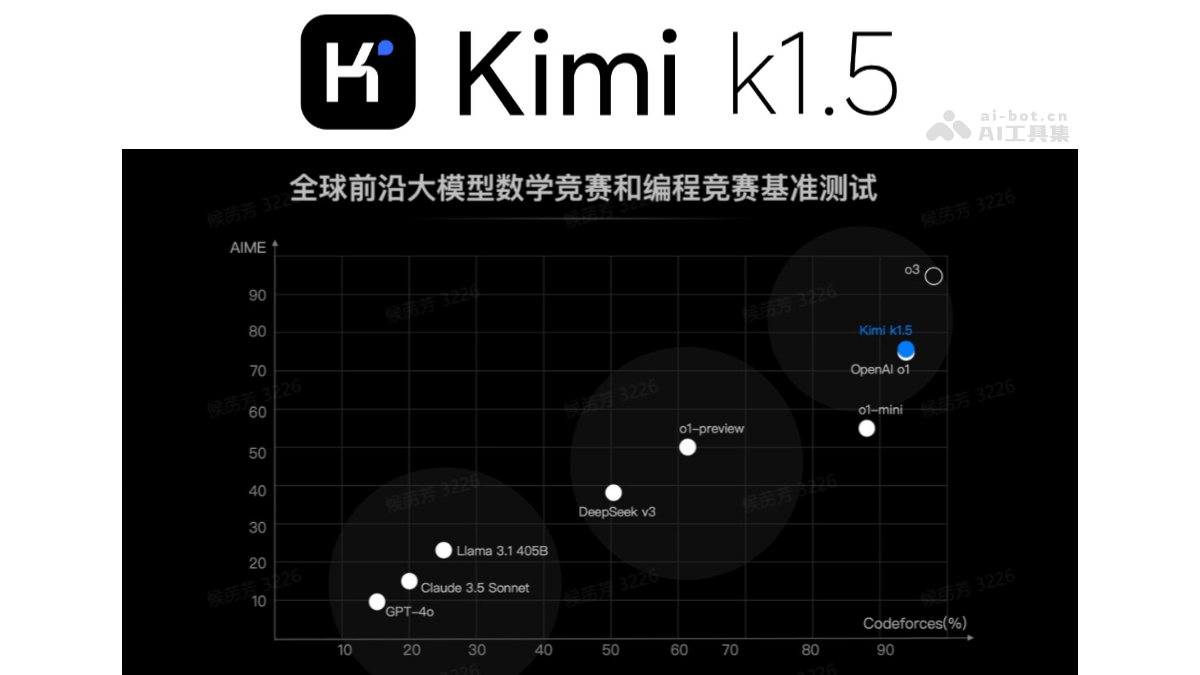
Main features of k1.5
-
Multimodal reasoning capability: k1.5 can process text and visual data simultaneously and has joint reasoning capabilities, making it suitable for fields such as mathematics, coding, and visual reasoning.
-
Short chain-of-thought and long chain-of-thought: In short chain-of-thought mode, k1.5's mathematics, coding, visual multimodal, and general capabilities greatly surpass globally leading models (such as GPT-4 and Claude 3.5), with a lead of up to 550%. In long chain-of-thought mode, its performance reaches the level of the official version of OpenAI o1.
-
Outstanding mathematics and coding capabilities: k1.5 performs excellently in mathematical reasoning and programming tasks, especially with LaTeX-formatted mathematical formula input.
-
Efficient training and optimization: Through long context scaling (the context window is extended to 128k) and improved policy optimization, k1.5 achieves more efficient training and demonstrates reasoning characteristics of planning, reflection, and correction.
-
Deep reasoning capability: k1.5 excels at solving complex reasoning tasks, such as difficult mathematical problems, programming debugging, and work challenges, and can help users unlock more complex tasks.
Technical principles of k1.5
-
Long Context Scaling: Kimi k1.5 extends the context window of reinforcement learning to 128k, significantly improving the model's reasoning ability by increasing context length. The core is based on the Partial Rollout strategy, which reuses previous trajectory segments to generate new trajectories and avoids the high computational cost of generating complete trajectories from scratch.
-
Improved Policy Optimization: The model adopts a reinforcement learning formulation based on Long-CoT and combines it with a variant of Online Mirror Descent for policy optimization. Through effective sampling strategies, length penalties, and data recipe optimization, the algorithm's performance is further improved.
-
Simplistic Framework: The design of Kimi k1.5 abandons complex techniques such as Monte Carlo tree search, value functions, and process reward models. Instead, by scaling context length and optimizing policies, it achieves powerful reasoning ability. This enables the model to perform excellently in long-context reasoning while also possessing the ability to plan, reflect, and correct.
-
Multimodalities: The model was jointly trained on text and visual data, can process text and visual information simultaneously, and has cross-modal reasoning capabilities.
-
Long2Short technology: Kimi k1.5 proposes a method to transfer the reasoning capabilities of long chain-of-thought models to short chain-of-thought models, including model merging, shortest rejection sampling, DPO (Direct Preference Optimization), and Long2Short RL (reinforcement learning).
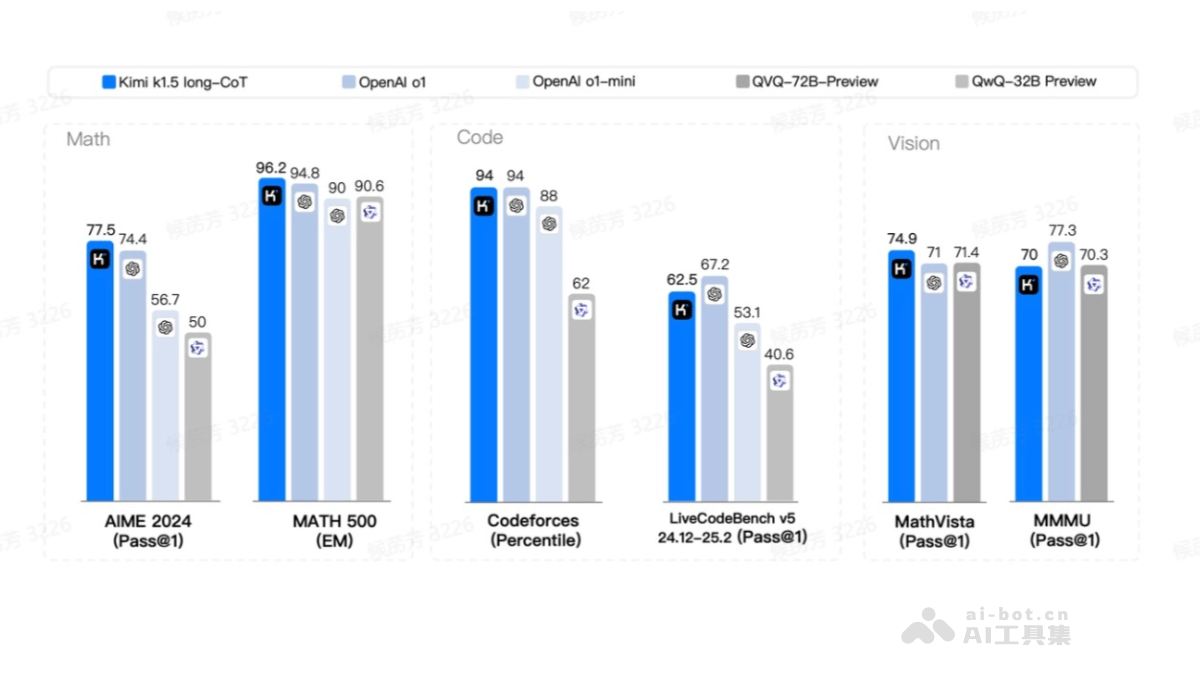
k1.5 project address
- GitHub repository:https://github.com/MoonshotAI/kimi-k1.5
- Technical paper:https://github.com/MoonshotAI/Kimi-k1.5/blob/main/Kimi_k1.5.pdf
How to use k1.5
-
Web: Visit the Kimi official websiteto use it directly.
-
Mobile: Search for "Kimi Smart Assistant" in the app store and download it, or search for "Kimi Smart Assistant" through the WeChat Mini Program.
-
API calls: Developers can use the Kimi API for calls.
Application scenarios of k1.5
-
Complex reasoning tasks: Kimi k1.5 performs excellently in deep reasoning tasks and can handle complex math problems, programming debugging, and reasoning challenges.
-
Cross-modal reasoning: The model supports joint reasoning over text and visual data, and can handle tasks involving math problems with graphic analysis, comprehensive understanding of code and images, and more.
-
AI smart assistant: Kimi k1.5 can serve as a smart assistant, providing users with efficient reasoning capabilities and helping solve a variety of complex problems. It can understand user needs through multi-turn conversations and provide detailed answers.
-
Education: In educational scenarios, Kimi k1.5 can be used to assist teaching and help students solve math problems, programming exercises, and logical reasoning problems.
-
Scientific research and development: For researchers and developers, Kimi k1.5 can serve as a tool to assist with complex theoretical derivation, code generation, and algorithm optimization. It supports mathematical formula input in LaTeX format, further enhancing its applicability in the scientific research field.
-
Multimodal data analysis: Kimi k1.5 can process multimodal data and is suitable for analysis tasks that require combining text and image information, such as image annotation, visual question answering, and more.