
What is Step R-mini
Step R-mini (full name Step Reasoner mini) is a reasoning model launched by StepFun. It is the first reasoning model in the Step series model family, skilled at proactive planning, experimentation, and reflection. Based on a logic mechanism of slow thinking and repeated verification, it provides users with accurate and reliable responses. The model is not only good at solving complex problems such as logical reasoning, code, and mathematics, but also takes into account general domains such as literary creation. Step R-mini performs excellently on mathematical benchmarks and code tasks, achieving proficiency in both arts and sciences. Step R-mini adheres to the Scaling Law principle, including the scaling of reinforcement learning, data quality, test-time computation, and model size.

Main features of Step R-mini
- Mathematics problems: Builds reasonable reasoning chains, plans and solves complex mathematics problems step by step. When solving difficult Olympiad problems, it enumerates different solution approaches for cross-validation. When handling geometry problems, it proactively uses sketches to build a medium for deep thinking, comprehensively and rigorously analyzes the problem requirements, selects the best solution formula, and based on repeated self-questioning determines whether there are factors that have not been considered.
- Logical reasoning: Autonomously tries multiple problem-solving approaches. After obtaining a preliminary answer, it asks itself whether there are other possibilities, ensuring that all effective solutions are enumerated, checks for omissions before submission, and provides comprehensive and accurate reasoning results.
- Code solutions: Based on long reasoning chains, correctly solves relatively difficult algorithm problems, such as problems rated "Hard" on the LeetCode technical platform. It can also handle complex development requirements, gradually analyze user needs and intentions, construct code logic, intersperse analysis and verification of the current code fragment during code writing, and finally provide executable code.
- Literary creation: Deeply understands the user's expressive needs, analyzes the creation theme and literary genre requirements, considers the creative angle, depicted scenery, rhetorical devices, content structure, etc., endows things with symbolic meaning at the level of human emotions, and adds a personalized and innovative expression style, like a creator who "pursues perfection."
Technical advantages of Step R-mini
- Adheres to the Scaling Law principle:
- Scaling Reinforcement Learning: From imitation learning to reinforcement learning, from human preferences to environmental feedback, using reinforcement learning as the core training stage for model iteration.
- Scaling Data Quality: On the premise of ensuring data quality, continuously expands the data distribution and scale, providing support for reinforcement learning training.
- Scaling Test-Time Compute: Takes into account computational scaling during the testing phase. The System 2 paradigm enables Step-Reasoner mini to reach 50,000 tokens for deep thinking on extremely complex task reasoning.
- Scaling Model Size: Insists that model size scaling is the core of System-2, and is developing a more intelligent, more general, and more comprehensively capable Step Reasoner reasoning model.
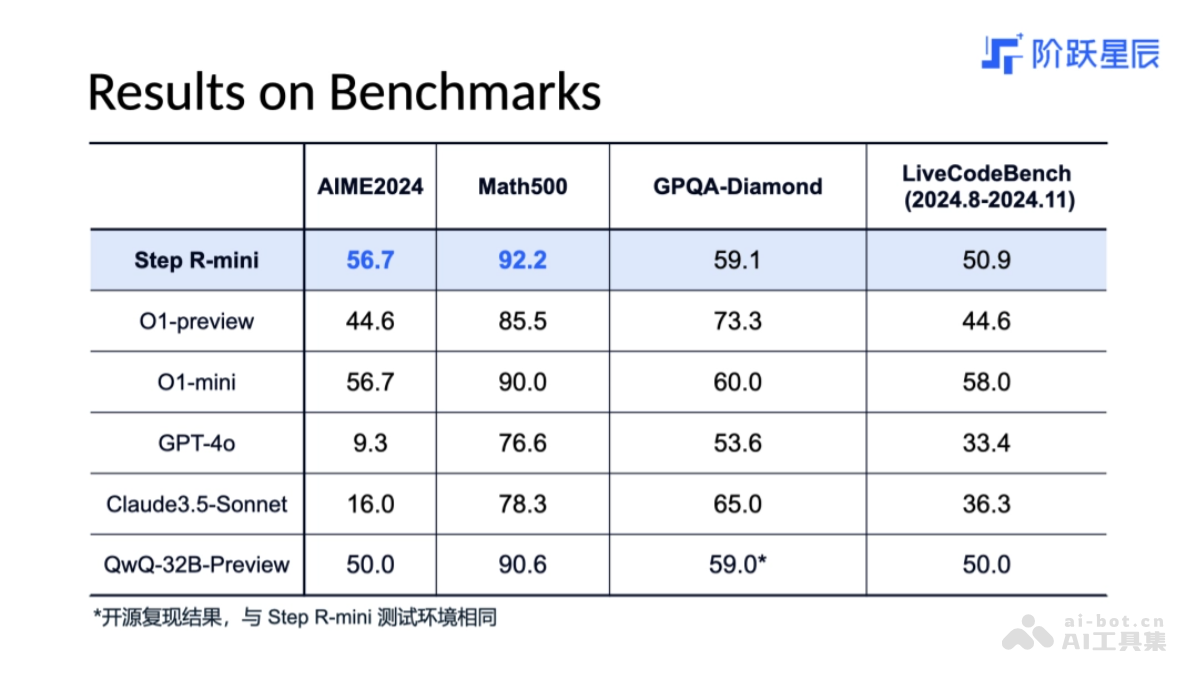
- Proficiency in both arts and sciences: On mathematical benchmarks such as AIME and Math, its results exceed o1-preview and are on par with OpenAI o1-mini. On LiveCodeBench code tasks, its performance is better than o1-preview. Most reasoning models find it difficult to balance capabilities in both the arts and sciences. Step R-mini, based on large-scale reinforcement learning training, uses an On-Policy reinforcement learning algorithm to achieve "proficiency in both arts and sciences."
Step R-mini project address
- Project official website:Step R-mini
Step R-mini examples
- Logical reasoning:When handling logical reasoning tasks, Step R-mini autonomously attempts multiple problem-solving approaches. After obtaining a preliminary answer, it asks itself whether there are other possibilities, ensuring that all effective solutions are enumerated, and checks for omissions before submitting.

Application scenarios of Step R-mini
- Educational tutoring: Assists students in solving difficult math problems and programming confusion, provides problem-solving ideas and code examples, and helps improve learning.
- Research support: Helps researchers with logical reasoning and data analysis, integrates interdisciplinary knowledge, and advances research projects.
- Enterprise office work: Assists programmers in developing code efficiently, provides managers with logical analysis and suggestions for business decisions, and optimizes office processes.
- Literary creation: Inspires cultural and creative workers, provides personalized and innovative literary creation plans, and enriches the connotation of works.
- Translation services: Meets high-quality translation needs, accurately converts languages, and promotes cultural exchange and dissemination.