
What is 9Router
9Router is an open-source AI codingrouting proxy tool that can connect mainstream AI coding tools such as Claude Code、Codex、Cursor、Cline into a unified local proxy layer, intelligently scheduling 40+ providers and 100+ models. The tool features a three-tier fallback routing and RTK Token compression engine that automatically switches seamlessly when subscription quotas are exhausted, saving an average of 20%-40% of input Tokens, and comes with a visual dashboard to track consumption and costs in real time, ensuring zero interruption of development tasks.
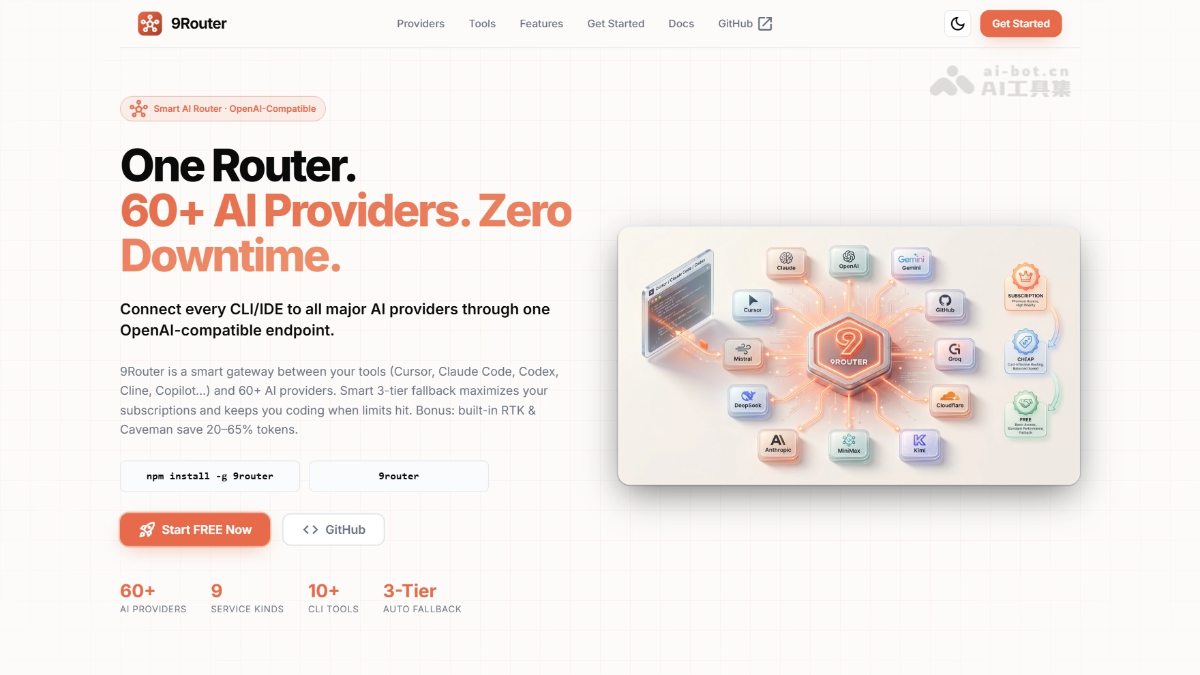
Main Features of 9Router
- Intelligent Three-Tier Routing: Automatically falls back and switches in the order of "subscription quota -> low-cost API -> free channels", seamlessly taking over when quotas are exhausted.
- RTK Token Compression: Built-in Token compression engine written in Rust, automatically streamlines tool outputs such as git diff, grep, ls, saving 20%-40% of input Tokens.
- Caveman Mode: Injects streamlined style prompts to make AI replies more concise, saving up to 65% of output Tokens.
- Unified Multi-Provider Management: Supports OAuth or API Key access to 60+ AI providers, including Claude, OpenAI, GLM, MiniMax, Kiro, etc.
- Real-Time Quota Tracking: Visual dashboard monitors each provider's Token consumption, remaining quota, reset countdown, and estimated cost.
- Automatic Format Conversion: Automatically translates between formats such as OpenAI, Claude, Gemini, Cursor, Kiro, compatible with any CLI tool.
- Multi-Account Rotation: Multiple accounts can be added for the same provider, supporting automatic rotation and failover.
- Request Logging and Cloud Sync: Supports debug log recording and cross-device configuration sync.
Technical Principles of 9Router
-
Local Proxy Layer Architecture: 9Router acts as a local proxy server (default
localhost:20128), and all AI coding tool requests first pass through this layer before being distributed to backend providers. -
Three-Tier Fallback Routing Algorithm: Automatically makes decisions based on quota status and error codes. The first tier prioritizes consuming subscription quota, the second tier switches to cost-effective APIs, and the third tier falls back to free services.
-
RTK Pre-Filtering: Before requests enter format conversion, the RTK engine scans
tool_resultthe first 1KB of content, automatically matching filters such as git-diff, grep, tree for lossless compression. -
Format Translation Middleware: Converts OpenAI standard format to native protocols such as Claude, Gemini, Kiro in real time, decoupling tools from providers.
-
OAuth Auto-Renewal: Automatically refreshes access tokens for subscription services, avoiding manual re-login.
How to Use 9Router
-
Install and Start: Execute
npm install -g 9routerfor global installation, then run9routerto start the local proxy service. The dashboard will automatically open in the browser (http://localhost:20128)。 -
Connect Providers: Go to the dashboard "Providers" page, log in via OAuth or fill in API Key to access 60+ providers such as Claude, OpenAI, GLM, etc. To start at zero cost, you can directly connect to Kiro AI or OpenCode Free.
-
Create Combinations: On the "Combinations" page, add models by priority, for example, first the subscription tier
cc/claude-opus-4-7, then the cheap tierglm/glm-5.1, and finally the free tierkr/claude-sonnet-4.5, enabling automatic fallback. -
Configure the CLI: change the API Base URL of tools such as Claude Code, Codex, and Cursor to
http://localhost:20128/v1, and enter the API Key generated by the dashboard. -
Start coding: once configuration is complete, all AI requests are automatically intelligently routed through 9Router, seamlessly switching to lower-tier models when subscription quota is exhausted, fully transparent and imperceptible throughout.
9Router's core advantages
-
Zero-downtime coding: three-tier automatic fallback ensures development is not interrupted when quota is exhausted, with no need to manually switch tools or wait for a reset.
-
Significant cost reduction: the combination of RTK compression + streamlined mode + free/cheap tiers can push monthly AI programming costs close to zero.
-
One-stop management: manage all subscriptions, API Keys, and free accounts in a single dashboard, saying goodbye to manual switching across multiple platforms.
-
Transparent and controllable: real-time cost estimation and quota tracking help users maximize the value of every subscription.
-
Broad compatibility: supports 10+ mainstream CLI/IDE tools such as Claude Code, Codex, Cursor, Cline, OpenClaw, and GitHub Copilot.
9Router's project address
- Project website:https://9router.com/
- GitHub repository:https://github.com/decolua/9router
Comparison of 9Router with similar competitors
| Comparison dimension | 9Router | OpenRouter | LiteLLM |
|---|---|---|---|
| Positioning | Local routing proxy for AI programming tools | Cloud-based unified API gateway | Enterprise-grade LLM proxy and load balancing |
| Deployment method | Local / Docker / VPS / Cloudflare Workers | Pure cloud SaaS | Local/cloud, leaning toward enterprise deployment |
| Number of providers | 60+ (including OAuth subscriptions + API Key + free tier) | 200+ models | 100+ models/providers |
| Programming tool integration | Deeply adapted to CLIs such as Claude Code, Codex, and Cursor | General API, requires manual configuration | General SDK/Proxy, enterprise-grade integration |
| Token compression | Built-in RTK engine, automatically saves 20%-40% | No built-in compression | No built-in compression |
| Three-tier fallback | Subscription → cheap → free, automatic and seamless switching | Supports Fallback, but no tiered strategy | Supports Fallback and retry strategies |
| Quota tracking | Real-time dashboard, including reset countdown | Basic usage statistics | Enterprise-grade monitoring and alerting |
| Cost optimization | Designed specifically to reduce costs for individual developers | Pay-as-you-go billing, no free-tier aggregation | Enterprise budget control and rate limiting |
| Open-source license | Open source and free | Partially open source | Open source (MIT) |
Use cases for 9Router
-
Multi-subscription users: Users with subscriptions to Claude Pro, Codex Plus, Cursor, etc. at the same time, using intelligent scheduling to avoid wasted quota and interruptions from hitting limits.
-
Zero-cost developers: Users who only use free tiers such as Kiro AI, OpenCode Free, and Vertex AI to achieve completely free AI-assisted programming.
-
High-frequency coding sprints: During project deadlines, 24/7 uninterrupted coding is required, relying on multi-layer fallback to ensure continuity.
-
Token-sensitive projects: When handling large codebases, RTK compression greatly reduces the Token overhead of git diff and log-type requests.
-
Team/multi-device collaboration: Through cloud sync and VPS/Docker deployment, share unified AI provider configurations and routing policies within the team.