
What is ZDTaichu5.0-9B
ZDTaichu5.0-9B is a new-generation general-purpose multimodal large model open-sourced by Zidong Taichu, oriented toward the physical world and embodied intelligence scenarios. The model ranks first worldwide among models of the same parameter scale in 8 of nine major international spatial benchmarks, scoring 78.27 on MindCube-tiny, far ahead of models at the same level; at the same time, general capabilities such as image-text, OCR, mathematics, and code remain in the first tier. The model can adaptively recur for reasoning, using an entropy gating mechanism to perform additional recurrent computation on uncertain Tokens. The model has been validated in real-machine tasks in scientific research experiments and industrial manufacturing, and the weights and training scheme are fully open.
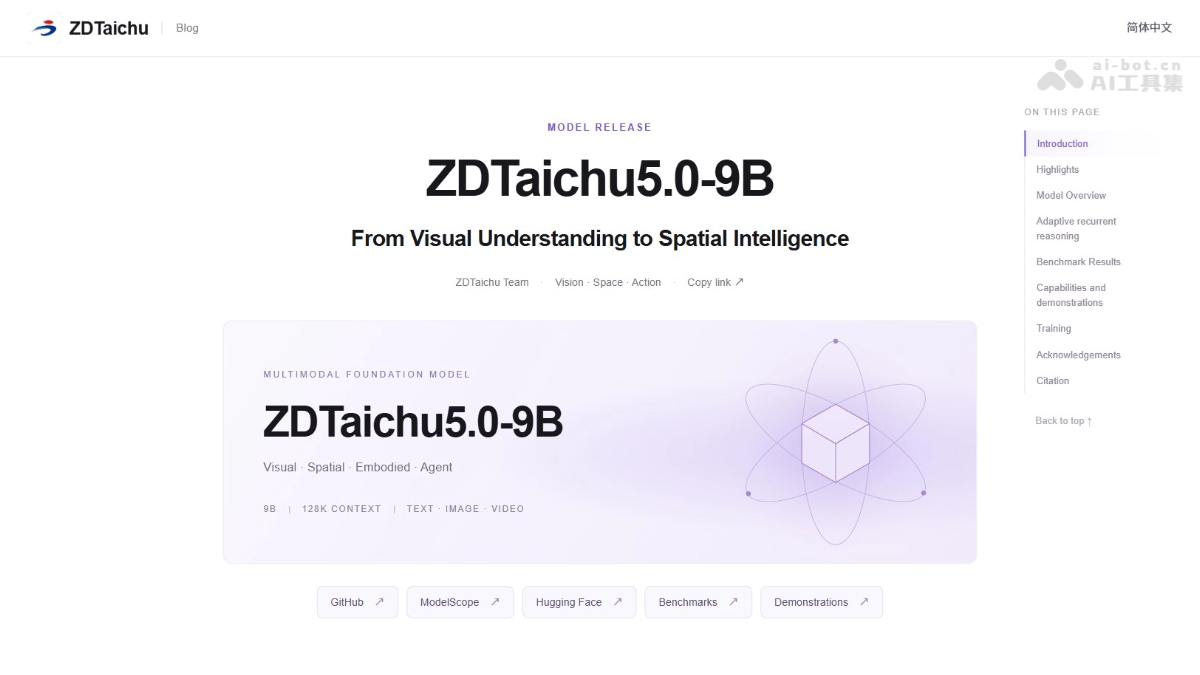
Main features of ZDTaichu5.0-9B
-
Spatial understanding and inference: Ranks first worldwide among models of the same parameter scale in 8 of nine major international spatial benchmarks, and excels at complex spatial reasoning such as reference frame transformation and orientation judgment.
-
General multimodal capabilities: Balanced image-text understanding, OCR, mathematics, and code capabilities; scores on AI2D, OCRBench, AIME2026, etc. remain in the first tier.
-
Embodied task planning: As the robot's "high-level brain," it is responsible for understanding the environment, remembering object identities, and decomposing task steps.
-
Scientific research experiment assistance: Connects simulation computation with wet experiments, automatically calling Python/SciPy to complete scientific analysis and generate reports.
-
Industrial manufacturing execution: Covers scenarios such as material preparation and delivery, machine loading and unloading, and workstation organization, handling real workstation problems such as dense shelves, occlusion, and preconditions.
Technical principles of ZDTaichu5.0-9B
- Adaptive recurrent reasoning: When generating each Token, the model uses an entropy gating mechanism to judge the uncertainty of the prediction. The more dispersed the probability distribution, the more it repeatedly executes partial layer-block computation at that position, correcting the internal representation round by round before outputting; positions with high certainty are output directly, precisely spending compute where it is "unsure," and without relying on external tools.
- Three stabilization mechanisms: To prevent representation drift caused by recurrent computation, damped updates are added to control the magnitude of correction in each round, using the original representation as a reference; a dual stopping criterion based on KL divergence and hidden-state residuals judges whether iteration has converged; intermediate states are retained, supporting selection of low-risk representations from multiple rounds of results and rollback when necessary.
- Progressive data curriculum: Training advances in stages—pretraining lays the foundation with image-text, web page, multi-view video, and 3D simulation data, after deduplication and quality filtering; the supervised fine-tuning stage feeds real business question-answer data, spatial embodied cases, and Agent tool-calling trajectories, and verifies the consistency of images, object relationships, and operational constraints in samples; finally, long-reasoning samples are used for annealing, combined with GRPO reinforcement learning, using automatically verifiable signals such as answer correctness, coordinate hits, and format compliance as rewards.
- Long-horizon task closed loop: The model's internal recurrence solves only single-step reasoning; task advancement relies on external feedback—after each step is executed, the environmental state is confirmed through a new image, realizing a continuous closed loop of "perception—cognition—action—feedback."

Follow WeChat and reply "open source" to join theAI open-source project communication group
How to use ZDTaichu5.0-9B
-
Obtain weights: Download the open-source weights from Huggingface or GitHub.
-
Local deployment: Load the model on a single consumer-grade/professional-grade GPU (9B parameters, relatively low VRAM requirement).
-
Multimodal interaction: With image + text instruction input, the model can output spatial reasoning results such as orientation judgments, target coordinates, and placeable point locations.
-
Integrate into robotic systems: Use it as a high-level planning module and connect it with low-level robotic control systems such as grasping and navigation.
-
Secondary training: Using the data production and training scheme released alongside the weights, continue fine-tuning with your own scenario data.
Core advantages of ZDTaichu5.0-9B
-
Top in its class for spatial ability: Sweeping nine major international spatial benchmarks, it took 8 global first places in the same-parameter general group, with MindCube-tiny leading models of the same level by more than 15 points.
-
No degradation in general ability: While achieving leapfrog breakthroughs in spatial embodied ability, general abilities such as image-text, OCR, mathematics, and code remain firmly in the top tier.
-
Adaptive looped reasoning: The entropy gating mechanism makes the model add computation only for Tokens it is "unsure" about, making reasoning more accurate while keeping average cost controllable.
-
Validated on real machines: It has been successfully run in real-machine tasks in scientific research experiments (test tube handling, pipette transfer) and industrial manufacturing (loading/unloading, workstation organization).
-
Benchmarked upward against large models: It leads Gemini 3 Pro by more than 7% on multiple spatial benchmarks, while the deployment cost of a small-parameter model is far lower than that of closed-source large models.
-
Fully open source and customizable: Weights, data production, and training schemes are all open, so developers can continuously fine-tune and adapt it to their own sites with their own data.
Project addresses for ZDTaichu5.0-9B
- Project official website:https://taichu-ai.github.io/ZDTaichu5.0-9B
- GitHub repository:https://github.com/Taichu-AI/ZDTaichu5.0-9B
- HuggingFace model library:https://huggingface.co/TaichuAI/ZDTaichu5.0-9B
Comparison of ZDTaichu5.0-9B with similar competitors
| Comparison dimension | ZDTaichu5.0-9B (Zidong Taichu) | Qwen3.5-9B(Alibaba Tongyi) |
|---|---|---|
| Positioning | A general multimodal model oriented toward the physical world | General multimodal model |
| MindCube-tiny | 78.27 points | 57.60 points (behind by 20.67 points) |
| Reference frame transformation (orientation judgment) | ✅ Answered "front right" correctly | ❌ Reference frame confused |
| Attribute binding + spatial sorting | ✅ Coordinates [237,226] hit the ground truth | ❌ Coordinates [360,280] point to the wrong box |
| Affordance reasoning (placement point judgment) | ✅ Coordinates [650,720] fall in an empty area | ❌ Coordinates fall in an area that does not meet the requirements |
| Spatial benchmark performance | 8 global first places with the same parameters, leading Gemini 3 Pro by 7%+ on multiple items | No mention of top rankings |
| General ability | AI2D 91.48、OCRBench 85.5、AIME2026 89.2、LiveCodeBench v6 73.4 | The article gives no scores, only a spatial ability comparison |
| Core features | Adaptive looped reasoning (entropy gating) + fully open-source training scheme | Mature ecosystem, broad application in general scenarios |
Application scenarios of ZDTaichu5.0-9B
- Industrial manufacturing: Material preparation and delivery, machine loading/unloading inspection, workstation organization, identifying targets from dense shelves, determining grasp positions, and checking back whether placement is correct.
- Automation of scientific experiments: The "high-level orchestration brain" of an automated experiment platform, completing multi-sample operations such as placing test tubes in sequence and transferring liquids with a dropper, while tracking sample identity, spatial position, and task progress.
- Scientific computing assistance: After receiving a natural language scientific question, automatically invokes Python/SciPy to compute analytical and numerical solutions, cross-checks them, and generates an analysis report, connecting simulation and wet-lab experiments.
- High-level robot planning: As the "brain" of embodied intelligence, it is responsible for understanding the environment, remembering objects, and breaking down steps, coordinating with low-level grasping/navigation control systems to complete long-horizon tasks.
- Intelligent warehousing and logistics: Handles work orders such as "take the second material box in the third row," completing attribute binding, spatial sorting, and target localization, and dealing with real warehousing issues such as occlusion and targets moving out of view.