
What is Youtu-Embedding
Youtu-Embedding is a general text representation model open-sourced by Tencent YouTu Lab for enterprise-level applications. Through large-scale corpus training and an innovative fine-tuning framework, the model possesses strong semantic understanding capabilities and can handle six major tasks, including text retrieval, intent understanding, and similarity judgment. Youtu-Embedding avoids the "negative transfer" problem that traditional models are prone to in new domains, and supports plug-and-play use as well as customized training based on business data. The model performs excellently on the Chinese semantic evaluation benchmark CMTEB, is widely applicable to scenarios such as enterprise customer service, knowledge management, and intelligent Q&A, and supports integration into LangChain, LlamaIndex, and other mainstream frameworks, helping developers quickly build efficient semantic applications.
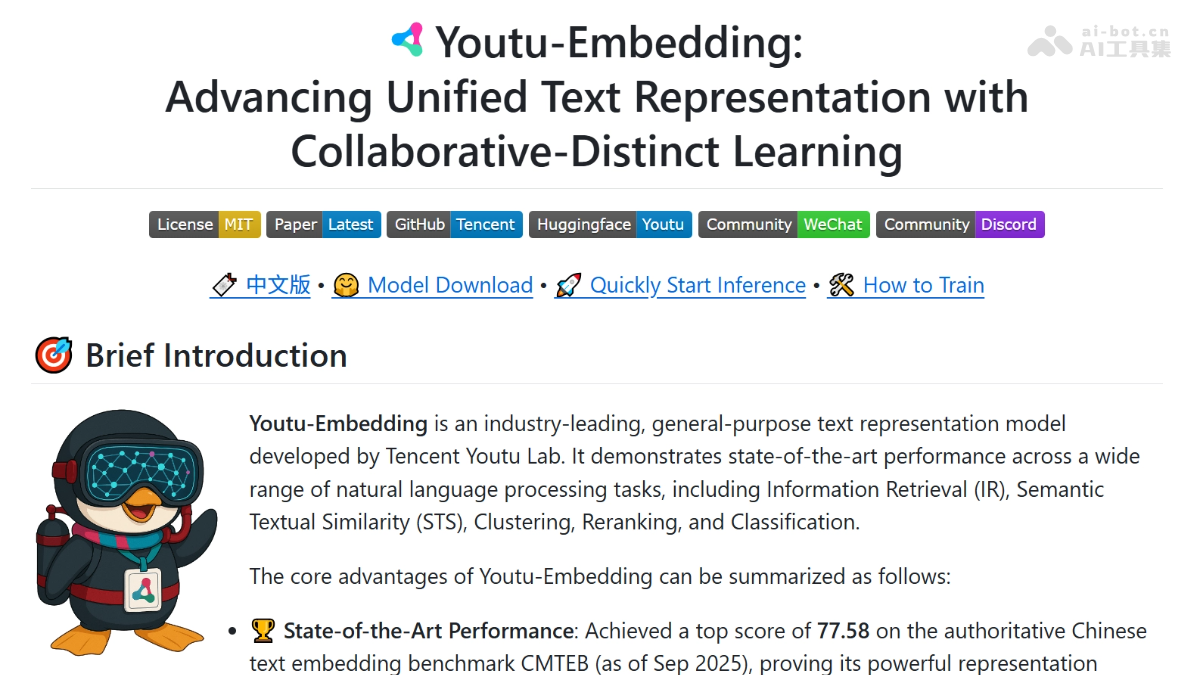
Youtu-Embedding's Main Features
-
Text Retrieval: Quickly retrieve the text snippets most relevant to the query content from massive amounts of text, suitable for scenarios such as search engines and knowledge base retrieval.
-
Intent Understanding: Accurately identify the intent of user input, helping build intelligent customer service systems and better understand user needs.
-
Similarity Judgment: Judge the semantic similarity between two pieces of text, used in text deduplication, recommendation systems, and more.
-
Classification and Clustering: Classify or cluster text, helping organize and manage large amounts of text data.
-
Reranking: Optimize the ranking of retrieval results to improve their relevance and accuracy.
-
Supports Multi-Task Learning: Through an innovative fine-tuning framework, supports multiple tasks simultaneously and avoids interference between tasks.
Youtu-Embedding's Technical Principles
- Large-Scale Pre-Training: Trained from scratch using 3 trillion tokens of Chinese and English corpus, covering a wide range of linguistic expressions and semantic information. It combines manually annotated data, real corpus, and synthetic samples generated with the assistance of large models to ensure the data is close to real business scenarios and lay a solid foundation for subsequent training.
- Semantic Alignment and Understanding: Through large-scale weakly supervised data, the model learns to recognize sentences that are "differently expressed but consistent in intent." Accurate semantic mappings are established in vector space to help the model better understand true intent and improve the accuracy of semantic retrieval and similarity judgment.
- Collaborative-Discriminative Fine-Tuning Framework: The data structures of different tasks (such as text retrieval and similarity judgment) are modeled in a unified way, reducing the cost of switching between models. A dedicated loss function is customized for each type of task to clarify the optimization direction. For example, retrieval tasks use the InfoNCE contrastive loss, while semantic similarity tasks use a ranking-aware loss function. Training effort is reasonably allocated by stage to avoid interference in multi-task training and ensure that the model learns solidly across various tasks.
Youtu-Embedding's Project Address
- GitHub Repository:https://github.com/TencentCloudADP/youtu-embedding
- HuggingFace Model Library:https://huggingface.co/tencent/Youtu-Embedding
- arXiv Technical Paper:https://arxiv.org/pdf/2508.11442
Youtu-Embedding's Application Scenarios
- Enterprise-Level Intelligent Customer Service: Quickly understand user questions and accurately retrieve answers from the knowledge base, improving customer service efficiency and user experience.
- Knowledge Base Management: Perform classification, clustering, and similarity judgment on massive knowledge documents, helping efficiently organize and retrieve knowledge base content.
- Intelligent Q&A Systems: Accurately matches user questions with answers in the knowledge base, supports multiple semantic expressions, and improves the accuracy and response speed of the question-answering system.
- Content Recommendation: By determining text similarity, recommends highly relevant content to users, improving the precision of content distribution.
- Knowledge Management: Classifies and clusters text, helping enterprises better manage and utilize knowledge assets, and improving the searchability and usability of knowledge.