
What is Xiaomi MiMo-V2.6
Xiaomi MiMo-V2.6 is an omni-modal model series released and open-sourced by Xiaomi, comprising two native omni-modal models, Pro and Flash, focused on large-scale Agentic reinforcement learning centered on verifiable complex tasks. Through 6 days of Live RL and approximately 750,000 trajectories, the models improve capabilities in software engineering, code, vision, Cyber, and more, extending to 3D games/Blender modeling, robotic arm operation, Computer Use, research assistance, and video and music creation.
Main Features of Xiaomi MiMo-V2.6
-
Complex Reasoning and Agent Tasks: Performs reinforcement learning for verifiable scenarios such as code, general tasks, vision, and cybersecurity.
-
Software Engineering Capabilities: Shows significant improvement on the out-of-sample long-horizon engineering benchmark DeepSWE v1.1, emphasizing real fixes and generalization.
-
3D World Building: Decomposes text/image/video requirements into multi-agent tasks, generating runnable 3D game scenes and interaction logic.
-
Blender 3D Modeling: Generates assets usable for animation, 3D printing, and game development based on descriptions or reference images.
-
Embodied Intelligence Control: Takes multi-view camera footage as input and performs closed-loop control of a robotic arm to complete grasping, color matching, and placement.
-
Computer Use Agent: Understands graphical interfaces and operates office/productivity tools to complete retrieval, editing, data processing, and error correction.
-
Research Assistance: Can participate in "dry experiments" for materials screening and Lean 4 formal mathematical proofs.
-
Content Creation: Generates frontends, PPTs, SVGs, videos, and music, emphasizing aesthetics, motion effects, and alignment of music and narration.
Technical Principles of Xiaomi MiMo-V2.6
- Large-Scale Agentic RL: The model continuously trial-and-errors across multi-task environments such as Code, General, Visual, and Cyber, using verifiable results as reward signals; it completes approximately 750,000 trajectories in under 6 days, relying on large batches, a fully asynchronous architecture, and 1M context training to push single-step updates to 2.7–3.7B tokens, thereby improving sample efficiency and out-of-sample generalization.
- Reward and Anti-Cheating Mechanisms: Provides finer rewards for long-horizon tasks through relative comparison within groups, and suppresses Reward Hacking through reward design, adversarial evaluation, anomaly detection, and cross-validation by verifiers; meanwhile, it freezes the MoE Router to suppress expert load drift and ensure stability in large-scale training.
- Unified Trajectory and System Decoupling: Uses unified trajectory representation and penalty mechanisms to refine learning signals, supporting high-concurrency interaction in multi-agent frameworks; decouples the control plane from the data plane to facilitate massive trajectory transfer, stabilizes task ratios in mixed batches, and optimizes consistency between training and inference engines.
- From Omni-Modal to World Operation: Combines language, vision, 3D spatial reasoning, and native action capabilities, enabling the model not only to generate code but also to correct behavior in a closed loop based on visual feedback in Blender, game engines, simulation environments, and GUIs.

Follow WeChat and reply "open source" to join theAI Open-Source Project Communication Group
How to Use Xiaomi MiMo-V2.6
Method 1: MiMo Desktop Client
- Open XiaoMi MiMo Desktop to download and install MiMo Desktop.
- After logging into your account, choose a membership subscription, or configure your own API Key in Settings.
- Switch between MiMo-V2.6-Pro / Flash in the model list; for real-time scenarios, you can enable UltraSpeed.
- Directly initiate programming, PPT/webpage/SVG/video/music creation, research, or computer operation tasks using natural language, and upload images, videos, files, and other materials.
- Through follow-up questions, screenshot feedback, requesting retries, or phased confirmation, let the model iterate and correct based on visual/log results.
Method 2: MiMo Open Platform API
- Go to the Xiaomi MiMo Open Platform, create an application, and copy the API Key.
- Select the model MiMo-V2.6-Pro / Flash, and enable UltraSpeed ultra-high-speed mode as needed.
- Pass in the model name, messages, tool/multimodal inputs, and return format according to the platform API documentation.
- For Agent tasks, integrate environment logs, test pass rates, screenshots, or verifier feedback to form an "execute—check—correct" loop.
- First conduct small-traffic canary validation of price, latency, success rate, and stability, then gradually replace it in the production pipeline.
Core advantages of Xiaomi MiMo-V2.6
-
RL at scale: Uses verifiable complex tasks as the core for large-scale Agentic RL, about 750,000 trajectories in 6 days, with empirical evidence of out-of-sample generalization.
-
Outstanding Agent capabilities: Benchmarks against top closed-source models on multiple tasks such as software engineering, terminal, web, vision, and Cyber.
-
From full modality to action: Covers text, images, video, GUI, 3D, Blender, robotic arms, and Computer Use.
-
Strong cost-effectiveness: The article states that at the same intelligence level, the price is about 1/20–1/60 of overseas models, and API prices remain unchanged.
-
Engineering stability design: Uses MoE Router freezing, Reward Hacking defenses, and a unified trajectory mechanism to support stable training.
-
Amphibious in creation and research: Can do frontend/PPT/video/music, and can also participate in materials screening and Lean 4 formal proofs.
Project address of Xiaomi MiMo-V2.6
- HuggingFace model repository:https://huggingface.co/collections/XiaomiMiMo/mimo-v26
Comparison of Xiaomi MiMo-V2.6 with similar competitors
| Dimension | Xiaomi MiMo-V2.6-Pro | Claude Fable 5.1 |
|---|---|---|
| Model nature | Open-source full-modal model, emphasizing Agentic RL and self-improvement | Top closed-source models mentioned in the article |
| Open source/reproducible | Open weights, technical report, RL code, and task environment | Closed source, mainly used via API/product |
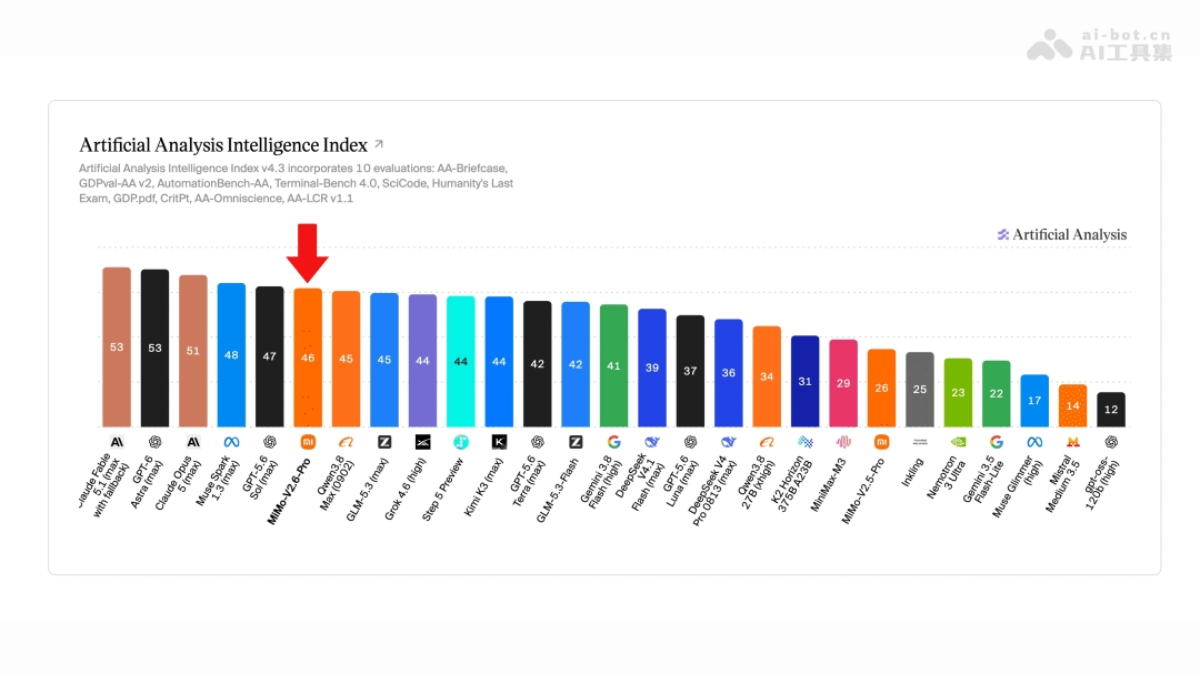
| Relative intelligence positioning | The article states an AA index of 46, surpassing Kimi K3 / Qwen3.8 Max | The article states it still leads MiMo-V2.6-Pro |
| Controllability | High; can be self-hosted, modify the harness, and do domain RL | Low; mainly black-box services |
| Main advantages | Reproducible, modifiable, flexible in cost and deployment | The article's framing gives closed source a higher ceiling |
| More suitable for | Research teams, Agent engineering teams, cost-sensitive scenarios | Scenarios pursuing closed-source flagship performance with sufficient budget |
Application scenarios of Xiaomi MiMo-V2.6
-
Software engineering Agent: Automatically locate bugs, modify code, run tests, and continue fixing based on failure logs, suitable for improving R&D efficiency.
-
3D Interactive World Generation: Generate runnable mini-game scenes, Blender assets, or prototype demos from text/images/videos.
-
Computer Use Office Automation: Operate the GUI to complete information retrieval, spreadsheet organization, document editing, and cross-tool workflows.
-
Scientific Research Assistance: Handle high-threshold tasks such as literature/patent review, MOF material "dry experiment" screening, and Lean 4 formal proofs.
-
Multimodal Content Production: Batch-generate frontend pages, PPTs, SVGs, popular science videos, and background music with narration, for marketing, education, and creative production.