
What is VideoPainter
VideoPainter is a video inpainting andeditingframework launched by the Chinese University of Hong Kong, Tencent ARC Lab, the University of Tokyo, the University of Macau and other institutions, specifically designed for processing video content of arbitrary length. VideoPainter is based on a dual-branch architecture, combining a lightweight context encoder and a pretrained diffusion model to achieve efficient background preservation and foreground generation. The framework supports plug-in operations, allowing users to flexibly adjust the inpainting effect according to their needs. VideoPainter introduces ID resampling technology, which can maintain object consistency in long videos. VideoPainter has built VPData and VPBench, currently the largest video inpainting dataset, containing more than 390,000 video clips, providing support for large-scale training and evaluation. VideoPainter has demonstrated excellent performance in multiple metrics such as video quality, masked region preservation and text alignment, bringing new breakthroughs to the field of video inpainting and editing.
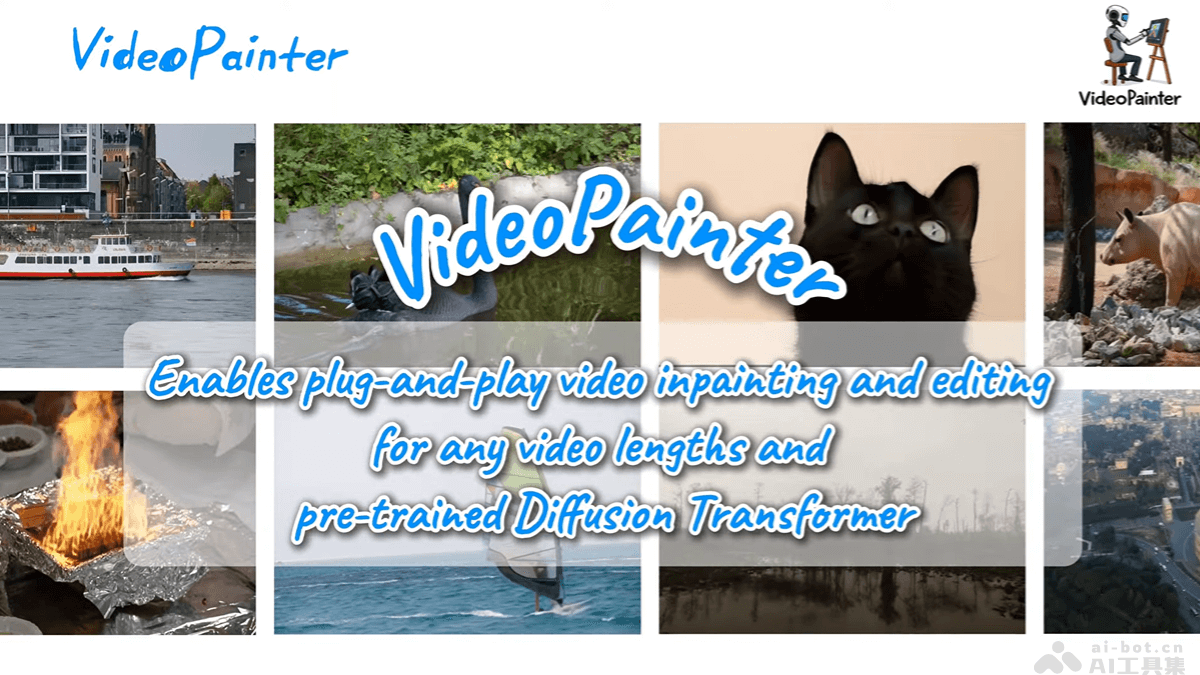
Main features of VideoPainter
- Video inpainting of arbitrary length: Process various content from short clips to long videos, and repair occluded or damaged parts.
- Background preservation and foreground generation: Based on a dual-branch architecture, achieve accurate preservation of the background and high-quality generation of the foreground.
- Text-guided video editing: Support video editing with text instructions, such as adding, deleting, replacing or modifying objects in videos.
- Object consistency maintenance: Maintain the identity consistency of objects in long videos, avoiding object drift or mutation.
- Plug-in control: Support combination with different diffusion models or LoRA (low-rank adaptation) models to meet diverse video generation and editing needs.
Technical principles of VideoPainter
- Dual-branch architecture:
- Background branch: Based on a lightweight context encoder, extract background features and inject them into the pretrained diffusion model to ensure background coherence.
- Foreground branch: Based on the generation capability of the diffusion model, generate foreground content according to text prompts, and combine it with background features to achieve high-quality inpainting.
- Lightweight context encoder: It contains only two layers and occupies 6% of the main model parameters. It extracts background features and injects them into the diffusion model in a grouped manner. Based on selective feature fusion, background features are injected into the model to avoid confusion between foreground and background information.
- ID resampling technology: During training, enhance the ID information of the target region to improve the model's perception of the inpainting region. During inference, combine the inpainting region features of the previous video clip with the current clip to ensure object consistency in long videos.
- Plug-in control: Support combination with different diffusion models or LoRA models, and users can choose suitable models for video inpainting or editing according to their needs. Compatible with text-to-video (T2V) and image-to-video (I2V) diffusion models, further expanding the scope of application.
- Large-scale dataset construction: Use advanced visual models (such as SAM2, Grounding DINO, etc.) to automatically generate precise segmentation masks and dense text descriptions. Build VPData and VPBench, containing more than 390,000 video clips, providing support for large-scale training and evaluation.
VideoPainter project address
- Project official website:https://yxbian23.github.io/project/video-painter/
- GitHub repository:https://github.com/TencentARC/VideoPainter
- HuggingFace Model Repository:https://huggingface.co/TencentARC/VideoPainter
- arXiv Technical Papers:https://arxiv.org/pdf/2503.05639
Application Scenarios of VideoPainter
- Film and Television Restoration and Production: Restore damaged footage in old movies and TV series, or add special effects and modify scenes.
- Advertising and Marketing: Quickly generate high-quality video content, add or replace backgrounds and props, and achieve personalized customization.
- Video Creation and Live Streaming: Repair errors or interference in videos in real time, add virtual props, and enhance visual effects.
- VR and AR Applications: Generate immersive video content, repair or modify virtual scenes, and enhance the sense of reality.
- Education and Training: Produce instructional videos, restore images of ancient books, add virtual equipment or annotations, and enhance teaching effectiveness.