
What Is VideoGrain
VideoGrain is a zero-shot multi-granularityvideo editingframework introduced by the University of Technology Sydney and Zhejiang University, capable of fine-grained video modification at the category, instance, and part levels. VideoGrain is based on modulating spatiotemporal cross-attention and self-attention mechanisms, enhancing the control of text prompts over target regions, maintaining feature separation between regions, and solving the problems of semantic misalignment and feature coupling in existing diffusion models. VideoGrain does not rely on additional parameter tuning, and can achieve high-quality video editing in real-world scenarios while maintaining temporal consistency. VideoGrain performs excellently in multi-granularity editing tasks, significantly outperforming existing T2I and T2V methods, providing a more flexible and precise tool for video content creation.
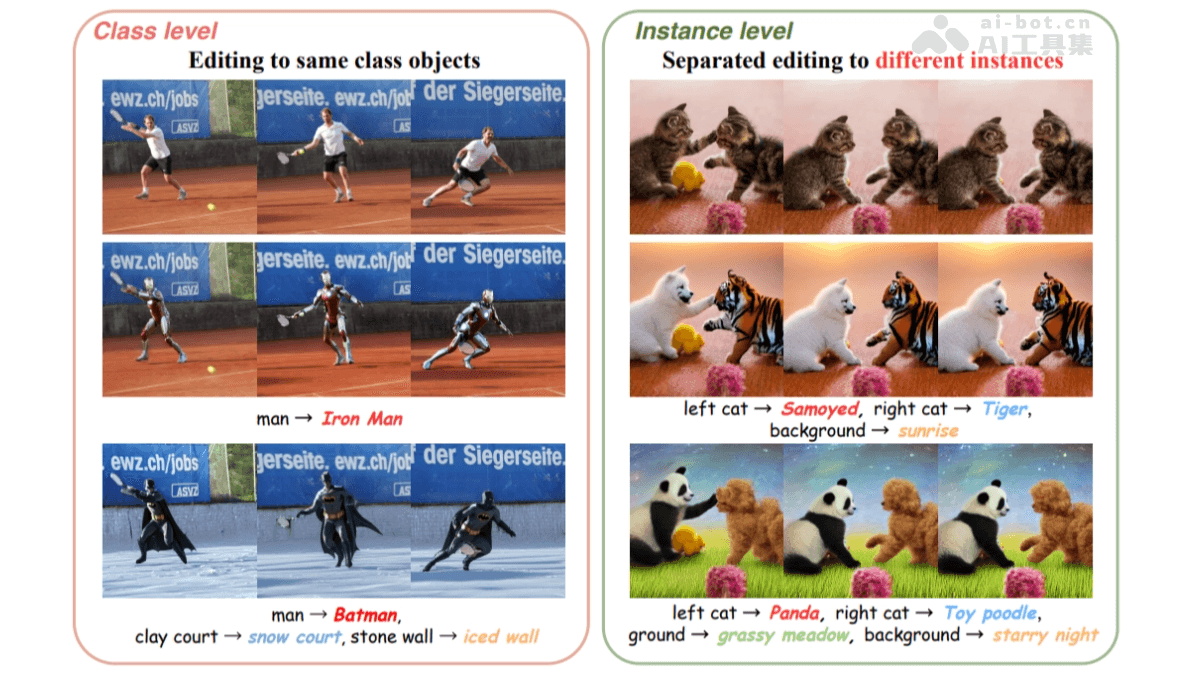
VideoGrain's Main Features
- Multi-granularity video editing: Edit multiple objects in a video separately into different categories (e.g., edit one person into "Spider-Man" and another person into a "polar bear"), or modify parts of an object (e.g., change clothing color or add accessories).
- Text-driven region control: Precisely control specific regions in a video based on natural language prompts, achieving precise editing effects
- Temporal consistency: During the editing process, maintain the temporal coherence of the video, avoiding frame-to-frame flickering or unnatural transitions caused by editing.
- No parameter tuning required: As a zero-shot method, VideoGrain does not require additional training or parameter tuning of the model.
- Efficient computational performance: In experiments, it shows lower memory usage and faster editing speed, making it suitable for real-time video editing applications.
VideoGrain's Technical Principles
- Cross-attention modulation: Based on modulating cross-attention layers, enhance the ability of text prompts to focus on target regions while suppressing attention to irrelevant regions. Bind text prompts to spatial regions of video frames, and by adjusting the attention weights of query-key pairs, concentrate text features on the corresponding regions, achieving precise text-to-region control.
- Self-attention modulation: In self-attention layers, enhance the self-attention of features within a region and reduce interference between regions. The model can avoid editing errors caused by category feature coupling (e.g., treating different instances as the same category). Ensure that each query only focuses on its target region, maintaining feature separation and editing independence.
VideoGrain's Project Address
- Project website:https://knightyxp.github.io/VideoGrain
- GitHub repository:https://github.com/knightyxp/VideoGrain
- HuggingFace model library:https://huggingface.co/papers/2502.17258
- arXiv technical paper:https://arxiv.org/pdf/2502.17258
VideoGrain's Application Scenarios
- Film and television production: Quickly replace characters, modify scenes, or add special effects to improve post-production efficiency.
- Advertising and marketing: Flexibly adjust products, people, or backgrounds to quickly adapt to different advertising needs.
- Content creation: Provide creative tools for video bloggers to easily add special effects, modify scenes, or characters.
- Education and training: Enhance the effectiveness of instructional videos and attract students' attention by modifying content.
- Interactive entertainment: Modify game trailers or interactive video content in real time to improve the user experience.